

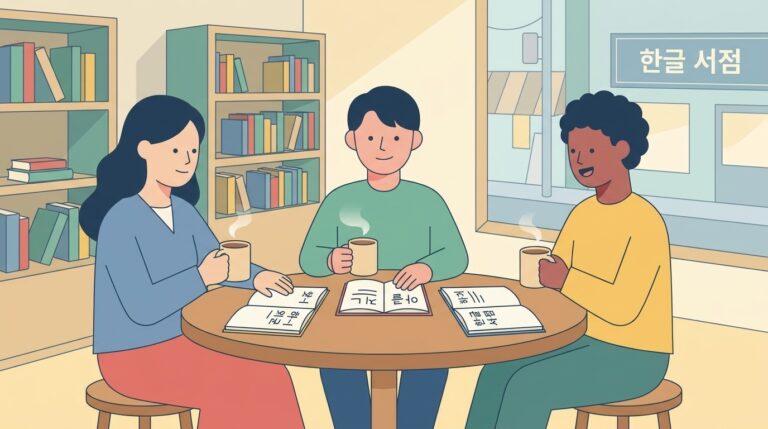
How to Share Your Deepest Thoughts in a Korean Book Club
Phase 1: Empathy (Story-driven Opening)
안녕하세요! It’s your Daily Hangul editor here!
Picture this: It’s a brisk autumn evening in Seoul. You push open the heavy wooden door of a cozy, tucked-away independent bookstore in Yeonnam-dong. The scent of roasted drip coffee and old paper fills the air. Around a rustic oak table, five locals are sitting with paperbacks covered in colorful sticky tabs. This is your very first Korean book club (독서 모임, dokseo mo-im).
You’ve read the chapter three times. Your dictionary app is open. But suddenly, the club host looks warmly in your direction: “자, 이번 챕터 읽고 어떠셨어요?” (Ja, ibeon chaepteo ikgo eotteosyeosseoyo? / “Well, how did everyone feel after reading this chapter?”)
Your pulse quickens. In your native language, you could talk for hours about narrative tension and moral ambiguity. But in Korean, your mind frantically freezes on: “좋았어요… 재미있었어요.” (It was good… it was interesting.) You cringe internally. Is that all your B1 Korean can muster?
Take a deep breath! You are not alone. As an editor who has coached hundreds of intermediate learners through this exact cultural hurdle, I can assure you that moving from simple daily transactions to expressing personal philosophies is the most exhilarating leap you will make. This guide is crafted directly from real learner struggles and authentic literary salon experiences in Seoul. By the end of this article, you will hold the exact keys to sounding thoughtful, empathetic, and culturally tuned-in.
Phase 2: Core Expressions Deep Dive
Here are the three foundational phrases that will instantly elevate your speech from elementary to thoughtful and articulate.
1. 저는 이 부분이 가장 인상 깊었어요. (Jeoneun i bubuni gajang insang gipeosseoyo.)
- Pronunciation: Jeo-neun ee boo-boo-nee ga-jang in-sang gee-peo-sseo-yo (Think of in-sang like “insight” without the ‘t’, and gipeo like a gentle “keeper” with a soft ‘g’).
- Meaning: Literal: “As for me, this part deeply impressed.” / Actual Nuance: “This part really stood out to me the most / resonated deeply with me.”
- K-Culture Moment: You’ll frequently hear this line in literary talk shows or dramas like Romance is a Bonus Book (로맨스는 별책부록) when editors passionately pitch manuscripts.
- Editor’s Insight: Instead of judging a book bluntly as “good” or “bad,” Koreans prefer to describe how the text affected them emotionally. Saying something 인상 깊다 (left a deep impression) sounds artistic and reflective.
- Situation Spectrum:
- Casual: 이 부분 진짜 인상 깊었어. (I bubun jinjja insang gipeosseo.) ⚠️ (Close friends only)
- Semi-formal: 저는 이 부분이 가장 인상 깊었어요. (Jeoneun i bubuni gajang insang gipeosseoyo.) ✅ (Perfect for book clubs)
- Formal: 이 대목이 매우 인상 깊었습니다. (I daemogi maeu insang gipeotseumnida.) ✅ (Formal presentations)
- 🤔 Think About It: Why does Korean focus on the impression received (인상 깊다) rather than declaring the book’s quality objectively?
2. 주인공 마음에 깊이 공감했어요. (Juingong maeume gipi gonggamhaesseoyo.)
- Pronunciation: Joo-in-gong ma-eum-e gee-pee gong-gam-hae-sseo-yo (Gong-gam echoes like a warm gong humming with sympathy).
- Meaning: Literal: “I deeply sympathized with the main character’s heart.” / Actual Nuance: “I could totally relate to what the protagonist was feeling.”
- K-Culture Moment: The buzzword 공감 (gonggam – empathy/connection) is central to contemporary Korean media, from healing essays to variety show reactions.
- Editor’s Insight: In English, we often say “I related to the character.” In Korean, using 마음 (heart/mind) shows that you connected emotionally with their inner state.
- Situation Spectrum:
- Casual: 주인공한테 완전 공감했잖아. (Juingonghante wanjeon gonggamhaetjana.) ⚠️
- Semi-formal: 주인공 마음에 깊이 공감했어요. (Juingong maeume gipi gonggamhaesseoyo.) ✅
- Formal: 인물의 심경에 깊이 공감하게 되었습니다. (Inmurui simgyeonge gipi gonggamhage doeotseumnida.) ✅
- 🤔 Think About It: How does talking about entering someone’s “heart” (마음) change the intimacy of your literary commentary?
3. 저는 조금 다르게 생각했어요. (Jeoneun jogeum dareuge saenggakhaesseoyo.)
- Pronunciation: Jeo-neun jo-geum da-reu-ge saeng-gak-hae-sseo-yo (Da-reu-ge flows smoothly like saying “da-roo-geh”).
- Meaning: Literal: “I thought a little differently.” / Actual Nuance: “I actually saw it from a slightly different perspective.”
- K-Culture Moment: In intellectual panels, speakers use this phrase to disagree respectfully without threatening social harmony.
- Editor’s Insight: The magic buffer word here is 조금 (a little). Even if you completely disagree, prefixing your thought with 조금 protects everyone’s feelings and maintains a cooperative atmosphere.
- Situation Spectrum:
- Casual: 난 좀 다르게 생각했는데? (Nan jom dareuge saenggakhaenneunde?) ⚠️
- Semi-formal: 저는 조금 다르게 생각했어요. (Jeoneun jogeum dareuge saenggakhaesseoyo.) ✅
- Formal: 저는 다소 견해를 달리합니다. (Jeoneun daso gyeonhaereul dallihamnida.) ✅
- 🤔 Think About It: Why does Korean communication prioritize relational harmony (jeong) when presenting contrasting intellectual viewpoints?
Phase 3: Textbook Korean vs. Real Korean
| Context | 📖 Textbook Korean | 🗣️ Real Korean | 💡 Why the difference? |
|---|---|---|---|
| Sharing your review | 책이 매우 감동적입니다. (Chaegi maeu gamdongjeogimnida.) “The book is very touching.” |
여운이 진짜 오래 가요. (Yeouni jinjja orae gayo.) “The lingering feeling stays with me for a really long time.” |
Native speakers love the concept of 여운 (lingering emotional resonance). It sounds poetic and authentic compared to textbook adjectives. |
| Disagreeing with an opinion | 당신의 의견에 반대합니다. (Dangsinui uigyeone bandaehamnida.) “I oppose your opinion.” |
그렇게 볼 수도 있겠네요! 그런데 저는… (Geureoke bol sudo itgenneyo! Geureonde jeoneun…) “You could certainly see it that way! But in my view…” |
Directly saying “I oppose” feels abrasive in Korean discussion circles. Validating the other person first maintains conversational warmth. |
Phase 4: K-Culture Deep Dive & Non-Verbal Manners
4-1. 눈치 (Nunchi) & Body Language in Discussion
In a Korean book club, non-verbal cues carry as much weight as spoken words. Notice how participants listen: they nod rhythmically (고개 끄덕임, gogae kkeudeogim) to signal active listening. Staring intensely into someone’s eyes can feel confrontational; instead, maintain soft eye contact, occasionally shifting your gaze to the book itself.
When quoting a line, hold the book with both hands or rest one hand gently on the page corner. If someone shares an emotionally vulnerable reflection, offer a gentle “아…” (ah…) and tilt your head slightly. Never cut someone off mid-sentence; wait for the final ending particle (-요 or -습니다) before chiming in.
4-2. Culture Code: Independent Bookstores & Chaek-Maek
Korea has experienced a renaissance of independent bookstores (동네서점, dongne seojeom). Neighborhoods like Mangwon-dong, Yeonnam-dong, and Seochon are dotted with intimate venues that transform into cultural salons after dark.
One beloved modern trend is 책맥 (Chaek-maek)—a portmanteau of 책 (book) and 맥주 (beer). Imagine discussing modern short stories while sipping a local craft ale under warm pendant lights. Platforms like Trevari (트레바리) have turned book clubs into major networking and intellectual hubs for young Koreans. Understanding this vibe means recognizing that these clubs are not academic exams; they are spaces for communal connection.
Phase 5: Real-Life Roleplay Scenario
Setting: A sunlit wooden attic of an independent book cafe near Mangwon Station.
Characters:
* Min-ji (민지): The warm and perceptive book club facilitator.
* Alex (알렉스): You, an intermediate Korean learner attending your first session.
민지: “자, 알렉스 씨! 이번 소설에서 주인공 진우가 꿈을 포기하는 장면, 어떻게 읽으셨어요?”
(Ja, Alex ssi! Ibeon soseoreseo juingong Jinu-ga kkumeul pogihaneun jangmyeon, eotteoke ik-eu-syeo-sseo-yo?)
“Now, Alex! In this novel, how did you read the scene where the protagonist Jin-woo gives up on his dream?”
🎭 [Smiling encouragingly while holding her cup with both hands]
알렉스: “저는 그 장면에서 진우의 마음에 깊이 공감했어요.”
(Jeoneun geu jangmyeoneseo Jinu-ui maeume gipi gonggamhaesseoyo.)
“In that scene, I deeply resonated with Jin-woo’s heart.”
🎭 [Nodding slowly, pointing toward page 84]
민지: “어머, 정말요? 저는 진우가 너무 쉽게 포기한 것 같아서 살짝 아쉬웠거든요.”
(Eomeo, jeongmallyo? Jeoneun Jinu-ga neomu swipge pogihan geot gataseo saljjak aswiwotgeodeunyo.)
“Oh, really? For me, I felt a bit disappointed because it seemed like Jin-woo gave up too easily.”
🔀 Interactive Decision Point: How should Alex reply?
- Option A: “민지 씨 생각이 틀렸어요. 진우는 현실적이었어요.” (Min-ji, your thought is wrong. Jin-woo was realistic.)
- Option B: “그렇게 볼 수도 있겠네요! 그런데 진우 입장에서는 가족 때문에 어쩔 수 없는 선택이었던 것 같아요.” (You could definitely see it that way! But from Jin-woo’s perspective, I feel it was an unavoidable choice because of his family.)
- Option C: “네, 저도 사실 잘 모르겠어요. 그냥 재미있었어요.” (Yeah, actually I don’t really know either. It was just fun.)
🔎 Feedback on Your Choice:
- If you chose A [Bad / Cultural Risk]: Saying 틀렸어요 (you are wrong) creates instant friction and shuts down discussion. Avoid direct negation!
- If you chose B [Best Choice]: Perfect! You validated Min-ji’s view first (그렇게 볼 수도 있겠네요), cushioned your opinion with 것 같아요, and backed it with textual empathy.
- If you chose C [Missed Opportunity]: Retreating into “I don’t know” hides your unique voice. You came to share, so step forward with courage!
(Continuing with Option B…)
민지: “아! 가족 배경을 생각하면 그럴 수도 있겠네요. 혹시 특별히 기억에 남는 문장이 있었나요?”
(Ah! Gajok baegyeongeul saenggakamyeon geureol sudo itgenneyo. Hoksi teukbyeolhi gieoge namneun munjangi isseonnayo?)
“Ah! Considering his family background, that makes total sense. Was there a sentence that stood out to you in particular?”
알렉스: “네, 92쪽에 진우가 혼자 독백하는 부분이 가장 인상 깊었어요.”
(Ne, gusibi-jjoge Jinu-ga honja dokbaekhaneun bubuni gajang insang gipeosseoyo.)
“Yes, on page 92, the part where Jin-woo has an internal monologue left the deepest impression on me.”
🎭 [Reading with clear, calm pronunciation]
민지: “맞아요, 그 문장 정말 여운이 오래 남았죠.”
(Majayo, geu munjang jeongmal yeouni orae namatjyo.)
“Exactly, that sentence left such a lasting emotional lingering effect.”
알렉스: “네. 혼자 읽을 때보다 여러분과 이야기 나누니까 책이 훨씬 더 깊이 다가오는 것 같아요.”
(Ne. Honja ilgeul ttaeboda yeoreobungwa iyagi nanunikka chaegi hwolssin deo gipi dagaoneun geot gataseo.)
“Yes. Rather than reading alone, discussing it with all of you makes the book feel so much deeper.”
🎭 [Looking around the table with a genuine, grateful smile]
Phase 6: 10-Second Emotion Shadowing Drill
Practice reading these sentences aloud. Pay attention to the pause markers (/) and the emotional guidance notes!
[😊 차분하고 따뜻하게 - Calm and warm]
“저는 이 부분이 / 가장 인상 깊었어요.”
(Jeoneun i bubuni / gajang insang gipeosseoyo.)-
[🥺 가슴 먹먹하게 - Heartfelt and moved]
“주인공 마음에 / 깊이 공감해서 / 울컥했어요.”
(Juingong maeume / gipi gonggamhaeseo / ulkeokhaesseoyo.) -
[🤔 조심스럽지만 부드럽게 - Tactful and gentle]
“그렇게 볼 수도 있겠네요, / 그런데 저는 조금 다르게 생각했어요.”
(Geureoke bol sudo itgenneyo, / geureonde jeoneun jogeum dareuge saenggakhaesseoyo.)
Phase 7: K-Culture Mini Dictionary
-
완독 (Wandok | Complete Reading)
Meaning: Finishing an entire book from first page to last.
In Practice: Often paired with 하다 (to do). In Korean book groups, people proudly cheer: “이번 주에 드디어 완독했어요!” (I finally finished the whole book this week!). -
인생책 (Insaeng-chaek | Life Book)
Meaning: The single book that changed your life or remains your all-time favorite.
In Practice: Combining 인생 (life) and 책 (book), it’s a staple icebreaker: “당신의 인생책은 무엇인가요?” (What is your life-defining book?). -
밑줄 긋다 (Mitjul geutda | Underline a Passage)
Meaning: Highlighting or underlining meaningful sentences while reading.
In Practice: Used figuratively for lines that hit your soul: “이 문장에는 밑줄을 그을 수밖에 없었어요.” (I had no choice but to underline this sentence). -
여운 (Yeoun | Lingering Afterglow)
Meaning: The resonance or emotional trace that persists long after an artwork or novel ends.
In Practice: Highly praised in modern literature: “결말의 여운이 며칠 동안 가시지 않네요.” (The lingering feeling of the ending hasn’t faded for days).
Phase 8: Traveler’s Survival Kit for Book Lovers
Top 3 Survival Phrases in Korean Bookstores
-
“요즘 여기서 가장 인기 있는 책이 뭐예요?”
(Yojeum yeogiseo gajang ingi inneun chaegi mwoyeyo?)
Pro Tip: Perfect when browsing a curated independent store and seeking staff recommendations. -
“독서 모임은 몇 층에서 진행되나요?”
(Dokseo moimeun myeot cheung-eseo jinhaengdoenayo?)
Pro Tip: Multi-story book cafes often have separate salon spaces on upper floors or underground. -
“이 책갈피도 같이 계산해 주세요.”
(I chaekgalpido gachi gyesanhae juseyo.)
Pro Tip: Korean indie bookstores feature exquisite artisan bookmarks (책갈피). Grab one as a souvenir!
Editor’s Travel Note
When hunting for independent bookstores in Seoul, forget international search engines. Make sure you use the Naver Map app to search for 독립서점 (independent bookstore) or 동네책방 (neighborhood bookshop). Top recommendations include Goyo-Seosa (고요서사) in Haebangchon for literary fiction and Wit and Cynical (위트앤시니컬) in Hyehwa for contemporary poetry. Many cafes accept cashless payments via T-money or international credit cards, but reserving a book club seat often requires a Korean bank transfer or KakaoPay.
Phase 9: “One Step Deeper” (Cultural Reflection)
In Western debate traditions, an intellectual discussion is often an arena of thesis and counter-thesis—a battleground where ideas are tested through vigorous critique. But inside a Korean book club, the priority tilts noticeably toward 공동체적 공감 (communal empathy). When Koreans continuously say “~것 같아요” (“it seems like…”) instead of asserting definitive facts, it isn’t a sign of hesitation or intellectual timidity. Rather, it is an intentional act of linguistic hospitality, deliberately leaving room on the table for someone else’s truth to sit alongside their own.
💬 Your Turn: What is your “인생책” (life book), and how would you describe its emotional effect using one Korean word? Share your thoughts in the comments below! I read and reply to every single one!
Phase 10: FAQ & Common Mistakes
Q: Can I join a Korean book club if I only speak B1-level Korean?
A: Absolutely! Most community book clubs in Seoul cherish diverse perspectives. What matters is not your grammar perfection, but your willingness to listen and share from the heart. Just let the host know beforehand: “한국어가 조금 서툴지만 열심히 참여하겠습니다.” (My Korean is a bit clumsy, but I will participate enthusiastically).
Q: What should I do if I couldn’t finish reading the whole book (완독 못 했을 때)?
A: Honesty is deeply respected! Don’t skip the meeting out of embarrassment. Simply say: “바빠서 완독은 못 했지만, 읽은 부분까지의 이야기가 정말 궁금해서 왔어요.” (I couldn’t finish the entire book due to a busy schedule, but I came because I was so curious about what everyone thought of the parts I did read).
Q: Should I use Banmal (informal language) or Jondaetmal (polite language)?
A: Always stick to standard polite language (해요체 – Haeyo-che) unless the club explicitly establishes an “equal-footing informal speech” (반말 모임) concept. Using respectful speech protects the psychological safety of the space.
🚨 Common Mistakes Alert Board
- Mistake: Blurt out “당신 말이 틀렸어요” (Your words are wrong).
Correct Action: Say “그렇게 생각할 수도 있겠네요. 다만 저는…” (One could think that way too. However, in my view…). - Mistake: Monopolizing the speaking time with a 5-minute monologue.
Correct Action: Keep your points to 2–3 sentences, then invite others in by asking: “다른 분들은 어떻게 느끼셨어요?” (How did the other members feel?). - Mistake: Apologizing profusely for slow speech.
Correct Action: Speak calmly, cite the page number (~쪽), and let your sincerity lead the way.
Phase 11: Action Mission & Practical Application
- 🥉 Bronze Mission (Solo Practice): Pick up any Korean book or translated article. Find one sentence you like and read aloud: “저는 이 문장이 가장 인상 깊었어요.” Practice five times until your tongue glides smoothly.
- 🥈 Silver Mission (Social Media): Post a photo of your current read on Instagram or Threads. Write a one-line Korean caption: “오늘 드디어 완독! 여운이 진짜 오래 가요.” and tag a Korean-learning friend!
- 🥇 Gold Mission (Real World): Visit a local Korean bookstore or join an online Korean reading club. Share at least one thought using “주인공 마음에 깊이 공감했어요” during the meetup!
🎮 K-Culture Mission: Watch an episode of a slice-of-life K-drama (like My Liberation Notes or Romance is a Bonus Book). Catch how characters express their emotional states without directly using harsh adjectives. Jot down one phrase that caught your ear!
Phase 12: Interactive Quiz Challenge
Test your knowledge before you step into that Seoul book cafe!
1. Context Judgment
Someone just shared an interpretation of the book’s ending that is completely opposite to yours. What is the most culturally elegant way to respond?
* A) “아니요, 결말은 그런 뜻이 전혀 아닙니다.”
* B) “그렇게 볼 수도 있겠네요! 그런데 저는 조금 다르게 해석했어요.”
* C) “책을 다시 읽으셔야 할 것 같아요.”
2. Fill in the Blank
Complete this natural expression for sharing your favorite scene:
“소설 50쪽에 나오는 대화가 가장 ( ) 깊었어요.”
3. True or False
In Korean literary salons, softening your assertions with “~인 것 같아요” (It seems like…) is considered uneducated and should be strictly avoided in formal discussions. (T / F)
👉 Click here to reveal Answers & Explanations!
-
Answer: B
Explanation: Validating the other member’s perspective before gently introducing your own viewpoint (그렇게 볼 수도 있겠네요! 그런데 저는…) preserves community rapport and reflects polished Korean manners. -
Answer: 인상 (Insang)
Explanation: The full compound expression is 인상 깊었어요 (left a deep impression). -
Answer: False
Explanation: Using ~것 같아요 is a deliberate, polite convention in Korean discussion culture to prevent coming across as dogmatic or self-assertive.







