

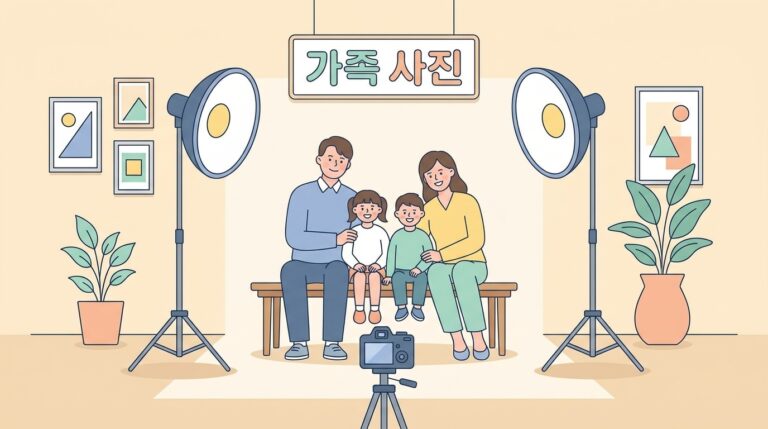
Phase 1: Empathy (Welcome to the Studio!)
안녕하세요! 매일한글 에디터입니다! (Hello! I’m your Daily Hangul editor!)
Have you ever watched a heartwarming K-drama where the entire family—from the proud grandparents sitting in vintage velvet armchairs to the fidgety toddlers wearing matching knit sweaters—gathers together in a classic Korean photography studio? Think of that nostalgic scene in Reply 1988 where everyone suddenly goes stiff as a wooden board the moment the photographer yells, “Smile!”
Taking a family portrait in Korea is an unforgettable experience, but stepping into a real Korean photo studio (사진관, sa-jin-gwan) can feel intimidating when you only speak English. You want a warm, radiant picture, but suddenly the photographer is shouting rapid-fire directions: “턱 당기세요!”, “어깨 펴세요!”, “조금만 더 붙으세요!” What do you do? Panic and freeze?
Don’t worry, my friend! Based on hundreds of real feedback sessions from international learners living in Seoul, this guide is crafted at the comfortable A2 (Elementary) level. With just a few simple, natural sentences, you will effortlessly navigate your studio session, communicate with the photographer like a pro, and walk away with a breathtaking family portrait that looks straight out of an aesthetic K-drama.
Phase 2: Top 3 Core Expressions
1. 가족 사진 찍으러 왔어요. (Gajok sajin jjigeureo wasseoyo.)
- Pronunciation: [Ga-jok sa-jin jji-geu-reo wa-sseo-yo] (Sounds like: Gah-joke sah-jin jee-geu-raw wah-saw-yo)
- Meaning: “We are here to take a family photo.”
- K-Culture Moment: The magic phrase you say right at the reception counter. You often see young couples or adult children taking their aging parents to celebrate a 60th birthday (환갑, hwangap) in weekend K-dramas.
- Editor’s Insight: The pattern
-(으)러 왔어요means “I came in order to [verb]”. Simply swap가족 사진(family photo) with여권 사진(passport photo) or프로필 사진(profile portrait) whenever your mission changes!- Situation Spectrum: Casual ⚠️ | Semi-formal (Polite -yo) ✅ | Formal (-sumnida) ✅
- 🤔 Think About It: In many Western countries, photo sessions are often self-booked online without much reception chit-chat. In Korea, stating your explicit shared goal immediately warmly connects you to the studio staff.
2. 조금만 더 붙어 앉아 주세요. / 조금만 더 붙을게요. (Jogeumman deo buneulgeyo.)
- Pronunciation: [Jo-geum-man deo bu-teul-ge-yo] (Rhymes with: Joe-geum-mahn duh boo-teul-geh-yo)
- Meaning: “We will lean in a little closer.”
- K-Culture Moment: Korean family photos despise empty gaps! Photographers will constantly say “더 붙으세요!” (Stick closer together!). Replying “조금만 더 붙을게요!” shows you understand the visual aesthetic.
- Editor’s Insight: The verb
붙다literally means “to stick” or “to adhere.” In photography context, it means closing physical gaps so shoulders overlap snugly, symbolizing closeness and 정 (jeong).- Situation Spectrum: Casual ⚠️ | Semi-formal ✅ | Formal ✅
- 🤔 Think About It: Why does Korean photography emphasize physical closeness so much compared to spaced-out individual framing? How does physical proximity reflect family bonding in your culture?
3. 자연스럽게 보정해 주세요. (Jayeonseureopge bojeonghae juseyo.)
- Pronunciation: [Ja-yeon-seu-reop-ge bo-jeong-hae ju-se-yo] (Sounds like: Jah-yawn-seu-rawp-geh boh-jung-hae joo-seh-yoh)
- Meaning: “Please retouch it naturally.”
- K-Culture Moment: Welcome to the world-famous Korean digital retouching (보정, bojeong). If you don’t specify, you might end up with porcelain doll skin and eyes doubled in size! This phrase is your golden ticket to looking like the best version of yourself.
- Editor’s Insight:
자연스럽게means “naturally,” and보정is photo editing/touch-up. Photographers love when you ask for this because it gives them clear creative boundaries.- Situation Spectrum: Casual 🚫 | Semi-formal ✅ | Formal ✅
- 🤔 Think About It: In Korean beauty standards, retouching isn’t seen as “fake,” but rather as courtesy and artistic polish. Does your culture prefer unedited raw honesty or polished perfection?
Phase 3: Textbook Korean vs. Real Korean
Situation 1: Asking to review the shots on the monitor
- 📖 교과서 한국어 (Textbook): “찍은 사진을 확인해도 됩니까?” (Jjigeun sajineul hwaginhaedo doemnikka? – May I inspect the photographed pictures?)
- 🗣️ 진짜 한국어 (Real-life): “모니터 한번 봐도 돼요?” (Moniteo hanbeon bwado dwaeyo? – Can we take a look at the monitor?)
- 💡 Why the difference? Textbook phrasing uses heavy administrative vocabulary (확인하다). Real-world Koreans talk simply about the concrete object in front of them (모니터, monitor) using the soft polite ending
-도 돼요?.
Situation 2: When the photographer tells you to smile
- 📖 교과서 한국어 (Textbook): “입꼬리를 올리고 미소를 지으십시오.” (Ipkkorireul olligo misoreul jieusipsio. – Raise the corners of your mouth and produce a smile.)
- 🗣️ 진짜 한국어 (Real-life): “활짝 웃어 보세요~ 치즈!” (Hwaljjak useo boseyo~ chijeu! – Try smiling brightly~ Say cheese!)
- 💡 Why the difference? Studio photographers are masters of atmosphere! Instead of clinical muscle commands, they use vivid onomatopoeia like
활짝(beaming wide) to create laughter and genuine emotion.
Phase 4: K-Culture Deep Dive & Non-Verbal Etiquette
4-1. Nunchi & Gestures (눈치 매너)
- The Generational Seating Chart: In Korea, family photos follow a respectful hierarchy. Grandparents and elderly parents sit comfortably in the center chairs. Grown children stand tall on either side, while grandchildren either sit on the floor cross-legged in front or sit on their grandparents’ laps. Never push an elder to stand at the edge!
- Chin Down, Shoulders Relaxed (턱 당기기): Koreans care deeply about small face proportions. The photographer will frequently gesture by pulling their chin towards their neck: “턱 살짝만 당겨주세요” (Tuck your chin in slightly). It elongates your jawline and avoids unflattering upward-angle shadows.
- Shoulder Overlap: If the photographer gently taps your shoulder, don’t step back! Angle your body slightly sideways toward the person beside you.
4-2. Cultural Code: The Art of “Bojeong” (보정 문화)
In Korea, studio photography is a high-tech craft. From ID portraits (증명사진) to grand family frames, Korean studios offer 1-on-1 live retouching where you sit right next to the designer. You can request subtle skin smoothing (피부톤 보정), shoulder symmetry adjustment, and flyaway hair removal. It is celebrated as an enjoyable collaborative design experience rather than a secretive edit!
Phase 5: Real-Life Roleplay Scenario
Setting: Sarang Studio (사랑 사진관), a sunlit modern studio in Bukchon Hanok Village. You are visiting with your family.
Characters:
* You (Guest)
* Master Kim (실장님 – Friendly Lead Photographer with a warm smile and funky glasses)
Master Kim: 어서 오세요! 예약하고 오셨나요?
(Eoseo oseyo! Yeyakhago osyeonnayo?)
“Welcome! Did you come with a reservation?”
🎭 Bows warmly at a 15-degree angle.
You: 네, 2시에 예약한 민우예요. 가족 사진 찍으러 왔어요.
(Ne, dusi-e yeyakhan Min-wooyeyo. Gajok sajin jjigeureo wasseoyo.)
“Yes, I’m Minwoo with a 2 PM reservation. We are here to take a family photo.”
🎭 Points gently to your family members standing by.
Master Kim: 반갑습니다! 저쪽 거울 보시고 옷매무새 한번 다듬어 주세요.
(Bangapseumnida! Jeojjok geoul bosigo otmaemusae hanbeon dadeumeo juseyo.)
“Glad to meet you! Please check the mirror over there and straighten your outfits.”
🎭 Hands you a small lint roller and comb.
You: 네, 준비 다 됐어요. 어디에 앉을까요?
(Ne, junbi da dwaesseoyo. Eodie anjeulkkayo?)
“Yes, we are all ready. Where should we sit?”
🎭 Looks towards the central studio chairs.
Master Kim: 부모님은 가운데 의자에 앉으시고, 두 분은 뒤에 서 주세요!
(Bumonimeun gaunde uijae anjeusigo, du buneun dwie seo juseyo!)
“Parents please take the center chairs, and you two please stand behind!”
🎭 Arranges the stools with practiced speed.
You: 알겠습니다. 조금만 더 붙을게요!
(Algetseumnida. Jogeumman deo buneulgeyo!)
“Understood. We will lean in a little closer!”
🎭 Resting hands lightly on your parents’ shoulders.
Master Kim: 좋아요! 자, 턱 살짝 당기시고, 활짝 웃으세요~ 하나, 둘, 셋!
(Joayo! Ja, teok saljjak danggisigo, hwaljjak useuseyo~ Hana, dul, set!)
“Great! Now, tuck your chins slightly, and smile big~ One, two, three!”
🎭 Flash pops twice with a crisp clicking sound.
You: 수고하셨습니다! 모니터 한번 봐도 돼요?
(Sugohasyeotseumnida! Moniteo hanbeon bwado dwaeyo?)
“Thank you for your hard work! Can we take a look at the monitor?”
🎭 Walks over cheerfully to the editing desk.
🔀 Interactive Decision Point
After reviewing the pictures, the photographer asks which photo style you prefer for editing. How do you respond?
- Option A: “완전히 다른 사람처럼 하얗게 만들어 주세요!” (Make us look like completely different people with pure white skin!)
- Outcome (Bad): ❌ The photographer will chuckle uncomfortably. You will end up with an unnatural photo where nobody looks like their real self!
- Option B: “자연스럽게 보정해 주시고, 눈가 주름만 조금 지워 주세요.” (Please retouch naturally, and just soften the fine eye wrinkles a bit.)
- Outcome (Best): 🏆 Perfect! It gives specific, polite directions. The editor will highlight your family’s natural charm while smoothing tiny imperfections.
- Option C: “그냥 마음대로 알아서 다 해주세요.” (Just do whatever you feel like doing on your own.)
- Outcome (Risk): ⚠️ If the editor’s aesthetic doesn’t match yours, you might be stuck paying for reprints or feeling awkward about the final result.
Phase 6: 10-Second Emotional Shadowing Drill
Practice matching the rhythmic melody and breathing pauses of native speakers. Pauses are marked with /.
- [😊 Friendly & Confident]
가족 사진 / 찍으러 왔어요.
(Gajok sajin / jjigeureo wasseoyo.)
We are here / to take a family photo. -
[🤗 Warm & Cooperative]
저희 / 조금만 더 / 붙어 앉을게요!
(Jeohui / jogeumman deo / buteo anjeulgeyo!)
We will / a little closer / sit together! -
[✨ Polite & Hopeful Request]
과하지 않게 / 자연스럽게 / 보정해 주세요.
(Gwahaji anke / jayeonseureopge / bojeonghae juseyo.)
Not excessively / naturally / please retouch it.
Phase 7: K-Culture Mini Dictionary
| Word (Hangul + Romanization) | English Meaning | Real-Life Practical Usage |
|---|---|---|
| 1. 원본 (Wonbon) | Original unedited raw files | Always ask: “원본 파일도 이메일로 보내주시나요?” (Do you also send the original raw files via email?). Some studios charge a small fee for this! |
| 2. 보정 (Bojeong) | Photo retouching / editing | The core service of Korean studios: correcting lighting, skin, posture, and facial symmetry. |
| 3. 액자 (Aekja) | Picture frame | Studios offer physical frames ranging from traditional wood to modern acrylic (아크릴 액자). |
| 4. 톤 (Ton) | Color tone / Mood palette | You can ask for “따뜻한 톤” (warm tone) or “화사한 톤” (bright & vibrant tone) to fit your home interior. |
Phase 8: Traveler’s Survival Kit
TOP 3 Survival Phrases
- “가장 잘 나온 걸로 골라 주세요.” (Gajang jal naon geollo golla juseyo.)
Pro Tip: Overwhelmed by 100 similar shots? Say this to let the professional photographer pick the best candid moment! - “사진 파일은 언제 받을 수 있나요?” (Sajin paireun eonje badeul su innayo?)
Pro Tip: Essential for tourists with tight schedules! Digital copies usually arrive within 24–48 hours by email. - “옷 갈아입는 곳이 있나요?” (Ot gara-imneun gosi innayo?)
Pro Tip: Need to change into matching family outfits or traditional Hanbok? Ask this right upon arrival.
Editor’s Travel Note
- Smart Booking Tip: Most trendy studios in Seoul (like in Yeonnam-dong or Gangnam) require reservations. Use the Naver Map app download to search for “가족 사진관” in your neighborhood and click the green reservation (예약) button.
- Card Payments: Nearly all photo studios accept international Visa/Mastercard without extra surcharge, but some local heritage studios in markets offer a 5% discount or bonus wallet photos if you pay with cash or a domestic bank transfer.
Phase 9: “One Step Deeper” (Reflective Essay)
In many Western cultures, portraiture has historically celebrated the autonomy and distinct personality of the individual. In Korea, however, a family portrait is an embodiment of 우리 (Woori – “We / Us”), our deeply rooted collective consciousness. Notice how the photographer gently nudges everyone to overlap shoulders until you feel each other’s body warmth. That physical closeness isn’t an accident; it is the visual expression of 정 (Jeong), the invisible emotional thread of shared care and vulnerability. When looking at a Korean family frame hanging on a living room wall, you don’t merely see four separate humans—you see a singular, bonded unit weathered through life together.
💬 Your Turn: Have you ever taken a formal studio portrait with your loved ones? What is the most important element of a family picture in your culture? Tell me in the comments below!
Phase 10: FAQ & Common Pitfalls
Q: Can we rent family outfits directly at Korean photo studios?
A: Yes! Many modern studios offer matching white shirts, denim, or even modern Hanboks for a small rental fee (around 10,000 to 20,000 KRW per person). Always check the studio website beforehand or send a quick inquiry: “의상 대여 되나요?” (Is costume rental available?).
Q: How long does the entire session usually take?
A: For standard family portraits, shooting takes about 20 to 30 minutes. The selection and 1-on-1 retouching consultation takes another 30 minutes. You can usually walk out the door in about 1 to 1.5 hours!
Q: Is tipping the photographer expected in Korea?
A: No, never! Korea has zero tipping culture. The price quoted on the menu or service board is 100% all-inclusive. A heartfelt “감사합니다! 수고하셨습니다!” is the greatest tip you can offer.
🚨 Common Mistakes Alert (흔한 실수 TOP 3)
- Sitting with stiff, rigid posture: Don’t sit like you’re at a military inspection! Loosen your shoulders and drop your tongue to the roof of your mouth to naturally relax your jaw.
- Forgetting to ask about print turnaround: Physical framed prints take 3 to 7 business days. If you are flying home tomorrow, request “디지털 파일만 먼저 받을게요” (We’ll receive just the digital files first).
- Wearing reflective glasses: Studio strobes reflect fiercely on anti-glare lenses. Push your glasses slightly down the bridge of your nose or take them off if your photographer suggests it.
Phase 11: Action Mission & Engagement
- 🥉 Bronze Mission: Stand in front of your bathroom mirror right now. Point your camera and say aloud 3 times: “활짝 웃으세요! 하나, 둘, 셋!”
- 🥈 Silver Mission: Share this post with a family member or travel buddy on social media and decide: What color palette would you wear for a Seoul photo shoot?
- 🎮 K-Culture Mission: Watch any episode of a family K-drama (like Once Again or Father is Strange). Spot the family portrait hanging in the main living room. Does it follow the seating hierarchy we discussed?
Phase 12: Interactive Quiz Challenge
Test your knowledge before booking your studio session!
1. [Situational Judgment]
You want to ask the photographer to make your family photo look polished, but without excessive, fake skin alterations. What do you say?
* A) 아주 하얗게 만들어 주세요.
* B) 자연스럽게 보정해 주세요.
* C) 사진 그냥 찍지 마세요.
2. [Fill in the Blank]
Complete the sentence to tell the staff you came for a family photo:
“가족 사진 ______ 왔어요.” (Hint: “in order to shoot”)
3. [True / False Cultural Quiz]
In traditional Korean family portrait layouts, young children sit in the middle chairs while grandparents stand behind them to show high energy. (True / False?)
🔍 Click here to reveal the answers and explanations!
- Answer: B (자연스럽게 보정해 주세요)
Explanation:자연스럽게means naturally, and보정means retouching. Option A will turn you into a cartoon character, and Option C means “Don’t take the photo at all!” -
Answer: 찍으러
Explanation: The full sentence is 가족 사진 찍으러 왔어요 (Gajok sajin jjigeureo wasseoyo). The pattern-러 오다means to come in order to do an action. -
Answer: False
Explanation: Korean etiquette prioritizes respect for elders. Grandparents sit centrally in the armchairs, while the younger generations stand protectively behind or around them.







