

Phase 1: 공감 (Story Immersion Opening)
안녕하세요! 매일한글 에디터입니다. (Hello! I’m your Daily Hangul editor.)
Picture this: You are standing in a neon-lit, velvet-cushioned Korean Noraebang (노래방) in Hongdae with your Korean friends or coworkers. You just poured every ounce of your soul into singing an iconic K-pop anthem or a heartfelt drama soundtrack. As your final breath fades out, the music stops abruptly, and a suspenseful drumroll echoes from the speakers. Giant animated graphics burst across the screen. The room freezes in anticipation… and boom: 71 points appears in flashing yellow font. Or maybe, against all odds, fireworks shoot out with a glorious 100 points!
Everyone looks at you with wide eyes. What do you say in that split second? Do you apologize? Do you stare awkwardly at the floor?
As a Korean language coach who has spent over a decade guiding foreigners through Seoul nightlife and social customs, I have seen so many brilliant beginners completely freeze up right here. But here is the secret: you don’t need complex grammar or high-level vocabulary to be the life of the room. You only need three punchy, intuitive reactions to break the ice and celebrate like a native. Based on real learner feedback and countless karaoke nights, this beginner guide will turn your karaoke score suspense into unforgettable bonding moments!
Phase 2: 핵심 표현 3선 심층 분석 (Top 3 Core Expressions)
1. 몇 점 나왔어요? (Myeot jeom nawasseoyo?)
- Pronunciation: [Myeot jeom na-wa-sseo-yo] (Sound analogy: “Myeot” sounds like ‘mutt’ with a soft ‘y’, “jeom” sounds like ‘jump’ without the ‘p’, followed by ‘na-wa-suh-yo’)
- Meaning: Literal: “How many points came out?” / Actual Nuance: “What score did we get?”
- K-Culture Moment: Seen non-stop on Korean variety shows like Run BTS or Going SEVENTEEN whenever idols sing competitively and rush toward the screen to see their results.
- Editor’s Insight: Notice that Koreans don’t say “What score did I receive?” Instead, they use the verb 나오다 (naoda – to come out). In Korean culture, this subtly shifts the responsibility onto the machine’s random calculation rather than judging your individual talent. It keeps things playful!
- Situation Spectrum: Casual: ✅ (몇 점 나왔어?) | Semi-formal: ✅ (몇 점 나왔어요?) | Formal: ⚠️
- 🤔 Think About It: In English, we usually ask “What did you get?” Why do you think Korean phrases emphasize the score “popping out” of the machine instead of your personal ability?
2. 백 점 나왔어요! (Baek jeom nawasseoyo!)
- Pronunciation: [Baek jeom na-wa-sseo-yo] (Sound analogy: “Baek” rhymes with ‘Beck’ in David Beckham + “jum na-wa-suh-yo”)
- Meaning: Literal: “100 points came out!” / Actual Nuance: “I got a perfect 100!”
- K-Culture Moment: The moment a digital fanfare plays, disco lights flash in overdrive, and your friends start banging their tambourines like rock stars.
- Editor’s Insight: Noraebang scoring algorithms are famously unpredictable. You can sing off-pitch with pure passion and still get 100! When that magic number appears, shouting this phrase validates the chaotic fun of the night.
- Situation Spectrum: Casual: ✅ (백 점 나왔다!) | Semi-formal: ✅ (백 점 나왔어요!) | Formal: 🚫
- 🤔 Think About It: Many Western karaoke setups don’t have scoring systems at all. Why do you think gaming and numerical scoring are so prominent in Korean entertainment?
3. 아쉬워요! (Aswiwoyo!)
- Pronunciation: [Ah-shee-wo-yo] (Sound analogy: “Ah” + “she” + “war” without the ‘r’ + “yo”)
- Meaning: Literal: “It is regretful!” / Actual Nuance: “So close! / What a bummer!”
- K-Culture Moment: When someone hits 98 or 99 points—just one point away from a perfect hundred—and the whole group groans in mock devastation.
- Editor’s Insight: The word 아쉽다 (aswipda) is a beloved cultural keyword. It doesn’t mean deep tragedy; it expresses that lingering, affectionate disappointment when something almost worked out perfectly.
- Situation Spectrum: Casual: ✅ (아쉽다!) | Semi-formal: ✅ (아쉬워요!) | Formal: ✅ (아쉽습니다)
- 🤔 Think About It: Is there a single word in your native language that encapsulates “missing the mark by an inch” with humor and warmth?
Phase 3: 교과서 한국어 vs 진짜 한국어 (Textbook vs. Real Korean)
Situation 1: Asking what the score is
- 📖 교과서 한국어: 당신의 점수는 몇 점입니까? (Dangsin-ui jeomsuneun myeot jeom-imnikka? – “What is your score?”)
- 🗣️ 진짜 한국어: 몇 점 나왔어요? (Myeot jeom nawasseoyo? – “What score came out?”)
- 💡 왜 다를까?: In real-life Korea, using the pronoun “당신” (you) sounds confrontational and robotic. Native speakers omit the pronoun entirely and naturally use the friendly verb “나오다” (to emerge/come out).
Situation 2: Reacting to a surprisingly low score
- 📖 교과서 한국어: 점수가 낮아서 슬픕니다. (Jeomsuga najaseo seulpeumnida. – “Because the score is low, I am sad.”)
- 🗣️ 진짜 한국어: 아, 기계 고장 났네! (A, gigye gojang nanne! – “Ah, the machine is totally broken!”)
- 💡 왜 다를까?: Nobody mopes at a Korean karaoke room. A low score is a golden excuse to make a classic joke by playfully blaming the technology!
Phase 4: K-Culture 딥다이브 & 비언어적 매너 (Deep Dive & Etiquette)
4-1. 눈치 (Nunchi) & Non-Verbal Manners
- The Tambourine Roll: When the final note ends, never sit in dead silence. Vigorously shake your tambourine during the drumroll graphic to build suspense!
- The Quick Skip (취소 매너): If someone gets a visibly low score (under 75 points) and seems shy, don’t let it linger on the monitor. Gently press the red 취소 (Cancel) button on the remote to swiftly start the next song. That is pure high-level Nunchi.
4-2. Culture Code Analysis: “Heung” (흥) & Coin Noraebangs (코노)
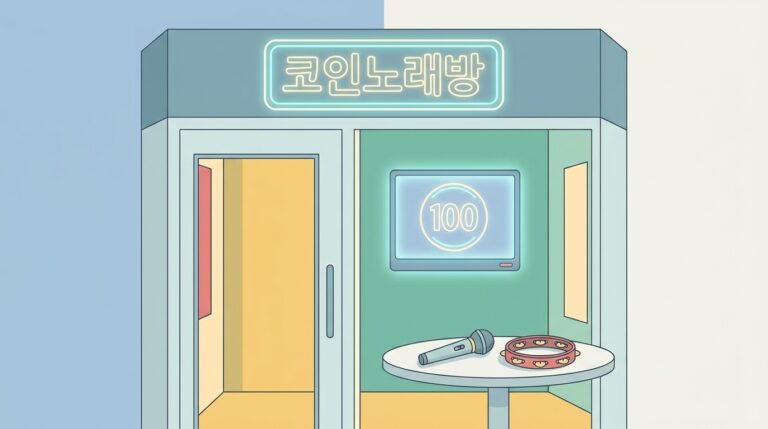
Karaoke in Korea is not an audition for The Voice; it is a communal release of 흥 (Heung – explosive joyful energy). With the meteoric rise of 코노 (Kono – Coin Noraebang), solo singing and casual 2-person hangouts have become daily stress-relief rituals. The score screen is simply interactive comedy designed to keep the energy bouncing from one song to the next.
Phase 5: 실전 롤플레이 시나리오 (Real-Life Roleplay Scenario)
Setting: A cozy Coin Noraebang in Hongdae. Your Korean language buddy, Minho, is holding the remote while you just finished singing a famous drama OST.
- 민호 (Minho): 와! 노래 진짜 잘 부르시네요! (Wa! Norae jinjja jal bureusineyo! / “Wow! You sing so well!”) 🎭 Clapping his hands with a bright smile.
- 나 (You): 고마워요! 점수 떨려요. (Gomawoyo! Jeomsu tteollyeoyo. / “Thank you! I’m nervous about the score.”) 🎭 Laughing while holding the mic close.
- 민호 (Minho): 두구두구두구! 과연 몇 점? (Dugudugudugu! Gwayeon myeot jeom? / “Drumroll! What will the score be?”) 🎭 Rattling the tambourine against his hip.
- 화면 (Screen): [Fanfare sound effects with ’88점’ flashing brightly on the monitor]
- 나 (You): 몇 점 나왔어요? (Myeot jeom nawasseoyo? / “What score did I get?”) 🎭 Pointing eagerly at the screen.
- 민호 (Minho): 88점 나왔어요! 대박! (Palsip-pal jeom nawasseoyo! Daebak! / “You got 88 points! Awesome!”) 🎭 Giving two big thumbs up.
- 나 (You): 아쉬워요! 90점 넘고 싶었어요. (Aswiwoyo! Gusip jeom neomgo sipeosseoyo. / “So close! I wanted to cross 90.”) 🎭 Playfully sighing with a wide grin.
- 민호 (Minho): 다음 곡에서 백 점 도전해요! (Daeum gog-eseo baek jeom dojeonhaeyo! / “Let’s challenge for 100 on the next song!”) 🎭 Handing over the songbook and remote.
🔀 인터랙티브 분기점 (Interactive Choice)
How do you keep the upbeat momentum going?
* Choice A: “기계가 고장 났나 봐요! 하하.” (Gigyega gojang nanna bwayo! Haha. – “The machine must be broken! Haha.”)
* 🌟 Feedback [Best]: Top tier humor! Blaming the machine keeps the mood light, warm, and hilarious.
* Choice B: “점수가 너무 나빠서 이제 집에 갈게요.” (Jeomsuga neomu nappaseo ije jibe galgeyo. – “The score is too bad so I’m going home now.”)
* 🚫 Feedback [Bad]: Kills the mood instantly. Even as sarcasm, it sounds genuinely hurt in Korean.
* Choice C: “민호 씨 노래도 몇 점 나오는지 봐요!” (Minho ssi noraedo myeot jeom naoneunji bwayo! – “Let’s see what score your song gets too!”)
* ⚠️ Feedback [Risk]: Playful, but make sure your tone is affectionate so it doesn’t sound like aggressive competition!
Phase 6: 10초 감정 섀도잉 드릴 (10-Second Emotion Shadowing Drill)
Practice reading these aloud with the designated emotion and rhythmic pauses marked by /:
[😊 설레고 기대에 차서 (Excited & Anticipating)]
몇 점 / 나왔어요? (Myeot jeom / nawasseoyo?)[🎉 엄청 신나고 자랑스럽게 (Super Proud & Cheerful)]
백 점 / 나왔어요! / 대박! (Baek jeom / nawasseoyo! / Daebak!)[🥺 장난스럽게 아쉬워하며 (Playfully Bummed Out)]
아, / 너무 / 아쉬워요! (Ah, / neomu / aswiwoyo!)
Phase 7: K-Culture 미니 사전 (Mini Dictionary: 4 Key Terms)
- 코노 (Kono / Coin Noraebang): Short for 코인 노래방. Compact, automated karaoke rooms where you pay per song (usually 500 to 1,000 KRW for 2-3 songs), popular for solo practice.
- 탬버린 (Taem-beo-rin / Tambourine): The ultimate party accessory in every Korean singing room, often outfitted with flashing LED lights to cheer on the singer.
- 점수 (Jeom-su / Score): The numerical result displayed after a song. Calculated by microphone volume, tempo match, and breath timing rather than true musical pitch.
- 서비스 (Seo-bi-seu / Free Bonus Time): Extra free minutes or songs added to your counter by generous traditional noraebang owners when they see you having fun!
Phase 8: 여행자를 위한 생존 키트 (Survival Kit for Travelers)
TOP 3 Survival Phrases
- 점수 꺼주세요 (Jeomsu kkeojuseyo) – “Please turn off the score feature.”
- Pro Tip: If score pressure gives you performance anxiety, look for the ‘점수’ button on the remote or ask the staff at the counter to disable it.
- 취소 (Chwi-so) – “Cancel / Skip”
- Pro Tip: Look for the large red circular button labeled ‘취소’ on the remote control. Press it once to instantly cut off the score fanfare and queue up the next song.
- 서비스 많이 주세요! (Seobiseu mani juseyo!) – “Please give us lots of bonus time!”
- Pro Tip: When paying at the front desk of a traditional (hourly) room, say this with an aegyo smile. Korean shop owners love giving generous extra minutes to polite guests!
Editor’s Travel Note
Before roaming the nightlife streets of Hongdae, Gangnam, or Sinchon, be sure to use the Naver Map app download guide to search for highly rated “코인노래연습장” (Coin Noraebangs). Most coin rooms accept Korean transport cards (T-Money) or credit cards, but carrying crisp 1,000 KRW paper bills is the most reliable way to insert cash directly into the booths!
Phase 9: “한 발 더 깊이” (One Step Deeper: Thought Reflection)
In Korean society, collective vulnerability is the quickest shortcut to intimacy. Singing out loud in front of colleagues or new friends breaks through rigid social hierarchies. The score screen acts as an equalizer: a junior employee might score 99 while the company director gets 65, sparking laughter and stripping away stiffness. Remembering that the score is a tool for social warmth rather than critique will instantly elevate your cultural comfort in Korea.
💬 Your Turn: In your culture, do people like to perform karaoke competitively, or is it strictly casual? What is your all-time go-to karaoke song? Drop your thoughts in the comments!
Phase 10: FAQ & 오해 방지 (Structured FAQ Schema)
Q: Does a low Noraebang score mean my Korean pronunciation was bad?
A: Absolutely not! The machine evaluates microphone sound intensity, pitch continuity, and rhythmic cadence. It cannot assess Korean pronunciation or lyrical grammar.
Q: What should I do if my Korean friend gets a surprisingly low score?
A: Do not stay silent! Immediately shout “기계 고장 났네!” (The machine is broken!) or playfully press the cancel button and hand them the mic for their next turn.
Q: How do I say “I got 100 points” in casual language to close friends?
A: You can say “백 점 나왔다!” (Baek jeom nawatta!) or simply shout “백 점! 대박!” (Baek jeom! Daebak!).
🚨 흔한 실수 (Common Mistakes) 경고판
- Mistake: Saying “나는 100점 받았어요” (I received 100 points).
- 🛠️ Correct Action: Say “백 점 나왔어요!” (Koreans use 나오다 for scores, not 받다).
- Mistake: Apologizing deeply when you get a low score (“죄송해요”).
- 🛠️ Correct Action: Laugh it off and say “아쉬워요!” (So close!). Noraebang is about laughter, not perfection.
- Mistake: Staring blankly at the remote when the score appears.
- 🛠️ Correct Action: Tap the red 취소 (Cancel) button to keep the room’s energy rolling!
Phase 11: 액션 미션 & 참여 유도 (Action Missions)
- 🥉 Bronze Mission (Solo Practice): Stand before a mirror and practice shouting “몇 점 나왔어요?” and “백 점 나왔어요!” with high energy 3 times.
- 🥈 Silver Mission (Social Media): Find a video clip of your favorite K-pop idols at karaoke and post a comment using the phrase “아쉬워요! 다음엔 백 점 가자!” (So close! Let’s get 100 next time!).
- 🥇 Gold Mission (Real Life): Visit a local Korean Noraebang or Coin Noraebang booth, sing your favorite song, and react in real-time with one of our core phrases!
- 🎮 K-Culture Mission: Watch an episode of a Korean drama with a company dinner (회식) scene and observe how coworkers react together when the score is announced.
Phase 12: 인터랙티브 퀴즈 챌린지 (Interactive Quiz Challenge)
Test your karaoke mastery below! Think through each question before unfolding the answers.
1. 상황 판단 (Situational): You sang your heart out and got 99 points—just one point away from 100! What is the most natural Korean reaction?
* A) 죄송합니다 (Joesonghamnida)
* B) 아쉬워요! (Aswiwoyo!)
* C) 당신의 점수입니다 (Dangsin-ui jeomsu-imnida)
2. 빈칸 채우기 (Fill in the Blank):
“점수가 잘 ________?” (Did the score come out well?)
* Hint: The verb for ‘to come out’.
3. True / False 문화 퀴즈:
In Korea, karaoke scores accurately evaluate your singing technique and pitch accuracy like a real vocal coach. (True / False)
👉 Click here to reveal answers & explanations!
- 1. Answer: B) 아쉬워요! (Aswiwoyo!)
- Explanation: When you miss a goal by just a tiny margin, “아쉬워요!” (So close!) is the exact natural expression native speakers use.
- 2. Answer: 나왔어요 (nawasseoyo)
- Explanation: The full natural phrase is “점수 잘 나왔어요?” (Did a good score come out?).
- 3. Answer: False
- Explanation: Korean karaoke machines score based on volume and rhythm input algorithms. It is strictly for entertainment and party energy!







