

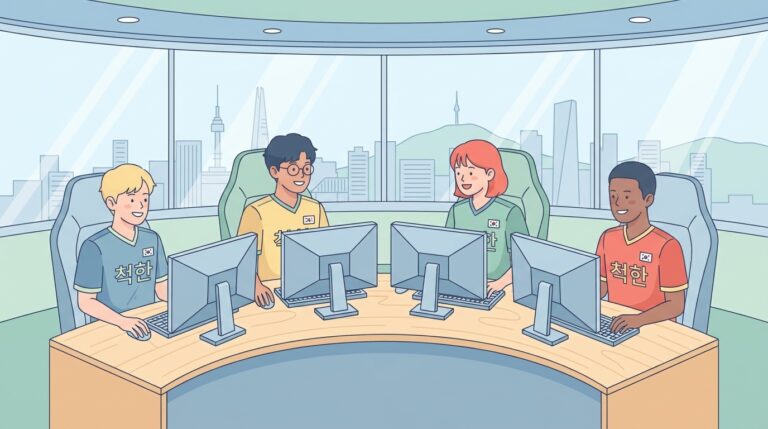
Phase 1: 공감 (Story-Driven Opening)
안녕하세요! 매일한글 에디터입니다.
Picture this: You step into a neon-lit, state-of-the-art PC bang in Sinchon on a Friday night. The air is thick with the aroma of fried ramyeon and the rhythmic, tactile clatter of mechanical keyboards. You queue up for a high-stakes ranked match in Valorant or Overwatch. Your team locks in, the match begins, and you press your push-to-talk key to coordinate a strategy. The moment a feminine voice resonates through the team comms, the atmosphere freezes. Within seconds, unprovoked questions flood the chat: “Are you duo-queuing with your boyfriend?” or “Can you just play support and get carried?”
For years, Korean competitive gaming—celebrated globally for its elite e-sports infrastructure—harbored an unspoken, suffocating undercurrent of casual misogyny. Talented women were either patronized as casual ‘mascots’ or subjected to aggressive harassment under the derogatory label of seeking a ‘bus’ (getting boosted). However, the tectonic plates of the Korean gaming industry are shifting. With women now comprising nearly half of all active gamers in South Korea and leading competitive rosters, the gaming community is engaging in a fierce, overdue cultural reckoning. In this C2 masterclass, drawn from deep sociological fieldwork and interviews with domestic e-sports strategists, we dissect the advanced linguistic registers and cultural tools needed to navigate, critique, and dismantle gender bias in Korean digital spaces. By mastering these nuanced, high-register expressions, you will not only speak like a native intellectual but also champion an inclusive, toxicity-free community.
Phase 2: 핵심 표현 3선 심층 분석 (Top 3 Core Expressions)
1. 실력으로 증명하다 (Silryeog-euro jeungmyeonghada)
- Pronunciation: [Sil-ryeog-eu-ro jeung-myeong-ha-da] (Think of ‘seal-yuck’ rolled smoothly into ‘jeung-myung-ha-da’ with an assertive cadence)
- Meaning: Literal: To prove through skill / Nuance: To decisively silence prejudiced skeptics and shatter systemic biases purely through undeniable competence and merit.
- K-Culture Moment: When legendary tank player Geguri broke onto the professional Overwatch scene after facing baseless hacking accusations born from male insecurity, analysts praised her using this exact phrase: 그녀는 논란을 오직 실력으로 증명했다 (Geunyeoneun nonraneul ojik silryeogeuro jeungmyeonghaetta – “She silenced all controversy purely by proving herself through skill”).
- Editor’s Insight: At the C2 level, note how the particle ‘-으로’ functions here as an instrumental marker of pure agency. It implies transcending endless political debates by delivering flawless tangible results.
- Situation Spectrum: Casual ✅ | Semi-formal ✅ | Formal ✅
- 🤔 Think About It: Does your native language equate meritocratic performance directly with moral vindication in gaming spaces the way Korean competitive culture does?
2. 성별 갈라치기를 지양하다 (Seongbyeol gallachigi-reul jiyanghada)
- Pronunciation: [Seong-byeol gal-la-chi-gi-reul ji-yang-ha-da] (Rhymes smoothly with ‘song-byul’ + ‘gal-la-chee-gee’ + ‘jee-yahng-ha-da’)
- Meaning: Literal: To avoid gender-based splitting / Nuance: To actively reject tribalistic, zero-sum gender warfare and refrain from framing social or gaming dynamics through divisive binary stereotypes.
- K-Culture Moment: Frequently deployed in high-level game developer panel discussions and editorial columns on sites like Inven or Ruliweb when critiquing toxicity that pits male and female player bases against each other.
- Editor’s Insight: Be extremely careful not to confuse 지양하다 (jiyanghada – to avoid/refrain from) with its phonetic cousin 지향하다 (jihyanghada – to aspire toward/pursue). Conflating these two at a C2 level completely flips your intended social commentary!
- Situation Spectrum: Casual ⚠️ | Semi-formal ✅ | Formal ✅
- 🤔 Think About It: How does the term ‘갈라치기’ (polarizing wedge politics) reflect modern Korean media discourse beyond the gaming sphere?
3. 클린한 게임 문화를 조성하다 (Keullinhoan geim munhwa-reul joseonghada)
- Pronunciation: [Keul-lin-han ge-im mun-hwa-reul jo-seong-ha-da] (Combines the loanword ‘Clean’ with Korean programmatic verbs)
- Meaning: Literal: To create a clean gaming culture / Nuance: To structurally establish a secure, harassment-free, and psychologically safe digital ecosystem for marginalized demographics.
- K-Culture Moment: Featured prominently in corporate sustainability and corporate social responsibility (CSR) statements by South Korean game publishers like Krafton, Nexon, and Riot Games Korea when launching anti-toxicity algorithmic filters.
- Editor’s Insight: While ‘클린’ is an English loanword, pairing it with ‘조성하다’ (to cultivate/construct deliberate socioeconomic environments) elevates this phrase into professional policy and activist discourse.
- Situation Spectrum: Casual ⚠️ | Semi-formal ✅ | Formal ✅
- 🤔 Think About It: Why do modern Korean institutions favor loanwords like ‘클린’ over native Hanja roots when discussing behavioral reforms in youth-centric spaces?
Phase 3: 교과서 한국어 vs 진짜 한국어 (Textbook vs. Real Korean)
Situation 1: Calling out a sexist voice-chat remark in real-time
- 📖 교과서 한국어: 게임 안에서 여성 플레이어에게 무례한 말을 하지 마십시오. (Geim an-eseo yeoseong peulleieoege muryehan mareul haji masipsio.) — “Please do not utter rude remarks to female players inside the game.”
- 🗣️ 진짜 한국어: 굳이 성별 프레임 씌우지 말고 본인 플레이에나 집중하시죠. (Guji seongbyeol peureim ssui-uji malgo bonin peulleie-na jipjunghasijyo.) — “Stop forcing gendered stereotypes into this and focus on your own gameplay.”
- 💡 왜 다를까? Textbook Korean sounds like a robotic warning notification. Native C2 speakers shut down microaggressions using biting, sharp, and composed debate vocabulary like ‘프레임 씌우다’ (to frame someone falsely) paired with the dismissive imperative ‘-하시죠’.
Situation 2: Praising an outstanding female teammate who clutched the round
- 📖 교과서 한국어: 당신은 여자이지만 아주 훌륭한 실력을 가지고 계시네요. (Dangsineun yeoja-ijiman aju hullyunghan silryeogeul gajigo gyesineyo.) — “Even though you are a woman, you possess exceptional skill.”
- 🗣️ 진짜 한국어: 완전 하드캐리 하셨네요! 브리핑 덕분에 라운드 깔끔하게 가져왔습니다. (Wanjeon hadeukaeri hasyeotneyo! Beuriping deokbune raundeu kkalkkeumhage gajyeowasseumnida.) — “An absolute hard carry! Thanks to your crystal-clear tactical comms, we secured that round flawlessly.”
- 💡 왜 다를까? Backhanded compliments containing patronizing qualifiers like “Even though you are female” perpetuate bias. True gamers celebrate tactical value directly—praising ‘하드캐리’ (hard carrying) and ‘브리핑’ (tactical voice comms) without irrelevant gender qualifications.
Phase 4: K-Culture 딥다이브 & 비언어적 매너 (Deep Dive & Non-Verbal Nuance)
4-1. 눈치 (Nunchi) & Tactical Voice-Chat Etiquette
Navigating Korean competitive lobbies requires acute 눈치 (Nunchi). When a female gamer joins voice chat, high-tier lobbies operate under an evolving moral consensus. The absolute zenith of modern gaming etiquette is “tactical neutrality”—refraining from sudden shifts in vocal pitch, overly solicitous flattery, or defensive posturing. When microaggressions flare up, subtle non-verbal cues carry enormous communicative weight:
* The Tactical Silence (침묵의 압박): Rather than screaming into the microphone, a sudden, dead silence from teammates following a sexist remark signals immediate social ostracization toward the offender.
* In-Game Ping Redistribution: When an obnoxious player spams ‘danger’ pings on a female teammate’s position, empathetic allies override this by calmly pinging objectives on the mini-map, reaffirming strategic cohesion.
4-2. Cultural Code Analysis: The LCK and the Paradigm Shift
South Korea’s e-sports ecosystem (governed by organizations like KeSPA and broadcasted across platforms like AfreecaTV and YouTube) long reflected hyper-masculine socialization. However, shifting market demographics have forced sweeping structural reform. Today, women constitute over 45% of the live spectator audience for the League of Legends Champions Korea (LCK). This economic sovereignty has transformed fan culture. Sexist commentary that was once dismissed as “mere gamer banter” now faces immediate sponsor boycotts and platform bans. The emerging norm is ‘클린 팬덤’ (Clean Fandom): a progressive movement where respectful language, active player protection, and the rejection of misogynistic tropes are seen as prerequisites for true competitive prestige.
Phase 5: 실전 롤플레이 시나리오 (Interactive Role-Play)
Setting: A premier cyber-sports lounge in Gangnam. You are competing in a high-tier ranked lobby alongside 수민 (Sumin), an elite Grandmaster shotcaller, and 민우 (Minwoo), an insecure pug teammate tilting after a lost round.
- Turn 1 (민우): 아, 진짜 마이크 켜보니까 보이스 여자였네? 이러니까 라운드 밀리지, 그냥 힐러나 잡고 버스나 타지 참. (A, jinjja maikeu kyeobonikka boiseu yeojayeonne? Ireonikka raundeu milliji, geunyang hilleona japgo beoseuna taji cham.)
- 🎭 Dismissive, sneering into his headset while aggressively banging his desk.
- “Ugh, so it was a girl on the mic all along? No wonder we got pushed back. Why don’t you just play healer and get carried?”
- Turn 2 (수민): 핑계 대지 마시죠. 방금 B사이트 진입 때 플래시 쿨타임 체크 안 하고 던진 건 민우 님 본인인데요? (Ping-gye daeji masijyo. Bang-geum Bi-saiteu jin-ip ttae peullaesi kul-ta-im che-keu an hago deonjin geon Min-u nim bon-in-in-de-yo?)
- 🎭 Composed, surgical, utterly devoid of emotional shaking.
- “Save your excuses. You were the one who threw the round by failing to track their flash cooldown during the B-site breach.”
- Turn 3 (민우): 뭐래? 실버 같은 소리 하네. 여자 게이머들 실력 안 되는 거 하루 이틀 보나? (Mwo-rae? Sil-beo gateun sori hane. Yeoja geimeodeul silryeok an doeneun geo haru iteul bona?)
- 🎭 Agitated, raising his voice defensively to mask his tactical blunder.
- “Whatever! Talking like some Silver scrub. As if we haven’t seen female gamers dragging teams down every single day.”
- Turn 4 (You – Learner): [Your turn to intercede and restore tactical authority.]
🔀 인터랙티브 분기점 (Interactive Choice)
Which response will you execute?
- Option A: 저기요, 아저씨. 여자한테 져서 화났어요? 게임이나 똑바로 하세요! (Jeogiyo, ajeossi. Yeojahante jyeoseo hwanasseoyo? Geimina ttokbaro haseyo!)
- Option B: 성별 문제로 물타기 하지 마시고, 수민 님 브리핑대로 리테이크 동선이나 제대로 맞춥시다. 지금 승패 가르는 건 성별이 아니라 포지셔닝입니다. (Seongbyeol munjero multagi haji masigo, Sumin nim beuripingdaero riteikeu dongseonina jedaero matchupsida. Jigeum seungpae gareuneun geon seongbyeori anira pojisyeoning-imnida.)
- Option C: 여성 유저분들한테 그런 편견 섞인 발언을 하시는 건 법적으로 처벌받을 수 있는 매우 부적절한 행위입니다. (Yeoseong yujeobundeulhante geureon pyeongyeon seokkin bareoneul hasineun geon beopjeogeuro cheobeolbadeul su inneun maeu bujeokjeolhan haengwi-imnida.)
💡 Feedback Matrix
- Option A (Risk): Emotionally retaliatory. Using ‘아저씨’ (mister) escalates an ego battle into an all-out shouting match, completely destroying match morale.
- Option B (Best): Flawless C2 Intervention. You immediately identify his rhetoric as ‘물타기’ (deflective dilution), validate Sumin’s tactical leadership (‘브리핑’), and anchor the entire squad’s focus onto objective competitive performance.
- Option C (Bad): Pedantic and disconnected from real gamer cadence. Citing abstract legal consequences in the middle of a high-octane clutch round breaks immersion and sounds overly mechanical.
Phase 6: 10초 감정 섀도잉 드릴 (Shadowing Drill)
Master the natural pauses (/) and emotive registers of high-tier dispute resolution:
[🔥 단호하고 날카롭게 / Resolute and razor-sharp]- Sentence: 실수를 성별 탓으로 돌리는 건 / 본인의 실력 부족을 자인하는 꼴입니다.
- Romanization: Silsu-reul seongbyeol taseuro dollineun geon / bonin-ui silryeok bujokeul jainhaneun kkol-imnida.
- Translation: Blaming your own blunder on gender / is nothing more than an open admission of your own incompetence.
[🤝 차분하고 중심을 잡으며 / Grounded and unifying]- Sentence: 편견 섞인 비난은 접어두고 / 팀 승리를 위한 플레이에 집중합시다.
- Romanization: Pyeongyeon seokkin binaneun jeobeodugo / tim seungri-reul wihan peulleie jipjunghapsida.
- Translation: Let’s set aside biased criticism / and lock our focus entirely on plays that secure a team victory.
[👏 감탄하며 진정성 있게 / Deeply impressed and authentic]- Sentence: 완벽한 에임 조절과 침착한 브리핑으로 / 판도를 완전히 뒤집으셨네요.
- Romanization: Wanbyeokhan eim jojeolgwa chimchakkhan beuriping-euro / pandoreul wanjeonhi dwijibeusyeotneyo.
- Translation: With immaculate crosshair placement and composed tactical callouts / you completely overturned the entire state of the game.
Phase 7: K-Culture 미니 사전 (Mini Dictionary)
- 여왕벌 프레임 (Yeo-wang-beol Peure-im)
- Literal Translation: Queen Bee Frame
- Usage: A toxic trope historically used to dismiss female gamers as individuals who only play games to bask in male adulation or exploit male players for boosts and virtual gifts. Dismantling this false narrative is a cornerstone of modern gaming equality.
- 버스 타다 (Beo-seu Ta-da)
- Literal Translation: To ride the bus
- Usage: To be carried by higher-skilled teammates to an unearned rank. Weaponized disproportionately against female players regardless of their individual KDA or tactical proficiency.
- 사상검증 (Sa-sang-geom-jeung)
- Literal Translation: Ideological witch-hunt / Thought vetting
- Usage: A serious socio-cultural issue in the Korean gaming industry where female voice actors, illustrators, or writers face coordinated harassment campaigns if they express support for women’s rights or feminist literature online.
- 클린 게이밍 (Keul-lin Ge-i-ming)
- Literal Translation: Clean Gaming
- Usage: An industry-wide and community-driven standard advocating for the eradication of harassment, verbal toxicity, and systemic exclusion across competitive platforms.
Phase 8: 여행자를 위한 생존 키트 (Survival Kit for Gamers)
Survival Phrases TOP 3
- 음성 채팅에서 악성 유저 차단 및 신고 부탁드립니다. (Eumseong chaeting-eseo akseong yujeo chadan mit singo butakdeurimnida.)
- Pro Tip: Use this to command your squad to mute and report a toxic harasser in competitive voice chat.
- 선입견 없이 공정하게 실력으로만 평가받고 싶습니다. (Seon-ip-gyeon eopsi gongjeonghage silryeog-euro-man pyeong-gabaggo sipseumnida.)
- Pro Tip: A sophisticated sentence to shut down patronizing backhanded compliments in gaming guilds or team tryouts.
- 비매너 행위 제재 규정이 엄격하게 적용되는 클린 PC방인가요? (Bi-maeneo haengwi jejae gyujeongi eomgyeokhage jeokyongdoeneun keullin Pisi-bang-in-gayo?)
- Pro Tip: Ask the front desk manager this to guarantee a safe, harassment-free gaming environment.
Editor’s Travel Note
When hunting for top-tier, secure PC bangs in Seoul (such as T1 Base Camp in Hongdae or luxury esports arenas in Gangnam), always install and check localized apps. Relying on foreign search engines will leave you stranded. Navigate via the 네이버 지도 앱 다운로드 (Naver Map App Download) to find cyber cafes tagged with ‘프리미엄 좌석’ (Premium Booths). Most high-end spaces utilize automated kiosks accepting foreign credit cards. If you feel uncomfortable playing in open communal rows, search specifically for 커플석 (Couple Booths) or 1인 전용 프라이빗 룸 (Single-player Private Rooms) for an uninterrupted, safe session.
Phase 9: “한 발 더 깊이” (Deep Cultural Reflection)
South Korea’s e-sports landscape has long operated under an ardent, almost sacred devotion to 능력주의 (Neungryeok-ju-ui – Radical Meritocracy): the belief that inside the digital arena, your real-world socioeconomic status, age, and lineage melt away, leaving only pure mechanics and reaction times. However, the historic marginalization of female gamers revealed the structural blind spot of this ideology: meritocracy cannot be genuine when access to voice communication, psychological comfort, and mentorship are unevenly distributed through systemic hostility. As South Korean society navigates intense public discourse surrounding gender equity, the gaming space serves as a vivid digital microcosm. Transforming gaming culture is not merely about being “polite”; it represents an intellectual expansion of what true fair play (공정) actually signifies in a 21st-century democracy.
💬 Your Turn: Have you ever witnessed or intervened in gender-based microaggressions in your local or online gaming circles? How do your local gaming idioms compare to Korean concepts like ‘성별 갈라치기’? Share your thoughts in the comments below!
Phase 10: FAQ & 오해 방지 (FAQ & Common Mistakes)
Q: Are all Korean gaming spaces hostile toward female voices in voice chat?
A: Absolutely not. While toxicity remains a systemic hurdle, the culture has evolved dramatically over the past three years. Top-tier competitive games like Valorant have thriving, highly integrated co-ed communities, and many guilds advertise themselves explicitly as ‘매너 지향 클린 길드’ (Manner-focused, anti-toxicity guilds) where misogynistic banter results in an immediate permanent ban.
Q: What is the most respectful way to compliment a female player who played exceptionally well?
A: Focus strictly on in-game mechanics and decisions. Praise their positioning (포지셔닝), crosshair placement (에임), or callouts (오더/브리핑). The moment you insert gender markers (e.g., “여성분치고는 잘하시네요” – “You’re good for a woman”), the compliment becomes patronizing.
Q: Why do Korean gamers use the word ‘물타기’ when calling out toxic arguments?
A: ‘물타기’ literally means diluting concentrated liquor with water. In rhetoric, it refers to the manipulative tactic of deflecting from one’s own mistake by muddying the conversation with unrelated topics—such as pivoting to gender stereotypes when one gets outplayed.
🚨 흔한 실수 (Common Mistakes) Warning Board
- Mistake: Using “언니 (Unnie)” or “누나 (Noona)” casually toward unfamiliar female teammates in voice comms.
- Correct Action: Keep communications professional. Use their agent name or gamertag followed by ‘님’ (Nim) (e.g., “제트 님”, “세이지 님”).
- Mistake: Confusing ‘지향’ (pursuing) and ‘지양’ (avoiding).
- Correct Action: Remember: 지양 (Jiyang) = NO! Always say “차별을 지양하다” (refrain from discrimination).
- Mistake: Over-apologizing when making a mechanical error by leaning into self-deprecation.
- Correct Action: Don’t say “제가 여자라 못해요” (even as a joke). Stay objective: “방금 판단 미스였습니다. 다음 라운드 집중할게요.” (“That was my misplay. Refocusing next round.”).
Phase 11: 액션 미션 & 참여 유도 (Action Missions)
- 🥉 Bronze Mission (Solo Practice): Read the Phase 6 Shadowing Drills aloud 5 times, paying close attention to the
/pauses and projecting an assertive, unflappable tone. - 🥈 Silver Mission (Social Application): Post a screenshot or brief clip of your favorite female Korean pro-gamer or streamer on social media, describing their play using the phrase: “실력으로 증명하는 멋진 플레이!”
- 🥇 Gold Mission (Real-Time Deployment): The next time you queue into an online match with Korean speakers, deliver a crisp, neutral tactical callout using “브리핑” or call for teamwork using “편견 없이 팀합 맞춥시다!”
🎮 K-Culture Mission: Search for interviews of professional player Geguri (게구리) on YouTube. Notice how Korean commentators speak about her journey using the concepts of 실력 (skill) and 극복 (overcoming bias).
Phase 12: 인터랙티브 퀴즈 챌린지 (Interactive Quiz)
1. 상황 판단 (Situational Judgment)
A teammate in your ranked match blames a female ally for a misplay, muttering: “이래서 여자랑 큐 돌리면 안 됨.” Which of the following is the most culturally sophisticated, C2-level rebuttal?
* (A) 야, 너 어디 살아? 얼굴 보고 얘기해!
* (B) 근거 없는 성별 갈라치기로 팀 사기 떨어뜨리지 마시고, 오더에 맞춰 브리핑이나 제대로 하세요.
* (C) 경찰서에 사이버 모욕죄로 접수하도록 하겠습니다.
2. 빈칸 채우기 (Fill in the Blank)
건전한 e스포츠 생태계를 만들기 위해서는 소모적인 혐오 발언을 ________(to avoid/refrain from), 포용적인 태도를 ________(to pursue/aspire toward) 해야 합니다.
* (A) 지향하고 / 지양해야
* (B) 지양하고 / 지향해야
* (C) 방조하고 / 타파해야
3. True / False 문화 퀴즈 (True or False)
In modern Korean e-sports broadcasts and professional competitive leagues, calling out an opponent’s gender as an explanation for their mechanical skill is considered acceptable casual banter.
* (True / False)
👉 Click to reveal answers & detailed explanations!
- Answer: (B)
- Explanation: Option (B) demonstrates exemplary C2 pragmatics. It diagnoses the fallacy (‘근거 없는 성별 갈라치기’), highlights the competitive consequence (‘팀 사기 저하’), and reasserts leadership through tactical discipline (‘브리핑’). Option (A) is an immature street quarrel, and Option (C) is awkwardly hyper-legalistic.
- Answer: (B)
- Explanation: ‘지양’ means to avoid undesirable actions, while ‘지향’ means to actively orient toward a constructive ideal. Therefore, we avoid hate speech (지양) and pursue inclusivity (지향).
- Answer: False
- Explanation: Modern Korean e-sports culture enforces rigorous disciplinary standards against gender-based insults. Casters, organizers, and fan communities treat discriminatory remarks as serious code-of-conduct violations that damage the integrity of competitive play.
- Explanation: Modern Korean e-sports culture enforces rigorous disciplinary standards against gender-based insults. Casters, organizers, and fan communities treat discriminatory remarks as serious code-of-conduct violations that damage the integrity of competitive play.







