

Why Korean Elevator Buttons Are Worn Out: The Secret to Surviving Ppalli-Ppalli Culture
Phase 1: Empathy (Storytelling Opening)
안녕하세요! This is your Daily Hangul editor.
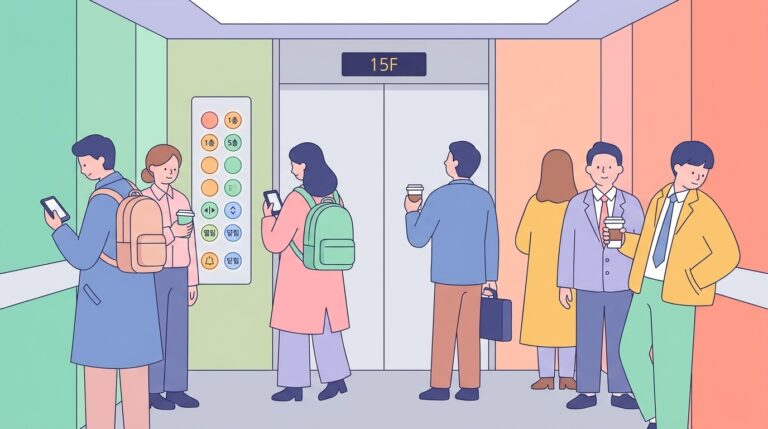
Picture this: You step into a sleek, high-tech elevator in a 25-story office building in Gangnam, Seoul. The mirror shines, soothing ambient jazz plays, and you glance over at the shiny control panel. Then you notice something bizarre: while the ‘열림’ (Open) button looks pristine and untouched as if straight out of the box, the ‘닫힘’ (Close) button is completely faded, scratched, and worn down to the bare metal! Someone has even pressed it so vigorously that the plastic cover is indented.
If you have ever felt a slight panic when someone rushes toward your closing elevator doors, or if you’ve wondered why Koreans frantically spam the close button before their second foot even touches the cabin floor, you are not alone! Many of our intermediate learners share this exact pain point: “Am I being rude if I don’t hold the door? Why does everyone look so focused on that one tiny button? What do I even say?”
Welcome to Korea’s famous Ppalli-Ppalli (빨리빨리 – hurry, hurry) culture in its purest daily habitat! Today, we are breaking down why that worn-out button exists, how to navigate Korean elevator etiquette with total confidence, and the natural conversational phrases that will make locals instantly smile at your sharp nunchi (social radar). Let’s dive in!
Phase 2: Deep Dive into 3 Core Expressions
Here are three indispensable expressions you will hear and use around elevators and fast-paced Korean service spaces.
1. 잠시만요, 같이 타요! (Jamsimanyo, gachi tayo!)
- Pronunciation: [Jam-si-man-yo, ga-chi ta-yo!] (Sounds like: “Jahm-she-mahn-yo, gah-chee tah-yo!” like saying ‘car-key’ with a soft ‘t’)
- Meaning: Literal: “Just a moment, let’s ride together!” | Actual Nuance: “Hold on, wait for me! I’m hopping on!”
- K-Culture Moment: You’ll see this in countless K-dramas like Misaeng or Business Proposal, where an exhausted intern sprints across the marble lobby clutching a stack of files, shouting this right before the doors slide shut.
- Editor’s Insight: Notice the use of ‘같이’ (together). In Korea, framing an urgent request as a shared action (“let’s ride together”) softens the urgency and builds instant rapport rather than sounding like a demanding command.
- Situation Spectrum: Casual ✅ | Semi-formal ✅ | Formal ⚠️ (In very formal corporate settings, use “잠시만 기다려 주시겠습니까?”)
- 🤔 Think About It: In your home culture, would you yell out to hold an elevator, or quietly resign yourself to waiting for the next one? How does communal speed change public behavior?
2. 닫힘 버튼 좀 눌러주세요 (Dachim beoteun jom nulleojuseyo)
- Pronunciation: [Da-chim beo-teun jom nul-leo-ju-se-yo] (Sounds like: “Dah-cheem buh-teun johm nool-luh-joo-seh-yoh”)
- Meaning: Literal: “Please press the close button a little.” | Actual Nuance: “Could you hit the close button for us, please?”
- K-Culture Moment: When an elevator fills up during peak lunch hour in Yeouido, the person standing right in front of the buttons becomes the honorary ‘Elevator Pilot’. Everyone instinctively looks at them, and an elder or coworker politely drops this phrase to kick off the ascent.
- Editor’s Insight: The tiny word 좀 (jom) is Korean’s ultimate politeness lubricant! It literally means “a little bit,” but functionally acts like “pretty please,” taking the sharp edge off an imperative request.
- Situation Spectrum: Casual ⚠️ | Semi-formal ✅ | Formal ✅
- 🤔 Think About It: Notice how the pilot role is unspoken. Why does high-density urban living create these unspoken micro-responsibilities?
3. 먼저 내리실게요 (Meonjeo naerisilgeyo)
- Pronunciation: [Meon-jeo nae-ri-sil-ge-yo] (Sounds like: “Muhn-juh neh-ree-sheel-geh-yoh”)
- Meaning: Literal: “[You/We] will alight first.” | Actual Nuance: “Excuse me, letting people step off first!” or “Please exit first!”
- K-Culture Moment: Seen in busy subway transfer hubs or crowded department store elevators where an organized crowd yields to allow descending passengers room to step out without a collision.
- Editor’s Insight: This is a classic example of modern Korean honorific contraction (-실게요). While grammarians debate its formal correctness, in customer service and public transit, it serves as a polite verbal buffer that prevents body bumps before they happen.
- Situation Spectrum: Casual 🚫 | Semi-formal ✅ | Formal ✅
- 🤔 Think About It: How does polite language adapt to crowded physical spaces in your native tongue?
Phase 3: Textbook Korean vs. Real-World Korean
Let’s compare what you learn in grammar books versus how Koreans actually speak when the doors are sliding shut!
Situation A: Asking someone to hold the door
- 📖 교과서 한국어 (Textbook Korean): 문을 열어 두십시오. (Muneul yeoreo dusipsio. – “Please keep the door open.”)
- 🗣️ 진짜 한국어 (Real-World Korean): 잠깐만요! / 같이 가요! (Jamkkanmanyo! / Gachi gayo! – “Hold on! / Wait for me!”)
- 💡 왜 다를까? (Why the difference?): Nobody uses ultra-formal imperative forms like -십시오 in a split-second physical reaction. Real-world Korean prioritizes brevity and immediate comprehension over stiff textbook formality.
Situation B: Telling people you need to squeeze past to get off
- 📖 교과서 한국어 (Textbook Korean): 제가 내려야 하니 비켜 주시겠습니까? (Jega naeryeoya hani bikyeo jusigesseumnikka? – “Since I must get off, would you please step aside?”)
- 🗣️ 진짜 한국어 (Real-World Korean): 내릴게요! / 잠시만 지나가겠습니다! (Naerilgeyo! / Jamsiman jinagagessumnida! – “Getting off! / Passing through for a second!”)
- 💡 왜 다를까? (Why the difference?): Asking a complex speculative question takes 3 seconds—by then, the elevator doors have already closed and taken you to the 18th floor! A prompt statement of intent (내릴게요) clears the path instantly.
Phase 4: K-Culture Deep Dive & Non-Verbal Manners
4-1. 눈치 (Nunchi) & The Elevator Pilot Protocol
In Korea, elevator etiquette is practically an Olympic sport governed by 눈치 (Nunchi – social situational awareness):
1. The Pilot Responsibility: If you board first and stand right by the button panel, congratulations: you are the captain now. Your duty is to hold the ‘열림’ (Open) button when people are approaching, and hit the ‘닫힘’ (Close) button as soon as the last person’s heel clears the threshold.
2. The Hand Shield Gesture: If you are holding the door for someone running toward the cabin, extend your forearm across the door opening (without actually touching the sensor) while pressing the button. This visual cue reassures the sprinter that the doors won’t crush them.
3. The Micro-Bow: When someone holds the door for you, you don’t need a lengthy speech. A quick 15-degree head nod accompanied by a brief “감사합니다” (Gamsahamnida) is peak polite efficiency.
4-2. Cultural Code: The Philosophy Behind the Worn-out Button
Why is the close button practically scrubbed clean across the country? Korea transformed from a post-war agrarian economy into a high-tech powerhouse within a single generation. This miracle economic sprint ingrained the mindset that time is the most precious shared resource.
Waiting 5 seconds for an automated elevator door to close by itself feels, to many Koreans, like an eternity of wasted momentum! Spamming that worn-out button is not about anger or impatience; it is a collective rhythm of efficiency that keeps Korea’s cities moving at lightning speed.
Phase 5: Real-World Roleplay Scenario
Setting: 8:55 AM. The bustling lobby of an office tower in Yeoksam-dong. The elevator chime rings, and employees are squeezing in before the 9:00 AM clock-in.
Characters:
* 김 대리 (Deputy Kim): An energetic, coffee-clutching office worker in a crisp suit.
* You: An international professional joining an orientation session on the 12th floor.
Turn 1 [김 대리]: 🎭 (Hurrying through the revolving door, seeing the elevator about to close)
잠시만요! 같이 타요!
(Jamsimanyo! Gachi tayo!)
"Wait a second! Let me jump on!"

Turn 2 [You]: 🎭 (Holding the '열림' button with one hand and gesturing welcomingly)
네, 어서 타세요!
(Ne, eoseo taseyo!)
"Yes, come on in quickly!"

Turn 3 [김 대리]: 🎭 (Catching his breath inside the elevator, giving a respectful head nod)
휴, 감사합니다! 몇 층 가세요?
(Hyu, gamsahamnida! Myeot cheung gaseyo?)
"Phew, thank you so much! What floor are you heading to?"

Turn 4 [You]: 🎭 (Pointing gently toward the panel)
저 12층이요. 닫힘 버튼 좀 눌러주세요.
(Jeo sib-i-cheung-iyo. Dachim beoteun jom nulleojuseyo.)
"12th floor for me. Could you hit the close button, please?"

Turn 5 [김 대리]: 🎭 (Rapidly tapping the worn-out button twice)
네, 12층 눌렀습니다. 오늘 면접 있으신가 봐요?
(Ne, sib-i-cheung nulleosseumnida. Oneul myeonjeob itseusin-ga bwayo?)
"Got it, 12th floor pressed. Looks like you might have an interview today?"

Turn 6 [You]: 🎭 (Smiling warmly, holding your visitor badge)
아, 오늘 오리엔테이션 첫날이에요!
(A, oneul orienteisyeon cheot-nal-ieyo!)
"Ah, it’s my first day of orientation!"

Turn 7 [김 대리]: 🎭 (Elevator dings: '12층입니다' as the doors slide open)
오, 환영합니다! 먼저 내리실게요.
(O, hwanyeonghamnida! Meonjeo naerisilgeyo.)
"Oh, welcome aboard! Please, step out first."

Turn 8 [You]: 🎭 (Stepping out with a courteous nod)
감사합니다. 좋은 하루 보내세요!
(Gamsahamnida. Joeun haru bonaeseyo!)
"Thank you. Have a wonderful day!"
🔀 Interactive Branch Point: How do you react when the elevator pilot misses your floor?
Imagine you are tucked in the back, and the elevator reaches the 12th floor, but nobody moves to make room.
* Option A: Shout loudly: “비켜요! 나 내려야 돼요!” (Bikyeoyo! Na naeryeoya dwaeyo! – “Get out of my way! I have to get off!”)
* Option B: Say clearly with a gentle forward step: “죄송합니다, 이번에 내릴게요!” (Joesonghamnida, ibeone naerilgeyo! – “Excuse me, getting off right now!”)
* Option C: Say nothing, look at your shoes, and ride all the way to the 25th floor rooftop.
Feedback:
* Choice A (Bad 🚫): Too abrasive and grammatically blunt. It creates unnecessary tension in a quiet elevator.
* Choice B (Best ✅): Perfect balance of apology (죄송합니다) and decisive announcement (내릴게요). People will immediately part like the Red Sea.
* Choice C (Risk ⚠️): You will be horribly late for your meeting! Remember, Seoul moves fast; speak up politely!
Phase 6: 10-Second Emotional Shadowing Drill
Practice these lines out loud with the marked intonation pauses (/) and emotional cues:
[⚡ 다급하고 간절하게 - Urgent & Earnest]
잠시만요! / 같이 타요! / 문 좀 잡아주세요!
(Jamsimanyo! / Gachi tayo! / Mun jom jab-a-juseyo!)-
[🙏 정중하고 차분하게 - Polite & Calm]
저 10층 가는데요, / 닫힘 버튼 좀 / 눌러주시겠어요?
(Jeo sip-cheung ganeundeyo, / dachim beoteun jom / nulleo-jusigesseoyo?) -
[😊 명쾌하고 상냥하게 - Crisp & Friendly]
감사합니다! / 먼저 내리세요, / 좋은 하루 되세요!
(Gamsahamnida! / Meonjeo naeriseyo, / joeun haru doeseyo!)
Phase 7: K-Culture Mini Dictionary (4 Key Terms)
- 빨리빨리 (Ppalli-ppalli) | Hurry-hurry / Lightning speed culture
The cultural drive for promptness and peak efficiency that fuels same-day deliveries, instant internet speeds, and fast elevator rides. - 눈치 (Nunchi) | Situational emotional intelligence
The art of scanning the room, gauging the mood, and knowing without being told whether you should hold the door or step back. - 엘베 (El-be) | Elevator (Slang abbreviation)
Common youth and office slang combining the first syllables of 엘리베이터. Example: “엘베 잡았다, 빨리 와!” (El-be jab-at-da, ppalli wa! – “I caught the elevator, come quick!”) - 칼퇴 (Kal-twae) | Sharp departure from work / Leaving right on the dot
Literally “knife-leaving work.” At 6:00:00 PM, people take the stairs or race to the elevator to catch that mythical on-time train home!
Phase 8: Survival Kit for Travelers
Top 3 Elevator Survival Expressions
- 몇 층 가세요? (Myeot cheung gaseyo?)
- Pronunciation: [Myut cheung gah-seh-yoh?]
- Pro Tip: If you stand near the buttons, ask this to elderly folks or people carrying groceries to press their floor for them.
- 먼저 타세요 (Meonjeo taseyo)
- Pronunciation: [Mun-juh tah-seh-yoh]
- Pro Tip: Use this when an elevator is nearly full, or when yielding to pregnant women, kids, or seniors.
- 내립니다! (Naerimnida!)
- Pronunciation: [Neh-reem-nee-dah!]
- Pro Tip: A crisp two-word announcement when you are stuck behind a wall of tall commuters.
Editor’s Travel Note
Navigating Seoul’s massive multi-level metro stations requires speedy footwork! To make sure you find stations with functional elevators when carrying heavy luggage, always consult the official Naver Map App Download and Transit Guide. Unlike generic global maps, it marks real-time elevator status and precise wheelchair/luggage accessible exit numbers.
Phase 9: “One Step Deeper” (Reflective Essay)
In Western cultures, pressing the elevator close button while someone walks across the lobby is frequently viewed as callous or selfish. Yet in South Korea’s hyper-dense vertical cities, pressing that button is rarely about excluding others; rather, it reflects a communal contract of shared momentum. When people step into an elevator, their collective goal is to reach their destination without imposing idle waiting time on the group. Efficiency is considered a form of consideration. The worn-out paint on the ‘닫힘’ button isn’t a badge of rudeness—it is a tangible testament to millions of small moments where busy citizens worked in unspoken unison to keep the city’s heartbeat ticking forward without losing a second.
💬 Your Turn: Does your country prioritize holding the door, or moving quickly? How would you feel standing next to Korea’s worn-out close button? Let us know in the comments below!
Phase 10: FAQ & Common Mistakes
Q: Is it considered rude to press the ‘닫힘’ (Close) button right after boarding?
A: Not at all! In fact, if the cabin is full and nobody else is running toward it, lingering without pressing the close button will make your fellow passengers wonder why you haven’t pressed it yet! Just make sure nobody is rushing toward the doors before you tap it.
Q: What should I do if an elderly person gets on the elevator with me?
A: Immediately step toward the panel, hold the ‘열림’ button, and ask with a slight bow: “어르신, 몇 층 가세요?” (Eoreusin, myeot cheung gaseyo? – “Sir/Ma’am, which floor may I press for you?”). It is considered the gold standard of Korean filial courtesy.
Q: Why do Korean elevator doors sometimes reopen automatically even when I press close?
A: Most modern elevators in Korea have sensitive infrared motion sensors and safety bumper pads. If someone’s coat or shopping bag breaks the light curtain, the doors will bounce open automatically. Don’t panic—just hold ‘열림’ for a second to let the sensor reset.
🚨 Common Mistakes Alert!
- Mistake: Accidentally pressing 비상 (Bisang – Emergency) instead of 닫힘 (Close).
- Correct Action: The emergency button is usually red or has a telephone icon. ‘닫힘’ always shows two triangles pointing inward toward each other: ▶◀.
- Mistake: Standing silently blocked in the corner until the doors close on your floor.
- Correct Action: Speak up before the door opens! Announce: “내리겠습니다!” (Naerigesseumnida!) at least 2 seconds before the doors slide back.
- Mistake: Forgetting to thank someone holding the door.
- Correct Action: Never walk through held doors silently. Always nod and say “감사합니다!” (Gamsahamnida!).
Phase 11: Action Missions
- 🥉 Bronze Level: Stand in front of your mirror or phone camera, make the polite arm-shield gesture, and practice saying: “잠시만요, 같이 타요!” three times with crisp emotion.
- 🥈 Silver Level: Next time you watch an office K-Drama (like Misaeng or King the Land), spot an elevator scene. Note how quickly the characters press the button and comment on social media with
#DailyHangulPpalli. - 🥇 Gold Level: During your next trip to Korea, take the elevator in an office building or department store, serve as the pilot, and successfully ask: “몇 층 가세요?” to a local!
🎮 K-Culture Mission: Go to YouTube or your favorite streaming platform and search for a clip of a Korean elevator prank or sitcom scene. Notice the worn-out button on the panel—it’s everywhere once you know to look for it!
Phase 12: Interactive Quiz Challenge
Q1. What is the unspoken duty of the person standing closest to the elevator buttons in Korea?
* A) Stare at their smartphone and ignore everyone.
* B) Act as the pilot by holding the open button and pressing floors for others.
* C) Press every single floor button as a prank.
Q2. Fill in the blank: When you are about to exit a crowded elevator, you should politely announce: “죄송합니다, 이번에 ________!”
* A) 먹을게요 (meogeulgeyo)
* B) 내릴게요 (naerilgeyo)
* C) 잘게요 (jalgeyo)
Q3. True or False: In Korea, pressing the ‘닫힘’ (Close) button is always considered selfish and anti-social.
* True / False
👉 Click here to reveal the answers and explanations!
- Q1 Answer: B! The first person near the control panel naturally assumes the ‘elevator pilot’ role out of courtesy and nunchi.
- Q2 Answer: B (내릴게요)! 내릴게요 means “I am getting off.” (먹을게요 means “I will eat,” and 잘게요 means “I will sleep!”)
- Q3 Answer: False! In Korea’s fast-paced service culture, closing the doors promptly when everyone is aboard respects everyone’s valuable time.
Keep practicing your Korean with joy and confidence, and we’ll see you on the next floor with Daily Hangul! 화이팅! (Hwaiting!)







