

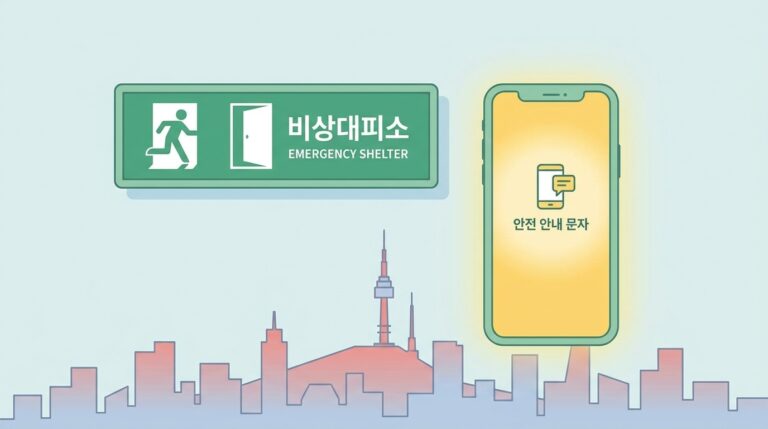
How to Survive a Natural Disaster in Korea: Typhoon and Earthquake Evacuation Guide
Phase 1: Empathy (Story-Immersive Opening)
안녕하세요! 매일한글 에디터입니다. (Hello! I am your Daily Hangul editor.)
Picture this: You are sipping an iced Americano in a sunlit Busan cafe or browsing cosmetics in a bustling Hongdae shop. Suddenly, every single smartphone in the building emits an ear-splitting, synchronized air-raid siren. People freeze. Screen displays pop up with urgent Korean text marked [긴급재난문자] (Emergency Disaster Alert). Outside, the wind howls like a freight train—Typhoon warnings are escalating, or a rare seismic tremor rattles the coffee mugs on your table.
In movies like Exit (엑시트) or Tsunami (해운대), Koreans seem to instinctively know where the shelters are, what stairs to take, and which evacuation phrases to shout. But when you are standing there clutching your bag, relying on basic textbook phrases like “날씨가 나쁩니다 (The weather is bad)” won’t cut it.
Navigating natural disasters in a foreign country is terrifying. Over the past decade, dozens of our intermediate learners have shared the exact same panic: “I knew how to order food, but when the earthquake alert went off, I couldn’t even ask where the nearest shelter was.” This guide is built directly from real emergency scenarios and survivor insights. By the end of this lesson, you will master B2-level situational Korean to understand rapid government alerts, communicate decisively with locals, and find safety with confidence.
Phase 2: Core Expressions In-Depth
1. 대피소가 어디예요? (Daepisoga eodieyo?)
- Pronunciation: [Dae-pi-so-ga eo-di-ye-yo?] (Sounds like: deh-pee-so-gah uh-dee-yeh-yo)
- Meaning: Literal: “Shelter where is it?” vs. Real Nuance: “Where is the designated evacuation shelter?”
- K-Culture Moment: Seen frequently in the action-comedy disaster film Exit, where citizens sprint toward the rooftop and municipal shelters marked with civil defense signs.
- Editor’s Insight: In Korean, safety centers have different labels. A 대피소 (daepiso) is a fortified evacuation shelter (usually underground subway stations or civil defense basements). Do not confuse it with 쉼터 (swimteo), which is simply a rest area or cooling center for elderly residents.
- Situation Spectrum: Casual: ⚠️ (Use 대피소 어디야?) | Semi-formal: ✅ | Formal: ✅ (대피소가 어디에 위치해 있습니까?)
- 🤔 Think About It: Notice how Korean urban infrastructure relies heavily on subway stations as subterranean shelters. Does your hometown use transit stations as disaster bunkers?
2. 지금 밖으로 나가면 위험해요? (Jigeum bakkeuro nagamyeon wiheomhaeyo?)
- Pronunciation: [Ji-geum bak-keu-ro na-ga-myeon wi-heom-hae-yo?] (Sounds like: jee-geum bahk-kku-roh nah-gah-myuhn wee-huhm-heh-yo?)
- Meaning: Literal: “Now to outside if go, is it dangerous?” vs. Real Nuance: “Is it too risky to head outside right now, or should we shelter in place?”
- K-Culture Moment: When severe typhoons like Hinnamnor strike coastal cities, shop owners and apartment guards warn residents not to step onto flooded roads.
- Editor’s Insight: The conditional grammar pattern -(으)면 (if/when) paired with 위험해요 (is dangerous) allows you to consult local consensus. Koreans prioritize collective appraisal during crises; asking this signals that you value community situational awareness.
- Situation Spectrum: Casual: ⚠️ | Semi-formal: ✅ | Formal: ✅
- 🤔 Think About It: In many Western cultures, individuals act on personal risk assessment. In Korea, asking locals around you reinforces communal solidarity and prevents chaotic mistakes.
3. 재난 문자 뭐라고 온 거예요? (Jaenan munja mworago on geoyeyo?)
- Pronunciation: [Jae-nan mun-ja mwo-ra-go on geo-ye-yo?] (Sounds like: jeh-nahn moon-jah mwoh-rah-goh on guh-yeh-yoh?)
- Meaning: Literal: “Disaster text, what did it say came?” vs. Real Nuance: “What did the emergency alert on our phones say?”
- K-Culture Moment: That universally relatable moment in any K-Drama or real Seoul subway car when 50 phones chime at once, and everyone checks their screens to decode the district alert.
- Editor’s Insight: This sentence uses the intermediate indirect quotation -(이)라고 하다 (to say that…) condensed into colloquial speech 뭐라고 온 거예요?. It is the most natural, native-like way to ask a Korean bystander to summarize a formal government alert.
- Situation Spectrum: Casual: ⚠️ (재난 문자 뭐라고 왔어?) | Semi-formal: ✅ | Formal: ⚠️
- 🤔 Think About It: Korea sends location-based Cell Broadcasting Service alerts for missing persons, typhoons, heatwaves, and tremors. How does this hyper-connected administrative speed contrast with your country’s alert system?
Phase 3: Textbook Korean vs. Real Korean
Situation 1: Ground Tremor / Earthquake Shaking
- 📖 교과서 한국어 (Textbook Korean):
“지진이 발생하였으니 신속하게 책상 밑으로 대피하십시오.”
(Jijini balsaenghayeosseuni sinsokhage chaeksang miteuro daepihasipsio. / Since an earthquake has occurred, evacuate under the desk promptly.) - 🗣️ 진짜 한국어 (Real Native Korean):
“흔들려요! 머리 감싸고 밑으로 들어가세요!”
(Heundeullyeoyo! Meori gamssago miteuro deureogaseyo! / It’s shaking! Cover your head and get underneath!) - 💡 왜 다를까? (Why is it different?): Textbook Korean borrows written civil defense manuals with archaic formal causatives (
-하였으니). Real Koreans shout quick sensory cues (흔들려요) and concise imperative action verbs (감싸고 들어가세요).
Situation 2: Typhoon Strong Winds & Flash Flood Warning
- 📖 교과서 한국어 (Textbook Korean):
“강풍과 폭우가 예상되오니 외출을 자제하시기 바랍니다.”
(Gangpung-gwa poguga yesangdoeoni oechul-eul jajehasigi baramnida. / As strong winds and torrential rains are expected, please refrain from going outside.) - 🗣️ 진짜 한국어 (Real Native Korean):
“지금 바람 너무 세서 간판 떨어져요. 그냥 안에 있어요!”
(Jigeum baram neomu seseo ganpan tteoreojyeoyo. Geunyang ane isseoyo! / The wind is way too strong and signs are falling down. Just stay inside!) - 💡 왜 다를까? (Why is it different?): Real-world safety warnings emphasize immediate visceral dangers (e.g., loose shop signs, flying umbrellas) combined with the practical conversational adverb 그냥 (geunyang – just/simply).
Phase 4: K-Culture Deep Dive & Non-Verbal Manners
4-1. 눈치 (Nunchi) & Non-Verbal Manners during Evacuation
- Don’t Film for Social Media: Pulling out a selfie stick to vlog rising floodwaters in Gangnam or flying debris during a typhoon will draw furious glares from locals. It shows a severe lack of Nunchi (situational awareness) and disrespect toward those facing property damage or danger.
- Head Protection Body Language: When entering a designated emergency zone or exiting a shaken building, Koreans shield their heads with hard bags, backpacks, or cushions. Mimic this immediately—it communicates discipline and situational compliance to building safety wardens.
- Follow the Yellow Evacuation Signs: Look for the yellow-and-green pictogram labeled 비상구 (Emergency Exit) or 지하대피소 (Underground Shelter). Do not take the elevator (엘리베이터 금지); always head for stairwells.
4-2. Cultural Code Analysis: Korea’s “Safe Society” & Emergency Infrastructure
In modern Korean culture, natural disaster response is deeply communal. Memories of historical building collapses and severe urban flash floods have shaped an ultra-responsive civil defense grid. High-rise apartment complexes (아파트) conduct regular broadcast drills via in-wall intercoms, and public television (such as KBS) immediately flips to 24/7 disaster monitoring mode with sign-language interpreters and real-time survivor message ribbons scrolling at the bottom.
Phase 5: Real-World Roleplay Scenario
Setting: A beachfront guesthouse in Haeundae, Busan. Typhoon “Haneul” is making landfall. The windows rattle violently, and street sirens are audible.
Characters:
* You: A traveler staying in Busan.
* Manager Min (민 매니저): A seasoned, calm Korean guesthouse host.
- You:
“민 매니저님, 방금 폰에서 엄청 시끄럽게 울렸는데 이거 무슨 소리예요?”
(Min maenijeonim, banggeum poneseo eomcheong sikkeureopge ullyeonneunde igeo museun sori-yeyo?)
🎭 [Looking alarmed, holding up your vibrating phone]
“Manager Min, my phone just went off with a loud alarm—what is this sound?” -
Manager Min:
“태풍 경보 재난 문자예요. 해일 경보까지 같이 떴네요.”
(Taepung gyeongbo jaenan munjayeyo. Haeil gyeongbokkaji gachi tteonneyo.)
🎭 [Checking the wall-mounted weather broadcast monitor with a serious face]
“It’s an emergency alert for a typhoon warning. A storm surge warning was issued as well.” -
You:
“재난 문자 뭐라고 온 거예요? 지금 밖으로 나가면 위험해요?”
(Jaenan munja mworago on geoyeyo? Jigeum bakkeuro nagamyeon wiheomhaeyo?)
🎭 [Glancing out the rain-streaked glass window]
“What does the alert specifically say? Is it dangerous to go outside right now?” -
Manager Min:
“네, 해안 도로 침수 위험 때문에 외출 금지예요. 지금 나가시면 절대 안 돼요!”
(Ne, hae-an doro chimsu wiheom ttaemune oechul geumjiyeyo. Jigeum nagasimyeon jeoldae an dwaeyo!)
🎭 [Shaking his head firmly, pointing toward the flooded street curb]
“Yes, outdoor travel is barred due to coastal road flooding risks. You must definitely not go out right now!” -
You:
“만약에 물이 차오르면 가장 가까운 대피소가 어디예요?”
(Maniyage muri chaoreumyeon gajang gakkaun daepisoga eodieyo?)
🎭 [Adjusting your daypack, preparing for worst-case scenarios]
“If the water levels rise, where is the closest evacuation shelter?” -
Manager Min:
“근처 해운대초등학교 강당이 지정 대피소예요. 하지만 여긴 3층이라 실내가 더 안전합니다.”
(Geuncheo Haeundae Chodeunghakgyo gangdangi jijeong daepisoyeyo. Hajiman yeogin samcheung-ira silnaega deo anjeonhamnida.)
🎭 [Gesturing calmly to reassure you]
“The auditorium at nearby Haeundae Elementary School is the designated shelter. However, we are on the third floor, so indoors here is safer.” -
You:
“알겠습니다. 혹시 정전되면 어떻게 해야 하나요?”
(Algetseumnida. Hoksi jeongjeondoemyeon eotteoke haeya hanayo?)
🎭 [Looking toward the ceiling lights, speaking politely]
“Understood. In case of a power outage, what should we do?” -
Manager Min:
“제가 비상 손전등이랑 생수를 복도에 준비해 뒀으니 걱정 마세요. 저랑 같이 상황 보시죠.”
(Jega bisang sonjeondeung-irang saengsureul bokdoe junbihae dwosseuni geokjeong maseyo. Jeorang gachi sanghwang bosijyo.)
🎭 [Handing you an emergency bottle of water with a reassuring smile]
“I have prepared emergency flashlights and bottled water in the hallway, so don’t worry. Let’s monitor the situation together.”
🔀 Interactive Choice Point
The power suddenly flickers off and the wind rattles the external balcony glass with immense pressure. What do you do?
- Choice A: “바깥 상황 사진 찍어서 SNS에 올려볼게요! (I’ll take photos of the outside and post them on social media!)”
- Choice B: “창문에서 떨어져서 안쪽 방으로 들어갈게요. (I will move away from the windows and go into an interior room.)”
- Choice C: “답답하니까 편의점 가서 간식 사 올게요! (It feels suffocating, so I’ll run to the convenience store to buy snacks!)”
Feedback:
* Choice A (Risk ⚠️): Standing near external glass during gale-force winds is dangerous due to flying projectile shattered glass. Do not risk injury for photos.
* Choice B (Best ✅): Moving away from shattered glass hazards and staying in a windowless room (hallway/interior room) is the standard typhoon indoor safety protocol.
* Choice C (Bad 🚫): Flying roof tiles, falling shop signs, and live fallen wires make stepping outside during typhoon landfall life-threatening.
Phase 6: 10-Second Emotion Shadowing Drill
Practice these high-stakes sentences with the indicated pause slashes (/) and emotional tone anchors:
[🚨 Urgently & Decisively]
“흔들림 멈출 때까지 / 책상 밑에서 / 머리 감싸고 계세요!”
(Heundeullim meomchul ttaekkaji / chaeksang mit-eseo / meori gamssago gyeseyo!)
“Until the shaking stops / stay under the desk / keeping your head covered!”-
[🤝 Calmly & Reassuringly]
“놀라지 마세요, / 제가 지정 대피소 위치 / 바로 확인해 드릴게요.”
(Nollaji maseyo, / jega jijeong daepiso wichi / baro hwaginhae deurilgeyo.)
“Don’t be alarmed, / I will look up / the designated shelter location for you right now.” -
[⚡ Quick & Inquiring]
“재난 문자 온 거 보셨어요? / 지금 밖으로 나가면 위험해요?”
(Jaenan munja on geo bosyeosseoyo? / Jigeum bakkeuro nagamyeon wiheomhaeyo?)
“Did you see the disaster alert that came in? / Is it dangerous if we step outside now?”
Phase 7: K-Culture Mini Dictionary
-
긴급재난문자 (Gingeup Jaenan Munja)
Translation: Emergency Disaster Cell Broadcast Alert.
Everyday Usage: High-priority government push messages broadcast to all cellular handsets within a specific cell tower grid for earthquakes, fires, downpours, or cold waves. -
대피소 (Daepiso)
Translation: Civil Evacuation Shelter.
Everyday Usage: Officially designated safe zones. In cities, yellow civil defense stickers mark underground subway platforms, public school gyms, and civic community centers as safe shelters. -
침수 (Chimsu)
Translation: Inundation / Flooding / Submersion.
Everyday Usage: Common during monsoon (장마) and typhoons. You will often hear: “지하차도 침수 주의 (Caution: Underpass submersion risk)” or “차량 침수 (Vehicle flooding)”. -
지진해일 (Jijinhaeil)
Translation: Tsunami (Seismic Ocean Wave).
Everyday Usage: Broadcast term used along the East and South Sea coasts. Often accompanied by the loanword 쓰나미 (Ssunami).
Phase 8: Survival Kit for Travelers
Top 3 Survival Phrases
- “도와주세요! (Dowajuseyo!)”
Help me! — Scream this loud and clear in life-threatening scenarios. - “여기 물이 차올라요! (Yeogi muri chaollayo!)”
The water is rapidly filling up here! — Essential when trapped in a basement, underground path, or semi-basement floor. - “가까운 지하철역 어디예요? (Gakkaun jihacheol-yeok eodieyo?)”
Where is the closest subway station? — Subway platforms serve as dual-purpose fortified earthquake shelters in Korean metropolitan zones.
Editor’s Travel Note
- Essential App Download: Before embarking on your travels across Korea, install the Emergency Ready App (안전디딤돌) published by the Korean Ministry of the Interior and Safety. It offers English-language emergency alerts, shelter GPS maps, and emergency medical center directories.
- Navigation Verification: You can search the exact Korean term 대피소 on the Naver Map App to immediately see nearby certified underground shelters within 500 meters of your real-time location.
- Emergency Hotlines: Dial 119 for Fire and Rescue, 112 for Police, and the 1330 Korea Travel Hotline for 24/7 multi-language emergency translation assistance.
Phase 9: “A Step Deeper” (Reflective Question)
In Korean society, the word 우리 (Uri – We/Our) is not merely a linguistic pronoun; it is a collective lifeline. When natural disasters hit, Koreans rally around volunteer food trucks, nationwide blood drives, and rapid local clean-up efforts with legendary speed. Even emergency public texts address the populace with civic responsibility: “이웃을 살펴 주시고 안전에 유의하시기 바랍니다 (Please look out for your neighbors and take heed of safety).”
Disaster preparedness in Korea is built upon an implicit social contract that everyone protects both themselves and the person standing next to them.
💬 Your Turn: How does emergency response in your home country compare? Is it treated primarily as an individual responsibility, or do communal and civic structures lead the evacuation process? Share your thoughts in the comments below!
Phase 10: FAQ & Common Mistakes
Q: Can I turn off the Korean emergency disaster siren on my foreign phone?
A: You can toggle off government alerts in your phone’s notification settings, but we strongly advise against it while visiting Korea. Even if you cannot read all the Sino-Korean terms, seeing the alert tells you to immediately observe the local crowd (눈치) and look for broadcast warnings.
Q: Are subway stations really safe during major earthquakes?
A: Yes. In modern Korean cities, underground subway stations are engineered to withstand strong seismic tremors and are formally designated as Primary Civil Defense Shelters (민방위 대피소).
Q: What should I say if I need an English speaker while calling 119?
A: Stay calm and say: “영어 통역 부탁드립니다 (Yeongeo tong-yeok butakdeurimnida – Please connect me to an English interpreter).” The emergency operator will patch you through to an on-call translator.
🚨 Common Mistakes Board (흔한 실수)
- ❌ Mistake 1: Rushing to the elevator during an earthquake or fire.
Correct Action: Never use the 엘리베이터. Take the 비상계단 (Emergency Stairwell) while keeping low. - ❌ Mistake 2: Confusing ‘대피 (Evacuation)’ with ‘퇴실 (Checkout/Departure)’.
Correct Action: If an announcement orders 대피, drop your heavy luggage, grab your passport/phone, and exit the premises right away. - ❌ Mistake 3: Driving through low-lying flooded roads.
Correct Action: Even if water looks shallow, urban underpasses (지하차도) flood in minutes. Turn back and find high ground.
Phase 11: Action Missions & Community Engagement
- 🥉 Bronze Mission (Solo Shadowing): Say 대피소가 어디예요? (Where is the shelter?) 5 times out loud in under 10 seconds until your tongue moves without pausing.
- 🥈 Silver Mission (Safety Prep): Open your map app right now, search 대피소, and take a screenshot of the closest evacuation shelter to your current accommodation in Korea.
- 🥇 Gold Mission (Real-life Practice): Next time you visit a public subway station in Korea, locate the civil defense emergency cabinet containing gas masks and flashlights, and identify the green 대피소 placard.
- 🎮 K-Culture Mission: Watch the opening 15 minutes of the disaster film Exit (엑시트) or Sinkhole (싱크홀). Count how many times characters yell 대피 (Evacuation) or look for the exit stairs!
Phase 12: Interactive Quiz Challenge
Question 1: Situational Judgment
You are on the 10th floor of a hotel in Seoul when the walls shudder from an earthquake. What should you shout and do?
* A) “날씨가 좋아요!” and ride the elevator down.
* B) “흔들려요! 머리 감싸고 밑으로 들어가세요!” and take cover under a sturdy desk.
* C) “재난 문자 보내주세요!” and stand by the window.
👉 Click to reveal Answer & Explanation
Correct Answer: B
Explanation: In an earthquake, protect your head first under a sturdy desk and alert others by shouting that the room is shaking (“흔들려요! 머리 감싸고 밑으로 들어가세요!”). Elevators and windows are high-hazard zones.
Question 2: Fill in the Blank
Complete the sentence to ask where the civil defense safe zone is:
“가장 가까운 ____________가 어디예요?” (Where is the closest evacuation shelter?)
* A) 편의점 (Pyeonuijeom)
* B) 대피소 (Daepiso)
* C) 미용실 (Miyongsil)
👉 Click to reveal Answer & Explanation
Correct Answer: B (대피소)
Explanation: 대피소 means evacuation shelter. 편의점 is a convenience store, and 미용실 is a hair salon.
Question 3: True or False (Culture Quiz)
During severe typhoon flash flooding, walking along outdoor coastal promenades to shoot video updates for social media is considered acceptable local behavior as long as you carry an umbrella.
* True
* False
👉 Click to reveal Answer & Explanation
Correct Answer: False
Explanation: Coastal areas are prone to deadly tidal surges (해일) and flying debris during typhoons. Venturing outside violates official safety warnings and demonstrates a severe lack of Nunchi.







