

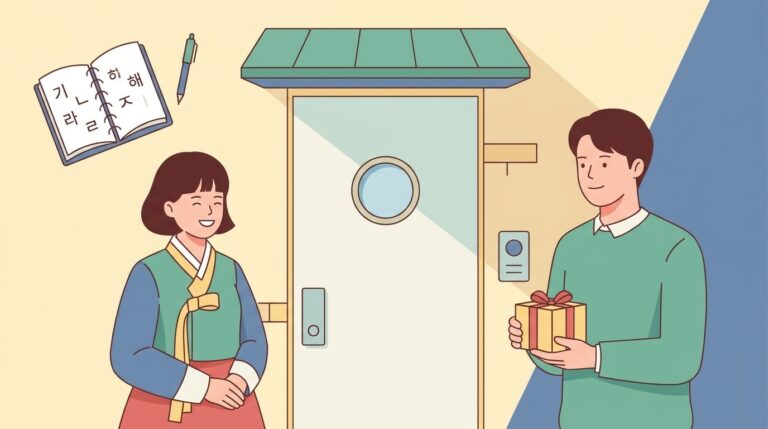
안녕하세요! 매일한글 에디터입니다. (Hello! I’m your Daily Hangul editor.) Have you ever watched a K-Drama where someone walks into a friend’s brand-new apartment proudly clutching a gigantic 30-roll pack of toilet paper and a gallon of laundry detergent? If your immediate reaction was, “Wait, did they run out of groceries, or is that actually a housewarming gift?!”—you are definitely not alone! When I first hosted international friends at my place in Seoul, one guest brought an expensive bottle of wine, while another brought a single potted cactus, both nervously asking: “Did I do this right? What am I even supposed to say when I step in?”
Visiting someone’s new home in Korea—a ritual known as 집들이 (Jipdeuri)—is one of the warmest social milestones you can experience. But for absolute beginners (A1 level), stepping through that front door can feel overwhelming. What do you hand over? Which hand do you use? And what simple Korean words will make your host feel genuinely honored without tying your tongue in knots? This guide is crafted directly from real classroom feedback and native everyday experiences to give you foolproof phrases, cultural secrets, and rock-solid confidence. Let’s make you the most charming housewarming guest ever!
1. 초대해 주셔서 감사해요. (Chodaehae jusyeoseo gamsahaeyo.)
- Pronunciation: [Cho-dae-hae joo-syeo-seo gam-sa-hae-yo] (Think: “Cho” as in choke, “dae” like day, “joo-syeo-seo”, followed by the classic “gam-sa-hae-yo”)
- Meaning: Literal: “Because you invited me, I am thankful.” | Actual Nuance: “Thank you so much for having me over!”
- K-Culture Moment: In variety shows like Home Alone (나 혼자 산다), when cast members visit a colleague’s newly renovated bachelor pad, this is the very first polite greeting uttered before removing their shoes at the foyer.
- Editor’s Insight: Even if you speak zero other Korean words all evening, saying this right as the door opens instantly sets an appreciative, respectful atmosphere. It shows you recognize the effort they made to clean and prepare food.
- Situation Spectrum: Casual (Friends): ⚠️ (Use 초대해 줘서 고마워 / Chodaehae jwoseo gomawo) | Semi-formal (Coworkers/Acquaintances): ✅ | Formal: ✅
- 🤔 Think About It: In English, we often say “Thanks for having me!” at the end of the party. Why do you think Koreans prioritize expressing gratitude right at the entryway?
2. 작은 선물이에요. (Jageun seonmurieyo.)
- Pronunciation: [Jah-geun seon-mool-ee-eh-yo] (Sound analogy: “Jah-geun” sounds like a soft “jug-in”, and “seon-mul” rhymes with “sun-pool”)
- Meaning: Literal: “It is a small gift.” | Actual Nuance: “Here is a little something for you / I hope you like this small token!”
- K-Culture Moment: Whenever characters in romantic K-Dramas hand over a housewarming item, they shyly look down and use this phrase—even if the gift is a fancy premium espresso machine!
- Editor’s Insight: Korean politeness embraces humility. Calling your gift “big” or “expensive” creates a burden (부담 / budam) for the host. Calling it 작은 선물 (small gift) relieves pressure and highlights pure goodwill.
- Situation Spectrum: Casual: ✅ | Semi-formal: ✅ | Formal: ✅ (Universal polite phrase)
- 🤔 Think About It: Why does Korean culture value downplaying one’s own generosity rather than highlighting how much effort went into finding the item?
3. 집이 정말 예뻐요! (Jibi jeongmal yeppeoyo!)
- Pronunciation: [Jee-bee jeong-mahl yeh-peoh-yo] (Say “Jee-bee”, then “jeong-mahl” like “jung-mull”, and “yeh-poh-yo”)
- Meaning: Literal: “The house is really pretty!” | Actual Nuance: “Your place looks gorgeous! / You have such a lovely home!”
- K-Culture Moment: You will hear this exact exclamation in almost every YouTube room-tour vlog (룸투어) the instant the camera pans across aesthetic mood lamps and pastel kitchenware.
- Editor’s Insight: Korean apartments or one-room studios are intimate spaces. Welcoming someone in means opening up personal territory. Complimenting the interior immediately reassures the host that their decor choices are approved!
- Situation Spectrum: Casual: ✅ | Semi-formal: ✅ | Formal: ⚠️ (Use 집이 참 멋지네요 / Jibi cham meotjineyo for senior bosses)
- 🤔 Think About It: How do compliments about living spaces build personal warmth and solidarity in your culture compared to Korea?
Situation 1: Handing over your present at the door
- 📖 교과서 한국어 (Textbook Korean): 이것은 당신을 위한 선물입니다. (Igeoseun dangsineul wihan seonmurimnida. – “This is a present for you.”)
- 🗣️ 진짜 한국어 (Real-life Korean): 이거 작은 선물이에요! (Igeo jageun seonmurieyo! – “Here’s a little something for the house!”)
- 💡 왜 다를까? (Why the difference?): In conversational Korean, the word 당신 (dangsin – you) can sound stiff, confrontational, or like translated poetry. Real locals drop “you” completely and use friendly pointing words like 이거 (this).
Situation 2: Praising their new apartment
- 📖 교과서 한국어 (Textbook Korean): 귀하의 가옥이 아주 훌륭합니다. (Gwiha-ui ga-ogi aju hullyunghamnida. – “Your residence is very magnificent.”)
- 🗣️ 진짜 한국어 (Real-life Korean): 와, 집 진짜 깔끔하고 예뻐요! (Wa, jip jinjja kkalkkeumhago yeppeoyo! – “Wow, your place is so clean and pretty!”)
- 💡 왜 다를까? (Why the difference?): Words like 가옥 (ga-ok – house/dwelling) belong in real estate contracts or historical museums. Real Koreans say 집 (jip) and naturally drop in 진짜 (jinjja – really) for sincere enthusiasm.
4-1. 눈치 (Nunchi) & Entryway Etiquette
- The Two-Handed Handover: Whenever you pass your gift to the host, hold it with both hands, or support your right forearm with your left hand. It communicates that the gift has your complete, undivided attention.
- The 현관 (Hyeongwan) Threshold Rule: Never step onto the wooden floor with your outdoor shoes! Step out of your shoes right onto the designated sunken entryway, turn your shoes around so the toes point toward the exit door (a classic considerate guest move), and slip into the indoor slippers your host provides.
- Don’t Tear It Open Right Away: Unlike in some Western cultures where hosts rip wrapping paper open on the spot, Korean hosts often set the gift aside politely to avoid making you feel evaluated. Don’t feel offended—it is polite reserve!
4-2. The Cultural Symbolism of Housewarming Gifts
Ever wondered why toilet paper and laundry detergent reign supreme at a Korean housewarming?
* 두루마리 휴지 (Toilet Paper Roll): The paper rolls out smoothly and effortlessly without snags. Giving it symbolizes: “May all your future plans and business ventures unravel smoothly without friction! (일이 술술 풀리기를!)”
* 세제 (Laundry Detergent): Detergent creates rich, bubbling foam when mixed with water. This symbolizes: “May wealth and good fortune bubble up endlessly in this new home! (거품처럼 부자가 되기를!)”
If you prefer modern, trendy gifts, scented diffuser sets, wine, or yellow fruit baskets (yellow represents prosperity) are also huge favorites among 20s and 30s Koreans!
Setting: You arrive at the 5th-floor officetel of your Korean coworker/friend, Minji (민지), in Mapo-gu, Seoul. The hallway smells faintly of savory bulgogi and fresh baked goods.
- 민지 (Minji): (Opens door with an apron on, smiling widely) 어서 와요! 찾기 어렵지 않았어요? (Eoseo wayo! Chatgi eoreopji anasseoyo? / Welcome! Was it hard to find?)
- You: (Smiling warmly, stepping into the entryway) 아니요, 쉬웠어요! 초대해 주셔서 감사해요. (Aniyo, swiwosseoyo! Chodaehae jusyeoseo gamsahaeyo. / No, it was easy! Thank you for inviting me.)
- You: (🎭 Both hands holding a gift bag with a luxury diffuser set) 이거 작은 선물이에요. (Igeo jageun seonmurieyo. / Here is a small gift for the house.)
- 민지 (Minji): (🎭 Eyes widening, receiving it with both hands with a bow) 어머, 뭘 이런 걸 사 왔어요! 그냥 와도 되는데… (Eomeo, mwol ireon geol sa wasseoyo! Geunyang wado doeneunde… / Oh my, why did you buy this! You really didn’t have to bring anything…)
- You: (Takes off sneakers neatly, puts on guest slippers) 집들이잖아요! 받아 주세요. (Jipdeurijanhayo! Bada juseyo. / Come on, it’s a housewarming! Please take it.)
- You: (🎭 Looking around the bright living room in awe) 와! 집이 정말 예뻐요! (Wa! Jibi jeongmal yeppeoyo! / Wow! Your home is really pretty!)
- 민지 (Minji): (Blushing, gesturing toward the sofa) 고마워요, 아직 정리가 덜 됐어요. 편하게 앉으세요! (Gomawoyo, ajik jeongniga deol dwaesseoyo. Pyeonhage anjeuseyo! / Thank you, it’s still not completely organized. Please sit comfortably!)
- You: (Nodding comfortably) 네, 감사합니다. (Ne, gamsahamnida. / Thank you so much.)
🔀 Your Interactive Moment: Minji says: “뭘 이런 걸 사 왔어요! 그냥 와도 되는데! (Why did you bring this? You should have come empty-handed!)” How do you respond?
- Option A: “네, 다음에는 진짜 그냥 올게요!” (Ne, daeumeneun jinjja geunyang olgeyo! – “Okay, next time I will really bring nothing!”)
- Feedback: [Risk!] While humorous among close childhood friends, at an A1 level with a coworker it can sound slightly blunt. Better to stick with warm courtesy!
- Option B: “집들이잖아요! 마음에 들면 좋겠어요.” (Jipdeurijanhayo! Maeume deulmyeon jokgesseoyo. – “It’s a housewarming party after all! I hope you like it.”)
- Feedback: [BEST!] Perfect balance! It acknowledges the tradition and expresses humble hope that they enjoy the gift.
- Option C: “비싼 거니까 꼭 쓰세요.” (Bissan geonikka kkok sseuseyo. – “It was expensive, so make sure you use it.”)
- Feedback: [Bad!] Big cultural faux pas! Bragging about price creates huge discomfort (부담) for your host.
Practice reading these out loud at normal speed. Use the slashes / as your natural breathing pauses!
[😊 기쁘고 신나게 / Cheerful & bright]- 초대해 주셔서 / 감사해요!
- Cho-dae-hae ju-syeo-seo / gam-sa-hae-yo!
[🤲 겸손하고 다정하게 / Humble & sweet]- 이거 / 작은 선물이에요.
- I-geo / ja-geun seon-mul-i-e-yo.
[🤩 감탄하며 눈 크게 뜨고 / Awe & delight]- 와! / 집이 / 정말 예뻐요!
- Wa! / Jib-i / jeong-mal yep-peo-yo!
- 집들이 (Jipdeuri) | Housewarming gathering | The custom of inviting friends, family, or colleagues into a newly occupied home to share food and impart blessings.
- 두루마리 휴지 (Durumari Hyuji) | Roll toilet paper | The quintessential Korean housewarming staple representing things rolling out smoothly without obstacles.
- 세제 (Seje) | Detergent | Another traditional housewarming gift symbolizing bubbling prosperity, abundance, and domestic luck.
- 실내화 / 슬리퍼 (Sillnaehwa / Seullipeo) | Indoor house slippers | Essential footwear offered by the host right at the entryway to keep feet warm and floors pristine.
Top 3 Survival Phrases for Houseguests
- 화장실 써도 돼요? (Hwajangsil sseodo dwaeyo?)
- Pro Tip: “May I use the restroom?” Always ask before wandering around looking for the bathroom doors in a private home.
- 음식이 진짜 맛있어요! (Eumsigi jinjja masisseoyo!)
- Pro Tip: “The food is delicious!” Praise the home-cooked dishes or the delivery spread enthusiastically; food is the love language of Korean hosting.
- 잘 먹고 잘 놀다 갑니다! (Jal meokgo jal nolda gamnida!)
- Pro Tip: “I ate well and had such a wonderful time!” The golden farewell phrase when putting your shoes back on.
Editor’s Travel Note
- Gift Shopping on the Go: Need a reliable housewarming gift fast in Seoul? Use a [네이버 지도 앱 다운로드 (Naver Map app download guide)] to locate the nearest Olive Young for luxury room sprays, or check a [다이소 매장 찾기 안내 (Daiso store locator guide)] to grab cute wrapping bags and greeting cards!
In Western homes, housewarmings often celebrate individual independence and personal milestone achievements. In Korea, however, a 집들이 (Jipdeuri) is rooted in ancient community solidarity called 정 (Jeong). Traditionally, setting up a new home was a village effort—neighbors brought firewood and matches to keep the hearth burning. Today, bringing toilet paper or detergent is our modern urban version of fueling each other’s hearths. When you bring a gift into a Korean home, you aren’t just visiting a building; you are actively contributing your blessings to the foundation of their life.
💬 Your Turn: What is the most traditional housewarming gift in your home country? Would people find it funny if you brought a giant pack of toilet paper to a party? Let’s chat in the comments below!
Q: Can I buy scented candles or diffusers instead of toilet paper?
A: Absolutely! Among millennials and Gen Z Koreans, scented reed diffusers, potted plants, fancy hand washes (like Nonfiction or Tamburins), and quality wine are extremely popular and stylish housewarming choices.
Q: What if my Korean friend lives in a tiny studio (one-room)?
A: If space is limited, bringing a giant 30-pack of toilet paper might actually cramp their room! In that case, compact gifts like a specialty dessert box, fruit, or a digital gift voucher via KakaoTalk Gift are much more considerate.
Q: Should I take my socks off when entering a Korean house?
A: No! In fact, walking barefoot inside someone else’s home can be seen as slightly impolite. Keeping clean socks on (or wearing the slippers provided by your host) is standard etiquette.
🚨 흔한 실수 (Common Mistakes) Top 3
- Wearing dirty or holed socks: You will take off your shoes immediately! Correct Action: Always wear clean, presentable socks when visiting someone’s house.
- Handing gifts with one hand like a grocery bag: Correct Action: Hand the present gently with two hands while bowing your head slightly.
- Insisting on opening the gift right away: Correct Action: Let the host decide when to open it; don’t pressure them to unwrap it in front of the door.
- 🥉 Bronze Level: Stand in front of your mirror and practice saying: “초대해 주셔서 감사해요! 이거 작은 선물이에요.” three times with two hands outstretched.
- 🥈 Silver Level: Share your favorite gift idea on Instagram or TikTok and tag our Daily Hangul study squad using the hashtag
#DailyHangulHousewarming. - 🥇 Gold Level: Next time you visit any Korean friend or attend a meetup, bring a small snack and use 이거 작은 선물이에요! in real life.
- 🎮 K-Culture Mission: Watch an episode of I Live Alone (나 혼자 산다) and spot how many rolls of toilet paper or boxes of detergent are piled in the hallway during a housewarming episode!
1. Situational Judgment: You just stepped onto the entryway mat at Minji’s new home. What should you do with your shoes?
* A) Leave them on; Koreans don’t mind shoes in the living room.
* B) Take them off, turn them to face the door, and slip into indoor slippers.
* C) Take them off and immediately throw them into the host’s shoe closet.
2. Fill in the Blank: Handing over a small gift politely:
* “이거 _______ 선물이에요.” (igeo _______ seonmurieyo.)
* A) 비싼 (expensive)
* B) 무거운 (heavy)
* C) 작은 (small)
3. True or False: Bringing toilet paper as a housewarming gift in Korea means you think their house is dirty.
* True / False
👉 Click to reveal answers & explanations!
- Answer: B | Always take off shoes at the entryway, turn them toward the door for easy leaving, and wear guest slippers.
- Answer: C (작은) | 작은 선물이에요 (It’s a small gift) is the classic humble Korean expression.
- Answer: False | Toilet paper symbolizes problems unraveling smoothly (술술 풀리다) and is one of the highest compliments and blessings for prosperity!







