

Phase 1: Empathy (Story-Immersive Opening)
안녕하세요! 매일한글 에디터입니다. (Hello! It’s your Daily Hangul editor.)
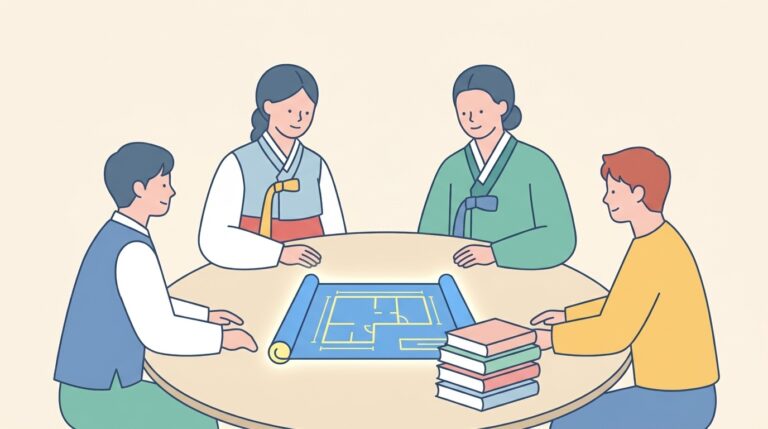
Picture this scene straight out of an intellectual K-drama like Chief of Staff (보좌관) or Misaeng (미생): You are sitting in an austere, high-ceilinged conference room at the KOICA (Korea International Cooperation Agency) headquarters in Seongnam or the Government Complex in Sejong. Around the mahogany table sit senior directors, policy analysts, and educational specialists. The project on the table is monumental: a multi-million-dollar Technical and Vocational Education and Training (TVET) reform initiative in Southeast Asia. You’ve prepared the syllabus, the infrastructure specs, and the digital learning tools. Everything looks airtight on paper.
Then, the senior Korean project director leans back, taps his fountain pen against his legal pad, and drops the question that makes every development consultant’s stomach drop: “그런데, 3년 뒤 우리 지원 사업이 종료되고 전문가들이 철수한 이후에도 이 시스템이 굴러갈 수 있습니까? 현지 예산과 인력만으로 운영 가능한 ‘지속 가능성’ 담보 방안이 다소 추상적인 것 같습니다.” (By the way, once our grant project concludes in three years and our experts withdraw, can this system really run on its own? The plan to secure ‘sustainability’ with local budget and personnel alone seems rather abstract.)
In that split second, you realize standard textbook business Korean won’t save you. You cannot simply say “열심히 하겠습니다” (I will work hard) or rely on elementary development jargon. You need C2-level conceptual agility to discuss ownership (수원국 주도성), exit strategies (출구 전략), and institutional anchoring (제도적 안착). Securing sustainability in Educational ODA projects isn’t just about technical capability; it’s an art of framing cooperation as mutual empowerment rather than top-down aid. Today, based on real feedback from seasoned international consultants and multilateral diplomats, we’re diving deep into the linguistic architecture of advanced Korean development cooperation.
Phase 2: Core 3 Expressions Deep-Dive
1. 현지 주도형 역량 강화를 통한 출구 전략을 선제적으로 마련해야 합니다
- Pronunciation: Hyeonji judohyeong yeongnyang ganghwareul tonghan chulgu jeollyageul seonjejeogeuro maryeonhaeya hamnida. (Think: Hyun-jee joo-doh-hyung yung-nyang gang-hwa-reul tong-hahn chool-goo jul-ryah-geul sun-jeh-juhg-eu-roh mah-ryun-hae-yah hahm-nee-dah)
- Meaning: Literal: “We must preemptively prepare an exit strategy through local-led capacity building.” / Real Nuance: “We are not here to create dependency; our goal from Day 1 is to make ourselves obsolete by empowering local counterparts to run the institution.”
- K-Culture Moment: Evocative of boardroom negotiations in Stranger (비밀의 숲), where strategic policy planners debate systemic accountability.
- Editor’s Insight: In Korean policy jargon, 출구 전략 (exit strategy) is not an abandonment plan; it’s the gold standard of responsible project design. Pairing it with 현지 주도형 (locally led/driven) shifts the psychological framing from patronizing assistance to respectful partnership.
- Situation Spectrum:
- Casual: 🚫 (Sounds bizarrely bureaucratic with friends)
- Semi-formal: ⚠️ (Only among policy think-tank colleagues)
- Formal: ✅ (The exact standard for steering committees and proposal defenses)
- 🤔 Think About It: In Western development discourse, “exit strategy” can sometimes sound cold or transactional. Why do you think Korean public administration places such heavy institutional pride on a well-timed, orderly exit?
2. 밑 밑 빠진 독에 물 붓기 식이 되지 않으려면 제도적 안착이 선행되어야 합니다
- Pronunciation: Mit ppajin doge mul butgi sigi doeji aneuryeomyeon jedeojeok anchagi seonhaengdoe-eoya hamnida. (Think: Meet pah-jeen doh-geh mool boot-gee sheeg-ee dweh-jee ahn-eu-ryuh-myun jeh-doh-juhk ahn-chah-gee sun-haeng-dweh-uh-yah hahm-nee-dah)
- Meaning: Literal: “To prevent pouring water into a bottomless jar, institutional anchoring must precede.” / Real Nuance: “Without legal, budgetary, and structural codification within the recipient country’s system, our funding will vanish into thin air the moment we pack our bags.”
- K-Culture Moment: Used frequently by investigative journalists and fiery assembly members in political dramas when criticizing poorly designed municipal budgets.
- Editor’s Insight: 밑 빠진 독에 물 붓기 is one of Korea’s most evocative traditional idioms. When used at a C2 level in a high-stakes proposal review, it proves you understand fiscal realism and despise superficial KPI-chasing.
- Situation Spectrum:
- Casual: ✅ (Used when friends waste money/energy futilely)
- Semi-formal: ✅ (Common in organizational team reviews)
- Formal: ✅ (Adds powerful rhetorical impact to policy presentations)
- 🤔 Think About It: Does your native culture use an agricultural or domestic metaphor to describe squandered collective investment? How does calling an empty system a 밑 빠진 독 (bottomless clay jar) reflect Korea’s historical anxiety over resource scarcity?
3. 일회성 지원에 그치지 않고, 마중물 역할을 하여 자생적 생태계를 조성해야 합니다
- Pronunciation: Ilhoeseong jiwone geuchiji anko, majeungmul yeokhwareul hayeo jasaengjeok saengtaegyereul joseonghaeya hamnida. (Think: Eel-hweh-sung jee-wuhn-eh geu-chee-jee ahn-koh, mah-jeung-mool yuhk-hwahl-eul hah-yuh jah-saeng-juhk saeng-tae-gyeh-reul joh-sung-hae-yah hahm-nee-dah)
- Meaning: Literal: “Rather than stopping at one-off support, we must serve as priming water to foster a self-sustaining ecosystem.” / Real Nuance: “Our aid is purely catalytic; it sparks the local mechanism so the education system breathes and replicates on its own accord.”
- K-Culture Moment: Featured in documentary specials on Korea’s transformation from post-war aid recipient to OECD DAC donor member.
- Editor’s Insight: 마중물 (priming water poured into a manual water pump to draw groundwater up) is Korea’s ultimate philosophical metaphor for public spending. It conveys immense humility: donor funds are merely the starter cup; the true reservoir belongs to the partner nation.
- Situation Spectrum:
- Casual: ⚠️ (Metaphorical and somewhat poetic)
- Semi-formal: ✅ (Inspiring in speeches and strategy pitches)
- Formal: ✅ (A cornerstone phrase for high-level ODA whitepapers)
- 🤔 Think About It: Notice the humility embedded in 마중물. How does portraying donor funds as a modest catalyst change the power dynamic compared to words like “driver” or “engine”?
Phase 3: Textbook Korean vs. Real Korean
Situation 1: Expressing doubts about whether local teachers will maintain the digital curriculum
- 📖 교과서 한국어 (Textbook Style):
사업이 끝난 후에 교사들이 이 프로그램을 계속 사용할 수 있을지 걱정됩니다.
(Saeobi kkeutnan hue gyosadeuri i peurogeuraemeul gyesok sayonghal su isseulji geokjeongdoemnida. / I am worried whether teachers can keep using this program after the project ends.) - 🗣️ 진짜 한국어 (Native C2 Policy Style):
본 사업 종료 후 교원 연수 체계가 현지 교육부 정규 연수 과정으로 내재화되지 않는다면, 현장 지속성은 담보하기 어렵습니다.
(Bon saeop jongnyo hu gyowon yeonsu chegyega hyeonji gyoyukbu jeonggyu yeonsu gwajeongeuro naejaehwadoeji anneundamyeon, hyeonjang jisokseongeun dambohagi eoryeopseumnida. / If the teacher training framework is not internalized into the local Ministry of Education’s formal curriculum upon project completion, on-site sustainability will be difficult to guarantee.) - 💡 왜 다를까?: Textbook phrasing relies on emotional, subjective words like 걱정됩니다 (I’m worried), which sounds fragile and amateurish in formal governance. Professional Korean elevates this into systemic causation using nominalized technical compounds: 내재화 (internalization/institutionalization) and 담보하다 (to guarantee/collateralize).
Situation 2: Emphasizing that local budget allocation is non-negotiable for project approval
- 📖 교과서 한국어 (Textbook Style):
그 나라 정부도 돈을 내야 우리도 사업을 승인할 수 있습니다.
(Geu nara jeongbudo doneul naeya urido saeobeul seung-inhal su isseumnida. / That country’s government must also pay money so that we can approve the project.) - 🗣️ 진짜 한국어 (Native C2 Policy Style):
수원국의 매칭 펀드 조성 및 유지 관리비 편성에 대한 구체적 확약이 전제되어야 심의 통과가 가능합니다.
(Suwongugui maeching peondeu joseong mit yuji gwanribi pyeonseonge daehan guchejeok hwagyagi jeonjedoeeoya simui tonggwaga ganeunghamnida. / The review can only be approved on the premise that concrete commitments regarding the recipient country’s matching fund allocation and maintenance budget are established.) - 💡 왜 다를까?: Native high-level administrative Korean replaces direct financial terms like 돈을 내다 with legal-budgetary terminology (매칭 펀드 조성, 유지 관리비 편성, 구체적 확약), preserving diplomatic face while establishing ironclad conditionality.
Phase 4: K-Culture Deep-Dive & Non-Verbal Manners
4-1. 눈치 (Nunchi) & Non-Verbal Protocol in Policy Consultations
When presenting educational sustainability to Korean steering committees, non-verbal cues carry equivalent weight to your slide deck:
* The Two-Handed Document Pass & Glance: When presenting evaluation reports (중간 평가 보고서) to a chair or director, deliver the binder with both hands, thumbs securing the top edge, bowed at roughly 15 degrees. Maintain eye contact until they receive it, then lower your gaze momentarily.
* The “Thoughtful Pen Hold”: In Korean institutional settings, aggressively gesturing with an open palm or pointer finger can seem confrontational. Instead, hold a capped luxury pen lightly between both hands above the table while speaking. It signals disciplined, deliberative weight.
* Nunchi around “침묵” (Strategic Silence): When a senior Korean director remains silent after your sustainability proposal and softly mutters “흠… 취지는 알겠는데…” (Hmm… I understand the intent, but…), do not interrupt the silence to over-explain. This silence is an invitation to concede that operational risks exist and to offer a mitigation clause (보완 대책).
4-2. Cultural Code Analysis: The “Recipient to Donor” Pride (수원국에서 공여국으로)
To master development cooperation discussions in Korea, you must understand the deep collective narrative surrounding the country’s economic rise. South Korea is the first nation in the history of the OECD Development Assistance Committee (DAC) to transition from a war-torn, destitute recipient country (수원국) to a major donor country (공여국).
Because Koreans remember surviving off foreign grain assistance and rebuilding their school desks from scrap timber during the 1950s and 60s, they carry deep skepticism toward paternalistic, donor-dependent models. Korean educational ODA emphasizes grit, rapid institutional transfer, and vocational competitiveness. When you speak about educational sustainability using Korean values, you are not merely quoting textbook development principles; you are resonating with the living memory of how Korea built its own miracle on the backs of teachers and vocational training.
Phase 5: Real-World Roleplay Scenario
Setting: Meeting Room 302 at the KOICA Headquarters. Steam rises from a paper cup of green tea. You (Consultant Alex) are defending the sustainability section of a 5-year Technical Education Modernization Project before Director Park (박 국장), an experienced ODA veteran.
- 박 국장: 알렉스 전문관님, 제출하신 교육 인프라 구축 계획서는 잘 검토했습니다. 그런데 기자재 보급 이후 현지 마스터 교원 양성 계획이 다소 부실해 보입니다.
(Alex jeonmungwannim, jechulhasin gyoyuk inpeura guchuk gyehoekseoneun jal geomtohaesseumnida. Geureonde gijajae bogeup ihu hyeonji maseuteo gyowon yangseong gyehoegi daso busilhae boimnida.)
(Alex, I’ve thoroughly reviewed your education infrastructure plan. However, the master teacher training plan following the hardware provision looks somewhat fragile.)
🎭 [안경을 벗으며 서류를 톡톡 두드린다 / Removes his glasses and taps the document lightly] -
알렉스: 지적해 주셔서 감사합니다, 국장님. 단순 하드웨어 지원에 매몰되지 않도록, 현지 교원 직무 연수 시스템과의 연계를 최우선으로 설계했습니다.
(Jijeokhae jusyeoseo gamsahamnida, gukjangnim. Dansun hadeuweeo jiwone maemoldoegi antorok, hyeonji gyowon jingmu yeonsu siseutemgwaui yeon-gyereul choe-useoneuro seolgyehaesseumnida.)
(Thank you for pointing that out, Director. To prevent getting bogged down in mere hardware aid, we prioritized linkage with the local in-service teacher training system.)
🎭 [차분하고 흔들림 없는 눈빛으로 미소를 짓는다 / Maintains a calm, steady gaze with a gentle smile] -
박 국장: 연계만으로는 부족합니다. 3차년도 사업 종료 후 인건비와 소모품 조달 예산은 현지 교육청에서 전액 감당할 수 있겠습니까?
(Yeon-gyemaneuroneun bujokhamnida. Samchanyeondo saeop jongnyo hu ingeonbiwa somopum jodal yesaneun hyeonji gyoyukcheong-eseo jeonaek gamdanghal su itsseumnikka?)
(Linkage alone is insufficient. Once the Year 3 project ends, can the local district office absorb the personnel and consumable procurement budgets entirely?)
🎭 [팔짱을 끼고 고개를 약간 갸우뚱한다 / Crosses arms and tilts his head slightly in critical inquiry] -
알렉스: 바로 그 지점 때문에, 본 사업은 초기부터 수원국 교육부와 3단계 재정 이양 로드맵을 체결하고자 합니다.
(Baro geu jijeom ttaemune, bon saeobeun chogibuteo suwonguk gyoyukbuwa sandangye jaejeong iyang rodeumaebeul chegyeolhagoja hamnida.)
(Precisely because of that point, this project aims to execute a three-stage financial handover roadmap with the partner Ministry of Education from inception.)
🎭 [노트북 슬라이드를 전환하며 도표를 제시한다 / Transitions the slide to reveal a phased budget transition chart] -
박 국장: 재정 이양 로드맵이라… 구체적으로 어떤 구조입니까?
(Jaejeong iyang rodeumaebira… Guchejeogeuro eotteon gujoimnikka?)
(A financial handover roadmap… What does the concrete structure look like?)
🎭 [호기심 어린 표정으로 상체를 테이블 쪽으로 당겨 앉는다 / Leans forward toward the table with an intrigued expression] -
알렉스: 1차년도에는 공여국이 80%를 부담하되, 연차별로 현지 매칭 예산을 20%씩 증액하여, 3차년도에는 현지 재정 자립도를 60%까지 끌어올릴 계획입니다.
(Ilchanyeondoneun gong-yeogugi palsippeosenteureul budamhadae, yeonchabyeollo hyeonji maeching yesaneul isippeosenteussik jeung-aekhayeo, samchanyeondoneun hyeonji jaejeong jaripdoreul yuksippeosentekkaji kkeureo-ollil gyehoek-imnida.)
(In Year 1, the donor covers 80%, but by incrementing the local matching budget by 20% annually, we project local financial self-reliance to reach 60% by Year 3.)
🎭 [손바닥을 모았다가 완만하게 위로 펼치는 제스처 / Gathers both hands together, then opens them upwards gently] -
박 국장: 밑 빠진 독에 물 붓기가 되지 않으려면 결국 제도적 안착이 핵심인데, 법적 근거는 확보되었습니까?
(Mit ppajin doge mul butgiga doeji aneuryeomyeon gyeolguk jedeojeok anchagi haeksiminde, beopjeok geon-geoneun hwakbodoeeotseumnikka?)
(To avoid pouring water into a bottomless jar, institutional anchoring is key; have we secured the legislative baseline?)
🎭 [고개를 끄덕이며 서류에 펜으로 체크 표시를 한다 / Nods slowly while making checkmarks on the draft] -
알렉스: 네, 이미 현지 국가직무능력표준(NCS) 법안 개정 태스크포스에 우리 자문단이 참여하도록 실무 협약을 마쳤습니다.
(Ne, imi hyeonji gukkajingmuneungnyeokpyojun(NCS) beoban gaejeong taeseukeuposeue uri jamundani chamyeohadorok silmu hyeobyageul macheotseumnida.)
(Yes, we have already concluded a working protocol for our advisory team to participate in their National Competency Standards legislative revision taskforce.)
🎭 [단호하고 신뢰감 있는 목소리로 매듭을 짓는다 / Concludes with a resolute, authoritative tone of voice]
🔀 Interactive Decision Point
How should Alex conclude this negotiation to guarantee final project clearance?
- Option A: “어차피 현지 정부가 약속 안 지키면 우리가 원조 중단하면 됩니다.” (If the local government breaks their promise, we can just suspend the aid.)
- Option B: “마중물 역할을 넘어 지속 가능한 자생적 교육 생태계가 안착될 수 있도록 최선을 다해 후속 관리를 병행하겠습니다.” (Beyond serving as priming water, we will spare no effort in concurrent follow-up management so that a sustainable, self-generating educational ecosystem takes root.)
- Option C: “나머지는 현지 사정이니 우리가 너무 깊게 개입하면 내정 간섭이 될 수 있습니다.” (The rest is their internal affair, so intervening too deeply might constitute interference in domestic politics.)
Feedback:
* Option A (Bad – 외교적 결례): Threatening aid suspension sounds arrogant, abrasive, and contrary to partnership diplomacy. Rating: 0/10.
* Option B (Best – 압도적 찬사): Uses the C2 metaphor 마중물, references the ecosystem (자생적 교육 생태계), and demonstrates programmatic follow-through (후속 관리). Rating: 10/10.
* Option C (Risk – 무책임한 회피): Citing non-interference as an excuse for poor monitoring makes you appear negligent in fiscal oversight. Rating: 3/10.
Phase 6: 10-Second Emotion Shadowing Drill
Master the natural cadence, breath control, and pauses of an elite policy advisor. Shadow these lines aloud following the slash marks (/ = brief pause for breath and emphasis).
[🤝 단호하지만 정중하게 / Resolute yet deeply courteous]
“단순한 일회성 물품 지원은 / 지양해야 하며, / 현지 교원의 역량 강화가 / 수반되어야 합니다.”
(Dansunhan ilhoeseong mulpum jiwoneun / jiyanghaeya hamyeo, / hyeonji gyowonui yeongnyang ganghwaga / subandoeeoya hamnida.)
(We must avoid simple one-off material aid / and local teacher capacity building / must be accompanied.)-
[💡 정책적 확신을 담아 / Filled with strategic policy conviction]
“우리의 역할은 / 어디까지나 마중물이며, / 종국에는 수원국 스스로가 / 이 제도를 운영할 수 있어야 합니다.”
(Uriui yeokhwareun / eodikkajina majeungmurimyeo, / jonggugeneun suwonguk seuseuroga / i jedoreul un-yeonghal su isseoya hamnida.)
(Our role / is strictly that of priming water, / and ultimately the recipient country / must be able to run this system themselves.) -
[📊 냉철한 사업 분석 / Cool-headed, data-driven programmatic clarity]
“출구 전략 없는 지원은 / 밑 빠진 독에 물 붓기입니다. / 제도적 안착 방안을 / 재설계해 주십시오.”
(Chulgu jeollyak eomneun jiwoneun / mit ppajin doge mul butgi-imnida. / Jedeojeok anchak bang-aneul / jaeseolgyehae jusipsio.)
(Assistance without an exit strategy / is pouring water into a bottomless jar. / Please redesign / the institutional anchoring plan.)
Phase 7: K-Culture Mini Dictionary (4 Key Terms)
- 수원국 (Suwonguk) | Recipient Country / Partner Country
- Formal international development term for the partner country receiving aid. In contemporary Korean diplomatic discourse, progressive agencies increasingly favor 협력국 (Cooperation Country / Partner Country) to emphasize equal partnership, but 수원국 remains the standard legal term in administrative statutes.
- 공여국 (Gong-yeoguk) | Donor Country
- The nation providing official development finance or technical cooperation. When Koreans use this term, there is implicit historical gravity: Korea was once the world’s most vulnerable 수원국, but transformed into a responsible 공여국.
- 자생력 (Jasaengnyeok) | Self-reliance / Viability / Capacity for Self-Regeneration
- Composed of 자 (self), 생 (live/grow), and 력 (strength). In project evaluation, if an educational program has high 자생력, it means schools can update curricula and troubleshoot equipment without foreign technical subsidies.
- 사후 관리 (Sahu gwanli) | Post-Project Management / Follow-up Monitoring
- Korea’s National Assembly Audits (국정감사) scrutinize this term relentlessly. It evaluates whether solar-powered school labs built five years ago are still running or sitting abandoned due to broken capacitors. Proposing robust 사후 관리 is mandatory for grant renewals.
Phase 8: Survival Kit for Travelers & Field Experts
Survival Expressions TOP 3
- 현지 조달이 가능한 부품인지 확인 부탁드립니다.
(Hyeonji jodari ganeunghan bupuminji hwagin butakdeurimnida.)
Pro Tip: Essential when purchasing educational lab instruments in Korea for export. If parts cannot be procured locally (현지 조달), the sustainability score will plummet during review. - 수원국 실무진의 오너십(주도성)을 높일 방안이 필요합니다.
(Suwonguk silmujinui oneosip(judoseong)eul nopil bang-ani piryohamnida.)
Pro Tip: Korean bureaucrats frequently use the transliterated word “오너십” alongside “주도성”. Use both interchangeably to sound thoroughly acclimated to international project consultancies. - 성과 관리 지표(KPI)를 정량적, 정성적으로 세분화합시다.
(Seonggwa gwanli jipyoreul jeongnyangjeok, jeongseongjeogeuro sebunhwahapsida.)
Pro Tip: Elevates meeting debates instantly by demanding clear balance between quantitative (정량적) student enrollment numbers and qualitative (정성적) pedagogical improvements.
Editor’s Field Note: Navigating Korea’s Policy Corridors
- Pangyo & Seongnam Transit: To attend meetings at the KOICA headquarters, bypass confusing bus hubs by taking the Shinbundang Line to Pangyo Station, then hop a quick 7-minute taxi. Ensure you download the Naver Map navigation application to share exact transit waypoints with your driver in Korean.
- Sejong Government Complex Security: For Ministry of Education ODA review sessions in Sejong City, security is strictly biometric. Carry your physical passport or Alien Registration Card (ARC)—digital scans are flatly rejected at Government Complex Sejong Gates.
- The Paper Business Card Ritual: Never toss your business card across a conference table. Present it with both hands, English-facing-up toward the recipient, and take a brief 5-second pause to admire their title before laying it neatly on your notebook.
Phase 9: “한 발 더 깊이” (Reflective Essay)
In Korean development cooperation, the ancient proverb “물고기를 주기보다 물고기 잡는 법을 가르쳐라” (Teach someone how to catch fish rather than giving them fish) is an existential doctrine. Korea’s meteoric leap from post-colonial devastation to technological powerhouse was driven by one single engine: education. Koreans know, in their collective marrow, that physical infrastructure decomposes, but educated human capital (인적 자본) replicates exponentially. That is why a Korean committee will look past flashy 3D virtual reality classrooms if you cannot prove that the local curriculum will survive independently.
To speak this register of Korean is to touch the emotional core of Korea’s modern identity—a culture that conquered destitution through education, and now insists that true solidarity means helping others stand entirely on their own two feet.
💬 Your Turn: In your country’s international policy or community development projects, what is the biggest obstacle to long-term sustainability: budget constraints, political turnover, or cultural friction? Leave your insights in the comments below using at least one Korean term we learned today!
Phase 10: FAQ & Common Mistakes
Q: What is the semantic difference between 지속성 (jisokseong) and 지속 가능성 (jisok ganeungseong)?
A: While they sound similar, 지속성 simply describes the continuous state or endurance of an action over time (e.g., “the continuity of this policy”). 지속 가능성 translates directly to “sustainability” in the ecological and developmental sense (as in SDGs, 지속가능발전목표). In official project proposals, always use 지속 가능성 when evaluating future systemic durability.
Q: Can I use the term 원조 (wonjo) freely when meeting partner country ambassadors?
A: It is grammatically correct, but diplomatically outdated. 원조 carries a traditional “charity/aid” connotation. In modern professional Korean, replace it with 개발 협력 (development cooperation) or 공적개발원조 (ODA) to convey respectful, multilateral partnership.
Q: How do I express “capacity building” naturally without sounding like an online translator?
A: Avoid word-for-word machine translations like 능력 건설 (which sounds like physical building construction). The established, professional term is universally 역량 강화 (yeongnyang ganghwa).
🚨 Common Mistakes Warning Board
- Mistake 1: Saying “우리가 돈을 주다” (We give money).
- Correct Action: Use “예산을 배정하다/지원하다” (Allocate/support budget) or “재정적 기여를 하다” (Make financial contributions).
- Mistake 2: Confusing 수원국 (Recipient nation) with 공여국 (Donor nation).
- Correct Action: Remember that 수 (受) means “to receive” and 공 (供) means “to supply”. Mixing these up in front of high commissioners flips the entire donor-recipient dynamic awkwardly!
- Mistake 3: Ending sentences with casual declarative forms like “지속 가능해야 해요” in ministerial boardrooms.
- Correct Action: Anchor your statements with high-formality modal endings: “지속 가능성을 담보해야 합니다” or “지속 가능성이 확보되어야 할 것으로 사료됩니다” (It is considered that sustainability must be secured).
Phase 11: Action Missions & Engagement
- 🥉 Bronze Mission (Solo Shadowing Practice): Record yourself reciting the 3 core sentences from Phase 6 on your smartphone. Pay acute attention to the slash pauses (
/) and make sure your pronunciation of 마중물 (majeungmul) sounds smooth and melodious. - 🥈 Silver Mission (Community Engagement): Write a short 3-sentence policy tweet or LinkedIn post in Korean describing your ideal educational project. Use both 역량 강화 and 제도적 안착.
- 🥇 Gold Mission (Real-World Application): Attend your next international conference, academic seminar, or language exchange and critique an ODA case study using the phrase “밑 빠진 독에 물 붓기 식이 되지 않도록, 출구 전략이 필요합니다”.
- 🎮 K-Culture Mission: Watch an episode of the political drama Chief of Staff (보좌관) or a KBS development documentary. Listen closely for how many times civil servants utter 역량 강화 and 지속 가능성 in a single policy debate.
Phase 12: Interactive Quiz Challenge
Test your mastery of C2-level Educational ODA Korean. Select your answers, then tap the spoiler toggles to reveal detailed analyses.
1. Situational Judgment Quiz
You are submitting an evaluation summary to KOICA. You want to warn that without local ownership, the schools built in the rural province will fall into disuse. Which sentence achieves the most sophisticated, professional Korean tone?
* (A) 현지인들이 신경 안 쓰면 학교가 다 망가질 것 같아요.
* (B) 수원국의 주도적 오너십이 결여될 경우, 기증 시설물의 방치로 이어져 사업의 지속 가능성을 저해할 우려가 있습니다.
* (C) 학교 건물을 지어줬으니 나머지는 현지 주민들이 알아서 관리해야 합니다.
🔍 Click to Reveal Answer & Commentary
Correct Answer: (B)
Analysis: Option (B) demonstrates exemplary C2 administrative phrasing (주도적 오너십 결여, 기증 시설물의 방치, 지속 가능성을 저해할 우려). Option (A) is far too colloquial (망가질 것 같아요), and Option (C) sounds dismissive and diplomatically unprofessional.
2. Fill-in-the-Blank Quiz
다음 빈칸에 들어갈 가장 적절한 고유어 비유 표현을 고르세요.
“외부 지원금은 현지 교육 재정을 영구히 대체할 수 없습니다. 단지 마른 펌프에 물을 끌어올리기 위해 붓는 ( ) 역할을 해야 할 뿐입니다.”
* (A) 걸림돌 (Stumbling block)
* (B) 마중물 (Priming water)
* (C) 옥에 티 (A flaw in the jade)
🔍 Click to Reveal Answer & Commentary
Correct Answer: (B) 마중물
Analysis: 마중물 (priming water) perfectly encapsulates the catalytic philosophy of modern educational development aid. 걸림돌 means an obstacle, and 옥에 티 means a minor flaw in an otherwise perfect object.
3. True / False Cultural Pragmatics Quiz
Statement: In formal Korean development administration, it is considered polite to minimize discussion of an “exit strategy” (출구 전략) because mentioning the withdrawal of foreign experts early on might offend the partner government.
* True
* False
🔍 Click to Reveal Answer & Commentary
Correct Answer: False
Analysis: Completely false! In Korean public management, establishing a transparent, phased 출구 전략 (exit strategy) right from the project formulation phase (사업 형성 단계) is seen as the ultimate mark of fiscal accountability, professional integrity, and deep respect for partner country self-reliance.






