

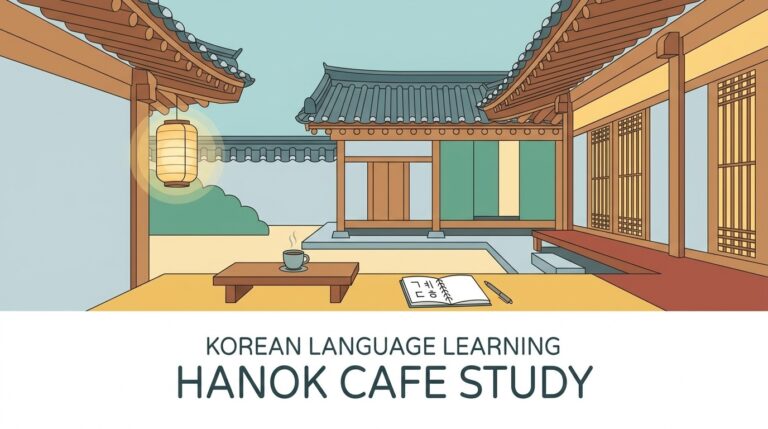
Step Into a Hanok Cafe with Confidence: Essential Korean Phrases and Etiquette
Phase 1: Empathy (Welcome to the Hanok Magic)
안녕하세요! 매일한글 에디터입니다. (Hello! This is your Daily Hangul editor.)
Picture this: You are strolling down the cobblestone labyrinth of Ikseon-dong or Bukchon Hanok Village in Seoul. The scent of roasted grains and sweet ginger fills the air, drifting from beneath swooping tiled roofs (giwa). You spot an idyllic wooden gateway with warm paper lamps glowing inside. It looks straight out of a K-Drama like Extraordinary Attorney Woo or Our Blues—a serene traditional Hanok converted into a modern cafe.
Excited, you step through the entryway, but your heart suddenly begins to race. You see a low wooden platform (maru) where customers are sipping tea. There are neat rows of shoes on the stone floor, a busy barista at an espresso machine, and a counter tucked behind a sliding paper door. A wave of panic hits you: Do I leave my shoes here? Can I order an iced Americano, or must I choose traditional tea? Should I find a seat first, or wait in line?
Take a deep breath! You are not alone. Over 80% of our beginner learners tell us that Hanok cafes were their most intimidating yet unforgettable cultural experience in Korea. The rules feel slightly different from a regular Starbucks or sleek Hongdae dessert lounge. That is why this guide is crafted directly from real learner questions and practical cultural insights. Master just a handful of polite A2-level phrases and simple etiquette rules, and you will glide right through those wooden doors with the quiet confidence of a local insider.
Phase 2: Core Expressions (Deep Dive)
Here are the three golden phrases that will completely unlock your Hanok cafe experience.
1. 신발 벗고 들어가야 하나요? (Sinbal beotgo deureogaya hanayo?)
- Pronunciation: Sin-bal beot-go deu-reo-ga-ya ha-na-yo? (Think of sinbal sounding like “sin-ball” with a soft ‘s’, and beotgo like “but-go” with a quick clipped t-sound).
- Meaning: “Should I take off my shoes before entering?” (Literal: “Must I enter having taken off shoes?”)
- K-Culture Moment: Seen in countless variety shows and travel vlogs whenever cast members step from an outdoor stone courtyard onto a delicate wooden ondol floor.
- Editor’s Insight: Hanok cafes often feature hybrid seating: some tables have standard chairs, while elevated rooms require sitting on silk cushions. When in doubt, stop at the stone ledge (didimdol) and ask this phrase with a gentle nod. The staff will immediately smile and point you in the right direction.
- Situation Spectrum: Casual (⚠️ 신발 벗어? – close friends only) | Semi-formal (✅ 신발 벗고 들어가야 해요?) | Formal (✅ 신발 벗고 들어가야 하나요?)
- 🤔 Think About It: In many Western homes and venues, shoes stay on even indoors. Why do you think Korean spaces treat elevated wooden floors with such spotless, domestic reverence?
2. 자리 먼저 잡아야 해요? (Jari meonjeo jabaya haeyo?)
- Pronunciation: Jah-ri meon-jeo jah-bah-ya hae-yo? (Jari rhymes with “Safari”, meonjeo sounds like “mun-juh”).
- Meaning: “Should I grab a seat first?” (Literal: “Do I need to catch a seat first?”)
- K-Culture Moment: During bustling weekend afternoons in tourist hotspots, popular courtyard spots fill up fast. You will hear locals whispering this to their friends right at the doorway.
- Editor’s Insight: The verb 잡다 (japda) literally means “to catch” or “to hold.” Pairing it with jari (seat/spot) creates the everyday phrase “to claim a seat.” In cozy Hanok spots with limited seating, staff often prefer you secure a spot before placing an order at the counter.
- Situation Spectrum: Casual (⚠️ 자리 먼저 잡을까?) | Semi-formal (✅ 자리 먼저 잡아야 해요?) | Formal (✅ 자리를 먼저 잡아야 합니까?)
- 🤔 Think About It: The Korean expression uses the active verb “catch” for a seat. How does this reflect the dynamic, fast-paced cafe culture in bustling cities like Seoul?
3. 따뜻한 오미자차 한 잔 주세요. (Ttatteut-han omijacha han jan juseyo.)
- Pronunciation: Tah-teut-han oh-mi-ja-cha han jahn joo-seh-yo. (Pronounce ttatteut with a tense, crisp ‘t’ sound, like the ‘t’ in “stop”).
- Meaning: “Please give me one cup of warm Omija tea.”
- K-Culture Moment: In historical dramas and cafe scenes, characters often sip vibrant ruby-red Omija tea, celebrated for its five distinct flavors (sweet, sour, salty, bitter, and spicy).
- Editor’s Insight: Even if you adore Iced Americanos (Ah-Ah), traditional Hanok cafes shine brightest through teas (cha) and herbal infusions. Remember: Korean counters love the counter word 잔 (jan, cup/glass) after the drink name!
- Situation Spectrum: Casual (🚫 따뜻한 오미자차 줘 – too blunt for staff) | Semi-formal (✅ 따뜻한 오미자차 한 잔 주세요.) | Formal (✅ 따뜻한 오미자차 한 잔 부탁드립니다.)
- 🤔 Think About It: Notice how polite Korean requests typically finish with “Please give me” (주세요) rather than hypothetical phrases like “Could I possibly have…”. Directness and politeness blend smoothly together!
Phase 3: Textbook vs. Real Korean
Textbooks often teach polite formulas that sound a bit robotic in a real cafe. Let us compare textbook lines with how actual Koreans speak.
Situation A: Asking for the best or signature menu item
- 📖 교과서 한국어 (Textbook Korean): “무엇을 추천합니까?” (Mueos-eul chucheonhamnikka? – “What do you recommend?”)
- 🗣️ 진짜 한국어 (Real Korean): “여기 시그니처 메뉴가 뭐예요?” (Yeogi sigeunicheo menyuga mwoyeyo? – “What is the signature menu here?”)
- 💡 왜 다를까? (Why the difference?): While chucheon (recommendation) is grammatically fine, Korean youth and cafe-goers almost always ask for the “signature menu” (시그니처 메뉴) or “best menu” (베스트 메뉴) to see the cafe’s specialty creation.
Situation B: Telling the staff you will enjoy the drink inside
- 📖 교과서 한국어 (Textbook Korean): “매장 내부에서 마시겠습니다.” (Maejang naebueseo masigessseumnida. – “I will consume it inside the store.”)
- 🗣️ 진짜 한국어 (Real Korean): “먹고 갈게요!” (Meokgo galgeyo! – “I’ll eat/drink here and then go!”)
- 💡 왜 다를까? (Why the difference?): In everyday speech, verbs like 먹다 (meokda, to eat/consume) naturally encompass drinks too. Koreans commonly contrast “먹고 갈게요” (dine-in) with “포장해 갈게요” (takeout).
Phase 4: K-Culture Deep Dive & Non-Verbal Manners
4-1. 눈치 (Nunchi) & Gestures in a Hanok
Visiting a Hanok cafe requires a little extra Nunchi (social awareness):
1. The Sacred Threshold (문턱, Munteok): Look down when entering wooden doorways! Hanok doors have raised wooden sills. Never step directly on top of the threshold. In Korean belief, stepping on the threshold invites bad luck, and physically, it warps the handcrafted wood. Always step cleanly over it.
2. Shoe Alignment: If an area requires shoe removal, step out of your shoes, turn them around so the toes point toward the outside garden, and step onto the floor. This makes leaving seamless and shows thoughtful manners to other visitors.
3. Cushion Etiquette: If you sit on a floor cushion (bangseok), avoid dragging it with your feet. Pick it up with both hands, place it gently, and sit down cross-legged (yangban dari).
4-2. Cultural Code: The “Newtro” Hanok Boom
Why are young Koreans so obsessed with Hanok cafes? It is all about 뉴트로 (Newtro)—a blend of “New” and “Retro.” Modern life in Korea is hyper-digital and fast-paced (Ppalli-ppalli culture). Stepping into a timber Hanok courtyard with rain trickling off clay tiles gives people heeling (healing and peaceful mindfulness). When you visit, take time to enjoy the contrast between state-of-the-art espresso gear and 100-year-old pine beams.
Phase 5: Real-World Roleplay Scenario
Setting: Cafe Sol-hyang, a peaceful Hanok cafe in Bukchon with exposed timber pillars, sliding rice-paper doors, and an open stone courtyard.
Characters:
* 민지 (Min-ji): A welcoming, soft-spoken barista wearing a modern linen apron.
* 알렉스 (Alex): An enthusiastic traveler eager to order traditional tea and floor seating.
- Turn 1 (민지): 어서 오세요! 몇 분이세요?
(Eoseo oseyo! Myeot bun-iseyo?)
“Welcome! How many people in your party?”
🎭 (Wipes the wooden counter with a friendly smile) -
Turn 2 (알렉스): 두 명이에요. 저기, 자리 먼저 잡아야 해요?
(Du myeong-ieyo. Jeogi, jari meonjeo jabaya haeyo?)
“Two people. Excuse me, should we grab a seat first?”
🎭 (Gestures politely toward the inner wooden courtyard) -
Turn 3 (민지): 네, 안쪽에 마루 자리 비어 있으니까 먼저 앉으셔도 돼요!
(Ne, anjjoge maru jari bieo isseunikka meonjeo anjeusyeodo dwaeyo!)
“Yes, the wooden floor seat inside is open, so you can sit there first!”
🎭 (Points toward the elevated room with silk cushions) -
Turn 4 (알렉스): 감사합니다! 혹시 신발 벗고 들어가야 하나요?
(Gamsahamnida! Hoksi sinbal beotgo deureogaya hanayo?)
“Thank you! By any chance, do we take off our shoes to enter?”
🎭 (Looks down toward the stone stepping stone hesitantly) -
Turn 5 (민지): 네, 신발은 아래 돌 위에 벗어두시면 됩니다.
(Ne, sinbareun arae dol wie beoseodusimyeon doemnida.)
“Yes, you can leave your shoes on the stone step below.”
🎭 (Nods gently with two hands folded) -
Turn 6 (알렉스): 알겠습니다. 따뜻한 오미자차랑 아이스 아메리카노 한 잔 주세요!
(Algesseumnida. Ttatteut-han omijacharanga aiseu amerikano han jan juseyo!)
“Got it. Please give us one warm Omija tea and one iced Americano!”
🎭 (Hands over the payment card using both hands) -
Turn 7 (민지): 네, 진동벨 울리면 카운터로 와주세요.
(Ne, jindongbel ullimyeon kaunteoro wajuseyo.)
“Sure! When the buzzer vibrates, please come up to the counter.”
🎭 (Hands over the round vibrating pager with both hands) -
Turn 8 (알렉스): 네, 감사합니다!
(Ne, gamsahamnida!)
“Yes, thank you!”
🎭 (Receives the pager with a slight bow and walks to the floor seats)
🔀 Interactive Choice Point
You are now standing at the edge of the wooden platform with your drinks tray. What do you do?
- Option A: Step directly onto the wooden threshold (munteok) with your sneakers on to inspect the view.
- Option B: Slip your shoes off on the stepping stone, point the toes outwards toward the garden, step over the wooden sill, and sit down.
- Option C: Leave your shoes on the stone, but carry your dirty umbrella and hang it on the traditional paper sliding door (hanji).
Feedback:
* Choice A (Bad): Stepping onto the raised wooden threshold in outdoor shoes will immediately draw concerned looks from staff and guests! Always take shoes off before touching the wooden floor.
* Choice B (Best! ⭐): Perfect cultural manners! You preserved the pristine floor, respected the threshold, and prepped your shoes for an easy exit.
* Choice C (Risk): Traditional Korean paper (hanji) rips easily and absorbs water stains quickly. Always leave umbrellas in the designated plastic stand or rack at the main entrance.
Phase 6: 10-Second Emotion Shadowing Drill
Read these out loud! Match your breathing to the slashes (/) and embody the emotion tag:
[😊 Cheerful & Inquiring]
저기요, / 자리 먼저 / 잡아야 해요?
(Jeogiyo, / jari meonjeo / jabaya haeyo?)-
[🤔 Careful & Polite]
신발 / 벗고 / 들어가야 하나요?
(Sinbal / beotgo / deureogaya hanayo?) -
[☕ Warm & Anticipating]
따뜻한 / 오미자차 / 한 잔 주세요.
(Ttatteut-han / omijacha / han jan juseyo.)
Phase 7: K-Culture Mini Dictionary
-
좌식 (Jwa-sik) | Floor seating
Traditional seating where you sit directly on the floor with cushions rather than chairs. You will hear: “좌식 자리 괜찮으세요?” (Are you okay with floor seating?). -
문턱 (Mun-teok) | Door threshold / doorsill
The raised wooden border beneath traditional doors. Remember the cultural rule: step over it, never stand on it! -
방석 (Bang-seok) | Floor cushion
Thick, comfortable quilted cushions placed under you in jwasik rooms to keep you warm and cushion your knees. -
진동벨 (Jin-dong-bel) | Vibrating call buzzer / pager
The round plastic disc handed to you after ordering. When it lights up and buzzes, carry it to the pickup counter to exchange for your tray.
Phase 8: Traveler’s Survival Kit
Top 3 Survival Phrases
- 화장실이 어디예요? (Hwajangsiri eodiyeyo?)
Where is the restroom?
💡 Pro Tip: In historic Hanoks, restrooms are often located in the outer courtyard corner behind small wooden partitions. - 영수증 버려주세요. (Yeongsujeung beoryeojuseyo.)
Please discard the receipt.
💡 Pro Tip: The cashier will usually ask “영수증 필요하세요?” (Do you need the receipt?). This phrase is your effortless one-second reply. - 물 어디 있어요? (Mul eodi isseoyo?)
Where is the water?
💡 Pro Tip: Look for a self-service wooden table with lemon water and small paper cups called the “셀프 바” (Self-bar).
Editor’s Travel Note
- Navigation: Google Maps often struggles with tiny Hanok alleys in Seoul and Jeonju. Be sure to complete your Naver Map app download before heading into Bukchon or Ikseon-dong for pinpoint pedestrian navigation.
- Payments: Almost every Hanok cafe accepts international credit cards, Apple Pay (where supported), and transit T-Money cards. Cash is rarely required.
Phase 9: “One Step Deeper” (Reflective Essay)
Traditional Korean architecture is designed around the philosophy of Chagyeong (borrowing scenery from nature). Rather than building walls to shut out the world, a Hanok opens its wooden maru to let the mountain breeze, courtyard flora, and seasonal rain become living art. Sitting cross-legged on a bangseok with a cup of tea brings your eye line down closer to earth, encouraging unhurried mindfulness.
💬 Your Turn: Have you ever experienced floor seating in your home country or travels? How did sitting close to the floor change your perception of the room’s atmosphere? Share your thoughts in the comments below!
Phase 10: FAQ & Misconceptions
Q: Do I always have to take off my shoes in a Hanok cafe?
A: No! Many contemporary Hanok cafes have regular concrete or tiled courtyard areas where outdoor tables and normal chairs are set up. You only remove your shoes when stepping up onto polished wooden flooring (maru) or entering an enclosed tatami/mat room (ondolbang). When you see a step with shoes already parked there, that is your visual cue!
Q: What if my legs fall asleep while sitting on the floor?
A: This happens to Koreans too! It is completely acceptable to stretch your legs forward, lean gently against a wall, or shift your posture. You do not need to maintain rigid cross-legged posture for hours. Some cafes also provide low wooden backrests (jwa-sik uija) upon request.
Q: Can I just order coffee, or is traditional tea mandatory?
A: You can order whatever you like! Most Hanok cafes feature skilled baristas serving espresso, Einspänners, and lattes alongside traditional teas like Omija, Ssanghwa, and green tea. Feel free to mix and match!
🚨 Common Mistakes Board
| Foreigner Mistake | Why It Happens | Correct Action (정답) |
|---|---|---|
| 1. Stepping on the wooden sill (munteok) | Walking casually through low doorways without noticing the raised beam | Look down and lift your foot cleanly over the sill into the room. |
| 2. Leaving shoes scattered randomly on the stone | Rushing to sit down and dropping shoes in the middle of the path | Turn your shoes around toward the exit and place them neatly side-by-side. |
| 3. Leaving used cups on the floor table when leaving | Assuming staff will bus traditional floor tables | Carry your tray back to the counter marked 반납대 (Return Shelf). |
Phase 11: Action Missions & Engagement
Ready to put your learning into practice? Take on these three challenge levels:
- 🥉 Bronze Mission (Solo Shadowing): Stand in front of your mirror and practice saying: “저기요, 신발 벗고 들어가야 하나요?” three times with a polite head nod.
- 🥈 Silver Mission (Social Share): Post a picture of your favorite tea or coffee on Instagram/X with the Korean caption: “따뜻한 차 한 잔 주세요 🍵 #DailyHangul”.
- 🥇 Gold Mission (Real-World Mission): Visit a Hanok cafe in Korea (or an authentic traditional tea shop in your city), order a signature menu item using “시그니처 메뉴가 뭐예요?”, and return your tray with “잘 마셨습니다!” (Thank you for the drink!).
🎮 K-Culture Mission: Watch an episode of a slice-of-life K-Drama (such as Hospital Playlist or Our Beloved Summer). Can you spot a scene where characters take their shoes off before stepping onto an elevated platform? Notice which direction their shoes are placed!
Phase 12: Interactive Quiz Challenge
Test your knowledge before your cafe excursion!
Q1. Situational Judgment:
You enter a crowded Hanok cafe on a sunny Saturday afternoon. The counter has a long line, but several floor tables are opening up. What should you politely ask the staff?
(A) “물 버려주세요.”
(B) “자리 먼저 잡아야 해요?”
(C) “신발 신고 들어갈게요.”
Q2. Fill-in-the-Blank:
To order a warm traditional tea politely, fill in the blank:
“따뜻한 오미자차 한 ____ 주세요.”
(Hint: Counter word for a cup or glass!)
Q3. True or False Culture Check:
In a Hanok cafe, it is considered polite and respectful to stand directly on the raised wooden door threshold (munteok) to greet others inside. (True / False)
👉 Click to reveal answers & explanations!
- Q1 Answer: (B) “자리 먼저 잡아야 해요?”
Explanation: In busy cafes, asking if you should secure a seat first prevents ordering drinks when no seating is available. (A means “Please throw away water” and C means “I will enter with shoes on”—a major faux pas!). - Q2 Answer: 잔 (Jan)
Explanation: The complete phrase is “따뜻한 오미자차 한 잔 주세요” (Please give me one cup of warm Omija tea). Jan (잔) is the essential counter for cups and glasses. - Q3 Answer: False!
Explanation: You must never step on the wooden door threshold (munteok). Always step over it cleanly to avoid damaging the wood and respecting cultural custom!







