

안녕하세요! 매일한글 에디터입니다.
Picture this: You have just landed at Incheon International Airport or stepped onto the bustling, neon-lit streets of Myeongdong. The irresistible scent of grilled skewered chicken, sweet hotteok, and simmering tteokbokki wafts through the evening air, calling your name. You smile, reach into your bag to grab your wallet, and suddenly freeze. All you have is a neat stack of foreign banknotes from home, and your foreign credit card won’t work at the cozy traditional stalls! You look across the street and spot a currency exchange booth with glowing LED boards displaying rates, but a knot forms in your stomach. What if the clerk speaks rapid-fire Korean? What if you ask the wrong question and get handed enormous 50,000-won bills that street vendors can’t break?
Take a deep breath! You are definitely not alone. Over the past decade, hundreds of our beginner Daily Hangul students have confessed that exchanging money was their very first real-world “language roadblock” upon landing in South Korea. The wonderful secret? You do not need to memorize complicated economic grammar to get your cash converted cleanly and courteously. With just three golden phrases and a splash of polite body language, you will breeze through any exchange window like a seasoned Seoulite. Let’s make your wallet market-ready!
Phase 2: Top 3 Core Expressions In-Depth Analysis
1. 환전해 주세요 (Hwanjeonhae juseyo)
- Pronunciation: [Hwan-jeon-hae ju-se-yo] (Sounds like: “Hwan-jun-heh joo-say-yo” — imagine sighing “hwan”, then saying “June”, followed by “hey, joo-say-yo”)
- Meaning: Literal: “Please do money exchange.” / Real Nuance: “I’d like to exchange currency, please.”
- K-Culture Moment: This is the iconic opening line spoken by international travelers in travel reality shows like Youth Over Flowers when landing in a new destination and sprinting to the nearest teller.
- Editor’s Insight: The noun 환전 (hwanjeon) combines the Hanja roots for “change/swap” (환) and “money” (전). Combining it with -해 주세요 (-hae juseyo) turns any service request into an instant, polite plea that warms up the teller immediately.
- Situation Spectrum: Casual: 🚫 | Semi-formal: ✅ | Formal: ✅
- 🤔 Think About It: In English, we often ask indirect questions like “Could you possibly exchange this for me?” In Korean, directly stating the action with the deferential suffix -주세요 is considered the peak of everyday politeness.
2. 잔돈은 만 원짜리로 주세요 (Jandoneun man-won-jjariro juseyo)
- Pronunciation: [Jan-do-neun man-won-jja-ri-ro ju-se-yo] (Sounds like: “Jahn-do-noon mahn-won-jah-ree-ro joo-say-yo”)
- Meaning: Literal: “As for the change, please give it in 10,000-won units.” / Real Nuance: “Could you give me smaller bills (10,000-won notes), please?”
- K-Culture Moment: In K-Dramas, whenever someone tries to pay an elderly street-stall grandma with a crisp 50,000-won bill (O-man-won), the vendor usually gasps or playfully scolds them to bring smaller notes. This phrase is your ultimate shield against that awkwardness!
- Editor’s Insight: 잔돈 (jandon) means “small change” or “smaller denominations,” and -짜리 (-jjari) attaches to numbers to specify a unit denomination. If you want 10,000-won bills, 만 원짜리 (man-won-jjari) is your magic ticket.
- Situation Spectrum: Casual: 🚫 | Semi-formal: ✅ | Formal: ✅
- 🤔 Think About It: Breaking big bills during a currency exchange saves time for both you and local vendors later. It reflects the Korean social consideration of not burdening small-business owners.
3. 오늘 환율이 어떻게 돼요? (Oneul hwanyuri eotteoke dwaeyo?)
- Pronunciation: [O-neul hwan-yu-ri eo-tteo-ke dwae-yo] (Sounds like: “Oh-neul hwan-yoo-ree uh-ttoh-kay dway-yo”)
- Meaning: Literal: “How does today’s exchange rate become?” / Real Nuance: “What is today’s exchange rate?”
- K-Culture Moment: Savvy shoppers walking the famous Myeongdong exchange alley comparison-shopping across three neighboring booths to get the best deal for their cosmetics shopping spree.
- Editor’s Insight: English speakers instinctively want to ask “What is the rate?” using 무엇 (mueot). But native Koreans almost universally use 어떻게 돼요? (eotteoke dwaeyo? / “How does it turn out?”) when inquiring about variable numbers like prices, age, or exchange rates.
- Situation Spectrum: Casual: ⚠️ | Semi-formal: ✅ | Formal: ✅
- 🤔 Think About It: Notice the philosophical difference: in Korean culture, dynamic figures like money rates or personal status are seen as evolving processes (되다, to become), rather than static facts (이다, to be).
Phase 3: Textbook Korean vs. Real Korean
Situation 1: Asking if currency exchange is possible at the counter
- 📖 교과서 한국어 (Textbook): 외화 환전 업무를 취급하십니까? (Oehwa hwanjeon eommureul chwigeubhasimnikka? / “Do you handle foreign currency exchange business?”)
- 🗣️ 진짜 한국어 (Real-Life): 달러 환전 돼요? (Dalleo hwanjeon dwaeyo? / “Can I exchange US dollars?”)
- 💡 왜 다를까? Textbook Korean teaches stiff, bureaucratic language meant for bank manuals. In real life, simply stating the currency and asking 돼요? (dwaeyo? / “Is it workable / possible?”) is natural, friendly, and 100% understood.
Situation 2: Asking for a balanced mix of bills
- 📖 교과서 한국어 (Textbook): 오만 원 지폐 대신 만 원 지폐 여러 장으로 분할하여 주십시오. (Oman-won jipye daesin man-won jipye yeoreo jangeuro bunhalhayeo jusipsio. / “Please divide it into several 10,000-won bills instead of 50,000-won bills.”)
- 🗣️ 진짜 한국어 (Real-Life): 만 원짜리 섞어서 주세요. (Man-won-jjari seokkeoseo juseyo. / “Please mix in some 10,000-won bills.”)
- 💡 왜 다를까? In fast-paced Seoul retail environments, speed and clarity win. Using the conversational verb 섞다 (seokda / to mix) in the form 섞어서 주세요 conveys your exact preference in under two seconds.
Phase 4: K-Culture Deep Dive & Non-Verbal Manners
4-1. 눈치 (Nunchi) & Polite Physical Etiquette
When exchanging money in South Korea, what your hands do is just as important as what your mouth says. Follow these essential non-verbal rules:
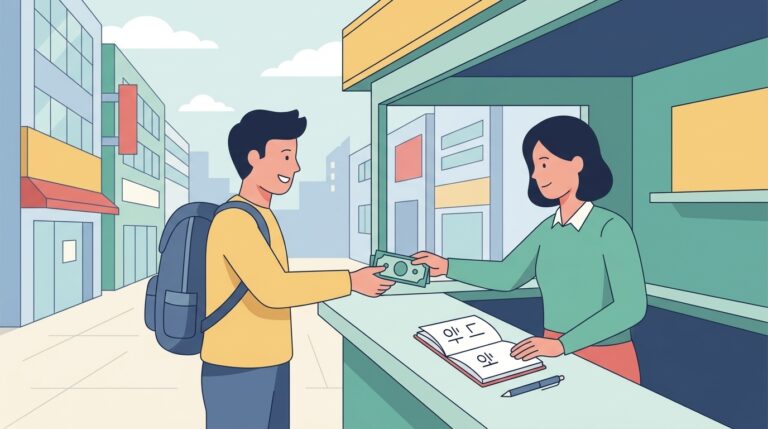
* The Two-Hand Rule (두 손으로 주기): Always hand over your foreign cash and passport using both hands. Alternatively, place your left fingertips gently under your right wrist or forearm while extending your right hand. Handing money over with a single, limp hand can come across as dismissive.
* The Reverent Receipt: When the teller pushes the tray of Korean won towards you, pull it toward yourself using both hands with a gentle nod of your head (목례, mongnye).
* The Discreet Count: It is completely normal and encouraged to count your money in front of the window before walking away, but do so quietly without snapping or violently flicking the bills.
4-2. Cultural Code: Cash vs. Card in Modern Korea
South Korea is celebrated as one of the most cashless societies on earth—you can buy a 1,000-won pack of gum with Apple Pay or an international debit card at any 24-hour convenience store! However, there is a major trap for travelers: traditional street food vendors, Dongmyo vintage flea markets, street sock stalls, and subway transit card recharge kiosks strictly demand hard paper cash. Keeping around 50,000 to 100,000 won in 5,000 and 10,000-won bills tucked inside your pouch ensures you never have to walk away from that steaming bowl of spicy tteokbokki empty-handed.
Phase 5: Real-Life Roleplay Scenario
Setting: A cheerful, brightly lit private money exchange window near Myeongdong Station Exit 5.
NPC Character: Teller Ms. Eun-ji Park (박은지), quick with her calculator, friendly, and wearing a welcoming smile.
- Turn 1 (Traveler): 안녕하세요! 달러 환전 돼요?
(Annyeonghaseyo! Dalleo hwanjeon dwaeyo?)
“Hello! Can I exchange US dollars here?”
🎭 Smiling politely and making gentle eye contact through the glass partition. -
Turn 2 (Teller): 네, 가능해요! 얼마 환전해 드릴까요?
(Ne, ganeunghaeyo! Eolma hwanjeonhae deurilkkayo?)
“Yes, you can! How much would you like me to exchange for you?”
🎭 Tapping on the digital counter calculator with a welcoming nod. -
Turn 3 (Traveler): 300달러 환전해 주세요.
(Sambaek-dalleo hwanjeonhae juseyo.)
“Please exchange 300 dollars.”
🎭 Handing three clean $100 bills across the counter using both hands. -
Turn 4 (Teller): 네, 여권 보여주시겠어요?
(Ne, yeogwon boyeojusigesseoyo?)
“Sure, could you show me your passport, please?”
🎭 Reaching out with two hands to accept the bills and gesturing toward the passport tray. -
Turn 5 (Traveler): 여기 있어요. 오늘 환율이 어떻게 돼요?
(Yeogi isseoyo. Oneul hwanyuri eotteoke dwaeyo?)
“Here it is. What is today’s exchange rate?”
🎭 Handing over the passport while looking at the digital rate screen. -
Turn 6 (Teller): 오늘은 1달러에 1,350원이에요. 총 405,000원입니다.
(Oneureun il-dalloe cheon-sam-baek-o-sip-won-ieyo. Chong sa-sip-man-o-cheon-won-imnida.)
“Today it’s 1,350 won per dollar. The total comes out to 405,000 won.”
🎭 Turning the calculator screen toward you so you can clearly see the calculation. -
Turn 7 (Traveler): 잔돈은 만 원짜리로 섞어서 주세요.
(Jandoneun man-won-jjariro seokkeoseo juseyo.)
“Please mix in some 10,000-won bills for the change.”
🎭 Gesturing modestly with hands held close together. -
Turn 8 (Teller): 네! 오만 원권 7장, 만 원권 5장, 오천 원권 1장입니다. 확인해 보세요!
(Ne! Oman-wongwon ilgop-jang, man-wongwon daseot-jang, ocheon-wongwon han-jang-imnida. Hwaginae boseyo!)
“Understood! Here are seven 50,000-won notes, five 10,000-won notes, and one 5,000-won note. Please count and check!”
🎭 Neatly counting the crisp bills in front of you and sliding the acrylic tray forward.
🔀 Interactive Branching Point: What do you say next?
- Option A: “감사합니다! 영수증도 주세요.” (Gamsahamnida! Yeongsujeungdo juseyo. / Thank you! Please give me a receipt too.)
- Feedback: [BEST CHOICE] ⭐ Spot-on! You showed gratitude and requested documentation for your travel budget smoothly and naturally.
- Option B: “야, 돈 더 줘!” (Ya, don deo jwo! / Hey, give me more money!)
- Feedback: [BAD CHOICE] 🚨 Red alert! “야” is an abrasive informal call, and using flat imperative slang will shock the teller and create instant hostility.
- Option C: “그냥 제 신용카드에 다 넣어주세요.” (Geunyang je sinyongkadeue da neoeojuseyo. / Just put it all onto my credit card.)
- Feedback: [RISKY CHOICE] ⚠️ Realistic hurdle! Currency exchange booths only trade physical banknotes. They cannot directly wire cash balances onto foreign credit cards.
Phase 6: 10-Second Emotion Shadowing Drill
Practice reading these out loud, pausing at each slash (/) and infusing the specified emotional vibe!
- [😊 Bright & Courteous]
안녕하세요! / 달러 환전 돼요?
(Annyeonghaseyo! / Dalleo hwanjeon dwaeyo?)
“Hello! / Can I exchange US dollars?” -
[🤔 Curious & Mindful]
오늘 환율이 / 어떻게 돼요?
(Oneul hwanyuri / eotteoke dwaeyo?)
“Today’s exchange rate… / how does it stand?” -
[🤝 Clear & Practical]
잔돈은 / 만 원짜리로 / 섞어서 주세요.
(Jandoneun / man-won-jjariro / seokkeoseo juseyo.)
“As for the change, / in 10,000-won bills, / please mix them in.”
Phase 7: K-Culture Mini Dictionary (4 Key Terms)
-
환율 (Hwanyul) | Exchange Rate
The fundamental financial metric. Whenever you see a display board in Incheon Airport or Myeongdong, look for the column labeled 환율 (Hwanyul) next to your currency flag. -
잔돈 (Jandon) | Pocket Change / Small Bills
Used across retail, taxi rides, and outdoor stalls. When you want smaller denominations rather than one single massive banknote, this is the noun to remember. -
현금 (Hyeongeum) | Physical Cash
The essential term when determining payment methods. You will frequently hear vendors ask: “현금 있으세요?” (Hyeongeum isseuseyo? / “Do you happen to have cash?”). -
지폐 (Jipye) | Paper Banknotes
Refers specifically to paper currency bills (1,000, 5,000, 10,000, and 50,000 won notes), as opposed to metallic coins (동전, dongjeon).
Phase 8: Survival Kit for Travelers
Survival Expressions TOP 3
- 영수증 주세요 (Yeongsujeung juseyo)
Romanization: [Yeong-su-jeung ju-se-yo]
Pro Tip: Always grab your receipt to double-check that the rate posted on the board matches the exact math printed on your slip. - 현금 결제 돼요? (Hyeongeum gyeolje dwaeyo?)
Romanization: [Hyeon-geum gyeol-je dwae-yo?]
Pro Tip: At traditional market stalls and underground fashion malls, asking if cash payment is okay often unlocks a tiny unadvertised discount or bonus item (덤, deom)! - 계좌이체 돼요? (Gyejwa-iche dwaeyo?)
Romanization: [Gye-jwa-i-che dwae-yo?]
Pro Tip: In younger indie flea markets or pop-up stores, artists often post bank account numbers for instant wire transfer if you run completely out of bills.
Editor’s Travel Note: On-the-Ground Currency Strategy
- Avoid exchanging everything at the airport: Incheon Airport counters carry convenience fees and slightly lower rates. Exchange just $30 to $50 upon arrival to cover your express train ticket and initial convenience store snacks.
- Head to Myeongdong for major sums: Private licensed exchange shops in Myeongdong (specifically near the Chinese Embassy area) historically offer the most competitive rates in Seoul. Use download the Naver Map app for currency booth locations to search for nearby licensed booths with high user reviews.
- Recharging T-Money Cards: Seoul subway ticket machines do not accept international credit cards for transportation card top-ups! You must feed paper Korean banknotes directly into the machine, so always reserve a few 10,000-won bills in your pocket.
Phase 9: “One Step Deeper” (Reflective Question)
In Western commercial interactions, transactions can sometimes feel like purely mathematical contracts: money is exchanged for goods, and words are kept to a sterile minimum. But in South Korea, commercial language is rooted in mutual care and shared community. When you frame your request with -해 주세요 (“please do for me”) and pass bills with both hands, you are participating in an ancient social rhythm of acknowledging the teller’s human effort. You are not just a customer demanding a commodity; you are an appreciative guest honoring a host.
💬 Your Turn: Have you ever experienced a sudden panic moment trying to pay in a foreign currency abroad? Drop a comment below and tell us which street food you plan to buy first with your freshly exchanged Korean won!
Phase 10: FAQ & Avoiding Misunderstandings
Q: Should I exchange all my travel spending money at Incheon Airport?
A: No, definitely avoid doing that! Airport currency counters consistently carry higher operational margins and wider spreads. Only convert enough money to fund your transport into the city and emergency snacks (around 30,000 to 50,000 won), and exchange the remainder in commercial hubs like Myeongdong or Hongdae.
Q: Do Korean money exchange booths accept folded, worn, or marked bills?
A: Korean private exchange tellers and banks inspect foreign notes very strictly. Banknotes with pen marks, minor tears, severe folding, or stamped logos might be rejected outright or discounted. Always bring crisp, unblemished, high-denomination notes (like $100 bills) for the highest exchange value.
Q: Can I exchange foreign coins in Korea?
A: As a general rule, no. Almost all private money exchange counters and city banks in Korea deal exclusively with paper banknotes. Foreign coins are difficult to repatriate and are generally turned away, so spend all your loose metal coins before flying out of your home country!
🚨 흔한 실수 (Common Mistakes) Warning Board
- Leaving your physical passport at your accommodation:
Correct Action: South Korean financial regulations strictly mandate physical identity verification for foreign currency exchange. A photocopy on your phone will usually be rejected. Always keep your physical passport handy. - Handing money over with a single, loose hand:
Correct Action: Always offer both the currency and your passport with both hands, or support your right elbow with your left hand. - Demanding small 1,000-won bills for hundreds of dollars:
Correct Action: Exchange tellers do not carry endless stacks of 1,000-won notes. Request 10,000-won bills (만 원짜리) instead, which are universally accepted and convenient everywhere.
Phase 11: Action Missions
- 🥉 Bronze Mission (Solo Practice): Stand before a mirror with your passport in hand. Practice bowing slightly, extending both hands, and stating clearly: “안녕하세요! 삼백 달러 환전해 주세요.”
- 🥈 Silver Mission (Social Share): Share this guide with your upcoming travel buddy or post in the comments: Calculate your target Korean travel budget in won using the phrase “___ 원 환전하고 싶어요!” (I want to exchange ___ won!).
- 🥇 Gold Mission (Real-World Test): On your next trip to Korea, step directly into a licensed Myeongdong or Hongdae exchange booth and complete your transaction entirely in Korean without switching to English!
- 🎮 K-Culture Mission: Watch an episode of a Korean variety show or travel vlog (such as Street Food Fighter). Listen carefully to identify how vendors and customers address each other during cash handovers!
Phase 12: Interactive Quiz Challenge
Test your knowledge before your plane takes off!
1. Situation Judgment: You are exchanging $200 at a booth in Seoul and want smaller denominations so you can easily purchase snacks at Gwangjang Market. What is the most natural sentence to say?
(A) 야! 천 원짜리 다 내놔.
(B) 잔돈은 만 원짜리로 섞어서 주세요.
(C) 카드로 환전해 주십시오.
2. Fill-in-the-Blank: Complete the polite question to ask the teller about the daily rate:
“오늘 _______이 어떻게 돼요?”
3. True or False: In Korea, every street stall, flea market vendor, and subway card recharge kiosk takes foreign credit cards, so you never need to carry paper won bills. (True / False)
👉 Click here to reveal the answers and explanations!
- Question 1 Answer: (B)
Explanation: “잔돈은 만 원짜리로 섞어서 주세요” (Please mix in some 10,000-won bills for the change) is extremely natural, polite, and effective. (A) uses rude slang, and (C) makes no logistical sense. - Question 2 Answer: 환율 (Hwanyul – Exchange Rate)
Explanation: “오늘 환율이 어떻게 돼요?” means “What is today’s exchange rate?” - Question 3 Answer: False!
Explanation: While standard convenience stores and restaurants are predominantly cashless, street snack vendors and subway card recharge machines still require physical paper Korean won cash!







