

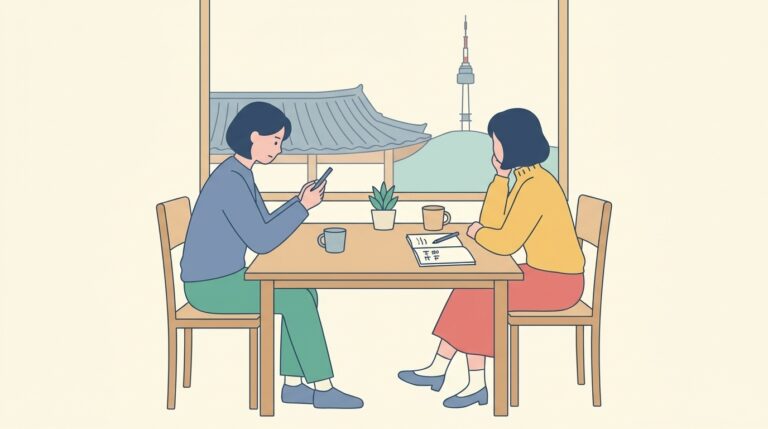
Phase 1: Empathy (Story-Driven Opening)
안녕하세요! 매일한글 에디터입니다.
Picture this: You’ve been living in Seoul for six months, and you finally found a Korean friend, Junho, who feels like family. You shared late-night chimaek (chicken and beer) by the Han River, exchanged vulnerable stories, and helped each other through tough weeks. You thought you had built genuine jeong (deep affection and communal bond). Then, out of nowhere, you find out he shared a personal secret you told him in confidence with mutual acquaintances, laughing it off as a casual joke.
Your chest tightens. You want to confront him, but how? If you open a dictionary or standard phrasebook, you’ll see stiff sentences like “저는 당신에게 실망했습니다” (I am disappointed in you). But saying that in real life sounds like a CEO firing an intern, or worse, an awkward robot reading a legal deposition. If you lash out with English-translated anger, you risk burning bridges without ever conveying the genuine hurt in your heart.
Expressing disappointment in Korean is an art form. Because Korean culture places immense value on relationships, showing hurt requires a delicate balance of emotional truth and cultural nuance. In this guide, developed from real coaching sessions with intermediate learners at Daily Hangul, you’ll master the exact words, intonation, and subtle non-verbal cues needed to voice disappointment gracefully. Let’s make sure your true voice is never lost in translation.
Phase 2: Core Expressions Deep Dive
1. 어떻게 나한테 이럴 수 있어? (Eotteoke nahante ireol su isseo?)
- Pronunciation: Uh-tteo-keh na-han-teh ee-ruhl soo ee-ssuh? (Sounds like “Uh-toe-kay” with a sharp, rising middle inflection that suddenly drops).
- Meaning: Literal: “How could you do this to me?” | Nuance: “Of all people, I never imagined you would break my trust.”
- K-Culture Moment: The quintessential confrontation line in modern K-Dramas (think Itaewon Class or Twenty-Five Twenty-One). It is used when someone you considered an ally betrays your implicit trust.
- Editor’s Insight: Notice the particle 한테 (hante, “to me”). Emphasizing na-han-te stresses the betrayal of the bond, not just the bad deed itself.
- Situation Spectrum: Casual ✅ | Semi-formal ⚠️ | Formal 🚫
- 🤔 Think About It: In English, we often say “How could you do that?” focusing on the actor. Why do you think Korean emphasizes “to me” (nahante) instead?
2. 솔직히 너한테 실망이 좀 크다. (Soljikhi neohante silmangi jom keuda.)
- Pronunciation: Sol-jji-khi neo-han-teh sil-mang-i jom keu-da. (The “khi” has an aspirated puff of breath like clearing a whisper).
- Meaning: Literal: “Honestly, toward you, disappointment is a bit big.” | Nuance: “I held you in high regard, which makes this blow especially painful.”
- K-Culture Moment: Heard during subdued, serious conversations between close colleagues or friends over soju when a serious boundary has been crossed.
- Editor’s Insight: Koreans rarely say “I am disappointed.” Instead, they say “disappointment is big” (silmangi keuda). Adding 좀 (jom, a little) actually intensifies the maturity and weight of the statement, functioning as a polite shock absorber.
- Situation Spectrum: Casual ✅ | Semi-formal ✅ | Formal ⚠️
- 🤔 Think About It: How does phrasing disappointment as an objective size (“the disappointment is large”) differ from declaring an identity (“I am disappointed”)?
3. 너한테 정말 서운하다. (Neohante jeongmal seounhada.)
- Pronunciation: Neo-han-teh jeong-mal suh-oon-ha-da. (The vowel ‘eo’ sounds like the ‘u’ in “cup”).
- Meaning: Literal: “I feel sad/regretful towards you.” | Nuance: “My feelings are hurt because I cared about you and expected warmth in return.”
- K-Culture Moment: The core emotional vocabulary of intimate relationships in Korea. When someone forgets your birthday or leaves you out of plans, this is what you say.
- Editor’s Insight: English lacks a single word for 서운하다 (seounhada). It is not aggressive rage; it is melancholic hurt rooted in unmet affection (jeong).
- Situation Spectrum: Casual ✅ | Semi-formal ⚠️ | Formal 🚫
- 🤔 Think About It: Can you think of an emotion in your native tongue that mixes love and resentment simultaneously?
Phase 3: Textbook Korean vs. Real Korean
Situation 1: Calling out a broken promise
- 📖 교과서 한국어 (Textbook): 저는 당신의 행동에 실망했습니다. (Jeoneun dangsin-ui haengdong-e silmanghaesseumnida. – I am disappointed by your behavior.)
- 🗣️ 진짜 한국어 (Real-life): 다른 사람도 아니고 네가 어떻게 그래? (Dareun saramdo anigo nega eotteoke geurae? – Not anyone else, but you… how could you do that?)
- 💡 왜 다를까?: Using “당신” (dangsin) between friends sounds theatrical, hostile, or translated directly from Western scripts. Real Koreans emphasize the exceptional nature of their relationship using “다른 사람도 아니고” (not just anyone else).
Situation 2: Expressing quiet emotional withdrawal
- 📖 교과서 한국어 (Textbook): 저는 이제 당신을 신뢰할 수 없습니다. (Jeoneun ije dangsin-eul sinnoehal su eopseumnida. – I cannot trust you anymore.)
- 🗣️ 진짜 한국어 (Real-life): 네가 이럴 줄은 몰랐어. 생각할 시간이 좀 필요해. (Nega ireol jureun mollasseo. Saenggakhal sigani jom piryohae. – I didn’t think you’d be like this. I need some time to think.)
- 💡 왜 다를까?: Directly saying “I don’t trust you” completely severs ties in Korean. Stating shock (ireol jureun mollasseo) and asking for time (saenggakhal sigan) establishes a firm boundary while maintaining conversational dignity.
Phase 4: K-Culture Deep Dive & Non-Verbal Manners
4-1. 눈치 (Nunchi) & Body Language: The Silent Coldness
In Western cultures, confrontation often involves direct eye contact, open hand gestures, or an elevated voice. In Korea, explosive anger is viewed as a loss of self-control. True, deep disappointment is communicated through quiet restraint:
* The Heavy Sigh (한숨 – Hansum): A slow, audible breath through the nose while looking down signals profound disillusionment.
* The Lowered Gaze (시선 떨구기): Looking slightly diagonally down instead of burning holes into their eyes shows you are processing profound emotional damage.
* Dropping the Ending Particle: Speaking in shortened, dry sentences without the usual sing-song warmth instantly signals that your emotional safety has been violated.
4-2. Cultural Code: 배신감 (Baesingam) and the Weight of 정 (Jeong)
Why does disappointment cut so deeply in Korean society? It comes down to 정 (Jeong)—the invisible social adhesive of mutual loyalty. When you become close with a Korean person, you enter their uri (we/us) circle. Within this circle, personal secrets and favors are shared under an unspoken pact of mutual protection.
When a friend breaks this bond, Koreans experience 배신감 (Baesingam – the feeling of betrayal). Unlike a transactional breach of contract, it feels like an emotional eviction from the community. Acknowledging this helps you realize that speaking up isn’t just about the isolated incident; it’s about rebuilding the damaged jeong.
Phase 5: Real-Life Roleplay Scenario
Setting: A quiet corner table at a small café in Yeonnam-dong. Rain is tapping gently against the glass. You are sitting opposite Minwoo (민우), your close Korean friend who canceled on your milestone birthday dinner at the last minute to hang out with someone else, and only texted an excuse today.
- Turn 1 (Minwoo): 어제 진짜 미안해! 갑자기 중요한 일이 생겨서 어쩔 수가 없었어. (Eoje jinjja mianhae! Gapjagi jung-yohan iri saenggyeoseo eojjeol suga eopseosseo. – I’m so sorry about yesterday! Something urgent came up and I had no choice.)
🎭 (Fidgeting with his coffee cup, offering an uneasy smile) - Turn 2 (You): 중요한 일? 다른 친구들 인스타 보니까 너 거기 있던데. (Jung-yohan il? Dareun chingudeul inseuta bonikka neo geogi itdeonde. – Urgent? I saw on other friends’ Instagram that you were there.)
🎭 (Looking him straight in the eyes without smiling) - Turn 3 (Minwoo): 아… 그게, 거절하기 힘든 자리라서 잠깐 들른 거야. (A… geuge, geojeolhagi himdeun jariraseo jamkkan deulleun geoya. – Ah… that was, it was a hard spot to turn down, so I just dropped by briefly.)
🎭 (Eyes darting away nervously) - Turn 4 (You): 솔직히 너한테 실망이 좀 크다. (Soljikhi neohante silmangi jom keuda. – Honestly, I feel really disappointed in you.)
🎭 (Letting out a soft sigh, tone steady and low) - Turn 5 (Minwoo): 화 많이 났어? 내가 진짜 다 설명할게. (Hwa mani nasseo? Naega jinjja da seolmyeonghalge. – Are you really angry? I’ll explain everything.)
🎭 (Leaning forward with genuine distress) - Turn 6 (You): 화가 났다기보다 서운해. 다른 사람도 아니고 네가 어떻게 그래? (Hwaga nattagiboda seounhae. Dareun saramdo anigo nega eotteoke geurae? – Rather than angry, I’m hurt. Not just anyone else, but how could you do that?)
🎭 (Shaking head slowly, voice softened with hurt) - Turn 7 (Minwoo): 내가 생각이 너무 짧았어. 네 생일인데 내가 정말 큰 실수했다. 미안해. (Naega saenggagi neomu jjalbasseo. Ne saeng-irinde naega jeongmal keun silsuhaetta. Mianhae. – I was so thoughtless. It was your birthday and I made a terrible mistake. I’m truly sorry.)
🎭 (Bowing head deeply in sincere regret) - Turn 8 (You): 사과는 받을게. 하지만 오늘은 그냥 혼자 있고 싶다. (Sagwaneun badeulge. Hajiman oneureun geunyang honja itgo sipda. – I accept your apology. But today, I just want to be alone.)
🎭 (Picking up your bag calmly, drawing a boundary)
🔀 Interactive Decision Point
How would you conclude the conversation at Turn 8?
- Option A: “야, 됐어. 다신 연락하지 마.” (Hey, forget it. Never contact me again.)
- Option B: “사과는 받을게. 하지만 생각할 시간이 좀 필요해.” (I accept your apology. But I need some time to think.)
- Option C: “괜찮아, 다음부터 그러지 마! 술 마시러 가자!” (It’s fine, just don’t do it next time! Let’s go drink!)
Feedback:
* Option A [Bad]: Burning bridges completely using harsh banmal makes future resolution impossible and displays emotional volatility.
* Option B [Best]: Mature, balanced, and deeply natural. It acknowledges the apology while maintaining your emotional boundary.
* Option C [Risk]: Sweeping deep hurt under the rug breeds long-term resentment. Minwoo may assume your boundaries don’t need to be respected.
Phase 6: 10-Second Emotion Shadowing Drill
Practice these lines out loud. Pay strict attention to the pauses (/) and the emotional guidance.
[💔 억누른 서운함을 담아 - Subdued hurt, heavy breath]
솔직히 말해서 / 너한테 정말 / 서운해.
(Sol-jik-hi mal-hae-seo / neo-han-te jeong-mal / seo-un-hae.)-
[😔 차분하지만 뼈아프게 - Calm yet striking deeply]
다른 사람도 아니고 / 네가 나한테 / 어떻게 이래?
(Da-reun sa-ram-do a-ni-go / ne-ga na-han-te / eo-tteo-ke i-rae?) -
[🛑 단호하게 선을 그으며 - Firmly drawing a boundary]
네가 이럴 줄은 몰랐어. / 생각할 시간이 좀 필요해.
(Ne-ga i-reol ju-reun mol-la-sseo. / Saeng-gak-hal si-ga-ni jom pi-ryo-hae.)
Phase 7: K-Culture Mini Dictionary
-
서운하다 (Seounhada) / 섭섭하다 (Seopseophada)
Meaning: Feeling dejected, hurt, or melancholic because someone close failed to meet your emotional expectations.
Usage: Used among lovers, close friends, and family when emotional warmth is lacking. -
배신감 (Baesingam)
Meaning: The gut-wrenching feeling of betrayal.
Usage: Applied when explicit agreements, mutual trust, or group secrets are violated (“배신감이 든다” = I feel deeply betrayed). -
정떨어지다 (Jeongtteoreojida)
Meaning: To lose all emotional fondness or affection for someone suddenly.
Usage: Casual speech when an action reveals an ugly side of someone’s character (“그 행동 보고 정떨어졌어” = Seeing that made me lose all feelings of friendship). -
손절하다 (Sonjeolhada)
Meaning: To cut someone off / cut ties completely.
Usage: Originally a financial stock term (“cutting losses”), now standard modern Korean slang among 20s-30s for unfriending and ghosting a toxic person.
Phase 8: Traveler’s Survival Kit
TOP 3 De-escalation & Boundary Expressions
- 잠깐 이야기 좀 할 수 있어? (Jamkkan iyagi jom hal su isseo?)
Can we talk privately for a moment?
Pro Tip: Never confront someone in front of their peer group; save face by pulling them aside. - 그런 뜻으로 한 말이 아닌데 오해했어. (Geureon tteuseuro han mari aninde ohaehaesseo.)
I didn’t mean it that way; you misunderstood.
Pro Tip: Useful if the friend turns defensive and accuses you of overreacting. - 오늘은 그냥 들어갈게. (Oneureun geunyang deureogalge.)
I’ll just head home today.
Pro Tip: The most polite exit line to step away from an uncomfortable social setting without causing a scene.
Editor’s Travel Note
If you find yourself in an emotionally charged conflict while navigating Korea, remember that Korean public spaces prize decorum. If you need a breather, step into an independent café or take a walk along the Cheonggyecheon stream.
Need to look up a tranquil, quiet spot nearby to clear your head? Use the Naver Map app navigation guide instead of Google Maps, as local reviews and quiet corner cafes are accurately updated in real time.
Phase 9: “A Step Deeper” (Reflective Essay)
In highly individualistic cultures, a broken promise is often evaluated on its contractual terms: what was agreed upon, what was broken, and how it can be logically resolved. In Korean society, however, relationships are fundamentally bonded by relational expectations. When you consider someone a close companion, you share an unspoken emotional ecosystem. Disappointment hurts not merely because an action failed, but because it feels like the other person stepped outside the sacred circle of mutual care.
This is why expressing hurt in Korean relies so heavily on words like seounhae rather than pure anger. It is an invitation to acknowledge mutual vulnerability. When you master these emotional nuances, you move from merely speaking Korean to truly understanding the Korean soul.
💬 Your Turn: Have you ever experienced a cultural clash when expressing negative emotions with friends from another background? Share your story in the comments below!
Phase 10: FAQ & Common Mistakes
Q: Can I use “실망했어요” (Silmanghaesseoyo) with an older person or boss?
A: Use extreme caution! Saying “실망했어요” to a superior implies that you were evaluating their performance and found them lacking. To someone older or in a higher position, expressing disappointment is done indirectly: “제가 기대했던 것과 달라서 조금 당황스럽습니다” (I am a bit flustered because it differed from what I had anticipated).
Q: What is the exact difference between “서운하다” (Seounhada) and “섭섭하다” (Seopseophada)?
A: They are 90% interchangeable! However, 서운하다 carries a slightly deeper, more personal, and tender ache, while 섭섭하다 often leans toward situational regret (e.g., leaving a party early or missing an event).
Q: How should I respond if a Korean friend tells me “너한테 서운해”?
A: Do not respond with logical counterarguments right away! Validate their feelings first: “내가 미처 몰랐어, 서운하게 해서 미안해” (I didn’t realize, I’m sorry for hurting your feelings). In Korea, acknowledging the emotion always comes before debating the facts.
🚨 Common Mistakes Warning Board
- Mistake: Saying “당신한테 실망했어요!”
Correct Action: Drop “당신” entirely. Say “[Name] 씨한테 실망했어요” or in casual speech, “너한테 실망했어”. - Mistake: Shouting “왜 그랬어?!” (Why did you do that?!) in public.
Correct Action: Lower your volume and use “어떻게 나한테 이럴 수 있어?” in a private setting. - Mistake: Confusing 화나다 (to be angry) with 서운하다 (to feel let down/hurt).
Correct Action: If you value the relationship, always default to 서운하다. It leads to reconciliation, whereas 화나다 triggers defensiveness.
Phase 11: Action Mission & Engagement
- 🥉 Bronze Mission (Solo Shadowing): Record a 10-second voice memo of yourself saying “솔직히 너한테 서운해. 다른 사람도 아니고 네가 어떻게 그래?” with the correct subdued sigh.
- 🥈 Silver Mission (Social Media Check): Find a scene in your favorite K-Drama where two close characters argue. Identify whether they use 서운하다, 실망이다, or 어떻게 이럴 수 있어, and tweet or share it tagging Daily Hangul!
- 🥇 Gold Mission (Real Life Application): The next time someone forgets a minor promise, instead of saying “괜찮아요” (I’m fine) when you are not, gently say: “조금 서운하네요~” with a warm smile.
Phase 12: Interactive Quiz Challenge
1. Situational Judgment: Your Korean study partner forgot your weekly one-on-one session for the second time to go to an impromptu gathering. Which response is the most natural B1 way to express your hurt firmly yet respectfully?
* A) 당신은 아주 나쁜 친구입니다. (Dangsineun aju nappeun chinguimnida.)
* B) 다른 사람도 아니고 네가 어떻게 이래? 진짜 서운하다. (Dareun saramdo anigo nega eotteoke irae? Jinjja seounhada.)
* C) 저는 당신을 법적으로 고소하겠습니다. (Jeoneun dangsineul beopjeogeuro gosohagesseumnida.)
👉 Click to reveal Answer & Explanation
Correct Answer: B
Explanation: Option B strikes the authentic balance of expressing personal betrayal (dareun saramdo anigo) and emotional vulnerability (seounhada). Option A uses the unnatural pronoun 당신, and Option C is an extreme legal threat!
2. Fill-in-the-Blank: Complete the sentence meaning “Honestly, my disappointment in you is quite big.”
* 솔직히 너한테 _______이 좀 크다.
👉 Click to reveal Answer & Explanation
Correct Answer: 실망 (Silmang)
Explanation: The full collocation is 실망이 크다 (disappointment is big).
3. True or False: Telling your Korean company manager “부장님, 실망했습니다” (Manager, I am disappointed in you) is considered polite since it ends in the formal -습니다 ending.
👉 Click to reveal Answer & Explanation
Correct Answer: False!
Explanation: Even with polite grammar, pointing out disappointment toward a senior or boss is culturally taboo because it reverses the social hierarchy. You should frame it around confusion or personal unmet expectations instead.







