

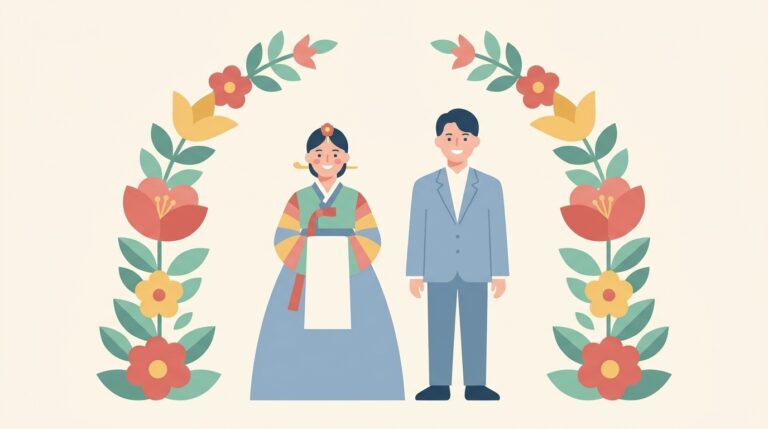
Attending a Korean Wedding: How to Wish the Couple a Happy Life Like a Native
Phase 1: Empathy (Story-immersive Opening)
안녕하세요! 매일한글 에디터입니다.
Imagine this: you receive an elegant, pastel-toned invitation in KakaoTalk. Your Korean coworker or close university friend is tying the knot! You dress up sharply, arrive at the bustling wedding hall, hand over the white envelope, and suddenly find yourself standing right inside the bride’s waiting room or shaking hands with the groom in the lobby. Your palms get a little sweaty. You want to say something much warmer than a dry “Congratulations,” but your brain freezes. You want to say, “I hope you two live happily ever after!”—yet direct translation apps give you weird, overly stiff phrases like “Please achieve eternal domestic bliss.”
Don’t panic! You are not alone. As an editor who has navigated dozens of Korean weddings and guided hundreds of beginner learners through this exact cultural milestone, I’ve got your back. Today, we are breaking down the natural, heartfelt phrases that real Koreans use to wish couples a happy life together, tailored perfectly for A2 beginners. By the end of this guide, you will step up to any Korean bride or groom with total confidence and a warm smile!
Phase 2: Core Expressions (Top 3)
1. 행복하게 잘 살아요! (Haengbokhage jal sarayo!)
- Pronunciation: [Haeng-bok-ha-geh jal sah-rah-yo] (Think haeng as in ‘hang’, bok like ‘pork’ with a soft b, jal like ‘jolly’ without ‘ly’, and sarayo like ‘sun-rise-yo’)
- Meaning: Literal: “Live happily and well!” | Nuance: Warm, natural, and standard wish for a couple’s future together.
- K-Culture Moment: In modern K-dramas like Queen of Tears, friends visiting the bridal suite say this while taking photos together.
- Editor’s Insight: In Korean, the verb 살다 (to live) paired with adverb 잘 (well) means much more than merely surviving—it means building a harmonious, prosperous, and peaceful household together.
- Situation Spectrum: Casual: ✅ | Semi-formal: ✅ | Formal: ⚠️ (For elders/bosses, use 행복하게 잘 사세요)
- 🤔 Think About It: In English, we often say “Congratulations on your wedding,” focusing on the event day. Korean phrases focus heavily on the daily life after the ceremony (살다 – to live). Why do you think Korean culture puts such strong emphasis on the continuous journey rather than just the wedding party?
2. 결혼 진심으로 축하해요, 두 분 늘 행복하세요! (Gyeolhon jinsimeuro chukahaeyo, du bun neul haengbokhaseyo!)
- Pronunciation: [Gyeol-hon jin-shim-eu-ro choo-kah-hae-yo, doo boon neul haeng-bok-ha-seh-yo]
- Meaning: Literal: “I sincerely congratulate your marriage, may both of you always be happy!” | Nuance: Extremely polite, heartfelt, and safe for colleagues, acquaintances, and friends.
- K-Culture Moment: Written in the wedding guestbook (방명록) placed outside the ceremony hall or spoken while handing over congratulations.
- Editor’s Insight: 진심으로 (jinsimeuro) means “from the bottom of my heart.” Adding this single word elevates a standard textbook greeting into a deeply touching sentiment.
- Situation Spectrum: Casual: ⚠️ | Semi-formal: ✅ | Formal: ✅
- 🤔 Think About It: Notice the counter word 두 분 (du bun – ‘two esteemed people’). Korean uses honorific counters to honor the newly formed unit as equals.
3. 꽃길만 걸으세요! (Kkotgilman georeuseyo!)
- Pronunciation: [Kkot-gil-man geo-reu-seh-yo] (Kkot rhymes with ‘boat’ with a tight k, gil like ‘gill’, man like ‘mahn’, georeuseyo like ‘go-reu-say-yo’)
- Meaning: Literal: “May you only walk on flower paths!” | Nuance: A poetic, trendy idiom wishing someone a smooth, joyful, and bump-free life ahead.
- K-Culture Moment: You will often see this written on celebration ribbons wrapped around grand flower wreaths (화환) outside Korean wedding venues.
- Editor’s Insight: Originating from idol fandoms cheering on their stars, this phrase crossed over into mainstream everyday Korean. It is cheerful, affectionate, and very modern.
- Situation Spectrum: Casual: ✅ | Semi-formal: ✅ | Formal: ⚠️
- 🤔 Think About It: Does your native language have floral or nature metaphors for good fortune and success? How does picturing a “path of flowers” feel compared to “smooth sailing”?
Phase 3: Textbook Korean vs. Real Korean
Situation 1: Wishing the couple a long, harmonious life
- 📖 교과서 한국어: 백년해로하십시오. (Baengnyeonhaerohasipsio.) — “Please grow old together until a hundred years.”
- 🗣️ 진짜 한국어: 두 분 오래오래 행복하게 잘 살아요! (Du bun orae-orae haengbokhage jal sarayo!) — “May you two live happily and well for a long, long time!”
- 💡 왜 다를까? 백년해로 is an archaic four-character idiom (사자성어) mostly reserved for speeches by elderly officiants (주례). When said by peer guests or younger acquaintances, it sounds unnaturally grand and robotic. Doubling the adverb 오래오래 (orae-orae) sounds affectionate and genuine.
Situation 2: Talking to a close friend getting married
- 📖 교과서 한국어: 행복한 가정을 꾸리기를 기원합니다. (Haengbokan gajeong-eul kkurigireul giwonhamnida.) — “I wish that you establish a happy household.”
- 🗣️ 진짜 한국어: 진짜 너무 예쁘다! 싸우지 말고 예쁘게 잘 살아! (Jinja neomu yeppeuda! Ssauji malgo yeoppeuge jal sara!) — “You look so gorgeous! Don’t fight, and live beautifully together!”
- 💡 왜 다를까? Korean friends share playful teasing alongside genuine love. Saying 싸우지 말고 (don’t fight/squabble) is an affectionate, realistic running joke between close buddies wishing peace upon marriage.
Phase 4: K-Culture Deep Dive & Non-verbal Manners
4-1. 눈치 (Nunchi) & Body Gestures
- Two-Hand Rule: When offering your wedding gift envelope or shaking hands with the bridegroom, always use two hands (or place your left hand gently under your right wrist/elbow). Handing an envelope with one hand looks dismissive.
- The 15-Degree Bow: Don’t drop into a deep martial-arts bow. Combine a soft smile, eye contact, and a modest 15-degree nod while saying “결혼 축하해요!”
- Bridal Suite Etiquette: Knock softly, wait for the photographer’s cue, step close beside the bride for a photo, and deliver your warm line 행복하게 잘 살아요! right before stepping away.
4-2. Culture Code: 축의금 (Gift Money) & 식권 (Meal Tickets)
Korean weddings are fast-paced and pragmatic. Most ceremonies take under 40 minutes, followed directly by the wedding buffet! Guests bring pristine cash in clean white envelopes called 축의금 (chuk-ui-gum).
Amounts follow clean cultural rules based on closeness: standard acquaintance is usually 50,000 to 100,000 KRW, close friends 100,000 to 200,000+ KRW. Odd numbers (3, 5, 7, 10 – where 10 is considered complete) represent yang (positive energy). When you hand this envelope to the desk managers, they will give you a 식권 (meal coupon). That meal ticket is your ticket to the grand celebration feast!
Phase 5: Real-life Roleplay Scenario
Setting: Inside the dazzling white bride’s waiting room (신부대기실). You are visiting your Korean colleague, Minji (민지), right before the ceremony begins.
- You: 민지 씨, 안녕하세요! 오늘 정말 아름다우세요.
(Minji ssi, annyeonghaseyo! Oneul jeongmal areumdauseyo.)
“Hello, Minji! You look truly beautiful today.”
🎭 Hands gently folded, delivering a warm greeting with bright eyes. -
Minji: 어머, 와주셔서 정말 감사해요! 바쁘셨을 텐데 먼 길 오셨네요.
(Eomeo, wajusyeoseo jeongmal gamsahaeyo! Bappeusyeosseul tende meon gil osyeotneyo.)
“Oh my goodness, thank you so much for coming! You must have been busy, yet you came all this way.”
🎭 Holding her bouquet, beaming with relief and gratitude. -
You: 당연히 와야죠. 두 분 결혼 진심으로 축하해요!
(Dang-yeonhi wayajyo. Du bun gyeolhon jinsimeuro chukahaeyo!)
“Of course I had to come. I sincerely congratulate you both on your marriage!”
🎭 Nodding politely with a slight head bow. -
Minji: 고마워요. 너무 떨려서 어떡하죠? 심장이 쿵쾅거려요.
(Gomawoyo. Neomu tteollyeoseo eotteokhajyo? Simjang-i kungkwang-georyeoyo.)
“Thank you. I’m so nervous, what should I do? My heart is pounding.”
🎭 Taking a deep breath and adjusting her veil nervously. -
You: 긴장하지 마세요! 두 분 정말 잘 어울려요. 앞으로 행복하게 잘 살아요!
(Ginjanghaji maseyo! Du bun jeongmal jal eoullyeoyo. Apeuro haengbokhage jal sarayo!)
“Don’t be nervous! You two match so well. Please live happily and well from now on!”
🎭 Giving a supportive, comforting smile and gentle nod. -
Minji: 따뜻한 말씀 고마워요. 꽃길만 걸을게요!
(Ttatteutan malsseum gomawoyo. Kkotgilman georeulgeyo!)
“Thank you for the warm words. We will walk only on flower paths!”
🎭 Smiling brightly, tension visibly melting away. -
You: 식 끝나고 맛있는 식사도 잘 할게요.
(Sik kkeunnnago masinneun siksado jal halgeyo.)
“I will enjoy the delicious meal after the ceremony as well.”
🎭 Patting stomach jokingly with a subtle smile. -
Minji: 네! 뷔페 맛있으니까 꼭 많이 드시고 가세요!
(Ne! Bwipé masisseunikka kkok mani deusigo gaseyo!)
“Yes! The buffet is great, so please make sure to eat plenty before you leave!”
🎭 Waving playfully as the next guest enters.
🔀 Interactive Branch: What would you say next to the groom in the lobby?
- Choice A: “신랑님, 오늘 너무 멋져요! 둘이 싸우지 말고 행복하게 잘 살아요!” (Sinrangnim, oneul neomu meotjyeoyo! Duri ssauji malgo haengbokhage jal sarayo!)
- Choice B: “당장 행복하게 살아라!” (Dangjang haengbokhage sarara!)
- Choice C: “축의금 냈으니까 밥 많이 먹을게요!” (Chuk-uigum naesseunikka bap mani meogeulgeyo!)
Feedback:
* Choice A [BEST]: Friendly, respectful, and appropriately upbeat! Using 신랑님 (Mr. Groom) with 행복하게 잘 살아요 hits the perfect emotional note.
* Choice B [BAD]: Grammatically imperative (당장… 살아라 means “Live happily right this instant!”). You will sound like an angry drama villain ordering them around!
* Choice C [RISK]: While funny between super close best friends, saying “I paid gift money so I will gorge on food” to someone you aren’t childhood buddies with sounds slightly rude and transactional.
Phase 6: 10-Second Emotional Shadowing Drill
Practice reading these out loud at natural speed. Follow the slash marks / for natural pauses!
[😊 기쁘고 활짝 웃으며 / Cheerful & Bright]
결혼 축하해요! / 두 분 / 행복하게 잘 살아요!
(Gyeolhon chukahaeyo! / Du bun / haengbokhage jal sarayo!)-
[✨ 다정하고 따뜻하게 / Tender & Heartfelt]
진심으로 축하해요. / 앞으로 / 꽃길만 걸으세요!
(Jinsimeuro chukahaeyo. / Apeuro / kkotgilman georeuseyo!) -
[🎉 씩씩하고 응원하듯이 / Encouraging & Supportive]
두 사람 너무 잘 어울려요! / 예쁘게 / 잘 살아요!
(Du saram neomu jal eoullyeoyo! / Yeoppeuge / jal sarayo!)
Phase 7: K-Culture Mini Dictionary
- 축의금 (Chuk-ui-gum) | Congratulatory Money
* Customary cash gifted in a designated white envelope to support the couple’s new start. Always prepare crisp, new bills if possible.
- 신부대기실 (Sinbu-daegisil) | Bride’s Waiting Room
* A dedicated, beautifully decorated chamber where the bride greets close guests and takes commemorative photos before walking the aisle.
- 식권 (Sikgwon) | Meal Ticket / Voucher
* A stamped paper coupon given at the reception table in return for the congratulatory money envelope, used to access the banquet buffet.
- 하객룩 (Hagaek-ruk) | Wedding Guest Fashion Look
* The polite dress code for guests. The cardinal rule in Korea: Avoid pure white dresses or outfits that distract from the bride’s white gown!
Phase 8: Traveler’s Survival Kit
Top 3 Survival Phrases for Wedding Guests:
- 축의금 봉투 어디에 내요? (Chuk-uigum bongtu eodie naeyo?)
* “Where do I submit the gift money envelope?”
* Pro Tip: Look for the desk split into 신랑측 (Groom’s side) and 신부측 (Bride’s side).
- 식권 한 장 주세요. (Sikgwon han jang juseyo.)
* “Please give me one meal ticket.”
* Pro Tip: If attending alone, say 한 장 (one ticket); if with a partner, say 두 장 (two tickets).
- 신부대기실이 어디예요? (Sinbu-daegisiri eodieyo?)
* “Where is the bridal waiting room?”
* Pro Tip: Ask any floor staff wearing headsets; waiting rooms are often tucked around the corner from the main hall.
Editor’s Travel Note
- Finding the Venue: Korean wedding halls can be located in sprawling multiplex buildings or hotel basements. Search the exact Korean name inside the 네이버 지도 길찾기 앱 to find the correct floor and subway exit without getting lost.
- Cash Preparation: Hall ATMs often run out of cash during peak wedding hours (Saturdays 12 PM – 2 PM). Withdraw cash ahead of time at a convenience store ATM or subway station.
Phase 9: “One Step Deeper” (Cultural Reflection)
In Western wedding speeches, you often hear wishes for “adventure,” “romance,” and individual passion. In Korea, the phrase 잘 살다 (to live well) holds deep communal weight. Historically, starting a family was not merely a romantic milestone between two individuals, but the joining of two networks of ancestors and relatives striving for stability, peace, and mutual prosperity. When you tell a Korean couple “행복하게 잘 살아요,” you aren’t just complimenting their wedding day—you are offering a peaceful prayer that their home will always have abundance, warmth, and resilience against life’s hardships.
💬 Your Turn: What is the traditional way people wish newlyweds well in your home country? Does it focus on love, wealth, children, or something unique? Share your culture’s tradition in the comments below!
Phase 10: FAQ & Avoiding Misunderstandings
Q: Can I say “행복하게 잘 살아” without the “요” (yo) at the end?
A: Only if the bride or groom is your younger sibling, childhood best friend, or someone of the same age with whom you already speak informal banmal (반말). If they are a coworker or older acquaintance, dropping the 요 will sound jarringly rude!
Q: What if I don’t know the spouse at all? Can I still say “두 분 행복하세요”?
A: Yes! In fact, mentioning 두 분 (both of you) is considered polite because it acknowledges that you are celebrating their union as a couple, rather than just treating it as your friend’s solo event.
Q: Is it rude to leave right after eating at the buffet without watching the whole ceremony?
A: While it is always best to watch the vows, Korean wedding schedules are notoriously tight, and some guests only attend the photo-op, hand over the envelope, and head down to the dining hall due to busy schedules. However, for a friend or colleague, staying through the group photo session (단체 사진) shows meaningful loyalty!
🚨 Common Mistakes (흔한 실수 TOP 3)
- ❌ Mistake 1: Wearing an all-white dress or bright ivory suit as a female guest.
- 👉 Correct Action: Wear navy, beige, pastel tones, or subtle formal attire. Never rival the bride’s white dress.
- ❌ Mistake 2: Putting crumpled cash or coins inside the gift envelope.
- 👉 Correct Action: Exchange your money for crisp paper bills and write your name vertically on the back-left corner of the envelope.
- ❌ Mistake 3: Saying “축하합니다” while looking down at your phone or looking distracted.
- 👉 Correct Action: Make gentle eye contact, give a two-handed handshake or soft bow, and speak with warm facial expression.
Phase 11: Action Mission & Engagement
- 🥉 Bronze Mission (Solo Practice): Stand in front of your mirror, smile, and say “결혼 축하해요, 행복하게 잘 살아요!” three times with a natural 15-degree nod.
- 🥈 Silver Mission (Social Connection): Find an Instagram or social media wedding announcement post from a Korean celebrity, friend, or creator and leave a comment: 두 분 결혼 진심으로 축하드려요! 꽃길만 걸으세요!
- 🥇 Gold Mission (Real-life Execution): Write this exact phrase in Hangul inside a handwritten card for your next Korean wedding or friend’s celebration.
- 🎮 K-Culture Mission: Watch an episode of a romantic K-drama (like King the Land or Crash Landing on You) and listen closely for when characters say 잘 살아 during farewell or celebration scenes. Notice their intonation!
Phase 12: Interactive Quiz Challenge
Q1. Situational Judgment:
You meet your team manager (부장님) at his daughter’s wedding. Which sentence is the most polite and appropriate?
1. 부장님, 예쁘게 잘 살아!
2. 따님의 결혼을 진심으로 축하드립니다. 두 분 행복하게 잘 살기를 바랍니다.
3. 축의금 냈으니 밥 먹으러 갈게요.
👉 Click to view Answer & Explanation
Correct Answer: 2
Explanation: Option 1 uses casual banmal (inappropriate for a boss’s daughter). Option 3 is overly blunt and rude. Option 2 is formal, respectful, and appropriately honors the manager and his daughter.
Q2. Fill in the Blank:
Complete the popular Korean idiom wishing someone a smooth, joyful journey ahead:
앞으로 _______만 걸으세요! (May you only walk on _______ paths!)
👉 Click to view Answer & Explanation
Correct Answer: 꽃길 (Kkotgil – flower path)
Explanation: The complete expression is 꽃길만 걸으세요! (Kkotgilman georeuseyo!).
Q3. True or False Culture Check:
In Korea, it is polite to hand the congratulatory money (축의금) envelope with only one hand as long as you give a high-five with the other.
👉 Click to view Answer & Explanation
Correct Answer: False
Explanation: Always hand the envelope using two hands, or support your right forearm with your left hand, accompanied by a polite nod or slight bow!







