

Phase 1: 공감 (Story Immersion Opening)
안녕하세요! 매일한글 에디터입니다.
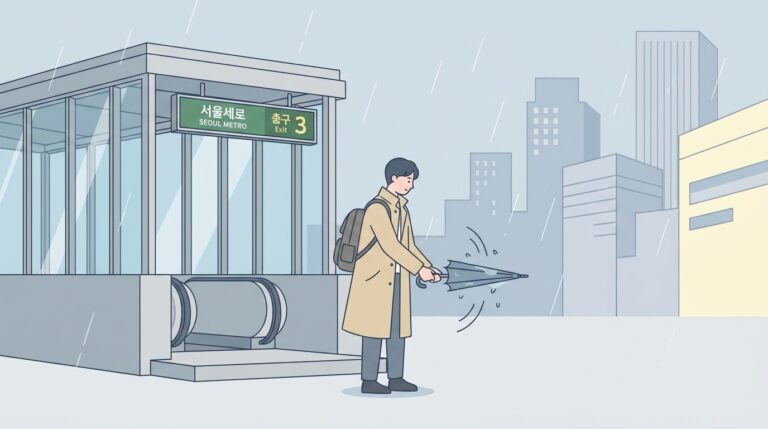
Have you ever watched a cozy K-Drama scene where two leads share a bright yellow umbrella under soft Seoul city lights? It looks utterly dreamy—until you experience the reality of a rainy monsoon evening on Seoul Subway Line 2. Picture this: you sprint down the station steps to escape a sudden downpour, heart pounding, holding a dripping wet umbrella. You dash straight through the turnstiles and squeeze into a crowded subway car just before the sliding doors close with a chime.
Then, the atmosphere suddenly turns chilly. You notice quiet murmurs and subtle side-eyes. You look down, horrified: water dripping from your umbrella has formed a steady puddle directly onto the pristine white sneakers of the commuter beside you! The intense weight of Korean nunchi (social awareness) hits you all at once.
Don’t worry, my friend—we have all been there! Korean public transit is famed for being spotless, punctual, and remarkably considerate. Learning the simple etiquette of shaking rainwater off your umbrella (우산 빗물 털기) and picking up a few polite phrases will save you from major awkwardness. Based on real questions from our international learners at Daily Hangul, here is your definitive insider guide to navigating Korean transit on a rainy day with 100% confidence!
Phase 2: 핵심 표현 3선 심층 분석
Here are the top three survival expressions every commuter needs on a rainy day in Korea.
1. 우산 털고 타세요 (Usan teolgo taseyo)
- Pronunciation: [Oo-sahn teol-goh tah-seh-yoh] (Think of ‘teol’ like a quick flick of dust, echoing the English word ‘toll’ with a soft ‘uh’ sound)
- Meaning: “Please shake your umbrella before getting on.”
- Literal: Umbrella shake-and ride (honorific polite request).
- Nuance: A gentle reminder or public service guideline heard at bus doors and station entrances.
- K-Culture Moment: You will hear bus drivers or transit safety attendants say this over the microphone when sudden showers drench the streets of Seoul.
- Editor’s Insight: The verb 털다 (teolda) means to flick, shake, or brush off. Koreans use this dynamic verb not just for rugs or coats, but specifically for clearing water droplets before entering shared spaces.
- Situation Spectrum: Casual ⚠️ | Semi-formal ✅ | Formal ✅
- 🤔 Think About It: In your home country, do people actively shake off their umbrellas before boarding, or is it common to just walk right in?
2. 빗물 튀어서 죄송합니다 (Binmul twieoseo joesonghamnida)
- Pronunciation: [Been-mool twee-eo-seo joe-song-hahm-nee-dah] (Pronounce ‘twi’ like ‘tweet’ without the ‘t’ at the end)
- Meaning: “I’m sorry for splashing rainwater on you.”
- Literal: Rainwater splashed, so I am sorry.
- Nuance: The ultimate polite apology that defuses any irritation immediately if your wet umbrella accidentally brushes someone.
- K-Culture Moment: Seen frequently in slice-of-life K-Dramas when commuters squeeze past each other during humid July monsoon rushes.
- Editor’s Insight: Using 죄송합니다 (joesonghamnida) instead of 미안해요 (mianhaeyo) signals high respect and mature accountability in close public quarters.
- Situation Spectrum: Casual ⚠️ | Semi-formal ✅ | Formal ✅
- 🤔 Think About It: How does saying the exact reason for an apology (“rainwater splashed”) change how the other person receives your apology?
3. 우산 비닐 커버 씌워 주세요 (Usan binil keobeo ssuiwo juseyo)
- Pronunciation: [Oo-sahn bee-neel kuh-beo sshui-woh joo-seh-yoh] (Say ‘ssui’ by smiling and making a sharp ‘s-wee’ sound)
- Meaning: “Please put on an umbrella plastic cover / sleeve.”
- Literal: Umbrella vinyl cover put-on please.
- Nuance: A common prompt from building security guards, department store greeters, or subway staff.
- K-Culture Moment: Entering a trendy cafe or a department store in Gangnam or Hongdae, where a staff member gently points to the umbrella vinyl stand or pad.
- Editor’s Insight: While Seoul is transitioning toward eco-friendly fabric dryers, you will still see vinyl sleeves in many commercial buildings.
- Situation Spectrum: Casual ⚠️ | Semi-formal ✅ | Formal ✅
- 🤔 Think About It: Notice how loanwords like vinyl (비닐) and cover (커버) seamlessly blend into everyday conversational Korean!
Phase 3: 교과서 한국어 vs 진짜 한국어
Let’s see how standard textbook Korean compares to what real locals say on the platform.
Situation 1: Reminding a friend or passenger to dry their umbrella
- 📖 교과서 한국어 (Textbook Korean):
우산의 물기를 제거하십시오. (Usan-ui mulgireul jegeohasipsio.) — Please eliminate the moisture from the umbrella. - 🗣️ 진짜 한국어 (Real Korean):
우산 물기 좀 털고 타요! (Usan mulgi jom teolgo tayo!) — Let’s shake the water off our umbrellas before getting on! - 💡 왜 다를까? (Why is it different?):
The textbook phrase sounds like a robotic laboratory instruction. Locals use the softening word 좀 (jom, ‘a little’) combined with the friendly inclusive ending ~타요 (tayo) to sound warm rather than bossy.
Situation 2: When your wet umbrella accidentally touches a stranger’s trousers
- 📖 교과서 한국어 (Textbook Korean):
저의 젖은 우산이 닿았으니 사과드립니다. (Jeo-ui jeojeun usani dahasseuni sagwadeurimnida.) — My wet umbrella touched you, so I offer an apology. - 🗣️ 진짜 한국어 (Real Korean):
앗, 죄송합니다! 물이 묻었죠? (At, joesonghamnida! Muri mudeotjyo?) — Oh, I’m so sorry! Did water get on you? - 💡 왜 다를까? (Why is it different?):
Spontaneous human interaction starts with natural exclamations like 앗 (at, ‘oops!’). Checking if water rubbed off demonstrates sincere empathy rather than formal legalistic phrasing.
Phase 4: K-Culture 딥다이브 & 비언어적 매너
4-1. 눈치 (Nunchi) & Non-Verbal Gestures
- The 3-Tap Ground Flick: Before crossing the threshold onto a bus or through the subway turnstiles, tap the tip of your long umbrella lightly against the exterior pavement 2 or 3 times while gently spinning it downward. This removes 80% of excess water without flinging drops onto pedestrians.
- The Vertical Clamp: Once inside the train car, hold your long umbrella vertically between your feet, resting the tip lightly on your shoe or keeping it close to your shins. Never sling a wet umbrella horizontally over your forearm or lean it against an empty seat—it will drench someone’s clothes instantly!
- Eye Contact & Slight Bow: If you hear someone rustling an umbrella near you, offering a micro-nod (a 15-degree head dip) acknowledges their presence and signals mutual courtesy.
4-2. Culture Code: From Plastic Sheaths to Eco-Dryers
For decades, Seoul subway stations provided thousands of single-use plastic umbrella bags (우산 비닐). However, in an effort to combat plastic waste, the Seoul Metropolitan Government introduced 우산 빗물 털이개 (rainwater umbrella shakers/dryers). These are tall, rectangular stands lined with ultra-absorbent microfiber carpets. When you enter the station, you simply slide your umbrella back and forth 3 to 4 times between the carpet pads. Doing this with practiced ease is the ultimate hallmark of a seasoned Seoulite!
Phase 5: 실전 롤플레이 시나리오
Setting: A stormy evening at Gangnam Station, Subway Line 2. The train car is packed with commuters heading home. You rush in just as the chimes ring.
Characters:
* You: A traveler trying to keep your balance with a soaking-wet long umbrella.
* Min-jun (민준): A sharp, fashion-conscious Seoul office worker wearing immaculate white designer sneakers.
- Turn 1 (Min-jun):
🎭 Looking down at his shoes as drops of water splatter on them, flinching slightly.
저기요, 우산에서 물이 계속 떨어지는데요… (Jeogiyo, usaneseo muri gyesok tteoreojineundeyo…)
“Excuse me, water keeps dripping from your umbrella…” -
Turn 2 (You):
🎭 Gasping in realization and pulling the umbrella closer between your legs.
앗, 정말 죄송합니다! 제가 우산 물기를 못 털었어요. (At, jeongmal joesonghamnida! Jega usan mulgireul mot teoreosseoyo.)
“Oh, I’m so sorry! I didn’t get to shake the water off my umbrella.” -
Turn 3 (Min-jun):
🎭 Expression softening as he sees your sincere apology, adjusting his stance.
비가 갑자기 많이 오긴 하죠. 우산 몸 쪽으로 바짝 붙여주세요. (Biga gapjagi mani ogin hajyo. Usan mom jjogeuro bajjak buchyeojuseyo.)
“It did suddenly pour outside. Please hold your umbrella close to your body.” -
Turn 4 (You):
🎭 Tucking the umbrella tightly between your shins and holding it firmly by the handle.
네, 이렇게 잡고 있을게요. 신발 안 젖으셨어요? (Ne, ireoke japgo isseulgeyo. Sinbal an jeojeusyeosseoyo?)
“Yes, I’ll hold it like this. Did your shoes get wet?” -
Turn 5 (Min-jun):
🎭 Checking his sneakers with a faint smile.
다행히 조금만 튀었어요. 괜찮습니다. (Dahaenghi jogeumman twieosseoyo. Gwaenchanseumnida.)
“Fortunately, just a tiny splash. It’s alright.” -
Turn 6 (You):
🎭 Taking out a tissue packet from your pocket and offering one politely.
휴지 좀 드릴까요? 닦으실래요? (Hyuji jom deurilkkayo? Dakkkeusillaeyo?)
“Would you like some tissues? Would you like to wipe it?” -
Turn 7 (Min-jun):
🎭 Nodding gratefully, taking the tissue.
감사합니다! 배려해 주셔서 다행이네요. (Gamsahamnida! Baeryeohae jusyeoseo dahaengineyo.)
“Thank you! That is very kind and considerate of you.” -
Turn 8 (You):
🎭 Bowing your head slightly with a warm, relieved smile.
조심히 들어가세요! (Josimhi deureogaseyo!)
“Get home safely!”
🔀 인터랙티브 분기점 (Interactive Branching)
What do you do if you notice your umbrella is soaking wet on a crowded train?
- Choice A: Lean your wet umbrella against the metal partition or the seat next to you.
- Choice B: Pull the umbrella upright right between your shoes and hold it tightly with both hands.
- Choice C: Shake your umbrella inside the train car to dry it off.
👉 Click to see the feedback for each choice!
- Choice A [RISK]: Leaning your wet umbrella spreads a puddle across the floor and might slide onto seated passengers’ feet. They will give you direct nunchi stares!
- Choice B [BEST]: Perfect execution! Keeping the umbrella centered between your feet minimizes horizontal contact and keeps drops confined to your own perimeter.
- Choice C [BAD]: Major transit offense! Shaking an umbrella inside a closed vehicle will splash everyone around you and invite immediate vocal complaints.
Phase 6: 10초 감정 섀도잉 드릴 (10-Second Shadowing Drill)
Practice reading these aloud with feeling! Follow the slashes / for brief natural pauses.
[🥺 죄송하고 다급하게 - Apologetic & Urgent]
앗, / 빗물 튀어서 / 정말 죄송합니다!
(At, / binmul twieoseo / jeongmal joesonghamnida!)
“Oops, / I’m so sorry / for splashing rainwater!”-
[😊 친절하고 배려 깊게 - Friendly & Thoughtful]
우산 물기 / 털고 탈게요! / 조금만 비켜주세요.
(Usan mulgi / teolgo talgeyo! / Jogeumman bikyeojuseyo.)
“I’ll shake the umbrella water off / before getting on! / Please excuse me for just a moment.” -
[🤝 정중하고 차분하게 - Polite & Calm]
신발 젖으셨을까 봐 / 걱정했어요. / 휴지 쓰실래요?
(Sinbal jeojeusyeosseulkka bwa / geokjeonghaesseoyo. / Hyuji sseusillaeyo?)
“I was worried / your shoes might have gotten wet. / Would you like to use a tissue?”
Phase 7: K-Culture 미니 사전 (Core Keywords)
- 빗물 털이개 (Binmul teorisae) | Rainwater umbrella shaker / dryer pad
- The rectangular stands with blue or grey microfiber carpet pads installed at subway station entrances. You slide your wet umbrella through them to dry it quickly.
- 눈치 (Nunchi) | Situational social radar / tact
- The intuitive skill of sensing what others around you are feeling. On rainy public transit, high nunchi means anticipating where your wet umbrella might bother someone before they complain.
- 뚜벅이 (Ttubeogi) | Public transit commuter / urban walker
- A charming Korean slang term for someone who doesn’t own a car and relies entirely on walking, subways, and buses. Rainy days are the ultimate test for proud ttubeogis!
- 장마철 (Jangmacheol) | Summer monsoon rainy season
- Usually lasting from late June to late July across Korea. It brings torrential, humid downpours where smart umbrella etiquette is an everyday essential.
Phase 8: 여행자를 위한 생존 키트 (Traveler’s Survival Kit)
TOP 3 Survival Phrases
- 우산 비닐 어디 있어요? (Usan binil eodi isseoyo?)
- Pronunciation: [Oo-sahn bee-neel uh-dee eess-uh-yoh?]
- Pro Tip: Use this when entering shopping malls or government buildings where umbrella stands might be tucked behind the automatic doors.
- 물기 털고 타실게요! (Mulgi teolgo tasilgeyo!)
- Pronunciation: [Mool-gee teol-goh tah-sheel-geh-yoh!]
- Pro Tip: Often heard shouted rhythmically by bus operators in downpours: “Let’s shake off the water before boarding!”
- 발밑에 둘게요 (Balmite dulgeyo)
- Pronunciation: [Bahl-meet-eh dool-geh-yoh]
- Pro Tip: Tell this to your seat neighbor to reassure them: “I’ll keep it down by my feet.”
Editor’s Travel Note
When traveling around Seoul during rainy weather, remember to download the KakaoMap subway transit tracker for real-time bus arrivals and indoor subway exit paths so you don’t get stuck walking outside in the downpour. Also, foldable compact umbrellas (3단 우산) are much easier to tuck into a waterproof zip-lock pouch in your backpack compared to long stick umbrellas!
Phase 9: “한 발 더 깊이” (A Step Deeper)
Korea is one of the most densely populated, hyper-connected societies in the world, with millions moving through the Seoul metropolitan subway network daily. In such confined communal spaces, personal freedom is naturally balanced by a deep collective responsibility (공공장소 배려). Shaking your umbrella dry isn’t just about avoiding a wet floor—it symbolizes an unspoken social contract: “I see you, I respect your space, and I won’t let my rainy day ruin yours.”
💬 Your Turn: Have you ever experienced a moment where small public manners like this made you feel warmly welcomed or surprised in Korea? Share your story in the comments below!
Phase 10: FAQ & 오해 방지 (FAQ Schema)
Q: What should I do if a subway station doesn’t have plastic bags or umbrella dryers?
A: Simply step to the side of the entrance stairs outside the fare gates, point the tip of your umbrella down, and gently tap the tip against the ground 2-3 times while rotating it. Then, roll it up and fasten the Velcro strap tightly before tapping your transit card.
Q: Can I bring a dripping wet umbrella onto a city bus?
A: City buses have less floor space than subway trains, making wet umbrellas even more hazardous. Many bus drivers will explicitly ask passengers to shake umbrellas before stepping on. It is best to shake it thoroughly and wrap the strap closed before the bus arrives at the curb.
Q: Is it rude to rest a wet umbrella on the empty seat next to me?
A: Yes, absolutely! Leaving a wet umbrella on cloth or plastic seats leaves puddles for the next passenger and is considered a major breach of transit etiquette. Always keep it between your legs or in your hands.
🚨 흔한 실수 (Common Mistakes) TOP 3
- Mistake 1: Shaking an umbrella vigorously side-to-side in a crowd.
- Correct Action: Keep the umbrella pointed down and shake it with short, downward vertical flicks.
- Mistake 2: Carrying an unfastened umbrella loosely.
- Correct Action: Fasten the umbrella strap tightly. A secured umbrella traps remaining moisture inside its folds instead of brushing against strangers.
- Mistake 3: Holding a long umbrella horizontally under your arm like a baguette.
- Correct Action: Keep it strictly vertical. Pointing an umbrella horizontally turns the sharp tip into a hazard for people walking behind you.
Phase 11: 액션 미션 & 참여 유도 (Action Missions)
- 🥉 Bronze Mission (Solo Practice): Stand in front of your bathroom mirror with an umbrella. Practice saying “앗, 빗물 튀어서 죄송합니다!” with a sincere apologetic expression 3 times.
- 🥈 Silver Mission (Social Sharing): On your next rainy day, take a photo of an umbrella dryer or your neatly fastened umbrella and post it to Instagram or X with the hashtag
#DailyHangulManners! - 🥇 Gold Mission (Real-World Execution): Next time you board a bus or subway in Korea during rain, practice the 3-tap ground flick and fasten your umbrella before entering the turnstile!
🎮 K-Culture Mission: Watch an episode of a recent slice-of-life K-Drama (like My Liberation Notes or Hospital Playlist). Pay close attention to how background characters hold their umbrellas when entering subway stations!
Phase 12: 인터랙티브 퀴즈 챌린지 (Interactive Quiz Challenge)
Test your knowledge before you step out into the Seoul rain!
Question 1. Situational Judgment
You are boarding a crowded bus in Hongdae. What should you do with your wet umbrella before stepping inside?
1. Open and close it rapidly inside the bus doorway.
2. Tap the tip against the ground outside, shake it gently, and tie the strap shut.
3. Hold it horizontally so it dries in the breeze.
🔎 Click to reveal Answer & Explanation
Answer: 2
Explanation: Shaking the umbrella downward outside and tying the strap prevents puddles on the bus floor and protects passengers from wet brush-ins.
Question 2. Fill-in-the-Blank
Fill in the missing word:
“우산 물기 좀 _____ 타요!” (Let’s shake the umbrella water off before boarding!)
1. 먹고 (meokgo)
2. 털고 (teolgo)
3. 자고 (jago)
🔎 Click to reveal Answer & Explanation
Answer: 2. 털고 (teolgo)
Explanation: 털다 means to shake or brush off particles or water droplets. 털고 타요 means “shake off and ride!”
Question 3. True or False
True or False: It is acceptable to rest your damp umbrella on the empty seat beside you if no one is currently sitting there.
🔎 Click to reveal Answer & Explanation
Answer: False (X)
Explanation: Damp umbrellas soak the seating fabric or leave slippery puddles on plastic seats, making them unusable for upcoming passengers. Always hold it vertically between your feet!







