

Caught in an Emergency? How to Report a Break-In in Korean Like a Local
Phase 1: Empathy (Real-Life Opening)
안녕하세요! 매일한글 에디터입니다.
Imagine this: You return to your cozy rental studio in Yeonnam-dong after a magical evening enjoying steaming street tteokbokki. You step into the quiet hallway and reach for the digital door keypad. But wait—the latch is open, the lock has visible scratch marks, and inside, your room is completely turned upside down. Your laptop bag is gone. Your heart hammers against your ribs. What do you do?
Most traditional textbooks teach stiff, formal lines like “절도 사건이 발생했습니다” (A larceny case has occurred). But in a real-life crisis when adrenaline spikes, you need punchy, natural words to alert neighbors and call the police without stumbling. Over the past decade guiding international students and expats in Seoul, I have walked many friends through unexpected emergencies. Learning these immediate phrases will give you genuine peace of mind and the practical power to protect yourself in Korea.
Phase 2: Core 3 Expressions Breakdown
Here are the three most critical expressions you need when reporting a break-in or theft:
1. 도둑 들었어요! (Doduk deureosseoyo!)
- Pronunciation: [Doduk deureosseoyo] (Sounds like: “Doe-dook dew-ruh-ssaw-yo”)
- Meaning: Literal: “A thief entered!” | Real nuance: “Someone broke into my place! / There’s been a burglary!”
- K-Culture Moment: You hear this in suspenseful K-Dramas whenever a character comes home to an open door, dropped groceries, and ransacked drawers.
- Editor’s Insight: The verb 들다 (deulda) literally means “to enter” or “to get in.” In Korean, rather than saying “my house was burglarized,” you declare the arrival of the intruder.
- Situation Spectrum: Casual: ✅ | Semi-formal: ✅ | Formal: ⚠️ (Use ‘도둑이 들었습니다’ for formal police statements)
- 🤔 Think About It: English focuses on the victim (“I got robbed”), while Korean often states the objective occurrence (“A thief entered”). Why do you think Korean spotlights the event rather than centering on the speaker?
2. 지갑을 도둑맞았어요. (Jigabeul dodukmajasseoyo.)
- Pronunciation: [Jigabeul dodukmajasseoyo] (Sounds like: “Jee-gahb-eul doe-dook-mah-jah-ssaw-yo”)
- Meaning: Literal: “I was hit by a thief regarding my wallet.” | Real nuance: “My wallet got stolen.”
- K-Culture Moment: The moment a traveler at a crowded traditional market pats their back pocket and realizes their belongings vanished.
- Editor’s Insight: The verb 도둑맞다 (dodukmatda) combines doduk (thief) and matda (to be struck by/to undergo an adversity). It expresses that you suffered a theft.
- Situation Spectrum: Casual: ✅ | Semi-formal: ✅ | Formal: ✅
- 🤔 Think About It: In Korean, experiencing bad fortune often involves the verb matda (to receive/be struck). Does your native language view theft as something done to you or something you lost?
3. 경찰 좀 불러주세요! (Gyeongchal jom bulleojuseyo!)
- Pronunciation: [Gyeongchal jom bulleojuseyo] (Sounds like: “Gyung-chahl johm bool-luh-joo-seh-yo”)
- Meaning: Literal: “Please call the police a bit!” | Real nuance: “Please call the police right now!”
- K-Culture Moment: Shouted to bystanders or convenience store clerks when an urgent crime or chase happens in an urban thriller.
- Editor’s Insight: Even in an emergency, Koreans naturally slip in 좀 (jom – a little/please). It softens the command into a desperate plea for help rather than a blunt order.
- Situation Spectrum: Casual: ⚠️ | Semi-formal: ✅ | Formal: ✅
- 🤔 Think About It: Why does Korean retain polite softeners like ‘좀’ even during high-stress moments? It reflects how deeply ingrained politeness is across all levels of Korean social interaction.
Phase 3: Textbook Korean vs Real Korean
Situation 1: Calling out for help to bystanders
- 📖 교과서 한국어: 누군가 제 물건을 훔쳤으니 경찰에 신고하십시오. (Nugunga je mulgeoneul humchyeosseuni gyeongchare singohasipsio.)
- 🗣️ 진짜 한국어: 저기요, 도둑이야! 경찰 좀 불러주세요! (Jeogiyo, dodugiya! Gyeongchal jom bulleojuseyo!)
- 💡 왜 다를까?: In real emergencies, Koreans drop long subordinate clauses and high-formality suffixes. Instead, they yell “도둑이야!” (Thief!) to command instant attention.
Situation 2: Telling your building manager the room was ransacked
- 📖 교과서 한국어: 주거 침입 흔적이 발견되었습니다. (Jugeo chim-ip heunjeogi balgyeondweeosseumnida.)
- 🗣️ 진짜 한국어: 문이 열려 있고 방이 엉망이에요. 도둑 든 것 같아요. (Muni yeollyeo itgo bang-i eongmang-ieyo. Doduk deun geot gatayo.)
- 💡 왜 다를까?: Real speakers describe what they physically see (door left open, room messy) rather than quoting penal code legal definitions like 주거 침입 (residential trespassing).
Phase 4: K-Culture Deep Dive & Non-verbal Manners
4-1. 눈치 (Nunchi) & Emergency Gestures
If you discover a break-in in Korea, do not touch anything inside. Preserving the crime scene (현장 보존, hyeonjang bojon) is critical for fingerprint and forensic verification by the police. When seeking assistance from a Korean neighbor or building supervisor:
* Body Language: Step outside the doorway, keep your hands visible, and avoid pointing aggressively. Slightly bow your upper body while asking for help to communicate urgency without sounding confrontational.
* Eye Contact: Maintain direct, serious eye contact. In Korea, steady eye contact combined with a lowered voice signals that something grave has occurred.
4-2. Culture Code: Safety Culture & The Digital Doorlock
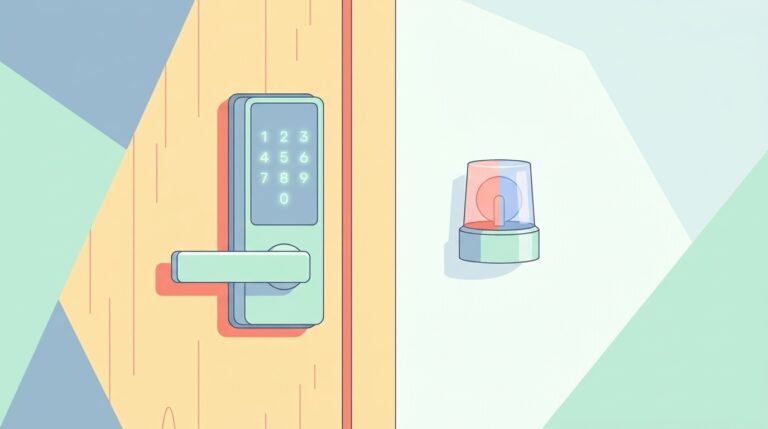
South Korea is globally famous for safe streets where people leave laptops unattended at cafes. However, residential break-ins can still happen, especially in low-rise multi-family buildings (빌라, villa) or rooftop units (옥탑방, oktapbang). Almost every Korean front door uses a digital keypad (doorlock). If your door lock makes unusual beeping sounds or shows tamper warnings, you should immediately notify your landlord before trying to reset it yourself.
Phase 5: Real-World Roleplay Scenario
Setting: Mark (an international exchange student) returns to his first-floor studio in Mapo-gu. He finds his digital lock scratched open and meets his building manager, Mr. Min-jun, in the hallway.
- Turn 1 (Mark): 아저씨! 큰일 났어요. 저 좀 도와주세요. (Ajeossi! Keunil nasseoyo. Jeo jom dowajuseyo.)
🎭 [Paling, waving his hands nervously toward his door]
“Mister! There’s big trouble. Please help me!” - Turn 2 (Min-jun): 마크 씨, 왜 그래요? 무슨 일 있어요? (Mark-ssi, wae geuraeyo? Museun il isseoyo?)
🎭 [Putting down his cleaning broom with a surprised face]
“Mark, what’s the matter? Did something happen?” - Turn 3 (Mark): 집에 도둑이 든 것 같아요. (Jibe dodugi deun geot gatayo.)
🎭 [Pointing at the scratched electronic door lock]
“I think someone broke into my home.” - Turn 4 (Min-jun): 뭐요? 도둑이요? 안에 누구 있어요? (Mwoyo? Dodugiyo? Ane nugu isseoyo?)
🎭 [Eyes widening, stepping closer to inspect the lock]
“What? A burglar? Is anyone inside?” - Turn 5 (Mark): 잘 모르겠어요. 방 안이 엉망이에요. (Jal moreugesseoyo. Bang ani eongmang-ieyo.)
🎭 [Shaking his head with trembling hands]
“I’m not sure. The room is completely ransacked.” - Turn 6 (Min-jun): 일단 안에 들어가지 마세요! 제가 112에 전화할게요. (Ildan ane deureogaji maseyo! Jega 112-e jeonhwahalgeyo.)
🎭 [Firmly stopping Mark with his arm and whipping out his phone]
“First of all, do not go inside! I will call 112.” - Turn 7 (Mark): 네, 알겠습니다. 경찰 좀 빨리 불러주세요. (Ne, algetseumnida. Gyeongchal jom ppalli bulleojuseyo.)
🎭 [Nodding respectfully, stepping back into the hallway]
“Yes, understood. Please call the police quickly.” - Turn 8 (Min-jun): 걱정 마요. 경찰 금방 올 거예요. (Geokjeong mayo. Gyeongchal geumbang ol geoyeyo.)
🎭 [Gently tapping Mark’s shoulder to calm him down]
“Don’t worry. The police will be here in no time.”
🔀 Interactive Decision Point
Now, Mr. Min-jun is dialing the police. What should Mark do while waiting?
- Option A: “제가 먼저 들어가서 없어진 물건 확인할게요!” (I will go in first and check what’s missing!)
- Feedback (Risk): 🚫 Danger! The intruder might still be inside, or you could erase fingerprint evidence. Never enter a burglarized room alone!
- Option B: “네, 복도에서 같이 기다릴게요.” (Yes, I will wait with you in the hallway.)
- Feedback (Best): ✅ Perfect! Staying in a well-lit, public hallway preserves evidence and ensures your personal safety.
- Option C: “경찰 부르지 말고 그냥 내일 방 뺄게요.” (Don’t call the police, I’ll just move out tomorrow.)
- Feedback (Bad): ⚠️ Not recommended! Without a formal police report (사건접수), you cannot claim insurance or legally resolve your lease deposit.
Phase 6: 10-Second Emotion Shadowing Drill
Read these out loud, pausing briefly at each slash (/) and matching the emotional cues:
[😨 Panicked and Out of Breath]
“저기요! / 도둑이 든 것 같아요! / 도와주세요!”
(Jeogiyo! / Dodugi deun geot gatayo! / Dowajuseyo!)-
[🚨 Firm and Urgent]
“지갑을 도둑맞았어요. / 경찰 좀 / 불러주세요!”
(Jigabeul dodukmajasseoyo. / Gyeongchal jom / bulleojuseyo!) -
[📞 Calmly Reporting on the Phone]
“여기는 마포구인데요, / 방 안에 / 누가 들어왔어요.”
(Yeogineun Mapogu-indeoyo, / bang ane / nuga deureowasseoyo.)
Phase 7: K-Culture Mini Dictionary
- 도둑 (Doduk) | Noun | Burglar / Thief.
Usage: General term for an intruder or thief; often used in expressions like doduk-i deulda (a thief breaks in). - 신고 (Singo) | Noun | Official Report / Crime Notification.
Usage: Used whenever notifying authorities: 112-e singohada (report to the police) or yushilmul singo (report lost property). - 엉망 (Eongmang) | Noun / Adverb | Mess / Chaos / In shambles.
Usage: Commonly used as “방이 엉망이에요” (the room is a total wreck) to describe a searched or disordered space. - 도어락 (Doeo-rak) | Noun | Digital Door Lock.
Usage: The ubiquitous electronic keypad found on modern Korean apartments and studios.
Phase 8: Survival Kit for Travelers
TOP 3 Survival Expressions
- 112에 신고해 주세요. (112-e singo-hae juseyo.)
Meaning: “Please report this to 112 (Police).”
Pro Tip: 112 is the universal police number in Korea. They provide interpretation support for foreign callers! - 문이 부서졌어요. (Muni buseojyeosseoyo.)
Meaning: “The door is broken / damaged.”
Pro Tip: Use this to explain that physical force was used to enter your room. - 도둑맞은 것 같아요. (Dodukmajeun geot gatayo.)
Meaning: “I think my items were stolen.”
Pro Tip: Clarifies to officers that your belongings didn’t simply go missing on their own.
Editor’s Travel Note
- Emergency SMS Service: Did you know you can send an English text message directly to
112? Learn more on the 경찰청 112 문자 신고 안내 portal. - Know Your Road Address: Dispatchers will always ask for your current location. Open the 네이버 지도 앱 다운로드 page to keep your exact Korean road-name address (도로명 주소) readily available on your phone.
Phase 9: One Step Deeper
Korea boasts one of the most effective community policing models in the world, often described as gongdongche chian (공동체 치안). In neighborhoods, local convenience stores function as designated safe shelters for women and foreigners in danger, marked with bright emergency bell signs. While Korea’s overall crime rate is remarkably low, the society responds with intense collective urgency when an intrusion occurs. Knowing how to communicate clearly triggers an immediate protective response from building managers, shopkeepers, and local police officers alike.
💬 Your Turn: Have you ever experienced an emergency while traveling abroad? What words were hardest to find? Share your thoughts or practice sentences in the comments below!
Phase 10: FAQ & Common Mistakes
Q: Can I text 112 in English if I cannot speak Korean well?
A: Yes, absolutely! If you send an SMS to 112 in English with your address and photos of the scene, the Korean National Police Agency will route your message through translation coordinators.
Q: What is the exact difference between 잃어버렸어요 and 도둑맞았어요?
A: 잃어버렸어요 (Ireobeoryeosseoyo) means “I lost it” through your own negligence. 도둑맞았어요 (Dodukmajasseoyo) means someone intentionally stole it from you. Never say 잃어버렸어요 to the police if you want to report a theft!
Q: What should I do if I find my hotel or Airbnb door unlocked?
A: Do not explore the room alone. Immediately inform the host or reception by saying: “문이 열려 있었어요. 확인해 주세요” (The door was open. Please check it).
🚨 Common Mistakes Warning Board
- Mistake: Saying “도둑을 당했어요” (Literal translation of ‘I was burglarized’).
👉 Correct Action: Say “도둑이 들었어요” (A thief entered) or “도둑맞았어요” (I suffered a theft). - Mistake: Dialing 119 for burglary reports.
👉 Correct Action: 119 is for fire and medical ambulances. Dial 112 for police emergencies. - Mistake: Cleaning up scattered belongings before the police arrive.
👉 Correct Action: Say “현장을 보존해야 해요” (We must preserve the scene) and wait outside.
Phase 11: Action Mission & Engagement
- 🥉 Bronze Mission (Solo Practice): Stand in front of your mirror and practice saying: “도둑이 들었어요! 경찰 좀 불러주세요!” 3 times with an urgent facial expression.
- 🥈 Silver Mission (Social Sharing): Leave a comment below with your favorite Korean city and write one sentence reporting a missing item (e.g., “서울에서 지갑을 도둑맞았어요”).
- 🥇 Gold Mission (Real Simulation): Open your voice memo app and record a mock 15-second call to 112 stating your current neighborhood and the problem.
- 🎮 K-Culture Mission: In your next K-Drama binge, listen closely for the word 신고 (singo) or 도둑 (doduk) whenever a crime storyline unfolds!
Phase 12: Interactive Quiz Challenge
Test what you learned today! Click on the toggle boxes below to check your answers.
1. Situation Judgment
You enter your guesthouse and find your backpack missing and the window broken. What is the most natural sentence to say to the host?
* (A) 가방을 잃어버렸어요. 청소해 주세요.
* (B) 방에 도둑이 든 것 같아요. 경찰 좀 불러주세요.
* (C) 경찰관이 되어서 기뻐요.
Click to view Answer & Explanation
Correct Answer: (B)
Explanation: (B) accurately states that a thief seems to have broken in (도둑이 든 것 같아요) and asks to call the police (경찰 좀 불러주세요). (A) means you merely lost it, and (C) means you are happy to become a police officer!
2. Fill-in-the-Blank
Complete the sentence to mean: “Please call the police!”
“경찰 ____ 불러주세요!”
Click to view Answer & Explanation
Correct Answer: 좀 (jom)
Explanation: “경찰 좀 불러주세요!” is the quintessential polite yet urgent way Koreans plead for someone to call the police.
3. Cultural True or False
True or False: In South Korea, dialing 119 connects you to the police department for reporting burglaries.
Click to view Answer & Explanation
Correct Answer: False
Explanation: In Korea, 112 is for police matters (theft, break-ins, crime). 119 is strictly for fire, rescue, and medical ambulances.







