

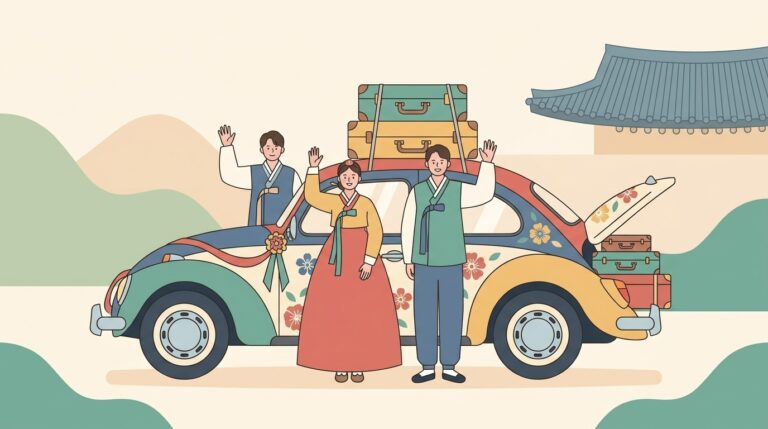
Phase 1: Empathy (Story-Immersive Opening)
안녕하세요! 매일한글 에디터입니다.
Imagine this: You are standing inside a bustling Gangnam wedding hall. The clock just struck 2:15 PM. Less than an hour ago, your close Korean coworker or dear college friend was walking down a flower-strewn aisle in a voluminous white dress or a tailored tuxedo. Now, the official ceremony is over, but instead of leisurely sipping champagne and partying until midnight, the newlyweds are literally sprinting. The bride is hastily pulling dozens of metal bobby pins from her hair in the dressing room, the groom is swapping his shiny patent shoes for comfortable sneakers, and a decorated sedan with ribbons and luggage in the trunk is idling by the venue curb.
Yes, welcome to the quintessential Korean wedding finale: heading straight from the wedding hall to Incheon Airport for the honeymoon (신혼여행 – sinhonyeohaeng)!
If you have watched K-dramas like Because This Is My First Life or Business Proposal, you might have chuckled at these breathless post-wedding scenes. But as a foreign guest or close friend attending in real life, it can feel utterly bewildering. When do you say goodbye? Why does everyone seem in such a rush? What words should you offer as they dive into the back seat of a taxi?
Many of our intermediate learners tell us: “I prepared a long, poetic congratulatory speech, but by the time I walked up to the couple, they had three minutes before their airport shuttle left! I froze.” Don’t worry! This guide is built directly on real feedback from expats and learners navigating Korean weddings. By the end of this lesson, you will master the exact words, rhythm, and etiquette needed to send the happy couple off gracefully—without feeling awkward or holding up their flight.
Phase 2: Core Expressions Deep Dive
Here are three essential expressions you will hear and use when a couple wraps up their wedding and heads directly to their honeymoon.
1. 잘 다녀오겠습니다! (Jal danyeo-ogessseumnida!)
- Pronunciation: [Jal dahn-yeo-o-get-seum-ni-da] (Pronounce danyeo like “tahn-yuh”, and give a crisp, decisive snap to get-seum-nee-dah).
- Meaning: Literal: “I will go well and return!” | Nuance: “We’re off! We promise to return safe, sound, and happily married.”
- K-Culture Moment: The bride and groom bow to their parents and turn to wave enthusiastically to friends right before shutting the car door at the venue driveway.
- Editor’s Insight: In Western weddings, couples often say “We’re leaving!” or “Off to Paris!” But Koreans almost always pair leaving with returning (다녀오다). It is a linguistic anchor of care and responsibility toward the community left behind.
- Situation Spectrum: Casual: 잘 다녀올게! (Jal danyeoolge!) ⚠️ | Semi-formal: 잘 다녀올게요! (Jal danyeoolgeyo!) ✅ | Formal: 잘 다녀오겠습니다! (Jal danyeo-ogessseumnida!) ✅
- 🤔 Think About It: Why do you think Korean farewells place so much emphasis on the promise of coming back safely rather than just celebrating the departure?
2. 오늘 와 주셔서 정말 감사해요! (Oneul wa jusyeoseo jeongmal gamsahaeyo!)
- Pronunciation: [Oh-neul wah joo-syeo-seo jeong-mahl gahm-sah-hae-yo] (Glide wa ju smoothly together: wah-joo-shuh-suh).
- Meaning: Literal: “Thank you truly for coming today.” | Nuance: “Your presence meant the world to us; thank you so much for taking time out of your weekend to celebrate us.”
- K-Culture Moment: The couple speed-walks through the buffet dining hall in modern hanbok or neat semi-formal suits, shaking hands and making eye contact with guests before rushing to change.
- Editor’s Insight: The honorific infix
-시-in주셔서acknowledges the effort the guest made. Attending a weekend wedding in Korea is a major social commitment involving traffic and monetary gift preparation (축의금 – chug-uigeum).- Situation Spectrum: Casual: 와 줘서 고마워! (Wa jwoseo gomawo!) ⚠️ (Only to same-age/younger close friends) | Semi-formal: 와 주셔서 감사해요! (Wa jusyeoseo gamsahaeyo!) ✅ | Formal: 참석해 주셔서 진심으로 감사드립니다. (Chamseokhae jusyeoseo jinsimeuro gamsadeurimnida.) ✅
- 🤔 Think About It: How does your native language verbally acknowledge the sacrifice of time someone made just to show up for your milestone?
3. 비행기 시간 때문에 먼저 일어날게요! (Bihaenggi sigan ttaemune meonjeo ireonalgeyo!)
- Pronunciation: [Bee-haeng-gi shee-gahn ddae-moo-neh meon-jeo ee-reo-nahl-geh-yo] (Tense the tt in ttae-mune like the sharp “t” in “star”).
- Meaning: Literal: “Because of airplane time, I will stand up first.” | Nuance: “We’d love to stay and chat more, but our flight departure is breathing down our necks!”
- K-Culture Moment: The couple is holding the hands of their favorite college circle at the venue entrance while glancing nervously at their wristwatches or Kakao T app.
- Editor’s Insight: Notice the verb
일어나다(to get up / stand up). In Korean social gatherings, politely announcing that you are “getting up first” (먼저 일어날게요) softens an abrupt departure far better than saying지금 갈게요(“I’m leaving now”).- Situation Spectrum: Casual: 비행기 때문에 먼저 갈게! (Bihaenggi ttaemune meonjeo galge!) ⚠️ | Semi-formal: 비행기 시간 때문에 먼저 일어날게요! (Bihaenggi sigan ttaemune meonjeo ireonalgeyo!) ✅ | Formal: 비행기 시간으로 인해 먼저 일어나 보겠습니다. (Bihaenggi sigan-euro inhae meonjeo ireona bogesseumnida.) ✅
- 🤔 Think About It: When leaving a party early in your culture, do you explain the physical reason (the flight) or apologize for breaking the mood?
Phase 3: Textbook Korean vs. Real Korean
Let’s see how real native speakers handle the rapid-fire energy of a post-wedding sendoff versus rigid textbook lines.
Situation 1: The couple saying goodbye to guests before hopping into the car
- 📖 Textbook Korean: “안녕히 계십시오. 저희는 떠납니다.” (Annyeonghi gyesipsio. Jeohuineun tteonamnida. – Goodbye. We are departing.)
- 🗣️ Real Korean: “저희 얼른 공항 가봐야 해서요, 다녀와서 연락드릴게요!” (Jeohui eolleun gonghang gabwaya haeseoyo, danyeowaseo yeollakdeurilgeyo! – We’ve got to dash to the airport, will reach out as soon as we’re back!)
- 💡 Why the difference: Nobody speaks like a train station announcer at their wedding! Real Koreans emphasize speed (
얼른 가봐야 해서) and promise post-trip reconnecting (다녀와서 연락드릴게요), which keeps the warmth alive.
Situation 2: The guest wishing the couple a rejuvenating honeymoon
- 📖 Textbook Korean: “즐거운 신혼여행을 즐기시기를 기원합니다.” (Jeulgeoun sinhon-yeohaeng-eul jeulgisigireul giwonhapnida. – I pray that you enjoy a delightful honeymoon.)
- 🗣️ Real Korean: “푹 쉬다 와요! 맛있는 거 많이 먹고 사진 보내요!” (Puk swida wayo! Masinneun geo mani meokgo sajin bonaeyo! – Rest up lots! Eat delicious food and send pictures!)
- 💡 Why the difference: Wedding preparation in Korea is notoriously exhausting (often referred to as ‘결혼 준비 전쟁’ – wedding prep warfare). Wishing them deep rest (
푹 쉬다 와요) shows real empathy for the grueling schedule they just completed.
Phase 4: K-Culture Deep Dive & Non-Verbal Manners
4-1. 눈치 (Nunchi) & Body Language: The 60-Second Parking Lot Send-off
When you see the couple changing into travel clothes, your nunchi (social situational radar) needs to activate.
* The Quick Handclasp & Half-Bow: When the couple comes over, do not trap them in a 10-minute storytelling session. Offer a warm two-handed handshake (두 손 악수) paired with a gentle nod/bow.
* The Wedding Favor Hand-off (답례품 – Dap-rye-pum): If you didn’t eat at the buffet, they might quickly thrust a gift box (often red ginseng, high-end cookies, or salt sets) into your hands. Accept it with two hands, smile, and say: “선물 감사해요, 얼른 차 타세요!” (Seonmul gamsahaeyo, eolleun cha taseyo! – Thank you for the gift, quickly get in the car!).
* Eye Contact and Luggage Space: Clear the path for the groomsmen or airport transfer drivers who are frantically loading 28-inch suitcases into the trunk.
4-2. Culture Code: The “Airport Fashion” (공항패션) Transformation
In Korea, “Airport Fashion” isn’t just for K-Pop idols strolling through Terminal 1. Newlyweds traditionally plan a coordinated “Honeymoon Departure Look.” In the venue bridal dressing room, the 40-pound beaded wedding gown and stiff three-piece tuxedo are swapped in under fifteen minutes for stylish matching linen sets, coordinated luxury sneakers, or sleek neutral athleisure. The car waiting outside might still sport a whimsical “Just Married” streamer or balloon cluster on the rear window, racing toward the Yeongjong Bridge highway to catch the evening flight to Bali, Hawaii, or Paris.
Phase 5: Real-Life Roleplay Scenario
Setting: Outside the main entrance of a wedding hall in Seocho-gu, Seoul. 2:50 PM.
Characters:
* Minho (민호): The groom, wearing clean white sneakers and a beige knit, checking his phone.
* Jiwon (지원): The bride, holding a mini crossbody bag with travel passports.
* Alex (알렉스): You, an intermediate-level international friend attending the wedding.
Minho: 알렉스 씨! 오늘 멀리까지 와 주셔서 진짜 감동했어요!
(Alex ssi! Oneul meollikkaji wa jusyeoseo jinjja gamdonghaesseoyo!)
🎭 Grasps Alex’s hand with both hands while smiling brightly.
“Alex! I’m genuinely touched you came all this way today!”
Alex: 민호 씨, 지원 씨, 두 사람 오늘 정말 빛났어요! 축하해요!
(Minho ssi, Jiwon ssi, du saram oneul jeongmal binnasseoyo! Chukahaeyo!)
🎭 Bows respectfully with a warm smile.
“Minho, Jiwon, you both were truly glowing today! Congratulations!”
Jiwon: 고마워요 알렉스 씨! 식사는 맛있게 하셨어요?
(Gomawoyo Alex ssi! Siksaneun masikke hasyeosseoyo?)
🎭 Adjusts her coat collar while looking apologetic.
“Thank you, Alex! Did you enjoy the meal at the buffet?”
Alex: 네, 갈비탕 정말 맛있었어요! 배부르게 잘 먹었습니다.
(Ne, galbitang jeongmal masisseosseoyo! Baebureuge jal meogeotseumnida.)
🎭 Pats stomach lightly to put the busy bride at ease.
“Yes, the short rib soup was delicious! I ate very well.”
Minho: 다행이네요! 저희 비행기 시간 때문에 지금 바로 인천공항 가봐야 해서요.
(Dahaeng-ineyo! Jeohui bihaenggi sigan ttaemune jigeum baro Incheon-gonghang gabwaya haeseoyo.)
🎭 Glances quickly at the driver loading suitcases into the black van.
“What a relief! We have to head straight to Incheon Airport right now due to our flight time.”
Jiwon: 더 이야기 나누고 싶은데 아쉬워요. 다녀와서 꼭 밥 사드릴게요!
(Deo iyagi nanugo sipeunde aswiwoyo. Danyeowaseo kkok bap sadeurilgeyo!)
🎭 Holds passport envelope tightly and offers a slight bow.
“I’m so sad we can’t chat longer. We’ll definitely treat you to a meal when we return!”
🔀 Interactive Branching Point: What should Alex say as the car door slides open?
- Option A: “조심히 잘 다녀오세요! 비행기 놓치실라, 얼른 타세요!” (Josimhi jal danyeo-oseyo! Bihaenggi notchisilla, eolleun taseyo!)
- Option B: “왜 벌써 가요? 오랜만에 친구들 다 모였는데 2차 맥주 한잔하러 가요!” (Wae beolsseor gayo? Orenmane chingudeul da moyeonneunde icha maekju hanjanhareo gayo!)
- Option C: “안녕히 가십시오. 결혼을 축하했습니다. 평생 잊지 않겠습니다.” (Annyeonghi gasipsio. Gyeolhoneul chukahaesseumnida. Pyeongsaeng itji ankessseumnida.)
Feedback:
* Option A [BEST]: Perfect balance of care, consideration, and cultural wit! You release them from social duty with warmth: “Have a safe, wonderful trip! Don’t miss your flight, hurry inside!”
* Option B [BAD]: Major nunchi failure! Suggesting the couple go for “Round 2 beers” right before their international honeymoon will induce absolute panic and awkward excuses.
* Option C [RISK]: Overly dramatic and archaic! Saying “I will never forget this wedding for the rest of my life” in ultra-formal speech sounds like you are parting during a war drama.
Phase 6: 10-Second Emotion Shadowing Drill
Practice reading these lines aloud with the emotional cues and pause marks (/).
[😊 다급하지만 벅찬 목소리로 - Hurried yet elated]
“저희 / 비행기 시간 때문에 / 먼저 일어날게요! / 다녀와서 / 꼭 연락드릴게요!”
(Jeohui / bihaenggi sigan ttaemune / meonjeo ireonalgeyo! / Danyeowaseo / kkok yeollakdeurilgeyo!)-
[✈️ 진심을 담아 따뜻하게 - Warm and encouraging]
“오늘 너무 멋졌어요! / 푹 쉬다 오시고 / 조심히 잘 다녀오세요!”
(Oneul neomu meotjyeosseoyo! / Puk swida osigo / josimhi jal danyeo-oseyo!) -
[🥺 아쉽지만 배려 깊게 - Regretful yet considerate]
“더 길게 얘기 못 해서 아쉽지만, / 차 막히기 전에 / 얼른 출발하세요!”
(Deo gilge yaegi mot haeseo aswijiman, / cha makhigi jeone / eolleun chulbalhaseyo!)
Phase 7: K-Culture Mini Dictionary
-
웨딩카 (Wed-ding-ka) | Noun: Decorated Wedding Car
Historically decorated with ribbons and soda cans, modern Korean wedding cars are typically high-end black sedans or large vans rented specifically for the direct commute from the wedding hall to Incheon International Airport. -
답례품 (Dap-rye-pum) | Noun: Return Favor / Thank-You Gift
A curated token of appreciation handed to guests who attended the wedding but could not stay to eat the banquet meal, or distributed immediately following the event. -
공항패션 (Gong-hang-pae-syeon) | Noun: Airport Fashion
The comfortable yet photogenic travel outfits newlyweds change into at the venue immediately after greeting their final guests. -
피로연 (Pi-ro-yeon) | Noun: Post-Ceremony Reception / Banquet
The buffet or traditional course meal area where guests eat while the couple quickly circulates table-by-table before making their airport sprint.
Phase 8: Traveler’s Survival Kit
Top 3 Survival Phrases for Attending a Korean Wedding Departure:
- 축의금 봉투 어디에 내요? (Chug-uigeum bongtu eodie naeyo?)
Where do I submit the celebratory money envelope?
Pro Tip: Look for the reception desk marked 축의대 (chug-uidae) right outside the main ceremony hall before entering. - 두 분 너무 잘 어울려요! (Du bun neomu jal eoullyeoyo!)
You two look so perfect together!
Pro Tip: Say this to the couple when posing with them in the waiting room or as they exit. - 공항 가실 때 차 안 막히면 좋겠어요! (Gonghang gasil ttae cha an makimyeon jokesseoyo!)
I hope you don’t run into traffic on the way to the airport!
Pro Tip: Highly relatable since Seoul weekend highway traffic toward Incheon is notoriously stressful!
Editor’s Travel Note: Smooth Logistics
If you are attending a wedding at a major convention hall and need to head to the airport yourself afterwards, make sure you download the Naver Map navigation application to check live congestion around the Olympic Expressway. If booking an airport taxi for yourself or helping friends, use the Kakao T ride-hailing service rather than trying to wave down a cab on the busy wedding hall streets.
Phase 9: “A Step Deeper” (Reflective Thought)
Have you ever wondered why Korean weddings move at such a breakneck speed? Within two hours, guests arrive, pay respects, watch the couple exchange rings, devour a 100-dish buffet, and watch the couple bolt for the airport. In Western and Middle Eastern cultures, weddings can last all night or even several days.
In Korea, weddings are a brilliant intersection of ppalli-ppalli (빨리빨리 – quick, efficient culture) and collective jeong (정 – deep communal bonding). The wedding ceremony itself is designed to efficiently accommodate hundreds of busy acquaintances and extended family members. But the true, intimate celebration belongs solely to the couple as soon as they cross into the airport departure lounge.
By releasing them with a cheerful, swift farewell, you aren’t being cold; you are giving them the ultimate Korean gift: freedom from intense social ceremony so they can finally breathe.
💬 Your Turn: In your home country, do newlyweds head straight to their honeymoon immediately after the vows, or do they party for days first? Share your wedding traditions in the comments below!
Phase 10: FAQ & Common Pitfalls
Q: Is it rude to leave the wedding hall right after eating if the couple has already departed for the airport?
A: Not at all! In Korean wedding etiquette, it is completely standard to leave once you have handed in your envelope, witnessed the ceremony, greeted the couple, and eaten at the buffet. Once the newlyweds head to the airport, the event is officially concluded for guests.
Q: What should I do if I want to give the couple an extra physical wedding gift instead of cash?
A: Because most Korean couples head directly to the airport from the venue, bulky physical gifts are actually a major logistical headache! If you have a physical present, ship it to their home address after they return from their honeymoon, or stick to the universal standard: clean crisp bills in a formal congratulatory envelope (축의금).
Q: Can I take photos of the couple entering the “wedding car” outside?
A: Yes! Close friends frequently follow the couple down to the curb, snap candid videos of them loading up their suitcases, and upload them to Instagram tagging the couple with captions like “잘 다녀와!” (Have a good trip!). Just make sure not to block the vehicle doors or the venue parking attendants.
🚨 Common Mistakes (경고판)
- Mistake: Trying to have an emotional, 15-minute conversation with the couple at the venue door.
Correct Action: Keep your goodbye under 30 seconds: say “축하해요, 조심히 잘 다녀오세요!” and let them move. - Mistake: Handing them oversized wedding gifts in the parking lot.
Correct Action: Never give large parcels at the venue when they have 4 suitcases bound for Incheon Airport. - Mistake: Using flat informal language (반말 – banmal) with the couple’s parents who are standing by the car.
Correct Action: Always bow deeply (90 degrees) to their parents and say: “오늘 정말 축하드립니다, 어르신!” (Oneul jeongmal chukadeurimnida, eoreusin!).
Phase 11: Action Missions
- 🥉 Bronze Mission (Solo Practice): Stand in front of your mirror and practice saying: “비행기 시간 때문에 먼저 일어날게요! 다녀와서 연락드릴게요!” with a bright, energetic tone in under 5 seconds.
- 🥈 Silver Mission (Social Media): Find a K-drama clip featuring a wedding departure (e.g., Crash Landing on You, Queen of Tears, or Hometown Cha-Cha-Cha). Share a screenshot on Instagram or X with the caption: “신혼여행 잘 다녀오세요! ✈️ #DailyHangul”
- 🥇 Gold Mission (Real-Life Application): The next time a Korean coworker or friend mentions they are taking off for a trip or honeymoon, send them a KakaoTalk message: “푹 쉬다 오시고 맛있는 거 많이 드세요! 조심히 잘 다녀오세요!”
🎮 K-Culture Mission: Watch Episode 1 or the finale of any romantic K-drama. Notice what outfits the couple wears when heading to the airport versus the actual wedding ceremony. Can you spot the luggage handover?
Phase 12: Interactive Quiz Challenge
1. Situation Decision:
Your Korean friend Jiwon is getting into the decorated wedding sedan at 3:00 PM. Her flight departs at 6:30 PM from Incheon (an hour away). What is the most polite and culturally savvy thing to say?
* A) “비행기 늦으면 안 되니까 얼른 타! 다녀와서 봐!”
* B) “우리 오늘 뒤풀이(afterparty) 어디서 해요?”
* C) “가지 마세요, 저랑 더 놀아요.”
👉 Click to reveal answer & explanation
Correct Answer: A
Explanation: Recognizing the couple’s time crunch (비행기 늦으면 안 되니까) and encouraging them to get in the car (얼른 타!) while promising to meet after the trip (다녀와서 봐!) proves you have world-class nunchi!
2. Fill in the Blank:
Fill in the missing words used when a couple formally promises to return safely:
“저희 신혼여행 조심히 잘 ( )!”
* A) 먹겠습니다
* B) 다녀오겠습니다
* C) 시작하겠습니다
👉 Click to reveal answer & explanation
Correct Answer: B (다녀오겠습니다)
Explanation: 다녀오겠습니다 (danyeo-ogessseumnida) means “we will go and return safely.” A means “I will eat,” and C means “I will begin.”
3. True or False Culture Check:
True or False: In Korea, it is considered rude if the couple does not stay at the wedding hall reception until every single guest has finished drinking and talking.
👉 Click to reveal answer & explanation
Correct Answer: FALSE
Explanation: Most Korean wedding halls rent spaces in strict 60-to-90-minute blocks. Guests completely expect and encourage the couple to change immediately and rush off to catch their honeymoon flight!







