

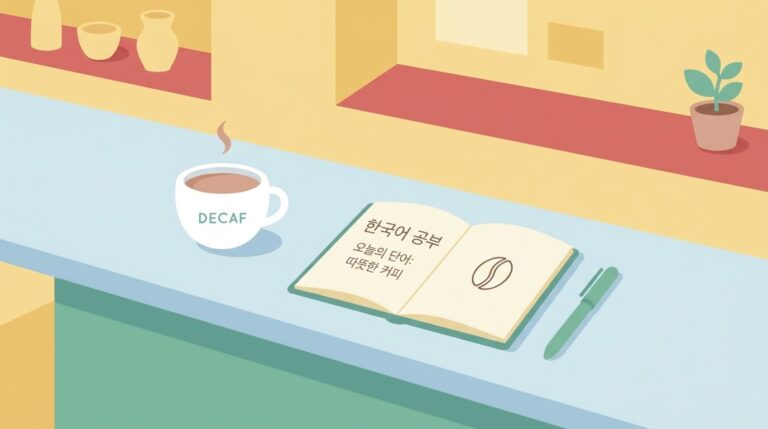
안녕하세요! 매일한글 에디터입니다.
Picture this: You’ve just landed in Seoul, and within three hours, you notice that almost everyone walking along the streets of Gangnam or Euljiro is holding an iced Americano like it’s a vital medical drip. If you’ve watched K-dramas like Misaeng or Start-Up, you already know the iconic office scene where interns and managers chug dark roasted coffee straight from venti cups just to survive back-to-back presentations. In Korea, we playfully refer to morning coffee not as a luxury, but as 카페인 수혈 (kapein suhyeol)—a literal “caffeine transfusion.” But what happens when that third cup of dark brew hits your bloodstream, and suddenly your hands are trembling, your stomach is twisting, and your heart is beating like an upbeat K-Pop track?
Many of our intermediate learners share this exact pain point: you want to be part of Korea’s dynamic cafe culture, socialize with colleagues on a “coffee run,” and order confidently in Korean. Yet, when caffeine sensitivity strikes, you freeze at the counter because you don’t know how to gracefully say, “I’m shaking from too much caffeine, please give me decaf,” without sounding robotic or overly dramatic. This guide is built directly from real student experiences and street-tested survival tactics. By mastering the nuanced expressions in this lesson, you’ll protect your physical well-being while seamlessly navigating Korea’s bustling cafe society.
Phase 2: Core 3 Expressions In-Depth
1. 가슴이 두근거려요
- Pronunciation: Gaseumi dugeungeoryeoyo (Think: Ga-seum-ee doo-geun-guh-ryuh-yo, mimicking the rhythmic sound of a thumping bass drum: thump-thump = dugeun-dugeun).
- Meaning: Literal: “My chest is fluttering/throbbing.” | Actual Nuance: “My heart is racing / I’m getting caffeine jitters.”
- K-Culture Moment: In romance dramas, a protagonist clutching their chest says this when their crush hugs them. But in a modern Seoul office at 3:00 PM, saying this while looking at an empty espresso shot cup means you’ve definitely crossed the danger zone of caffeine overdose.
- Editor’s Insight: Koreans use the onomatopoeia 두근두근 (dugeun-dugeun) for both romantic excitement and caffeine-induced tachycardia. Adding the verb form 두근거리다 (dugeungeorida) turns it into a vivid bodily sensation.
- Situation Spectrum: Casual (✅ – 가슴이 두근거려), Semi-formal (✅ – 가슴이 두근거려요), Formal (⚠️ – 심계항진 증상이 있습니다 is overly medical).
- 🤔 Think About It: In English, we often say “I’m jittery” or “my hands are shaking.” Why do you think Korean centers this physical discomfort directly on the chest and heartbeat (가슴)?
2. 디카페인으로 변경해 주세요
- Pronunciation: Dikafeineuro byeongyeonghae juseyo (Think: Dee-kah-fe-een-oo-ro byun-gyung-hae joo-seh-yo).
- Meaning: Literal: “Please change [this] to decaf.” | Actual Nuance: “Could I switch this to decaf, please?”
- K-Culture Moment: As wellness and sleep health gain massive traction among young professionals in Seongsu and Hongdae, requesting decaf (디카페인) has transformed from an unusual demand to an essential daily modification.
- Editor’s Insight: The particle -으로/로 (-euro/ro) denotes the direction or method of change, paired with the polite command verb 변경해 주세요 (byeongyeonghae juseyo). It sounds much more natural and refined than merely pointing and saying “디카페인 주세요 (Dikafein juseyo)”.
- Situation Spectrum: Casual (⚠️ – 디카페인으로 바꿔줘), Semi-formal (✅ – 디카페인으로 변경해 주세요), Formal (✅ – 디카페인으로 변경 부탁드립니다).
- 🤔 Think About It: Have you noticed how easily global loanwords like “decaf” (디카페인) blend into agglutinative Korean grammar particles?
3. 커피 좀 줄여야겠어요
- Pronunciation: Keopi jom juryeoyagesseoyo (Think: Kuh-pee jom joo-ryuh-yah-get-ssuh-yo).
- Meaning: Literal: “I must reduce coffee a bit.” | Actual Nuance: “I really need to cut down on my coffee intake.”
- K-Culture Moment: Overheard in nearly every lunch break banter in Yeouido. Coworkers commiserating over acid reflux and insomnia while sheepishly sipping herbal tea.
- Editor’s Insight: The word 좀 (jom) softens the sentence so you don’t sound overly solemn, while the grammar ending -아/어야겠어요 (-a/eoyagesseoyo) conveys personal resolve based on a newly realized necessity.
- Situation Spectrum: Casual (✅ – 커피 좀 줄여야겠어), Semi-formal (✅ – 커피 좀 줄여야겠어요), Formal (✅ – 커피 섭취를 좀 줄여야 할 것 같습니다).
- 🤔 Think About It: Compare how English speakers say “I need to detox” versus the pragmatic Korean focus on adjusting daily consumption volumes (줄이다).
Phase 3: Textbook Korean vs. Real Korean
Situation 1: Ordering a Low-Caffeine or Non-Caffeine Alternative
- 📖 교과서 한국어 (Textbook Korean):
- 저는 카페인을 소화하지 못하므로 차를 마시겠습니다. (Jeoneun kapeineul sohwahaji mothameuro chareul masigesseumnida.)
- “Because I cannot digest caffeine, I will drink tea.”
- 🗣️ 진짜 한국어 (Real Korean):
- 요즘 카페인 때문에 잠을 못 자서 논카페인 음료로 할게요. (Yojeum kapein ttaemune jameul mot jaseo non-kapein eumnyoro halgeyo.)
- “I haven’t been sleeping well lately because of caffeine, so I’ll go with a caffeine-free drink.”
- 💡 왜 다를까?: Native speakers rarely speak in rigid clinical causal clauses (
-므로). Instead, they mention a relatable lifestyle symptom (lack of sleep) and use conversational markers like 논카페인 (non-caffeine) or 카페인 없는 메뉴 (caffeine-free menu).
Situation 2: Explaining That You’re Shaking from Over-caffeination
- 📖 교과서 한국어 (Textbook Korean):
- 카페인 섭취로 인해 신체적 떨림 현상이 발생했습니다. (Kapein seopchwiro inhae sinchejeok tteollim hyeonsangi balsaenghaesseumnida.)
- “A physical trembling phenomenon occurred due to caffeine intake.”
- 🗣️ 진짜 한국어 (Real Korean):
- 아메리카노 두 잔 연달아 마셨더니 손이 덜덜 떨려요. (Amerikano du jan yeondara masyeotdeoni soni deoldeol tteollyeoyo.)
- “I had two Americanos back-to-back and now my hands are shaking like crazy!”
- 💡 왜 다를까?: Natural Korean thrives on mimetic sensory expressions like 덜덜 (deoldeol – shivering/shaking vigorously) paired with real-life specifics like 연달아 (yeondara – consecutively).
Phase 4: K-Culture Deep Dive & Non-Verbal Manners
4-1. 눈치 (Nunchi) & Gestures
When declining another round of coffee during a team meeting or with friends:
* The Chest Tap: Lightly patting your chest once or twice with an apologetic smile immediately signals that you’re experiencing heart palpitations without needing an elaborate medical explanation.
* The Two-Handed Cup Decline: If someone offers to buy you another shot or beverage, gently cover the top of your empty cup with one palm while slightly bowing your head: “마음만 감사히 받겠습니다, 지금 손이 떨려서요!” (Maeumman gamsahi batgesseumnida, jigeum soni tteollyeoseoyo! – I truly appreciate the thought, but my hands are shaking right now!)
4-2. Cultural Code: The Double-Edged Sword of “수혈 (Transfusion)”
In contemporary Korea’s high-speed 빨리빨리 (ppalli-ppalli) culture, iced coffee has served as social glue and workplace fuel. However, a profound counter-trend is sweeping Seoul’s cafe landscape: the decaf boom. Major specialty brands like Mega Coffee, Compose, Twosome Place, and local boutiques now spotlight decaf roasting beans. Opting out of caffeine used to be seen as lacking stamina; today, acknowledging your limits and prioritizing restorative sleep is respected as mature self-management.
Phase 5: Real Role-play Scenario
Setting: You are sitting at a stylish coffee roastery in Seongsu-dong with your Korean colleague, Min-woo (민우), around 4:30 PM on a hectic Thursday.
Characters:
* Min-woo: Energetic project manager who runs on 4 shots of espresso a day.
* You: An intermediate Korean speaker whose stomach and heart are protesting from morning meetings.
- 민우: 이제 보고서 하나 남았네요! 우리 힘내게 카페인 충전하러 갈까요? 제가 쏠게요! (Ije bogoseo hana namanneyo! Uri himnaege kapein chungjeonhareo galkkayo? Jega ssolgeyo!)
“Just one report left! Shall we go recharge on caffeine for energy? My treat!”
🎭 Min-woo stretches his arms, jingling his car keys cheerfully. -
You: 민우 씨, 마음은 감사한데… 사실 아까 커피를 세 잔이나 마셨거든요. (Min-woo ssi, maeumeun gamsahande… sasil akka keopireul se jan-ina masyeotgeodeunyo.)
“Min-woo, thanks for offering, but… honestly, I already drank three cups of coffee earlier.”
🎭 You rub the back of your neck with a sheepish grin. -
민우: 에이, 그래도 한국 직장인은 네 잔부터 시작이죠! (Ei, geuraedo hanguk jikjang-ineun ne janbuteo sijagijo!)
“Come on, for Korean office workers, four cups is just getting started!”
🎭 Min-woo laughs, teasingly handing you a cafe punch card. -
You: 안 돼요, 지금 가슴이 너무 두근거려서 손까지 덜덜 떨려요. (An dwaeyo, jigeum gaseumi neomu dugeungeoryeoseo sonkkaji deoldeol tteollyeoyo.)
“No way, my heart is pounding so hard right now that even my hands are shaking.”
🎭 You show your slightly trembling hand with wide, pleading eyes. -
민우: 헐, 진짜요? 안색이 좀 창백해 보이긴 하네요. 무리하면 안 되죠! (Heol, jinjjayo? Ansaegi jom changbaekhae bo-igin haneyo. Murihamyeon an doejo!)
“Whoa, really? You actually look a bit pale now that I look. You shouldn’t push yourself!”
🎭 Min-woo’s eyes widen with genuine concern. -
You: 네, 오늘 밤에 잠 못 잘 것 같아요. 커피 좀 줄여야겠어요. (Ne, oneul bame jam mot jal geot gat-ayo. Keopi jom juryeoyagesseoyo.)
“Yeah, I feel like I won’t be able to sleep tonight. I really need to cut back on coffee.”
🎭 You sigh gently and place a hand over your stomach. -
민우: 그럼 저기 카페 가서 디카페인 음료나 따뜻한 캐모마일 차 마셔요. (Geureom jeogi kape gaseo dikafein eumnyona ttatteut-han kaemomail cha masyeoyo.)
“Then let’s go to that cafe and get a decaf drink or warm chamomile tea.”
🎭 Min-woo nods in total agreement and points toward a quiet cafe across the street. -
You: 좋아요! 전 디카페인으로 변경해서 마실게요. (Joayo! Jeon dikafeineuro byeongyeonghaeseo masilgeyo.)
“Sounds great! I’ll just change mine to decaf.”
🎭 You smile with relief as you walk together.
🔀 Interactive Branching Point
When Min-woo insists on buying you an extra shot of espresso at the counter, what do you say?
- Choice A: “야, 싫다고 했잖아! 너 혼자 마셔!” (Ya, siltago haetjanha! Neo honja masyeo!)
Feedback (Bad): 🚨 Aggressive and blunt! Dropping banmal (informal speech) on a colleague like this disrupts workplace harmony instantly. - Choice B: “저 카페인 부작용 때문에 쓰러질 것 같아요. 절대 안 마십니다.” (Jeo kapein bujagyong ttaemune sseureojil geot gat-ayo. Jeoldae an masimnida.)
Feedback (Risk): ⚠️ A bit too tense and dramatic. Using words like ‘쓰러지다’ (collapse) and ‘절대’ (never) creates an awkward chill in a friendly social moment. - Choice C: “마음만 받을게요! 오늘 카페인 한도 초과라 전 캐모마일이나 디카페인으로 할게요.” (Maeumman badeulgeyo! Oneul kapein hando chogwara jeon kaemomairina dikafeineuro halgeyo.)
Feedback (Best): 🌟 Perfect score! Polite, witty (caffeine limit exceeded), maintains group warmth, and clearly states your alternative boundary.
Phase 6: 10-Second Emotion Shadowing Drill
Read these out loud, observing the rhythmic pauses (/) and channeling the tagged emotion!
[😮💨 지치고 어지러운 목소리로]
커피를 / 너무 많이 마셨나 봐요… / 속이 울렁거려요.
(Keopireul / neomu mani masyeonna bwayo… / sogi ulleonggeoryeoyo.)
“I think I drank too much coffee… my stomach feels queasy.”-
[🙏 간절하고 정중하게]
죄송하지만 / 혹시 디카페인 원두로 / 변경 가능할까요?
(Joesonghajiman / hoksi dikafein wonduro / byeongyeong ganeunghalkkayo?)
“Excuse me, but would it be possible to switch to decaf beans by any chance?” -
[💪 굳은 다짐을 담아 단호하게]
건강을 위해서 / 오늘부터 / 커피 한 잔으로 / 제한하려고요!
(Geongangeul wihaeseo / oneulbuteo / keopi han janeuro / jehanharyeogoyo!)
“For the sake of my health, starting today, I’m limiting myself to just one cup!”
Phase 7: K-Culture Mini Dictionary
- 카페인 수혈 (Kapein suhyeol) | Lit: Caffeine transfusion.
Used universally among students and workers to describe the urgent, life-saving morning coffee needed to function. - 얼죽아 (Eol-juk-ah) | Lit: Freezing to death, yet still iced Americano.
Short for “얼어 죽어도 아이스 아메리카노.” Represents Korea’s unique cultural habit of drinking iced beverages even in sub-zero winter temperatures. - 각성 상태 (Gakseong sangtae) | State of intense mental alertness/hyper-arousal.
Often used half-jokingly: “지금 각성 상태라 잠이 전혀 안 와요” (I’m in such a hyper-alert state that sleep is out of the question). - 디카페인 옵션 (Dikafein opsyeon) | Decaf substitution option.
Usually carries a small additional charge (+300 to +1,000 KRW) at kiosk screens under the 원두 선택 (Bean Selection) tab.
Phase 8: Traveler’s Survival Kit
Top 3 Survival Phrases
- 샷 하나만 빼주세요. (Syat hanaman bpaejuseyo.)
Pro Tip: If decaf isn’t available, asking the barista to pull one less espresso shot (연하게 해주세요 – please make it mild) reduces caffeine by roughly 50%. - 카페인 안 들어간 음료 추천해 주실래요? (Kapein an deureogan eumnyo chucheonhae jusillaeyo?)
Pro Tip: Perfect phrase when you are overwhelmed by the menu board at an artisanal tea or dessert cafe. - 디카페인 추가 요금 있나요? (Dikafein chuga yogeum innayo?)
Pro Tip: Quick way to check if modifying to decaf requires an extra micro-payment before swiping your travel card.
Editor’s Travel Note
When cafe-hopping in Seoul, self-service digital kiosks are everywhere. Look for buttons labeled 원두 변경 (Change Bean) or 디카페인 (Decaf) on the first screen after selecting your drink. If you’re exploring boutique neighborhood cafes in alleys, use the Naver Map app download for finding decaf cafes and search using the keyword ‘디카페인 카페’ to immediately filter spots with verified non-caffeinated selections.
Phase 9: “한 발 더 깊이” (Food for Thought)
In South Korea, offering a cup of coffee is an unspoken ritual of care, hospitality, and shared collective perseverance. Saying “no” to a hot cup prepared by a senior colleague once felt like rejecting their goodwill. However, modern Korean society is balancing its fast-paced collective drive with personal health boundaries and autonomy. Declining caffeine is no longer seen as being antisocial; rather, explaining your condition with warmth shows emotional intelligence and self-care.
💬 Your Turn: How does your culture view coffee consumption? Is taking a coffee break seen as pure relaxation, or is it fuel for productivity like in Seoul? Tell us your experience in the comments below!
Phase 10: FAQ & Common Mistakes
Q: Does all tea in Korean cafes come caffeine-free?
A: No! Traditional green tea (녹차 – nokcha), black tea (홍차 – hongcha), and matcha still contain considerable caffeine. If you want zero caffeine, choose grain or flower teas such as 보리차 (barley tea), 캐모마일 (chamomile), or 루이보스 (rooibos).
Q: What should I press if a self-service kiosk doesn’t show a decaf button?
A: Tap the original menu item (e.g., Cafe Latte), and a modification pop-up window will appear. Look for 원두 (Beans): usually you will see 고소한 맛 (Nutty), 산미 (Fruity/Acidic), and 디카페인 (Decaf).
Q: Can I ask for half-caffeine in Korea?
A: Yes! Say “하프 디카페인으로 해드릴까요?” (Half-decaf) or simply request “샷 반만 넣어주세요” (Syat banman neoeojuseyo – Please put in only half a shot).
🚨 흔한 실수 (Common Mistakes) 경고판
- Mistake: Saying “카페인 빼주세요 (Take out caffeine)” when ordering regular beans.
Correct Action: Standard espresso cannot have caffeine removed on the spot. Always say: “디카페인으로 변경해 주세요.” - Mistake: Shouting “심장이 아파요! (My heart hurts!)” when jittery.
Correct Action: “아프다” means sharp pain or illness, which might alarm people into calling an ambulance! Say: “가슴이 두근거려요” (My heart is racing). - Mistake: Assuming “밀크티 (Milk Tea)” has no caffeine.
Correct Action: Korean cafe milk tea is brewed with concentrated black tea leaves, often packing more caffeine than a single Americano.
Phase 11: Action Missions
- 🥉 Bronze Mission: Stand in front of your mirror and practice the 3 emotion drills from Phase 6 until the pronunciation flows in under 10 seconds.
- 🥈 Silver Mission: Next time you order at an independent cafe or brew your own cup, take an aesthetic photo and post it to Instagram or Threads with the caption: “오늘부터 커피 좀 줄여야겠어요 ☕🌿 #매일한글 #디카페인”.
- 🥇 Gold Mission: Visit a Korean cafe or kiosk in person (or simulate it online), successfully customize an order to decaf or half-shot in full Korean, and share your victory story in our comment section!
🎮 K-Culture Mission: Watch one episode of an office-themed K-Drama (like King the Land or Forecasting Love and Weather). Spot the exact moment someone is handed a coffee and note how they react!
Phase 12: Interactive Quiz Challenge
1. Situational Judgment
You are out with a Korean friend who notices your foot tapping uncontrollably and asks: “괜찮아요? 왜 그래요?” (Are you okay? What’s wrong?). Which response sounds most natural at an intermediate B2 level?
* A) 죽을 것 같아요. 커피는 독약입니다.
* B) 오늘 에스프레소를 너무 마셨더니 가슴이 두근거리고 손이 떨려요.
* C) 저는 카페인 반응 증상이 격렬하게 일어납니다.
2. Fill-in-the-Blank
완성해 보세요 (Fill in the missing particle and verb):
“혹시 추가 금액 내면 디카페인( ) ( ) 가능한가요?”
(Is it possible to switch to decaf if I pay an extra charge?)
3. True / False Cultural Check
T/F: In Korea, rejecting a beverage offered during a business gathering is strictly taboo, so you must always drink standard coffee even if your heart palpitates.
👉 Click for Answers & Explanations
- Answer: B
Explanation: Option B accurately expresses the cause (excessive espresso) alongside the real physical sensations (heart racing, hands shaking) in a polite, conversational tone. Option A is overly dramatic, and Option C sounds like an emotionless medical encyclopedia entry! -
Answer: 으로 / 변경 (또는 변경이)
Full Sentence: “혹시 추가 금액 내면 디카페인으로 변경 가능한가요?”
Explanation: The direction particle -으로 attaches to 디카페인 (which ends in an open consonant soundㄴ), followed by 변경 (change/switch). -
Answer: False
Explanation: While social courtesy is highly valued, politely explaining your physical limit (e.g., using 마음만 감사히 받겠습니다) or requesting a decaf/herbal alternative is widely respected in modern Korean social etiquette.







