

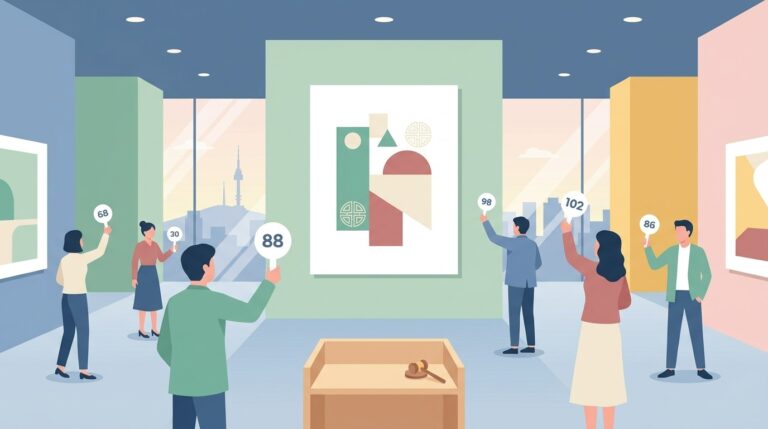
Phase 1: Empathy (Story-Immersive Opening)
안녕하세요! 매일한글 에디터입니다. (Hello! I’m your Daily Hangul editor.)
Picture this: You step into the sleek, whisper-quiet gallery of Seoul Auction in Gangnam or a premier preview hall in Pyeongchang-dong. Around you, bespoke-suited collectors, sharp young venture capitalists, and veteran gallery owners sip sparkling water while thumbing through thick catalogues. The air is thick with anticipation. You spot a transcendent piece by a Dansaekhwa master—perhaps Kim Whanki or Lee Ufan—or a trendy canvas by a rising contemporary artist that everyone from BTS’s RM to top Seoul gallerists has been buzzing about. You want to ask the specialist about the provenance, the artist’s current secondary market liquidity, or whether the estimate reflects genuine collector demand or just speculative hype.
Yet, the vocabulary you learned from everyday textbooks falls completely flat. Asking “이 그림 비싸요?” (Is this painting expensive?) feels painfully out of place in a room where cultural capital and financial acumen dance in delicate harmony. Many of our advanced learners reach out to us with this exact frustration: they possess high conversational fluency, but when engaging in high-context, culturally nuanced spaces like Korean art auctions and “Art-Tech” (아트테크) circles, they hit an invisible wall of hyper-specific idioms, honorific subtleties, and unspoken etiquette.
Drawing directly from the real-world experiences of global art consultants, curators, and our high-level learners who navigate Seoul’s dynamic art market, this masterclass will elevate your Korean to the sophisticated C1 echelon. Let’s step past the velvet rope and master the art of the auction room.
Phase 2: Deep Dive into 3 Core Expressions
1. 호가를 부르다 (Hoga-reul bureuda)
- Pronunciation: [Ho-ga-reul bu-reu-da] (Pronounce ‘ho’ like ‘hotel’, ‘ga’ like ‘garden’, ‘reul’ with a soft liquid flap, and ‘bu-reu-da’ like ‘boo-roo-dah’.)
- Meaning: Literally “to call out the asking/offering price”; contextually “to bid or advance the auction price incrementally from the floor or rostrum.”
- K-Culture Moment: In high-end K-dramas featuring chaebol families (such as Queen of Tears or Mine), you will often see auctioneers raising the room’s tension by shouting escalating price steps, or characters ordering their agents: “호가를 올려서라도 반드시 낙찰받아.” (Raise the bid and secure that piece at all costs.)
- Editor’s Insight: While beginners learn “가격을 말하다” (to state a price), 호가 (呼價) is an indispensable economic term in Korea. In auction rooms, it refers specifically to the stepped increments set by the auctioneer. When the bidding heats up, Koreans say “호가가 가파르게 올라가다” (The asking bids are rising steeply).
- Situation Spectrum: Casual 🚫 | Semi-formal ⚠️ | Formal ✅
- 🤔 Think About It: In your native culture, do people discuss financial investment and fine art using separate vocabularies, or are the market terms seamlessly blended as they are in Korea’s booming art-tech landscape?
2. 소장 가치가 충분하다 (Sojang gachiga chungbunhada)
- Pronunciation: [So-jang ga-chi-ga chung-bun-ha-da] (Think ‘so’ like ‘solar’, ‘jang’ rhyming with ‘song’, ‘ga-chi’ like ‘got-chee’, and ‘chung-bun-ha-da’ like ‘choong-boon-ha-da’.)
- Meaning: Literally “to possess sufficient collectible value”; contextually used by connoisseurs to indicate an artwork’s timeless museum-grade pedigree, historical significance, or long-term institutional merit.
- K-Culture Moment: Art consultants touring private viewings with VIP clients in Samcheong-dong or Hannam-dong will rarely say “이거 돈 돼요” (This makes money). Instead, they lean in discreetly and whisper: “이 시기 유화 작품은 소장 가치가 충분합니다.” (Oil works from this specific period have profound collectible value.)
- Editor’s Insight: Notice the Sino-Korean compound 소장 (所藏 – to keep in one’s private possession) paired with 가치 (價値 – value). This moves beyond mere commercial speculation. It frames the buyer not merely as an investor chasing returns, but as a cultivated patron of the arts.
- Situation Spectrum: Casual ⚠️ | Semi-formal ✅ | Formal ✅
- 🤔 Think About It: Why does Korean high society prioritize framing asset accumulation through terms of aesthetic preservation rather than raw commercial gain?
3. 안목을 키우다 (Anmogeul kiuda)
- Pronunciation: [An-mo-geul ki-u-da] (Pronounce ‘an’ like ‘un’ in ‘under’, ‘mok’ like ‘moke’ ending with an unreleased ‘k’, ‘eul’ as a flat tongue sound, and ‘ki-u-da’ like ‘kee-oo-dah’.)
- Meaning: Literally “to grow one’s discerning eye”; contextually “to cultivate an elevated aesthetic taste and market intuition for identifying genuine masterpieces.”
- K-Culture Moment: When global icons like RM of BTS share their private gallery visits on social media, Korean art commentators and cultural interviewers praise them by saying: “꾸준한 미술관 답사로 안목을 키운 진정한 컬렉터” (A true collector who has cultivated his discerning eye through constant museum pilgrimages).
- Editor’s Insight: In Korean culture, 안목 (眼目) is a revered trait. Unlike 시력 (physical eyesight) or 취향 (personal subjective taste), 안목 implies trained expertise, intuitive intelligence, and cultural refinement that can only be built over time through exposure and critical study.
- Situation Spectrum: Casual ✅ | Semi-formal ✅ | Formal ✅
- 🤔 Think About It: How does your own language distinguish between innate personal taste and an educated, refined discernment in the arts?
Phase 3: Textbook Korean vs. Real Korean
Situation 1: Inquiring About Potential Capital Appreciation
- 📖 교과서 한국어 (Textbook Korean):
이 그림은 나중에 가격이 오를까요?
(I geurimeun najunge gageogi oreulkkayo? / Will the price of this painting rise later?) - 🗣️ 진짜 한국어 (Real Korean):
중장기적인 관점에서 시세 차익이나 투자가치를 어떻게 보시나요?
(Jungjanggijeokin gwanjeom-eseo sise chai-gina tujagachireul eotteoke bosinayo? / From a medium-to-long-term horizon, how do you assess its potential for capital gains and investment viability?) - 💡 왜 다를까? (Why the difference?):
Directly mentioning “가격이 오르다” (price going up) sounds crass and overly speculative in a fine art auction preview. C1 speakers utilize professional economic phrasing like 시세 차익 (capital gains / market spread) and 중장기적인 관점 (medium-to-long-term perspective) to demonstrate financial sophistication.
Situation 2: Expressing Intent to Bid Competitively
- 📖 교과서 한국어 (Textbook Korean):
저는 저 그림을 꼭 경매에서 사고 싶습니다.
(Jeoneun jeo geurimeul kkok gyeongmaeeseo sago sipseumnida. / I definitely want to buy that painting at the auction.) - 🗣️ 진짜 한국어 (Real Korean):
현장 경합이 치열하더라도 상한선 내에서 적극적으로 패들을 들어볼 생각입니다.
(Hyeonjang gyeonghabi chiyeolhadeorado sanghanseon nae-eseo jeokgeukjeogeuro paedeureul deureobol saenggagimnida. / Even if the floor competition turns fierce, I intend to actively raise my paddle within my preset ceiling.) - 💡 왜 다를까? (Why the difference?):
Native connoisseurs don’t just say “사다” (to buy); they reference the procedural reality of the room—using terms like 경합 (bidding competition), 상한선 (hammer price ceiling), and 패들을 들다 (to raise the bidding paddle).
Phase 4: K-Culture Deep Dive & Non-Verbal Manners
4-1. 눈치 (Nunchi) & Auction Room Gestures
In an upscale Korean auction hall (such as Seoul Auction’s Pyeongchang-dong forum or K Auction in Apgujeong), the room breathes with an intense, restrained energy. The quintessential rule is 정중한 절제 (refined understatement):
* The Paddle Lift (패들 들기): Never raise your paddle with erratic, flamboyant arm movements. Keep your elbow resting near your lap or armrest and lift the paddle cleanly with a subtle, steady wrist flick, making direct, stoic eye contact with the auctioneer or floor spotter.
* The Connoisseur’s Stance (감상 자세): When attending the pre-auction preview (프리뷰), maintain at least two paces of distance from large canvases. Clasp your hands loosely behind your back—a classic posture known as 뒷짐 지기 (dwitjim jigi)—which signals respect, shows you are analyzing composition without risking accidental contact with the artwork, and gives off the aura of an experienced collector.
* Discretion Over Decibels: Never discuss hammer estimates loudly on your mobile phone in the preview hall. Discerning collectors exchange quiet whispers or communicate via discrete notations in their catalogues.
4-2. Cultural Code: The “MZ Art-Tech” Revolution
Over the past few years, South Korea has witnessed a seismic generational shift known as the MZ세대 아트테크 열풍 (MZ Generation Art-Tech Craze). Unlike previous generations who strictly viewed contemporary art as the secretive preserve of corporate conglomerates (chaebols), tech-savvy young Koreans in their late 20s to 40s view art collecting as both a prestigious intellectual hobby and a legitimate asset class.
Fueled by social media, art fairs like Frieze Seoul (which partnered with KIAF to transform Seoul into Asia’s premier contemporary art capital), and “RM tours” (visiting modern retrospectives visited by BTS leader RM), young professionals engage in fractional investment (조각투자), monitor auction clearance rates (낙찰률), and treat gallery hopping as a mainstream weekend cultural ritual. Mastering the language of art-tech allows you to converse effortlessly with Seoul’s most creative and financially dynamic tastemakers.
Phase 5: Real-World Roleplay Scenario
Setting: The VIP Preview Room of Seoul Auction Gangnam Center. Sleek granite floors, soft museum track lighting, and a curated crowd examining Lot 24, a breathtaking 1970s blue monochrome canvas.
Characters:
* You: An international collector and art-tech enthusiast seeking to bid on Korean modern art.
* Specialist Min Ji-won (민지원): A poised, impeccably tailored Senior Specialist with encyclopedic market knowledge.
Specialist Min:
고객님, 이번 근현대 미술 경매 프리뷰에서 유독 눈여겨보신 로트가 있으신가요?
(Gogaeknim, ibeon geunhyeondae misul gyeongmae peuribyueseo yudok nun-yeogyeobosin roteuga itsusinayo?)
“Valued client, is there a particular lot in this modern and contemporary preview that has caught your eye?”
🎭 Hands you a glossy auction catalogue open to the monochrome section, offering a warm yet formal bow.
You:
24번 로트의 단색화 소품에 시선이 가더군요. 도판으로 보던 것보다 물성이 훨씬 압도적입니다.
(Ishipsabon roteu-ui dansaekhwa sopume siseoni gadeogunyo. Dopaneuro bodeon geotboda mulseongi hwolssin apdojeogimnida.)
“My gaze was drawn to the small monochrome piece in Lot 24. The tactile physicality of the material is far more overwhelming in person than in the printed plate.”
🎭 Gazing intently at the canvas texture with hands clasped politely behind your back.
Specialist Min:
안목이 대단하십니다. 70년대 중반 과도기 작품이라 미술사적 의미는 물론이고, 소장 가치도 충분한 수작입니다.
(Anmogi daedanhasimnida. Chilsipdae jungban gwadogi jakpum-ira misulsajeok uimineun mullon-igo, sojang gachido chungbunhan sujagimnida.)
“You have a remarkable eye. Created during the artist’s transitional phase in the mid-1970s, it is a masterwork of profound collectible value as well as art-historical significance.”
🎭 Nods in quiet appreciation of your aesthetic discernment, leaning slightly closer.
You:
추정가 밴드가 1억에서 1억 5천 정도로 잡혀 있던데, 최근 세컨더리 마켓에서의 호가 흐름은 어떤가요?
(Chujeongga baendeuga ireog-eseo ireok ocheon jeongdoro japhyeo itdeonde, choegeun sekeondeori makes-eseo-ui hoga heureumeun eotteongayo?)
“The estimate band is set around 100 to 150 million KRW; how has the asking price trended recently on the secondary market?”
🎭 Pointing subtly with an open palm toward the catalog entry rather than poking at the page.
Specialist Min:
해외 주요 비엔날레 재조명 이후 문의가 쇄도하고 있습니다. 시작가부터 상당한 경합이 예상되는 상황입니다.
(Hae-oe juyo biennalle jae-jomyeong ihu mun-uiga swaedohago itseumnida. Sijakkabuteo sangdanghan gyeonghabi yesangdoeneun sanghwang-imnida.)
“Inquiries have surged following the artist’s recent re-examination at major international biennales. We anticipate substantial bidding competition starting right from the opening price.”
🎭 Adjusts her specialist badge discreetly, casting a meaningful glance toward the registration desk.
You:
서면이나 전화 응찰보다는 현장에서 직접 장내 분위기를 읽으며 패들을 들어보려 합니다.
(Seomyeon-ina jeonhwa eungchalbodaneun hyeonjang-eseo jikjeop jangnae bun-wigireul ilgeomyeo paedeureul deureoboryeo hamnida.)
“Rather than bidding by written commission or phone, I plan to raise my paddle in person on the floor while reading the room’s momentum.”
🎭 Speaking in a calm, measured C1 cadence, signaling confident intent.
Specialist Min:
탁월한 선택이십니다. 그렇다면 당일 VIP 패들 등록을 미리 도와드릴까요? 컨디션 리포트도 함께 준비해 두겠습니다.
(Tagwolhan seontaegisimnida. Geureotdamyeon dang-il VIP paedeul deungnogeul miri dowadeurilkkayo? Keondisyeon ripoteudo hamkke junbihae dugesseumnida.)
“An excellent decision. In that case, may I assist you with advance VIP paddle registration today? I will also prepare the official condition report for you.”
🎭 Smiles warmly and retrieves an elegant registration docket from her dossier.
You:
네, 부탁드립니다. 상태 보고서 확인 후 최종 상한선을 조율해 보겠습니다.
(Ne, butakdeurimnida. Sangtae bogoseo hwag-in hu choejong sanghanseoneul joyulhae bogesseumnida.)
“Yes, please. After reviewing the condition report, I will calibrate my final bidding ceiling.”
🎭 Accepting the document with both hands as a mark of high respect.
🔀 Interactive Choice Point
At this moment, Specialist Min asks if you would also like to review upcoming fractional ownership (조각투자) portfolios for rising pop-art painters. How do you respond?
- Option A: “요즘 조각투자가 MZ세대 사이에서 대세라던데, 포트폴리오의 기초자산 실물도 직접 열람할 수 있습니까?”
(Yoyojeum jogaktu-jaga MZ-sedae saieseo daeseradeon-de, poteupolrio-ui gichojasanso silmuldo jikjeop yeollamhal su itseumnikka? / They say fractional investment is mainstream among the MZ generation these days; can I inspect the underlying physical assets of the portfolio directly?) - Option B: “싸게 사서 빨리 팔고 싶은데, 어떤 그림이 다음 달에 제일 많이 오를 것 같아요?”
(Ssage saseo ppalli palgo sipeunde, eotteon geurimi daeum dare jeil mani oreul geot gat-ayo? / I want to buy cheap and flip fast; which painting do you think will go up the most next month?) - Option C: “아, 저는 실물 없는 디지털 투자는 절대 안 믿어서 그쪽은 전혀 관심이 없습니다.”
(A, jeoneun silmul eomneun dijiteol tujaneun jeoldae an mideoseo geujjogeun jeonhyeo gwansimi eopseumnida. / Ah, I never trust digital investments without physical presence, so I have zero interest in that.)
Feedback on Choices:
* Best Choice (Option A): 🌟 Perfection! You demonstrated an elite grasp of modern financial terminology (기초자산 – underlying asset, 실물 열람 – physical inspection) while maintaining an intellectually curious and professional tone.
* Bad Choice (Option B): ❌ Faux Pas Alert! Using phrases like “싸게 사서 빨리 팔다” (buy cheap, sell fast) completely shatters the sophisticated atmosphere. In fine art galleries, short-term flipping is taboo and specialist staff will immediately mark you as an untrusted speculative flipper rather than a serious collector.
* Risk Choice (Option C): ⚠️ A Bit Rigid! While being cautious with your capital is wise, phrasing your skepticism so dismissively (“절대 안 믿는다”) sounds culturally harsh and closes the door on hearing the specialist’s broader market insights.
Phase 6: 10-Second Emotion Shadowing Drill
Sharpen your cadence, pause points, and emotional delivery with these authentic collector lines. Slanted slashes (/) represent natural micro-pauses.
- [🧐 진중하고 날카롭게 – Serious & Perceptive]
단색화 특유의 마티에르가 / 도판보다 훨씬 생생하게 다가오네요.
(Dansaekhwa teugyu-ui matie-reuga / dopanboda hwolssin saengsaenghage dagaoneyo.)
“The unique impasto texture of this monochrome piece / feels far more vivid than in the printed plate.” -
[🤫 은밀하고 확신에 차서 – Secretive & Confident]
이번 경합이 치열하겠지만, / 저는 상한선까지 흔들림 없이 / 밀어붙일 생각입니다.
(Ibeon gyeonghabi chiyeolhagetjiman, / jeoneun sanghanseonkkaji heundeullim eopsi / mireobuchil saenggagimnida.)
“Competition will be fierce this time, / but without faltering / I intend to push all the way to my ceiling.” -
[🤩 감탄하며 차분하게 – Admiration with Composure]
작가의 초기 서사가 담긴 원작인 만큼, / 장기적인 소장 가치는 / 의심할 여지가 없겠어요.
(Jakkaui chogi seosaga damgin wonjagin mankeum, / janggijeogin sojang gachineun / uisimhal yeojiga eopgetseoyo.)
“As an original work embodying the artist’s early narrative, / its long-term collectible value / leaves absolutely no room for doubt.”
Phase 7: K-Culture Mini Dictionary
-
낙찰 (Nakchal)
Meaning: Successful bid / hammer fall.
Usage: Used when an artwork is officially sold under the auctioneer’s gavel.
Example: “치열한 경합 끝에 3억 원에 최종 낙찰되었습니다.” (After fierce bidding, it was finally hammered down at 300 million KRW.) -
프리뷰 (Peuribyu)
Meaning: Pre-auction preview exhibition.
Usage: The open exhibition held 1–2 weeks prior to an auction where prospective buyers inspect physical condition.
Example: “본 경매에 응찰하기 전에 프리뷰에 들러 실물을 반드시 확인해야 합니다.” (Before bidding in the main auction, one must drop by the preview to verify the physical piece.) -
아트테크 (Ateu-tekeu)
Meaning: Art-Tech (Art + Finance/Technology investment).
Usage: Describes modern art investing, tax-sheltered wealth building, and fractional shares in high-value works.
Example: “요즘 젊은 전문직 종사자들은 부동산 대신 아트테크로 자산을 다각화하고 있어요.” (These days, young professionals are diversifying their assets through art-tech rather than real estate.) -
조각투자 (Jogak-tuja)
Meaning: Fractional investment / fractional ownership.
Usage: Purchasing micro-shares in high-value blue-chip art (by Yayoi Kusama, Park Seo-bo, etc.) via regulated security tokens.
Example: “수억 원대 마스터피스를 조각투자로 1만 원부터 분할 소장할 수 있습니다.” (Through fractional investment, you can co-own multi-hundred-million-won masterpieces starting from just 10,000 KRW.)
Phase 8: Survival Kit for Art Travelers & Collectors
Top 3 Survival Expressions
-
“컨디션 리포트와 보증서를 서면으로 받아볼 수 있을까요?”
(Keondisyeon ripoteuwa bojeongseoreul seomyeon-euro badabol su isseulkkayo?)
“Could I receive the condition report and certificate of authenticity in writing?”
Pro Tip: Essential before committing to any serious bid in Korean galleries or auctions. -
“낙찰 수수료와 부가세가 포함된 최종 결제 금액이 얼마인가요?”
(Nakchal susuryowa bugasega pohamdoen choejong gyeolje geumaegi eolma-ingayo?)
“What is the total final settlement amount inclusive of buyer’s premium and VAT?”
Pro Tip: Korean major auctions typically charge a buyer’s premium of around 15–18% (plus VAT on the premium). Always clarify the net invoice! -
“작품 배송 및 전문 미술품 보험 연계 서비스가 제공되나요?”
(Jakpum baesong mit jeonmun misulpum boheom yeon-gye seobiseuga jegongdoenayo?)
“Do you provide specialized fine art shipping and integrated insurance transit services?”
Pro Tip: If shipping works overseas, major houses have dedicated international logistics desks.
Editor’s Travel Note: Conquering the Seoul Art Trail
- Pre-Auction Itinerary: Take the subway to Anguk Station (Line 3) and walk along the stone-wall streets of Samcheong-dong, home to legendary blue-chip galleries like Gallery Hyundai, Kukje Gallery, and Hakgojae.
- Must-Have Apps: Download the [Naver Map App for Samcheong Gallery Walk] to effortlessly navigate secluded private galleries, and install the [Seoul Auction Preview Reservation Guide] via their official mobile app to reserve exclusive VIP preview passes without waiting in line.
- Settlement Tip: For major auction transactions, Korean banking laws require advance registration for international transfers exceeding $10,000. Carry your passport and foreign residency registration if bidding in person.
Phase 9: “One Step Deeper” (Reflective Inquiry)
In contemporary Korea, the transition of art from aristocratic heirloom to dynamic “Art-Tech” reveals how modern Korean society navigates the intersection of cultural prestige and pragmatic wealth. While early Confucian traditions viewed overt commercial transactions of scholarly calligraphy with ambivalence, 21st-century Seoul celebrates aesthetic discernment as the ultimate form of self-actualization. To collect art in Korea today is not merely to amass monetary equity; it is an active performance of 안목 (discerning taste) that validates one’s intellectual standing within a fast-moving, design-conscious collective.
💬 Your Turn: In your culture, is discussing art as an investment vehicle considered forward-thinking or tacky? Have you ever visited a Korean gallery or seen your favorite Korean artist’s work up close? Share your thoughts in the comments below!
Phase 10: FAQ & Avoiding Misconceptions
Q: Can foreigners legally register and bid in Korean art auctions?
A: Yes, absolutely! Foreign nationals can register both online and in person at major Korean auction houses such as Seoul Auction and K Auction. You will need to provide valid passport identification, proof of address, and occasionally a bank financial reference or refundable bid deposit depending on the lot’s value.
Q: Is Korean art subject to capital gains tax when resold in Korea?
A: Under current Korean tax law, artworks by living domestic Korean artists are exempt from transfer income tax regardless of sale price! For deceased artists, transactions below 60 million KRW are entirely tax-free, and even above that threshold, substantial necessary expense deductions apply. This tax-favorable environment is one of the primary drivers of Korea’s art-tech boom.
Q: What is the difference between a gallery sale and an auction house purchase in Seoul?
A: Galleries represent the primary market (1차 시장), directly setting prices for artists they represent without public bidding wars. Auctions represent the secondary market (2차 시장), where consigned works are subjected to public price discovery via competitive bidding paddles. If you want transparent historical pricing benchmarks, auctions provide publicly recorded hammer results.
🚨 Common Mistakes Foreigners Make
- Mistake: Using informal or overly commercial verbs like “이거 얼마에 팔아요?” (How much do you sell this for?) at an upscale auction preview.
Correct Action: Frame your question through estimates: “이 로트의 추정가와 시작가는 어떻게 형성되어 있습니까?” (How are the estimate and starting bid structured for this lot?) - Mistake: Raising a paddle impulsively to acknowledge the auctioneer’s greeting.
Correct Action: Any clear lift of the paddle can be interpreted by room spotters as a binding bid! Only hold up your paddle when you deliberately intend to accept the current announced asking price (호가). - Mistake: Assuming the hammer price is the final cost.
Correct Action: Remember to calculate the 낙찰 수수료 (buyer’s premium, usually 15–19.8% including VAT). Always budget for the premium before setting your bidding limit!
Phase 11: Action Missions
- 🥉 Bronze Mission (Solo Practice): Practice the 10-Second Shadowing Drills in Phase 6 aloud three times. Focus on the confident, calm micro-pauses (
/) used when describing 소장 가치 (collectible value). - 🥈 Silver Mission (Community Engagement): Visit the official English/Korean website of Seoul Auction or K Auction. Browse the latest upcoming lot catalogue, select one modern Korean painting, and leave a comment below describing its 안목 and 물성 (physicality) using at least two words learned today.
- 🥇 Gold Mission (Real-World Execution): The next time you visit Seoul, book a visit to a preview exhibition in Samcheong-dong, Hannam-dong, or Gangnam. Approach a specialist and ask politely: “이 작품의 컨디션 리포트를 열람할 수 있을까요?” (May I inspect the condition report for this piece?)
- 🎮 K-Culture Mission: Watch an episode of a high-society K-drama (like Celebrity, Remarriage & Desires, or Mine). Spot the art pieces hanging on the walls or the auction scenes, and identify whether the characters display proper 뒷짐 지기 (hands behind back) posture!
Phase 12: Interactive Quiz Challenge
Test your mastery of Korean art auctions and art-tech before you enter the auction room!
1. Contextual Judgment
You are standing in the preview room speaking with an auction curator. You want to praise a canvas for having profound, long-term historical importance and museum quality. Which sentence is the most natural, C1-level choice?
* (A) 이 그림은 나중에 무조건 비싸게 되팔 수 있겠네요.
* (B) 미술사적 내러티브와 소장 가치가 대단히 충분한 수작이군요.
* (C) 이 로트를 사면 다음 주에 호가가 얼마나 올라갈까요?
2. Fill in the Blank
경매장에서 경매사가 부르는 가격 단위를 ( )(이)라고 하며, 치열한 입찰 경쟁 끝에 봉이 울리며 최종 매수가 결정되는 순간을 ( )(이)라고 합니다.
(In an auction room, the price increment called out by the auctioneer is termed [ ], and the moment when the hammer falls to finalize the purchase after fierce competition is called [ ].)
3. Cultural True or False
True or False: Under current South Korean tax regulations, profits generated from reselling artworks created by living domestic Korean artists are subject to heavy punitive capital gains taxes.
🔍 Click here to reveal the answers and explanations!
Answers & Explanations
-
Answer: (B)
Explanation: Option (B) demonstrates refined aesthetic critique using authentic connoisseur phrasing (미술사적 내러티브 – art-historical narrative; 소장 가치가 충분한 수작 – masterwork of profound collectible value). Option (A) is too crude, and Option (C) confuses short-term speculation with the auction process. -
Answer: 호가 (Hoga), 낙찰 (Nakchal)
Explanation: 호가 (asking/bidding price step) is called by the auctioneer, while 낙찰 (hammer fall / successful bid) marks the conclusion of the lot. -
Answer: False
Explanation: Works by living Korean artists are entirely exempt from transfer income tax in South Korea, a policy deliberately designed to foster the domestic contemporary art market and encourage active patronage!







