

Phase 1: Empathy (Immersive Storytelling Opening)
안녕하세요! 매일한글 에디터입니다.
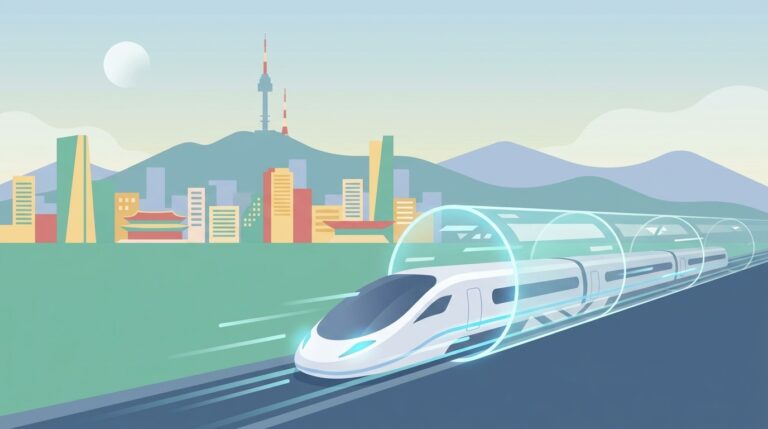
Picture this: You are sitting in an ultra-sleek conference room in Pangyo Techno Valley—the Silicon Valley of South Korea. Outside the glass walls, electric buses whisper by and software engineers sip iced Americanos even in sub-zero winter temperatures. Inside, the projector displays an engineering schematic of a near-vacuum tube transport system: the Hyper-Tube Express (HTX), Korea’s ambitious answer to the Hyperloop.
A senior researcher turns to you, eyes gleaming with technical pride: “서울에서 부산까지 20분 주파가 기술적으로 눈앞에 다가왔습니다. 어떻게 보십니까?” (Seoul-eseo Busan-kkaji 20-bun jupwaga gisuljeogeuro nun-ape dagawasseumnida. Eotteoke bosimnikka? / “A 20-minute journey from Seoul to Busan is technically right around the corner. What do you think?”)
You have brilliant arguments ready in your head. You want to discuss evacuation protocols in vacuum chambers, the seismic challenges of the Korean peninsula, and whether spending tens of trillions of won makes fiscal sense when the KTX-Cheongryong already darts across the country in two hours. But your tongue freezes. You stammer: “어… 비싸요. 그리고 위험해요.” (Uh… it’s expensive. And dangerous.)
The room politely moves on. The frustration is searing. You aren’t an A1 beginner struggling with postpositions; you are a C2-level professional or high-level academic who just sounded like a toddler because standard textbooks only teach you how to ask for subway transfers or say “교통이 편리해요” (transit is convenient).
Having coached diplomats, foreign tech executives, and mobility researchers in Seoul for over a decade, I see this exact wall hit C2 learners constantly. High-stakes Korean discourse around mobility innovation requires not just Hanja-derived policy vocabulary, but the sophisticated rhetorical framing native Koreans use to balance technological optimism (기술적 낙관론) against cold economic realism (경제적 타당성). This guide is built directly from actual boardroom seminars and policy debates to give you the razor-sharp vocabulary and cultural finesse needed to lead the room.
Phase 2: Core 3 Expressions Deep-Dive
1. 타당성 검토를 거치다 (Tadangsseong geomtoreul geochida)
- Pronunciation: [Ta-dang-seong geom-to-reul geo-chi-da] (Sounds like “tah-dahng-sung” + “gum-toe-reul” + “guh-chee-dah”)
- Meaning: Literal: “To pass through a validity/feasibility inspection.” | Actual Nuance: “To undergo rigorous feasibility analysis” (implying standard institutional or fiscal clearance).
- K-Culture Moment: In the corporate drama Misaeng or political thrillers like Designated Survivor: 60 Days, whenever a mega-project is pitched, directors slam the dossier on the table demanding whether it actually underwent this review before squandering taxpayer money.
- Editor’s Insight: In Korean public policy and tech infrastructure, 타당성 (feasibility) is almost always paired with 예비타당성조사 (Preliminary Feasibility Study, colloquially shortened to 예타). Using the verb 거치다 (to pass through/undergo) signals that you understand bureaucratic hurdles and institutional due diligence.
- Situation Spectrum:
- Casual: 🚫 (Sounds ridiculously pedantic at dinner)
- Semi-formal: ⚠️ (Only if discussing major investments)
- Formal: ✅ (The absolute golden standard in boardrooms and policy panels)
- 🤔 Think About It: In Western discourse, we often say “we vetted the project.” Why do Korean organizations emphasize 거치다 (passing through a path/filter), reflecting institutional collective gatekeeping rather than individual validation?
2. 시기상조라는 지적을 피하기 어렵다 (Sigisangjoraneun jijeogeul pihagi eoryeopda)
- Pronunciation: [Shi-gi-sang-jo-ra-neun ji-jeo-geul pi-ha-gi eo-ryeop-da] (Analogy: “She-ghee-sahng-joe” + “jee-juck-eul” + “pea-hah-ghee” + “uh-ryup-dah”)
- Meaning: Literal: “It is difficult to evade pointing out that the timing is premature.” | Actual Nuance: “It is hard to deflect criticisms that this move is premature/ill-timed.”
- K-Culture Moment: Found on the front page of every major Korean financial daily (Maeil Business, Hankyung) whenever a chaebol or the Ministry of Land, Infrastructure and Transport (MOLIT) announces futuristic tech while existing infrastructure runs a deficit.
- Editor’s Insight: 시기상조 (時期尙早 – too early / premature) combined with 지적을 피하기 어렵다 is a masterclass in polite Korean critique. Instead of bluntly declaring “It’s too early!”, this double-cushioned phrasing places the criticism on an objective third-party observer (지적), shielding you from appearing aggressively confrontational.
- Situation Spectrum:
- Casual: 🚫
- Semi-formal: ⚠️
- Formal: ✅ (Essential for analytical rebuttals)
- 🤔 Think About It: Notice how Korean rhetorical strategy frames critique as an external condition (지적) that cannot be avoided (피하기 어렵다). How does this protect interpersonal harmony (기분) during heated debates?
3. 천문학적인 매몰비용이 발생하다 (Cheonmunhakjeogin maemolbiyong-i balsaenghada)
- Pronunciation: [Cheon-mun-hak-jeo-gin mae-mol-bi-yong-i bal-ssaeng-ha-da] (Analogy: “Chun-moon-hahk-juh-gin” + “may-mole-bee-yong-ee” + “bahl-ssang-hah-dah”)
- Meaning: Literal: “Astronomical sunken costs occur.” | Actual Nuance: “To incur crippling, irreversible sunk costs on an astronomical scale.”
- K-Culture Moment: Think of high-stakes venture capital meetings in the drama Start-Up, where an investor calculates the risk of building proprietary hardware before standardizing technology.
- Editor’s Insight: 매몰비용 (Sunk Cost) is a loan concept from economics, but 천문학적인 (astronomical) elevates it into an existential corporate threat. When critiquing Hyperloop tube maintenance, air-tight seal degradation, and power consumption, this phrase packs lethal rhetorical weight.
- Situation Spectrum:
- Casual: 🚫
- Semi-formal: ⚠️
- Formal: ✅
- 🤔 Think About It: Why does Korean economic commentary frequently employ cosmic metaphors (천문학적) when discussing infrastructure failures? What does this reveal about the sheer scale of Korean government-led development projects (국책사업)?
Phase 3: Textbook Korean vs. Real Korean
Situation 1: Arguing that construction costs outweigh commercial viability
- 📖 교과서 한국어 (Textbook Korean):
- 비용이 너무 많이 들어서 경제성이 없습니다. (Biyong-i neomu mani deureoseo gyeongjeseong-i eopseumnida.)
- “Because it costs too much money, it has no economic viability.”
- 🗣️ 진짜 한국어 (Real Korean – C2 Professional):
- 배보다 배꼽이 더 커서 수지타산이 전혀 안 맞습니다. (Baeboda baekkobi deo keoseo sujitasan-i jeonhyeo an matseumnida.)
- “The ancillary costs completely eclipse the principal value, making it fundamentally unviable from an ROI perspective.”
- 💡 왜 다를까? (Why is it different?):
- The idiom 배보다 배꼽이 더 크다 (the belly button is bigger than the belly) is widely embraced even in corporate boardrooms when paired with the sophisticated financial term 수지타산 (收支打算 – calculating balance of income and expenditure). It adds vivid native punch while sounding analytical.
Situation 2: Acknowledging technological potential while remaining skeptical of deployment
- 📖 교과서 한국어 (Textbook Korean):
- 기술적으로는 가능하지만 시간이 오래 걸릴 것입니다. (Gisuljeogeuroneun ganeunghajiman sigani orae geollil geosimnida.)
- “Technologically it is possible, but it will take a long time.”
- 🗣️ 진짜 한국어 (Real Korean – C2 Professional):
- 원천 기술은 확보되었을지언정, 상용화까지는 넘어야 할 산이 많습니다. (Woncheon gisureun hwakbodoeeosseuljieonjeong, sang-yonghwakkajineun neomeoya hal sani manseumnida.)
- “Even granting that the core fundamental technology is secured, the commercialization pipeline remains fraught with hurdles.”
- 💡 왜 다를까? (Why is it different?):
- High-level Korean uses connective clauses like -을지언정 (even granting that / even if it were so) combined with metaphorical imagery (넘어야 할 산 – mountains that must be crossed). It avoids robotic repetition of -지만 and displays mastery over concessionary logic.
Phase 4: K-Culture Deep Dive & Non-Verbal Manners
4-1. 눈치 (Nunchi) & Debate Posture in High-Tech Forums
When evaluating high-profile mobility initiatives in Korea—especially those backed by government research grants (국책과제)—direct disagreement can be perceived as an attack on organizational capability.
* The Tilt and Pause: Never begin a counter-argument with “아닙니다” (No, you’re wrong). Instead, slightly tilt your head about 15 degrees, let out a soft aspirational sigh (“하…” or “음…”), and acknowledge their premise first: “말씀하신 기술적 잠재력에는 전적으로 공감합니다만…” (I fully empathize with the technological potential you noted, however…).
* Gaze & Posture: Avoid glaring eye-contact during counterpoints. Look down briefly at the data sheet or tablet as if the numbers themselves are forcing your skepticism, then look up with open palms held chest-high. This attributes the skepticism to objective market forces (수치와 현실), not personal arrogance.
4-2. Cultural Code: The ‘Palli-Palli’ Paradox vs. Balanced National Development
Korea possesses one of the world’s most hyper-efficient rail networks (KTX, SRT, GTX). The obsession with shrinking travel times stems from the cultural imperative of 빨리빨리 (palli-palli, speed culture). However, Hyperloop discourse in Korea isn’t merely about tech marvels—it touches the raw nerve of 국토 균형 발전 (Balanced National Development).
Seoul concentrates over 50% of the entire national population. Proponents of HTX argue that connecting Seoul and Busan in 20 minutes effectively unifies the entire peninsula into a single mega-metropolitan zone (메가시티), dispersing corporate real estate pressure. Opponents counter with the “Straw Effect” (빨대 효과), where ultra-fast transit actually drains regional talent and spending directly back into Gangnam. If you bring up the 빨대 효과 in a mobility debate, Korean analysts will instantly know you understand the socio-economic topography of the country, not just the machinery.
Phase 5: Real-world Roleplay Scenario
Setting: A private strategy lounge at the Pangyo Mobility Expo. Steam rises from two cups of Ssanghwa-tang as Dr. Min Ji-hoon, a senior government transit advisor, looks over your economic assessment report.
Characters:
* Dr. Min Ji-hoon: Veteran policy architect, passionate about Korean tech breakthroughs, but cautious of budgetary backlash.
* You: C2 Global Infrastructure Consultant assessing the Hyper-Tube commercialization roadmap.
Turn 1
* 민 박사: 하이퍼튜브 시제품의 아진공 튜브 주행 테스트가 성공을 거두었습니다. 이로써 국가적 상용화 추진에 탄력이 붙지 않겠습니까?
(Ha-ipeotyubeu sijepum-ui ajin-gong tyubeu juhaeng teseuteuga seong-gong-eul geodu-eosseumnida. Irosseo gukgajeok sang-yonghwa chujine tallyeogi bjutji anketseumnikka?)
“The near-vacuum tube run test of the Hyper-Tube prototype succeeded. Doesn’t this give major momentum to nationwide commercialization?”
🎭 [자신감 넘치는 미소를 지으며 찻잔을 내려놓는다 / Puts down tea with a confident smile]
Turn 2
* You: 기술적 진보라는 점에는 이견이 없습니다만, 천문학적인 인프라 구축 비용을 고려할 때 사업 타당성 검토를 더욱 엄격히 거쳐야 한다고 봅니다.
(Gisuljeok jinboraneun jeomeneun igyeon-i eopseumnidaman, cheonmunhakjeogin inpeura guchuk biyong-eul goryeohal ttae sa-eop tadangsseong geomtoreul deouk eomgyeoki geochyeoya handago bomnida.)
“There is no disagreement that it is technical progress, but considering the astronomical infrastructure construction costs, I believe the project feasibility review must be conducted far more rigorously.”
🎭 [차분하게 고개를 끄덕이며 자료의 비용 분석 그래프를 가리킨다 / Nods calmly, pointing at the cost-benefit graph on the document]
Turn 3
* 민 박사: 하지만 기존 고속철도망이 이미 포화 상태에 이르렀습니다. 국토 균형 발전이라는 대의를 감안한다면 단순 흑자 전환 이상의 가치가 있지 않을까요?
(Hajiman gijon gosokcheoldomang-i imi pohwa sangtae-e ireoreosseumnida. Gukto gyunhyeong baljeon-iraneun dae-uireul gamanhandamyeon dansun heukja jeonhwan isang-ui gachiga itji aneulkkayo?)
“However, the existing high-speed rail network has already reached saturation. Considering the greater cause of balanced national development, isn’t there value beyond simply turning an operational profit?”
🎭 [안경을 고쳐 쓰며 진지한 눈빛으로 응시한다 / Adjusts glasses, staring intently]
Turn 4
* You: 물론 메가시티 구상도 중요하지만, 자칫 지방 상권을 흡수하는 빨대 효과를 초래하거나 수지타산이 맞지 않아 막대한 재정 적자로 이어질 위험이 큽니다.
(Mollon megasiti gusangdo jung-yohajiman, jachit jibang sang-gwoneul heupsuhaneun ppaldae hyogwareul choraehageona sujitasan-i matji ana makdaehan jaejeong jeokjaro ieojil wiheomi keumnida.)
“Of course the mega-city vision is important, but there is a significant risk of triggering a ‘straw effect’ that drains regional commercial districts, or failing the break-even test and leading to massive fiscal deficits.”
🎭 [신중한 어조로 낮게 목소리를 깔며 / Speaking in a measured, lowered analytical tone]
Turn 5
* 민 박사: 결국 기존 KTX와의 중복 투자 문제와 예비타당성조사 문턱을 넘을 수 있느냐가 핵심 쟁점이 되겠군요.
(Gyeolguk gijon KTX-wawa-ui jungbok tuja munjewa yebitadangsseongjosa munteogeul neomeul su inneunyaga haeksim jaengjeomi doegetgunyo.)
“In the end, the core contention boils down to redundant investment with the existing KTX and whether it can clear the hurdle of the Preliminary Feasibility Study.”
🎭 [턱을 괴며 깊은 고뇌에 잠긴 듯한 표정을 짓는다 / Rests chin in hand, deep in contemplative thought]
Turn 6
* You: 바로 그 점입니다. 민간 자본 유치 없이는 국가 재정에 천문학적인 매몰비용만 안겨줄 수 있다는 지적을 피하기 어렵습니다.
(Baro geu jeomimnida. Min-gan jabon yuchi eopsineun gukga jaejeong-e cheonmunhakjeogin maemolbiyongman an-gyeojul su itdaneun jijeogeul pihagi eoryeopseumnida.)
“Precisely. Without attracting private capital, it is difficult to dodge the criticism that this might saddle national finances with astronomical sunk costs.”
🎭 [손바닥을 모으며 합의점을 도출하듯 시선을 맞춘다 / Brings hands together, locking eyes to consolidate mutual agreement]
Turn 7
* 민 박사: 공공성과 수익성 사이의 딜레마를 정확하게 짚어내셨군요. 다음 달 국회 공청회 발표 자료에 이 관점을 반영해 주실 수 있겠습니까?
(Gonggongseong-gwa su-ikseong sa-i-ui dillemareul jeonghwakhage jipeonaesyeotgunyo. Daeum dal gukhoe gongcheonghoe balpyo jaryo-e i gwanjeom-eul banyeonghae jusil su itgesseumnikka?)
“You have pinpointed the dilemma between public service and profitability with surgical accuracy. Could you reflect this perspective in next month’s National Assembly public hearing dossier?”
🎭 [환한 표정으로 서류철을 덮으며 악수를 청한다 / Closes the folder with a satisfied expression, offering a handshake]
Turn 8
* You: 영광입니다. 기술적 가능성이 경제적 실현 가능성으로 치환될 수 있도록 객관적 지표를 보완하겠습니다.
(Yeong-gwang-imnida. Gisuljeok ganeungseong-i gyeongjejeok silhyeon ganeungseong-euro chihwandoel su itdorok gaekgwanjeok jipyoreul bowanhagesseumnida.)
“It would be an honor. I will shore up the objective indicators so that technical possibility can be successfully translated into economic feasibility.”
🎭 [양손으로 정중하게 악수에 응하며 가볍게 목례한다 / Graciously accepts the handshake with both hands, bowing slightly]
🔀 인터랙티브 분기점 (Interactive Choice Branch)
At Turn 4, when Dr. Min highlights national balanced development, what if you chose a different strategic direction?
- Choice A: “지방 발전도 좋지만, 국민 세금을 그런 비현실적인 공상과학에 쏟아붓는 건 명백한 혈세 낭비입니다.” (Local development is nice, but pouring taxpayers’ money into unrealistic sci-fi is clear tax waste.)
👉 Outcome [Bad]: Total communication breakdown. Labeling a national project “혈세 낭비” (waste of blood-taxes) and “공상과학” (sci-fi) insults the research team’s decades of effort and destroys the relationship. - Choice B: “어차피 기술이 발전하면 비용 문제는 저절로 해결되니 일단 착공부터 하고 봐야 합니다.” (Costs will solve themselves as technology matures anyway, so we should just break ground first.)
👉 Outcome [Risk]: Appears naive and irresponsible. As an analyst, brushing aside capital expenditure (CAPEX) proves you lack professional fiscal rigor. - Choice C (Selected Path): “물론 메가시티 구상도 중요하지만, 자칫 지방 상권을 흡수하는 빨대 효과를 초래하거나 수지타산이 맞지 않아 막대한 재정 적자로 이어질 위험이 큽니다.”
👉 Outcome [Best]: Masterful C2 diplomacy. Validates the macro vision (메가시티 구상) while balancing it with sophisticated socio-economic counter-evidence (빨대 효과, 수지타산).
Phase 6: 10초 감정 섀도잉 드릴 (Shadowing Drill)
Practice these high-level delivery patterns. Pay close attention to pauses (/) and emotional tone cues.
- [🧐 냉철하고 분석적인 톤으로 / Cool and analytical]
원천 기술의 완성도와는 별개로, / 천문학적인 초기 인프라 매몰비용에 대한 / 엄격한 수지타산 검토가 / 선행되어야 합니다.
(Woncheon gisur-ui wanseongdoweneun byeolgaero, / cheonmunhakjeogin chogi inpeura maemolbiyong-e daehan / eomgyeokan sujitasan geomtoga / seonhaengdoeeoya hamnida.)
“Distinct from the maturity of fundamental technologies, / a rigorous ROI analysis / regarding astronomical initial infrastructure sunk costs / must precede all else.” -
[🤔 신중하면서도 날카로운 반론 톤으로 / Prudent yet incisive critique]
전 국민적 이동권 보장이라는 취지는 공감하나, / 막대한 감가상각비를 고려할 때 / 시기상조라는 시장의 지적을 / 결코 간과할 수 없습니다.
(Jeon gungminjeok idong-gwon bojang-iraneun chwijineun gonggamhana, / makdaehan gamgasanggakbireul goryeohal ttae / sigisangjoraneun sijang-ui jijeogeul / gyeolko gangwahal su eopseumnida.)
“While I resonate with the intent of ensuring mobility for all citizens, / given the immense depreciation costs, / we cannot overlook / market concerns that this is premature.” -
[🤝 전략적 타협과 미래지향적 제언 톤으로 / Strategic compromise and constructive outlook]
국가 재정의 과도한 부담을 방지하기 위해, / 민관 합작 투자 모델을 도입하여 / 리스크를 분산시키는 방안이 / 현실적인 대안이 될 것입니다.
(Gukga jaejeong-ui gwadohan budam-eul bangjihagi wihae, / min-gwan hapjak tuja modeur-eul do-iphayeo / riseukeureul bunsansikineun bang-ani / hyeonsiljeogin dae-ani doel geosimnida.)
“To mitigate excessive strain on national finances, / establishing a public-private partnership model / to diversify risk / will serve as the most realistic alternative.”
Phase 7: K-Culture Mini Dictionary
-
예비타당성조사 (Yebi-tadangsseong-josa / Preliminary Feasibility Study)
- Coloquially known as 예타 (Yeta). In Korea, any massive public project costing over 50 billion KRW (approx. $38M USD) must undergo this rigorous state-managed scrutiny by the KDI (Korea Development Institute). Politicians routinely fight to have projects “예타 면제” (exempt from feasibility studies), making it a hot-button political term.
- 수지타산 (Sujitasan / Break-Even Calculation)
- Hanja: 収支打算. Translates literally into counting income (수) and expenditure (지). Unlike simple “profitability” (수익성), 수지타산이 맞다/안 맞다 carries a practical, boots-on-the-ground weight used by everyone from high-flying fintech founders to market vendors.
- 빨대 효과 (Ppaldae Hyogwa / Straw Effect)
- The economic phenomenon where high-speed infrastructure unintentionally sucks wealth, retail consumption, medical tourism, and talent from peripheral satellite cities directly into the capital hub, like drinking through a straw.
- 국책사업 (Gukchaek-sa-eop / State-Funded National Project)
- Large-scale infrastructural or R&D initiatives driven, funded, and managed by the central South Korean government (e.g., KTX, Incheon International Airport, Saemangeum reclamation). Calling an initiative a 국책사업 grants it immense political inertia.
Phase 8: Professional Traveler & Expat Survival Kit
Survival Expressions TOP 3
- 이 노선은 환승 연계성이 어떻게 됩니까?
(I noseon-eun hwanseung yeon-gyeseong-i eotteoke doemnikka?)
Pro Tip: At mobility showcases, asking about 환승 연계성 (transit transfer connectivity) immediately identifies you as an urban systems thinker, not an ordinary tourist. -
예타 통과 가능성에 대해선 회의적인 시각이 지배적입니다.
(Yeta tong-gwa ganeungseong-e daehaeseon hoe-uijeogin sigagi jibaejeogimnida.)
Pro Tip: “Skeptical views dominate regarding the feasibility study approval.” Use this phrase to summarize the press sentiment in any real estate or tech seminar. -
실증 사업 단계에서 안전성 검증이 최우선 과제입니다.
(Siljeung sa-eop dangye-eseo anjeonseong geomjeung-i choe-useon gwaje-imnida.)
Pro Tip: “Safety validation is the foremost task in the empirical demonstration phase.” Perfect sentence for wrapping up tech presentations.
Editor’s Travel Note: Navigating Korea’s High-Tech Transit Ecosystem
- Must-Have Apps: Forget Google Maps in Korea for transit navigation. Download the Naver Map Application on iOS/Android for real-time bus arrivals down to the second, and the KorailTalk Official App for booking KTX and high-speed train tickets.
- Field Trip Recommendation: If you want to witness real-world Korean hyper-speed rail tech, hop on the newly debuted KTX-Cheongryong (KTX-청룡), which travels at 320 km/h. Notice the computerized regenerative braking systems and seamless in-seat smartphone wireless chargers—tangible signs of how Korea incrementally commercializes transit innovation.
Phase 9: “한 발 더 깊이” (A Step Deeper)
In Korean infrastructure debates, technology is never purely an engineering problem; it is an arena of profound public covenant (공공성의 사회적 합의). Because Korea rose from post-war poverty to an industrial superpower via hyper-centralized, government-orchestrated transit corridors (such as the Gyeongbu Expressway in 1970), Koreans view national infrastructure as a collective patrimony funded by citizen sweat. Consequently, spending public funds on speculative concepts like the Hyperloop is judged under intense civic scrutiny—balancing pride in technological primacy (기술 입국) against an abhorrence for fiscal irresponsibility (선심성 공약 / populist pork-barrel promises).
💬 Your Turn: What is the transit infrastructure priority in your home country? Would your society prioritize technical speed or fiscal conservatism? Leave a comment below using the phrase: “제 생각에는 [기술 혁신 / 경제적 타당성]이 더 우선이라고 봅니다!” (In my opinion, I believe [technological innovation / economic feasibility] takes priority!)
Phase 10: FAQ & Common Pitfalls
Q: Can I use ‘수지타산’ in an academic paper?
A: Yes, but with stylistic awareness. While 수지타산이 맞지 않다 is standard in executive boardrooms and editorial columns, peer-reviewed academic papers in economics usually prefer 비용편익비율(B/C 비율) (Cost-Benefit Ratio) or 수익성 분석 (Profitability Analysis). In policy presentations or executive speeches, however, 수지타산 resonates much more powerfully.
Q: What is the difference between ‘상용화’ and ‘실용화’?
A: 실용화 (Silyonghwa) means making a theoretical invention practically usable in real life (practicalization). 상용화 (Sang-yonghwa) means scaling it into the open market for widespread commercial purchase (commercialization). A Hyperloop prototype can achieve 실용화 in a closed test track, but unless citizens can buy a ticket, it has not achieved 상용화.
Q: When discussing high costs, is ‘매몰비용’ interchangeable with ‘초기비용’?
A: Not at all. 초기비용 (Chogi-biyong) is simply the upfront capital expense (CAPEX). 매몰비용 (Maemol-biyong) is strictly sunk cost—money already spent that cannot be recovered under any circumstance if the venture is abandoned. Conflating the two in an economic debate will immediately undermine your credibility.
🚨 Common Mistakes Warning Board
- Mistake: Saying “하이퍼루프는 너무 비싸서 안 돼요” (Hyperloop is too expensive so it won’t do).
- Correct Action: “천문학적인 초기 투자비 대비 경제적 편익이 낮습니다.” (Relative to astronomical upfront investments, the economic benefits remain modest.)
- Mistake: Using “빠른 시간” to describe travel speeds.
- Correct Action: Use technical terminology like “소요 시간 단축” (reduction in travel time) or “주파하다” (to cover/clear a distance in a specific time, e.g., 부산까지 20분 만에 주파).
- Mistake: Translating “It doesn’t make sense financially” as “말이 안 돼요”.
- Correct Action: Use “사업성이 결여되어 있습니다” (It lacks business feasibility) or “수지타산이 맞지 않습니다”.
Phase 11: Action Missions & Engagement
- 🥉 Bronze Level: Read the Phase 6 Shadowing Drill out loud 3 times. Focus on crisp articulation of the Hanja vocabulary: 원천 기술, 매몰비용, 수지타산.
- 🥈 Silver Level: Write a 3-sentence economic summary of an emerging technology in your home country using: ~을지언정, 시기상조, and 타당성 검토를 거치다.
- 🥇 Gold Level: Record a 60-second video elevator speech pitching whether South Korea should adopt Hyper-Tube technology or double down on high-speed rail, applying the Tilt and Pause nunchi technique from Phase 4.
- 🎮 K-Culture Media Mission: Search YouTube for a Korean business documentary clip with the keywords “하이퍼튜브 예타” or “GTX 사업 타당성”. Pinpoint at least two moments where analysts bring up 배보다 배꼽 or 예비타당성조사!
Phase 12: Interactive Quiz Challenge
Question 1: Situation Judgment
You are presenting an infrastructure counter-analysis to a panel of Korean urban planners. You need to politely convey that building an ultra-vacuum tube across mountainous terrain risks uncontrollable, irrecoverable losses. Which statement is the most professional and native?
- (A) 산이 많아서 돈을 다 날릴 위험이 큽니다.
- (B) 지형적 한계로 인해 천문학적인 매몰비용이 발생할 우려가 있습니다.
- (C) 한국 산에는 하이퍼루프가 아예 들어올 수가 없습니다.
- (D) 수지타산이고 뭐고 간에 무조건 실패할 것입니다.
👉 Click to view Answer & Detailed Explanation
- Correct Answer: (B)
- Feedback:
- (B) utilizes advanced academic vocabulary (지형적 한계, 천문학적인 매몰비용, 발생할 우려가 있다) which delivers a sharp critique without emotional vulgarity.
- (A) uses the slang/casual phrase 돈을 다 날리다 (blow through all the money), which is completely unacceptable in professional presentations.
- (C) and (D) are overly aggressive and dismissive (아예 들어올 수가 없다, ~이고 뭐고 간에), instantly violating professional decorum.
Question 2: Fill-in-the-Blank
Fill in the blank with the most natural connective ending indicating concession:
- “실험실 차원에서 원천 기술은 확보________, 실제 여객 운송을 위한 상용화까지는 여전히 막대한 안전 검증 비용이 수반됩니다.”
- (A) 되었는데도 불구하고
- (B) 되었을지언정
- (C) 되자마자
- (D) 되었더니
👉 Click to view Answer & Detailed Explanation
- Correct Answer: (B)
- Feedback: -을지언정 is a classic C2 formal literary connective used to concede the preceding clause while asserting a firm counter-truth in the following clause. (A) is grammatically plausible but clunky; (B) represents executive-level written and spoken elegance.
Question 3: True or False Cultural Quiz
- Statement: In South Korean government projects, if an infrastructure plan is labeled a 국책사업, it automatically skips the 예비타당성조사 (Preliminary Feasibility Study) by law.
👉 Click to view Answer & Detailed Explanation
- Correct Answer: False
- Feedback: By default under the National Finance Act, all state projects over a certain threshold must undergo 예타. A legal exemption (예타 면제) can only occur through special legislative motions or emergency cabinet approval, which frequently ignites fierce political debates in Korea!







