

Phase 1: Empathy (Story-Immersive Opening)
안녕하세요! 매일한글 에디터입니다.
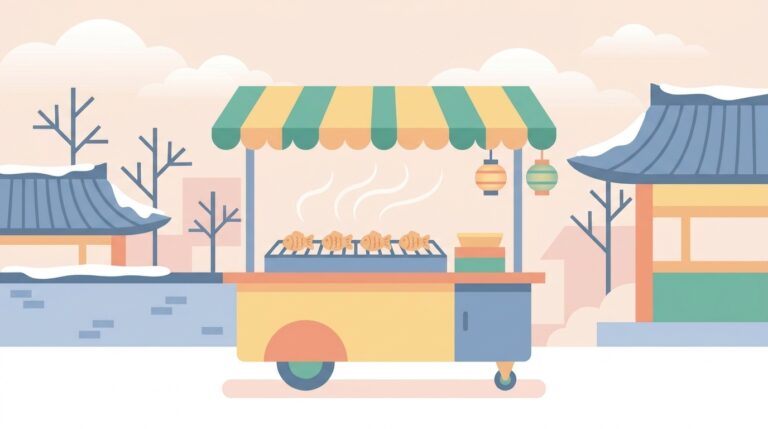
Imagine this: It is a brisk winter evening in Seoul. The temperature has dropped below zero, your fingertips are numb, and your breath plumps into small white clouds. Suddenly, a heavenly scent of roasted sweet dough and warm vanilla drifts down the alley. You spot the iconic glowing yellow vinyl tent. Inside, an elderly street vendor flips a steaming cast-iron mold to reveal rows of golden, crispy, fish-shaped pastries: Bungeoppang (붕어빵).
You step closer, stomach rumbling. But suddenly, your mind blanks out. How do I say red bean? What if they only take cash or local bank transfer? How do I politely ask for three pastries without looking completely lost? You end up pointing timidly, feeling a bit awkward, or worse, walking away empty-handed.
Don’t worry, my friend! You are not alone. As a cultural navigator who has guided hundreds of Korean language beginners, I see this exact moment happen every single winter. Today, we are turning that hesitation into complete confidence. With just three magical beginner phrases, you will walk up to any street cart in Korea and order fresh, piping-hot fish bread just like a born-and-raised Seoulite.
Phase 2: 3 Core Expressions In-Depth
1. 팥으로 세 개 주세요 (Pat-eu-ro se gae ju-se-yo)
- Pronunciation: [Pat-eu-ro se gae ju-se-yo] (Sounds like paht-oo-ro say-gay joo-say-yo — imagine saying “pot” with a soft ‘t’, then “say gay”)
- Meaning: Literally “By red bean, three items please” vs Natural nuance: “I’d like three red bean ones, please!”
- K-Culture Moment: In winter K-dramas like Weightlifting Fairy Kim Bok-joo, characters huddle around steaming stalls, shouting this exact phrase while stamping their cold feet.
- Editor’s Insight: The particle -으로 (-eu-ro) means “by way of” or “as for”. When choosing flavors among options, attaching -으로 tells the vendor your pick smoothly.
- Situation Spectrum: Casual ⚠️ / Semi-formal ✅ / Formal 🚫 (Polite, warm, and the gold standard for street stalls)
- 🤔 Think About It: In English, we say “Three red beans, please,” but Korean specifies the counter unit (개, gae) and choice marker (으로, eu-ro). How does counting items change between our languages?
2. 슈크림도 있어요? (Syu-keu-rim-do it-seo-yo?)
- Pronunciation: [Syu-keu-rim-do it-seo-yo] (Sounds like Shoo-cream-doh eet-suh-yo)
- Meaning: Literally “Chou cream also exists?” vs Natural nuance: “Do you have custard cream too?”
- K-Culture Moment: The great Korean debate: Pat-ppang (red bean) vs Syu-ppang (custard cream). K-pop idols often debate this passionately on live broadcasts!
- Editor’s Insight: Adding -도 (-do) means “also” or “too”. Asking with a rising intonation turns this basic statement into a natural, friendly question.
- Situation Spectrum: Casual ⚠️ / Semi-formal ✅ / Formal 🚫 (Ideal for street carts, bakeries, and cafes)
- 🤔 Think About It: Notice how Koreans say “Does it exist?” (isseoyo) rather than “Do you have?” (gajigo isseoyo). Street food interactions focus on the item’s presence rather than personal ownership!
3. 계좌이체 돼요? (Gye-jwa-i-che dwae-yo?)
- Pronunciation: [Gye-jwa-i-che dwae-yo] (Sounds like Gyeh-jwa-ee-cheh dway-yo)
- Meaning: Literally “Account transfer becomes?” vs Natural nuance: “Can I pay via bank transfer?”
- K-Culture Moment: Most street vendors in Korea don’t take foreign credit cards, but you will see plastic signs with bank account numbers taped to every cart.
- Editor’s Insight: 돼요? (Dwae-yo?) is one of the most versatile phrases in Korean. It means “Is it okay?” or “Does it work?”. Pair it with any payment noun when in doubt!
- Situation Spectrum: Casual ⚠️ / Semi-formal ✅ / Formal 🚫 (Essential survival phrase for modern Korean street vendors)
- 🤔 Think About It: Korea is nearly cashless, yet street vendors bridge the gap with real-time mobile bank transfers. Language adapts right alongside technology!
Phase 3: Textbook Korean vs Real Korean
Situation 1: Ordering your fish bread quantity
- 📖 교과서 한국어: 붕어빵 세 개를 저에게 주십시오. (Bung-eo-ppang se gae-reul jeo-e-ge ju-sip-si-o. / “Please grant three fish breads to me.”)
- 🗣️ 진짜 한국어: 팥 세 개 주세요! (Pat se gae ju-se-yo! / “Three red bean ones, please!”)
- 💡 왜 다를까? Street food carts are fast and noisy. Native speakers drop lengthy object particles (-를) and indirect pronouns (저에게) to keep interactions snappy and friendly.
Situation 2: Asking if you can pay without cash
- 📖 교과서 한국어: 신용카드로 결제할 수 있습니까? (Sin-yong-ka-deu-ro gyeol-je-hal su it-seum-ni-kka? / “Is it possible to execute payment via credit card?”)
- 🗣️ 진짜 한국어: 이체도 돼요? (I-che-do dwae-yo? / “Does bank transfer work too?”)
- 💡 왜 다를까? Ultra-formal textbook phrasing sounds like a corporate boardroom meeting. A short, polite “이체도 돼요?” conveys warmth and respect without unnecessary stiffness.
Phase 4: K-Culture Deep Dive & Non-verbal Manners
4-1. Nunchi (눈치) & Street Cart Body Language
When you approach a Bungeoppang cart, observe the rhythm of the cart owner (Imo or Sajangnim). They are often managing scorching hot irons, pouring batter, and packaging orders simultaneously.
* The Finger Counter: When stating your quantity (e.g., 세 개, three), hold up three fingers at chest height. It cuts through loud street noise instantly.
* Two Hands for Money: Always hand cash or show your mobile transfer screen using both hands, or support your right forearm with your left hand. This classic Korean gesture expresses sincere courtesy.
* The Paper Bag Cradle: When handed your hot paper bag, take it with both hands and leave the top slightly open so steam escapes, keeping the crust crispy!
4-2. Culture Code: Bungeoppang vs Ingeoppang & The Personality Test
Did you know Koreans distinguish between Bungeoppang (붕어빵) and Ingeoppang (잉어빵)?
* Bungeoppang uses standard waffle-like batter with filling concentrated in the belly.
* Ingeoppang has oil and glutinous rice added to the batter, making it slightly translucent, crunchier, with filling spread all the way to the tail.
Plus, Koreans love the classic Fish Bread Personality Test:
* Eating the Head first: You are an optimist, quick to make decisions, and adventurous.
* Eating the Tail first: You are cautious, detail-oriented, and romantic.
* Eating the Belly first: You are energetic, popular, and decisive!
Phase 5: Real-Life Roleplay Scenario
Setting: A cold evening outside Jongno 3-ga Station. An appetizing street cart glows under fairy lights. An affectionate cart owner (이모, Imo) is turning sizzling iron molds.
- Imo (이모): 어서 와요! 뭐 줄까? (Eo-seo wa-yo! Mwo jul-kka?)
- 🎭 Greets you with a warm smile, holding a metal spatula.
- Translation: “Welcome! What can I get you?”
- You (당신): 안녕하세요! 팥으로 세 개 주세요. (An-nyeong-ha-se-yo! Pat-eu-ro se gae ju-se-yo.)
- 🎭 Bows slightly and holds up three fingers.
- Translation: “Hello! Three red bean ones, please.”
- Imo (이모): 슈크림은 안 필요해? 오늘 슈크림 맛있는데! (Syu-keu-rim-eun an pil-yo-hae? O-neul syu-keu-rim mas-in-neun-de!)
- 🎭 Points proudly to the warm custard batch.
- Translation: “Don’t you need custard cream? The custard is delicious today!”
- You (당신): 그럼 슈크림도 두 개 주세요! (Geu-reom syu-keu-rim-do du gae ju-se-yo!)
- 🎭 Nods happily with sparkling eyes.
- Translation: “Then two custard cream ones too, please!”
- Imo (이모): 오케이, 다해서 오천 원이에요. (O-kei, da-hae-seo o-cheon won-i-e-yo.)
- 🎭 Packs warm pastries into a brown paper bag.
- Translation: “Okay, that’s 5,000 won in total.”
- You (당신): 계좌이체 돼요? (Gye-jwa-i-che dwae-yo?)
- 🎭 Takes out your phone, looking toward the vendor’s bank account sign.
- Translation: “Can I pay by bank transfer?”
- Imo (이모): 응, 저기 계좌번호로 보내줘요. (Eung, jeo-gi gye-jwa-beon-ho-ro bo-nae-jwo-yo.)
- 🎭 Points to a laminated cardboard sign on the glass window.
- Translation: “Sure, send it to that account number over there.”
- You (당신): 보냈어요! 감사합니다! (Bo-naess-eo-yo! Gam-sa-ham-ni-da!)
- 🎭 Politely shows the transfer confirmation screen and receives the steaming bag with both hands.
- Translation: “Sent! Thank you so much!”
🔀 Interactive Choice Point
The vendor says: “방금 구워서 엄청 뜨거워요!” (Bang-geum gu-wo-seo eom-cheong tteu-geo-wo-yo! / “They were just baked, so they are super hot!”) How do you respond?
- Choice A: 네, 감사합니다! 조심히 먹을게요. (Ne, gam-sa-ham-ni-da! Jo-sim-hi meok-eul-ge-yo.)
- Feedback: [BEST] Polite, respectful, and heartwarming. The vendor will smile warmly and might even slip in an extra treat next time!
- Choice B: 왜 이렇게 뜨거워요? (Wae i-reoh-ge tteu-geo-wo-yo?)
- Feedback: [BAD] Means “Why is it so hot?” Sounds critical and rude. Street food is meant to be hot!
- Choice C: 안 뜨거워요. (An tteu-geo-wo-yo.)
- Feedback: [RISK] Means “It’s not hot.” If you immediately take a bite, you will burn your tongue on hot red bean filling, and the vendor will look at you with deep worry!
Phase 6: 10-Second Emotional Shadowing Drill
Practice these with natural rhythm and voice emotion! The slash mark / indicates a brief natural pause.
[😊 Cheerful and Confident]- 팥으로 세 개 / 주세요! (Pat-eu-ro se gae / ju-se-yo!)
[🤔 Curious and Bright]- 슈크림도 / 있어요? (Syu-keu-rim-do / it-seo-yo?)
[🥺 Polite and Gentle Inquiring]- 혹시 / 계좌이체 돼요? (Hok-si / gye-jwa-i-che dwae-yo?)
[🥰 Grateful and Satisfied]- 와, 따뜻해요! / 잘 먹겠습니다! (Wa, tta-tteut-hae-yo! / Jal meok-get-seum-ni-da!)
Phase 7: K-Culture Mini Dictionary
- 팥 (Pat) | Red Bean Filling | The traditional sweet azuki bean filling boiled with sugar. It is the undisputed classic foundation of Korean winter snacks.
- 슈크림 (Syu-keu-rim) | Custard Cream | Borrowed from French chou à la crème, this sweet vanilla custard is the top rival to red bean among younger generations.
- 계좌이체 (Gye-jwa-i-che) | Bank Transfer | Direct peer-to-peer wire transfer. Crucial in Korea because street stalls rarely possess portable credit card terminals.
- 붕세권 (Bung-se-gwon) | Fish-bread Zone | A trendy slang combining Bungeoppang and Yeoksegwon (station influence zone). It describes an enviable neighborhood that has a fish bread vendor nearby!
Phase 8: Traveler’s Survival Kit
Top 3 Survival Expressions
- 얼마예요? (Eol-ma-ye-yo?) | How much is it? | Pro Tip: Vendors usually price them in sets (e.g., 2 for 1,000 won or 3 for 2,000 won).
- 섞어서 주세요 (Seokk-eo-seo ju-se-yo) | Please mix the flavors | Pro Tip: Use this when you want half red bean and half custard cream!
- 현금 있어요 (Hyeon-geum it-seo-yo) | I have cash | Pro Tip: Street vendors appreciate crisp cash (1,000 or 5,000 won bills) because it speeds up checkout.
Editor’s Travel Note
- Finding Carts: Look up carts easily using the community-driven 가슴속3천원 (3,000 Won in My Pocket) App or verify bustling spots via the Naver Map application.
- Payment Essentials: Always carry 3,000 to 5,000 won in physical bills during winter. If you don’t have Korean cash or a domestic bank account for Gyejwai-che, ask your hotel concierge or a local friend to exchange small currency before hunting for treats.
Phase 9: One Step Deeper (Reflection)
In Korean society, street carts represent more than fast food; they embody Jeong (정), an unspoken bond of warmth and communal affection. When temperatures plunge, standing shoulder-to-shoulder with strangers under a plastic tent while watching golden pastries bake creates a fleeting feeling of unity. Even busy professionals pause their rushed steps to take a warm bag of fish bread home to their family.
💬 Your Turn: Does your home culture have a seasonal street food that brings people together like Bungeoppang? Would you choose red bean or custard cream first? Share in the comments below!
Phase 10: FAQ & Common Mistakes
Q: Can I pay with an international Visa or Mastercard credit card?
A: In 95% of traditional outdoor street stalls, foreign credit cards cannot be processed because vendors do not carry card POS terminals. Always carry small cash bills (1,000 or 5,000 won) or travel with a companion who has Korean bank transfer enabled.
Q: Are Bungeoppang carts open all year round?
A: Generally no. Bungeoppang is intensely seasonal. Most stalls pop up in late October and disappear by late March. During summer, many vendors switch to selling roasted corn, tteokbokki, or soft-serve ice cream.
Q: What is the difference between Bungeo (carp) and Ingeo (carp)? Does it contain real fish?
A: Absolutely no fish inside! The name comes solely from the cast-iron fish shape mold. The snack was originally inspired by Japanese taiyaki in the 1930s and evolved into Korea’s unique winter staple.
🚨 Common Mistakes Warning Board
- Mistake: Handing over a 50,000 won bill for a 2,000 won purchase.
- Correct Action: Keep small 1,000 and 5,000 won paper bills handy so vendors don’t run out of change.
- Mistake: Eating straight from the center immediately.
- Correct Action: The sweet filling retains boiling heat! Nibble the crunchy tail or head first to let steam escape.
- Mistake: Saying 붕어빵 주십시오 (Bung-eo-ppang ju-sip-si-o).
- Correct Action: It sounds like a historical period drama. Stick to the natural and polite 주세요 (ju-se-yo)!
Phase 11: Action Missions & Engagement
- 🥉 Bronze Mission (Solo Practice): Stand in front of your mirror and say: “팥 세 개, 슈크림 두 개 주세요!” with confident hand gestures 3 times.
- 🥈 Silver Mission (Community Share): Leave a comment below declaring your camp: Team 팥 (Red Bean) or Team 슈크림 (Custard)? Tell us your reason!
- 🥇 Gold Mission (Real-World Challenge): Visit an authentic street food stall in Korea (or a Korean festival in your hometown), order entirely in Korean using ~주세요, and celebrate your delicious achievement!
- 🎮 K-Culture Mission: Watch an episode of a winter K-drama (like Reply 1988 or True Beauty) and spot a brown paper pastry bag or street cart scene!
Phase 12: Interactive Quiz Challenge
Test what you learned today! Pick your answers, then tap the spoiler toggle to check your score.
1. Situation Quiz: You want to buy 2 red bean fish breads and 2 custard fish breads. What is the most natural sentence?
* (A) 팥 둘 슈 둘 주십시오.
* (B) 팥 두 개, 슈크림 두 개 섞어서 주세요.
* (C) 물고기 빵 네 개 카드 돼요?
2. Fill-in-the-Blank: You want to pay via mobile bank transfer. Complete the phrase:
* “계좌______ 돼요?”
3. True or False Culture Check: Bungeoppang contains real minced fish paste.
* (True / False)
👉 Click here to reveal answers and explanations!
1. Answer: (B)
* Explanation: Saying 팥 두 개, 슈크림 두 개 섞어서 주세요 (Two red bean, two custard, mixed please) is natural and friendly. (A) is awkwardly stiff, and (C) calls them “fish bread” literally (mul-go-gi ppang), which vendors do not say!
2. Answer: 이체 (i-che)
* Explanation: 계좌이체 (Gye-jwa-i-che) means bank account transfer. Combining it with 돼요 gives the ultimate survival phrase!
3. Answer: False
* Explanation: Bungeoppang is strictly a sweet dessert pastry! There has never been real fish inside—only warm, sweet fillings like red bean or custard.







