

How to Vent Like a Real Korean: Unwinding Stress with Friends Over Late-Night Chimaek
Phase 1: Empathy (Immersive Storytelling Opening)
안녕하세요! 매일한글 에디터입니다. (Hello! I’m your Daily Hangul editor.)
Picture this: It’s 8:30 PM on a sweltering Thursday in Seoul. You’ve just stepped off the notoriously packed subway Line 2 after enduring back-to-back presentations, passive-aggressive client emails, and that one supervisor who never seems to notice your overtime. Your shoulders are practically touching your ears from tension. All you want is to collapse, but your phone buzzes with a message from your closest Korean friend: “야, 오늘 맥주 한잔 각이다. 나와!” (Hey, tonight definitely calls for a beer. Come out!)
Twenty minutes later, you find yourself tucked into the buzzing terrace of a pojangmacha in Euljiro. The air smells like crispy fried garlic chicken, sizzling grilled pork belly, and chilled draft beer. You want nothing more than to unload the entire emotional circus of your day. But suddenly, your brain freezes. You search through the textbook phrases you practiced so diligently. What comes out? “저는 오늘 직장에서 많은 스트레스를 받았습니다.” (I received a lot of stress at my workplace today.)
Your friend pauses, blinks, and laughs gently: “Are you writing an official report, or are you talking to me?”
We have all been there. Textbooks teach you how to pass standardized exams like the TOPIK, but they rarely teach you the raw, cathartic language of social decompression. In Korea, letting off steam through hearty venting—known as 수다 (suda)—is not just casual banter; it is an essential cultural survival mechanism and the ultimate catalyst for deep bonding. Based on real feedback from hundreds of intermediate learners in our Daily Hangul masterclasses, this guide is crafted to elevate your Korean from “robotic student” to “expressive insider.” Let’s transform your after-work catch-ups into truly therapeutic moments.
Phase 2: Core Expressions Deep Dive
Here are three high-impact, intermediate-level expressions you need when you want to blow off steam with Korean friends.
1. 속이 다 시원하다 (Sogi da siwonhada)
- Pronunciation: [Sogi da siwonhada] (Think: “So-gee da see-won-ha-da” — let out a long, relieved sigh on the final syllable)
- Meaning: Literal: “My inside feels completely cool” | Actual Nuance: “What a massive relief!” / “I feel so unburdened!”
- K-Culture Moment: Seen in nearly every workplace K-Drama (like Misaeng or Agency) when a protagonist finally tells off a manipulative manager or turns in a grueling project and downs an ice-cold somaek in one gulp.
- Editor’s Insight: In Korean somatic culture, unresolved tension, anger, and stress accumulate as heat in the chest (속). When you finally vent or resolve the situation, that toxic emotional heat disperses, leaving you “cool” (시원하다). Saying this signals that your heavy emotional knot has fully untied.
- Situation Spectrum: Casual ✅ | Semi-formal ⚠️ | Formal 🚫
- 🤔 Think About It: English speakers say “That’s a load off my chest,” focusing on weight. Koreans say “My inside is cool,” focusing on temperature. Why do you think Korean culture frames emotional catharsis as thermal relief?
2. 말도 마 (Maldo ma)
- Pronunciation: [Maldo ma] (Think: “Mahl-doh mah” — snap the final “ma” with wide eyes and a sharp nod)
- Meaning: Literal: “Don’t even speak words” | Actual Nuance: “Don’t even get me started!” / “You have no idea!”
- K-Culture Moment: Two friends sit down across a bubbling pot of extra-spicy tteokbokki. Friend A asks, “Was your shift tough today?” Friend B drops her chopsticks, shakes her head with a grimace, and fires back: “말도 마. (Don’t even get me started.)”
- Editor’s Insight: This short, punchy idiom is the ultimate conversational springboard. It tells your listener that what happened was so ridiculous, exhausting, or unbelievable that standard words can barely summarize it. It instantly commands 100% of the room’s attention.
- Situation Spectrum: Casual ✅ | Semi-formal 🚫 | Formal 🚫
- 🤔 Think About It: English says “Don’t get me started” (warning about a long rant), while Korean says “Don’t even speak” (implying the event transcends speech). How does this reflect Korean dramatic conversational timing?
3. 썰을 풀다 (Sseoreul pulda)
- Pronunciation: [Sseoreul pulda] (Think: “Ssul-eul pool-dah” — smooth and relaxed)
- Meaning: Literal: “To unravel an explanatory tale” | Actual Nuance: “To spill the tea” / “To dish out the crazy story”
- K-Culture Moment: You will hear this phrase constantly on Korean YouTube talk shows, variety programs, or around university cafes in Sinchon when someone leans forward and says, “내가 오늘 진짜 역대급 썰 풀어줄게.” (I’m gonna dish out a legendary story today.)
- Editor’s Insight: Derived from the Sino-Korean character 설 (說 – to explain/speak) combined with the native verb 풀다 (to untie/unravel). It turns your stressful complaint into an engaging piece of shared entertainment, making stress relief a mutual bonding activity.
- Situation Spectrum: Casual ✅ | Semi-formal ⚠️ (with familiar colleagues of similar rank) | Formal 🚫
- 🤔 Think About It: Notice how venting in Korea is framed as “unraveling a knot” (풀다). What happens psychologically when you treat your daily stressors as stories to be shared rather than burdens to hide?
Phase 3: Textbook Korean vs. Real Native Korean
Let’s replace stiff, exam-style sentences with natural, conversational Korean used by native speakers in their 20s and 30s.
Situation 1: Expressing Extreme Frustration About Work/Study
- 📖 교과서 한국어 (Textbook):
- “오늘 회사에서 스트레스를 많이 받아서 너무 화가 납니다.”
- (Oneul hoesaeseo seuteureseureul mani badaseo neomu hwaga namnida.)
- “I received a lot of stress at company today, so I am very angry.”
- 🗣️ 진짜 한국어 (Real-World Native):
- “오늘 팀장님 때문에 진짜 뚜껑 열릴 뻔했잖아.”
- (Oneul timjangnim ttaemune jinjja tteukkeong yeollil ppeonhaetjana.)
- “My lid almost flew off today because of my team lead, I swear.”
- 💡 왜 다를까? (Why the difference?): Real Koreans rely heavily on vivid visual idioms like 뚜껑 열리다 (to have one’s lid blow off like a boiling pot). Adding the conversational ending -잖아 (-jana) invites the listener to validate and share your emotional state instantly.
Situation 2: Suggesting an After-Work Venting Session
- 📖 교과서 한국어 (Textbook):
- “우리 만나서 대화를 나누며 기분을 전환합시다.”
- (Uri mannaseo daehwareul nanumyeo gibuneul jeonhwanhapsida.)
- “Let us meet, converse, and refresh our mood.”
- 🗣️ 진짜 한국어 (Real-World Native):
- “야, 오늘 밤에 맥주 한잔하면서 시원하게 털어버리자.”
- (Ya, oneul bame maekju hanjanhamyeonseo siwonhage teoreobeorija.)
- “Hey, let’s grab a beer tonight and shake it all off for good.”
- 💡 왜 다를까? (Why the difference?): The verb 털어버리다 (to dust off / shake off cleanly) carries a kinetic, active sense of liberation that formal vocabulary like 기분 전환 (mood diversion) completely misses.
Phase 4: K-Culture Deep Dive & Non-Verbal Manners
4-1. 눈치 (Nunchi) & Body Language of Venting
When venting with Korean friends, your words are only half the conversation. The non-verbal rhythm is crucial:
* The Leaning Clatter: When your friend says “말도 마,” immediately lean forward across the table, rest your forearms near your drink, and lock eyes. Don’t look at your phone. In Korea, giving full-body attention during a vent session is basic manners (예의).
* The Exclamatory Gasps (맞장구 – Matjanggu): Active listening in Korea is vocal. Pepper their story with reactions like “진짜?” (Seriously?), “대박…” (No way…), and “아니 그래서?” (No way, so then what happened?). Nodding vigorously (폭풍 끄덕임) signals unconditional emotional solidarity.
* The Table Slap: When the story reaches peak absurdity, lightly slap the table with an open palm or clap your hands once while groaning “아이고…”. This physical release validates your friend’s anger without words.
4-2. The Cultural Code: Spicy Food Therapy (매운맛 테라피)
Ever wonder why Koreans gravitate toward fire chicken (불닭), spicy braised chicken feet (매운 닭발), or bubbling tteokbokki when they are stressed? Koreans refer to this as 스트레스 풀리는 매운맛 (the stress-relieving spicy flavor). The physiological sensation of capsaicin stimulates endorphin and dopamine release, sweating out physical tension while venting emotionally across the table. It is culinary therapy: you burn the stress out of your system together.
Phase 5: Real-World Roleplay Scenario
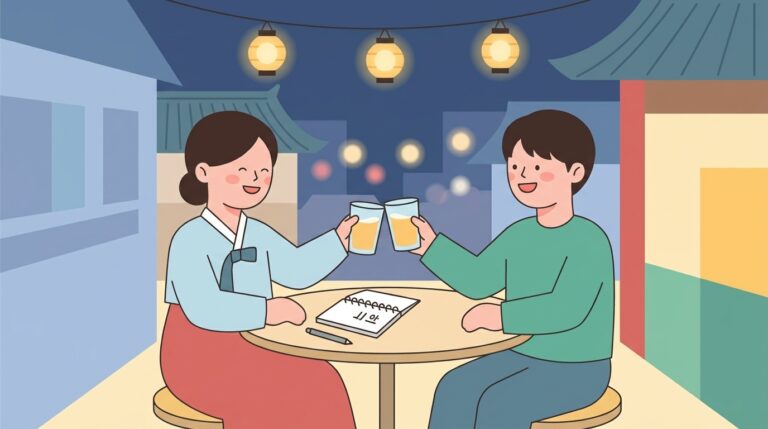
Setting: A bustling outdoor table at an Euljiro craft brewery on a brisk Friday evening. Neon signs glow, glasses clink, and savory aromas drift through the alley. You are meeting Minji (민지), your close Korean friend who works in marketing.
- 민지: 야! 너 얼굴이 왜 이렇게 반쪽이 됐어? 오늘 무슨 일 있었지?
(Ya! Neo eolguri wae ireoke banjjogi dwaesseo? Oneul museun il isseotji?)
🎭 Looking at you with genuine concern while pulling out the plastic chair for you.
“Hey! Why do you look so worn out? Did something happen today?” -
나 (You): 말도 마. 오늘 팀장님이 퇴근 10분 전에 기획서 다시 쓰라고 던졌잖아.
(Maldo ma. Oneul timjangnimi toegeun sippun jeone gihoekseo dasi sseurago deonjyeotjana.)
🎭 Slumping shoulders and shaking head in sheer exasperation.
“Don’t even get me started. My team manager tossed the project proposal back at me ten minutes before clocking out, telling me to rewrite it.” -
민지: 뭐? 진짜 제정신이야? 그걸 주말 앞두고 시킨다고?
(Mwo? Jinjja jejeongsiniya? Geugeol jumal apdugo sikindago?)
🎭 Slamming her wet towel on the table, eyes wide with indignation.
“What? Is he completely out of his mind? Dropping that right before the weekend?” -
나 (You): 그러니까! 그래서 내가 도저히 못 참겠어서 한마디 했지.
(Geureonikka! Geuraeseo naega dojeohi mot chamgesseoseo hanmadi haetji.)
🎭 Leaning closer over the small round table, lowering voice dramatically.
“Exactly! So I just couldn’t take it anymore and finally spoke up.” -
민지: 헐, 대박! 뭐라고 했는데? 빨리 썰 좀 풀어봐!
(Heol, daebak! Mworago haenneunde? Pppalli sseol jom pureobwa!)
🎭 Grabbing your wrist playfully with eager anticipation.
“OMG, seriously?! What did you say? Hurry up and spill the tea!” -
나 (You): 이미 합의된 일정이라 월요일 오전에 검토해 달라고 정중하게 받아쳤어.
(Imi habuidoen iljeong-ira woryoil ojeone geomtohae dallago jeongjunghage badachyeosseo.)
🎭 Sitting up straight with a proud, defiant grin.
“I politely pushed back, saying the schedule was already agreed upon and asked him to review it Monday morning.” -
민지: 와, 진짜 속이 다 시원하다! 너 완전 사이다였네! 맥주 마시자!
(Wa, jinjja sogi da siwonhada! Neo wanjeon saidayeonne! Maekju masija!)
🎭 Raising her frosted glass high in the air with a bright, triumphant smile.
“Wow, that is such a massive relief to hear! You were a total breath of fresh air! Let’s drink!” -
나 (You): 그래, 건배하고 오늘 스트레스 다 털어버리자!
(Geurae, geonbaehago oneul seuteureseu da teoreobeorija!)
🎭 Clinking glasses firmly with a loud ring.
“Yeah, let’s cheers and shake off all this stress tonight!”
🔀 Interactive Branching Point: How do you react when Minji says the manager is out of his mind?
Imagine the conversation pauses before you answer. Which response would you pick?
- Option A: “그냥 제가 일을 못해서 그런 것 같아요. 죄송해요.” (I think it’s just because I’m bad at work. I’m sorry.)
- Feedback [Bad]: Kills the venting momentum completely. Venting sessions are for mutual solidarity, not self-criticism or workplace apologies! Your friend will feel awkward.
- Option B: “그러니까! 그래서 내가 도저히 못 참겠어서 한마디 했지.” (Exactly! So I just couldn’t take it anymore and finally spoke up.)
- Feedback [Best]: Perfect match! It builds suspense, validates her shared anger, and sets up a dramatic storytelling arc (썰 풀기).
- Option C: “팀장님 고발하려고 노동청에 전화했어요.” (I called the Ministry of Employment to report my team manager.)
- Feedback [Risk]: A bit too intense and extreme for casual after-work venting unless an actual severe legal labor violation took place. Might alarm your friend unnecessarily.
Phase 6: 10-Second Emotion Shadowing Drill
Practice reading these lines aloud. Focus on the emotional tone markers and the pause slashes (/).
[😤 Frustrated and exasperated]
말도 마… / 오늘 팀장님 때문에 / 진짜 뚜껑 열릴 뻔했잖아.
(Maldo ma… / oneul timjangnim ttaemune / jinjja tteukkeong yeollil ppeonhaetjana.)-
[👀 Whispering with dramatic suspense]
너 아무한테도 말하지 마. / 내가 오늘 있었던 썰 / 딱 너한테만 풀어줄게.
(Neo amuhantedo malhaji ma. / naega oneul isseotdeon sseol / ttak neohanteman pureojulge.) -
[🍻 Immensely relieved and triumphant]
하, / 그렇게 질러버리니까 / 진짜 십 년 묵은 체증이 내려간 것처럼 / 속이 다 시원하다!
(Ha, / geureoke jilleobeorinikka / jinjja sim nyeon mugeun chejeung-i naeryeogan geotcheoreom / sogi da siwonhada!)
Phase 7: K-Culture Mini Dictionary
-
수다 (Suda)
Translation: Casual chatter / Venting gabfest
Usage: Refers to lighthearted, free-flowing conversation with close companions. You often hear 수다 떨다 (to engage in a chat marathon), especially when meeting friends at dessert cafes or local pubs to decompress. -
안주 (Anju)
Translation: Food paired specifically with alcoholic beverages
Usage: In Korea, drinking alcohol without 안주 is rare. Choosing the right 안주 (like pajeon with makgeolli, or dried squid with draft beer) is considered half the pleasure of catching up and relieving stress. -
불금 (Bulgeum)
Translation: “Fire Friday” (TGIF)
Usage: A portmanteau of 불타는 금요일 (Burning Friday). It embodies the widespread Korean custom of staying out late with friends on Friday night to aggressively “burn off” the built-up fatigue of the workweek. -
힐링 (Hilling)
Translation: Restorative self-care / Healing
Usage: Borrowed from English, but used uniquely as an adjective/noun in Korea to describe activities, meals, or peaceful gatherings that soothe mental exhaustion (e.g., “친구랑 수다 떠는 게 진짜 힐링이지” – Chatting with a friend is true healing).
Phase 8: Traveler’s Survival Kit
Top 3 On-the-Go Phrases for Local Pubs & Cafes
- “여기 시원한 생맥주 두 잔 먼저 주세요!” (Yeogi siwonhan saengmaekju du jan meonjeo juseyo!)
Pro Tip: Use this immediately upon sitting down at an outdoor pocha. Getting the drinks on the table early sets the rhythm for conversation. - “여기 제일 매운 안주가 뭐예요?” (Yeogi jeil maeun anjuga mwoyeyo?)
Pro Tip: If you want authentic spicy comfort food to blow off steam like a local, ask the pub owner directly. - “조용한 구석 자리로 앉아도 될까요?” (Joyonghan guseok jariro anjado doelkkayo?)
Pro Tip: Euljiro and Hongdae pubs can get loud. If you and your companion want to have a serious heart-to-heart vent session, request a corner seat away from the speaker.
Editor’s Travel Note
- Navigation: Looking for those nostalgic, atmospheric alleyway pochas in Seoul? Skip Google Maps (which has outdated pedestrian walking data in Korea). Be sure to complete your 네이버 지도 앱 다운로드 before heading out to search for spots tagged “노포” (historic hole-in-the-wall eateries) or “포차거리” (pocha streets).
- Transit Curfew: Remember that Seoul subway Line 2 and major buses wind down between midnight and 12:40 AM. If your venting session stretches past 1 AM, utilize 카카오 T 앱 다운로드 to hail a secure late-night taxi.
Phase 9: A Step Deeper (Cultural Reflection)
In Western cultures, venting is frequently categorized as venting frustration or “complaining,” which can carry a slightly negative or self-indulgent connotation. But in Korea, the dynamics of venting are anchored in the deep-seated cultural concepts of 한 (Han) and 정 (Jeong).
Han represents the collective emotional residue of unresolved grief, stress, and societal pressure. When unexpressed, Han festers into physical affliction (화병 – hwabyeong). But when Koreans gather over food and drink to express this grief together, communal warmth (Jeong) transforms that heavy Han into exuberant joy and shared release (흥 – Heung). When a Korean friend invites you to complain about your week, they aren’t merely asking for gossip; they are offering an intimate social sanctuary. They are offering to shoulder a portion of your burden.
💬 Your Turn: Have you ever felt that unloading your stress over a meal with a friend helped you feel closer to them than any formal conversation could? What is your personal favorite comfort food when you’ve had a tough day? Share your stories in the comments below!
Phase 10: FAQ & Common Pitfalls
Q: Can I use “속이 다 시원하다” when talking to my workplace boss?
A: Generally, no. “속이 다 시원하다” strongly implies that you felt internally irritated, frustrated, or blocked by a previous state of affairs. Saying this to a superior could sound as though you were holding a secret grudge against their orders. Instead, with bosses, use polite formal expressions like “문제가 잘 해결되어 정말 다행입니다.” (I am so relieved that the issue was resolved well.)
Q: What is the exact difference between “수다 떨다” and “뒷담화하다”?
A: 수다 떨다 (suda tteolda) is wholesome, general chatting, catching up, and venting about life events. 뒷담화하다 (dwittamhwahada) specifically refers to talking behind someone’s back or gossiping negatively about an absent third party. While everyday venting may occasionally brush against someone’s frustrating behavior, declaring “우리 뒷담화하자” sounds deliberately malicious.
Q: How do I reply if my Korean friend starts venting to me first?
A: The golden rule is validate first, advise later (or never)! Do not offer logical solutions immediately. Use reaction interjections: “진짜 힘들었겠다” (You must have had such a hard time), “완전 어이없다!” (That is completely ridiculous!), and “네 말이 맞아” (You’re totally right). Emotional agreement is what relieves their stress.
🚨 Common Mistakes Alert (외국인 학습자 흔한 실수 TOP 3)
- Saying “스트레스 받았어요” with a smiling, cheerful face: In Korean culture, emotional congruence is expected. If you describe high stress with a relaxed smile, listeners feel confused about your genuine sentiment.
- Correct Action: Match your facial expression to the mood: furrow your brow slightly or sigh before speaking.
- Overusing formal honorifics with peer drinking buddies: Saying “그분이 저에게 화를 내셨습니다” when ranting about a bad colleague creates emotional distance.
- Correct Action: Use standard peer-level informal language (반말) or natural polite forms (해요체) like “그 사람이 나한테 소리 질렀잖아.”
- Offering logical fixes instead of emotional 맞장구 (reactions): Telling a stressed Korean friend “Why don’t you talk to HR tomorrow morning?” in the first 5 minutes of their rant.
- Correct Action: Save the logic for later. Nod and exclaim “아니, 진짜 너무하네!” (Man, they are being so unfair!) first.
Phase 11: Action Missions
- 🥉 Bronze Level: Stand in front of your mirror and practice the line “말도 마, 오늘 진짜 뚜껑 열릴 뻔했잖아” three times. Focus on your facial expression and the sharp delivery of 말도 마.
- 🥈 Silver Level: Write a short 3-sentence diary entry in Korean describing your most stressful moment this week using at least one expression: 속이 다 시원하다, 말도 마, or 썰을 풀다. Leave it as a comment on this post!
- 🥇 Gold Level: During your next coffee catch-up or meal with a Korean language exchange partner or friend, steer the conversation using: “내가 오늘 진짜 재밌는 썰 하나 풀어줄게!”
🎮 K-Culture Mission: Watch an episode of the K-Drama Work Later, Drink Now (술꾼도시여자들). Count how many times the three female leads use 속 시원하다 or slap the table when listening to each other’s workplace venting.
Phase 12: Interactive Quiz Challenge
Test your real-world instincts with these three intermediate questions!
1. Situational Judgment:
Your Korean friend just spent 15 minutes pouring her heart out about how her manager took credit for her entire marketing presentation. What is the BEST native response?
* (A) “내일 아침에 매니저님께 정식으로 이메일을 보내서 따지세요.”
* (B) “와, 진짜 듣기만 해도 뚜껑 열린다. 어떻게 그럴 수가 있어?!”
* (C) “저는 스트레스가 풀렸습니다. 이제 음식을 먹읍시다.”
2. Fill-in-the-Blank:
Complete the dialogue using the idiom that means “What a huge relief / I feel unburdened”:
A: “그 까다롭던 고객사 계약 결국 우리가 따냈어!”
B: “대박! 몇 달 동안 고생했는데 이제 진짜 [ ]!”
3. True or False Culture Check:
In Korean venting culture, jumping in immediately with rational solutions and career advice is considered the highest form of respect and friendship.
* (True / False)
👉 Click here to reveal the answers and detailed explanations!
Answers & Explanations
-
Correct Answer: (B)
Explanation: Option (B) (“와, 진짜 듣기만 해도 뚜껑 열린다. 어떻게 그럴 수가 있어?!”) displays strong empathetic resonance (맞장구) and uses the authentic idiom 뚜껑 열리다. Option (A) gives unsolicited cold advice too early, and Option (C) is awkward and unnatural. -
Correct Answer: 속이 다 시원하다 (or 속이 다 시원하네!)
Explanation: When a long-standing, agonizing problem or project is successfully resolved, the trapped tension leaves your system, bringing thermal and emotional refreshment. -
Correct Answer: False
Explanation: Providing cold logic or immediate problem-solving before validating someone’s emotions often feels dismissive in Korean relationship culture. Emotional listening and shared venting (공감과 맞장구) must always precede practical advice!







