

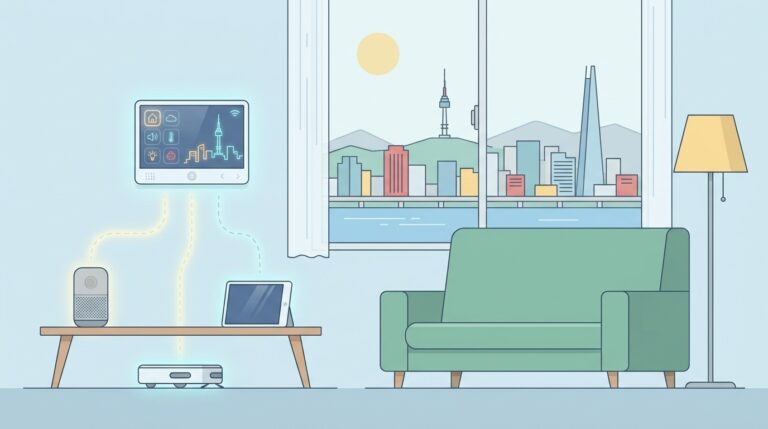
Smart Living in Korea: Master C1 Korean for IoT and Home Automation
Phase 1: Empathy (Story-Driven Opening)
안녕하세요! 매일한글 에디터입니다. (Hello! This is your Daily Hangul editor.)
Picture this: You have just moved into a sleek, brand-new officetel (오피스텔) in Pangyo Techno Valley or a modern high-rise apartment in Mapo. You stand in the foyer, mesmerized by the glowing wall-pad (월패드), the keyless biometric door lock, and the ambient lighting that greets you automatically. Everything in contemporary Korea is hyper-connected. You want to ask your building manager how to configure the floor heating so it activates before you arrive home from work, or explain to your tech-forward Korean colleagues how you automated your home office setup.
Yet, when you try to speak, you hit a linguistic roadblock. You know elementary words like 켜다 (to turn on) and 끄다 (to turn off), but native Korean professionals and urbanites speak in a far more sophisticated vocabulary. They seamlessly weave terms like 연동하다 (to interlink/sync), 원격 제어 (remote control), and 자동화 루틴 (automation routines) into everyday conversations. Sticking to beginner phrases makes you sound like a robotic user manual from the early 1990s rather than a fluent professional.
This guide was built directly from feedback collected from our advanced learners working in Seoul’s IT, design, and startup ecosystems. By mastering this C1-level unit, you will not only conquer the practicalities of modern smart living in Korea, but also navigate technical conversations with the effortless finesse of a Seoul tech insider.
Phase 2: Top 3 Core Expressions Deep-Dive
1. 스마트 기기를 연동하다 (Seumateu gigireul yeondonghada)
- Pronunciation: [seu-ma-teu gi-gi-reul yeon-dong-ha-da] (Think of ‘yeon-dong’ like ‘yawn’ + ‘dong’ as in ding-dong)
- Meaning: Literal: “To interlink smart devices” | Real Nuance: To synchronize or cross-integrate hardware and software across an ecosystem so they trigger each other automatically.
- K-Culture Moment: You will hear this in trendy Korean apartment tour vlogs and high-tech K-dramas where characters walk in and their ambient lighting, smart curtains, and speakers sync to their mood with a single command.
- Editor’s Insight: While 연결하다 (yeongyeolhada) means simply “to connect” (like plugging a cord into a socket), 연동하다 (聯動) carries the nuance of kinetic inter-operation—when one device acts, the other responds dynamically.
- Situation Spectrum: Casual: ✅ | Semi-formal: ✅ | Formal: ✅
- 🤔 Think About It: In English, we often say “sync,” “pair,” or “integrate.” How does the Hanja concept of 연동 (joint movement) reflect the idea of separate elements moving as a single, coordinated body?
2. 스마트홈 환경을 구축하다 (Seumateu-home hwan-gyeong-eul guchukhada)
- Pronunciation: [seu-ma-teu-hom hwan-gyeong-eul goo-chook-ha-da] (Sounds like ‘goo-chook-ha-da’, where ‘chook’ rhymes with ‘book’)
- Meaning: Literal: “To construct a smart home environment” | Real Nuance: To architect and deploy a customized, holistic smart home infrastructure.
- K-Culture Moment: Top Korean tech vloggers (테크 유튜버) reviewing new studio apartments often say: “이사 오자마자 조명이랑 스마트 플러그로 홈 IoT 환경을 구축했어요.” (As soon as I moved in, I set up a home IoT environment with smart lights and plugs.)
Editor’s Insight: 구축하다 (構築하다) is a premium C1 Sino-Korean verb typically reserved for building infrastructures, databases, or systems. Using it to describe your personal smart home setup sounds polished, deliberate, and technologically capable.
- Situation Spectrum: Casual: ⚠️ (sounds slightly academic, but great for tech enthusiasts) | Semi-formal: ✅ | Formal: ✅
- 🤔 Think About It: Why does Korean adopt high-level infrastructure vocabulary like 구축하다 for domestic technology rather than simpler words like 만들다 (to make)?
3. 원격으로 제어하다 (Won-gyeog-euro jeeohada)
- Pronunciation: [won-gyeo-geu-ro je-eo-ha-da] (Pronounce ‘won-gyeok’ with a soft ‘g’ transition, followed by ‘jay-uh-ha-da’)
- Meaning: Literal: “To control from a distant boundary” | Real Nuance: To tele-operate, monitor, or manage appliances remotely via cloud applications.
- K-Culture Moment: On a sub-zero winter evening in Seoul, a character heading home on the subway turns to their friend: “집 들어가기 30분 전에 원격으로 난방 켜 놨어.” (I turned on the heating remotely 30 minutes before getting home.)
- Editor’s Insight: 제어하다 implies precision command and operational regulation. It goes far beyond simply turning something on (켜다); it encompasses fine adjustments to temperature, modes, and timers.
- Situation Spectrum: Casual: ✅ | Semi-formal: ✅ | Formal: ✅
- 🤔 Think About It: How does the linguistic precision of 제어 (control/govern) vs 조절 (adjust) alter the tone of authority you convey when speaking about automation?
Phase 3: Textbook Korean vs Real Korean
Situation 1: Inquiring about IoT functionality at an electronics flagship store
- 📖 교과서 한국어 (Textbook): 이 전자제품은 사물인터넷 기능이 탑재되어 있습니까? (I jeonjajepumeun samurinteonet gineungi tapjaedoeeo isseumnikka? – “Is this electronic appliance equipped with Internet of Things functionality?”)
- 🗣️ 진짜 한국어 (Real-World): 이거 스마트폰 앱으로 연동돼요? (Igeo seumateupon aebeuro yeondongdwaeyo? – “Does this sync with the smartphone app?”)
- 💡 왜 다를까? (Why the difference?): While “사물인터넷 기능 탑재” is standard in promotional brochures, real native speakers ask directly about the practical touchpoint: the smartphone app (스마트폰 앱) and the interaction (연동되다).
Situation 2: Mentioning that you pre-heated your room while commuting
- 📖 교과서 한국어 (Textbook): 저는 원격 통신망을 사용하여 귀가 전에 실내 난방을 가동했습니다. (Jeoneun won-gyeok tongsinmangeul sayonghayeo gwiga jeone sinnae nanbangeul gadonghaesseumnida. – “I operated the indoor heating prior to returning home using remote telecommunication networks.”)
- 🗣️ 진짜 한국어 (Real-World): 집 들어가기 전에 앱으로 보일러 미리 돌려놨어. (Jip deureogagi jeone aebeuro boilleo miri dollyeonwasseo. – “I set the boiler running in advance via the app before heading inside.”)
- 💡 왜 다를까? (Why the difference?): Natural Korean uses the colloquial phrasal construction ~어/아 놓다 (completed action kept in state) paired with 돌리다 (to run/operate machines like boilers or laundry), creating an effortless native rhythm.
Phase 4: K-Culture Deep Dive & Non-Verbal Manners
4-1. 눈치 (Nunchi) & Gestures in Tech Interactions
When asking a building technician (관리소장님) or a landlord to troubleshoot smart home features, avoid aggressively thrusting your smartphone into their personal space. Instead, hold your smartphone with both hands at chest level, screen angled toward them, and offer a slight head tilt (갸우뚱) while asking:
* 이 기능이 자꾸 오류가 나는데, 제가 설정을 잘못 만졌을까요? (I gineungi jakku oryuga naneunde, jega seoljeong-eul jalmot manjyeosseulkkayo? – “This function keeps erroring out; could it be that I misconfigured a setting?”)
By politely framing the question as if the fault might be your unfamiliarity rather than their system’s breakdown, you display impeccable nunchi (cultural emotional intelligence), making them eager to assist you.
4-2. Cultural Code: The Korean Apartment “Wall-Pad” (월패드)
Over 60% of South Koreans live in modern apartment complexes (danji, 단지). The true nerve center of these spaces is the wall-mounted console known universally as the 월패드 (Wall-Pad). This hub manages communal deliveries, opens the downstairs glass gates, calls the elevator to your floor so it is waiting when you step out of your front door, and monitors real-time electricity and water consumption.
This extreme IoT integration is powered by Korea’s signature 빨리빨리 (Palli-Palli, fast-and-efficient) culture. In Korea, smart technology is not seen as an eccentric luxury; it is viewed as an essential time-saver that eliminates everyday friction.
Phase 5: Real-Life Roleplay Scenario
Setting: You are moving into an upscale, smart-enabled officetel in Pangyo. You meet 민호 (Minho), the tech-savvy resident manager, for your initial orientation.
1. 민호: 안녕하세요! 입주를 축하드립니다. 세대 내 월패드랑 스마트홈 허브 연동 방법 설명해 드릴게요. (Annyeonghaseyo! Ipjjureul chukhadeurimnida. Sedae nae wolpaedeorang seumateuhom heobeu yeondong bangbeop seolmyeonghae deurilgeyo. – “Hello! Congratulations on moving in. I’ll explain how to sync your unit’s wall-pad with the smart home hub.”)
2. You: 감사합니다! 혹시 스마트폰 앱으로도 모든 가전이랑 조명이 제어되나요? (Gamsahamnida! Hoksi seumateupon aebeurodo modeun gajeon-irang jomyeong-i jeeodoenayo? – “Thank you! Can all the appliances and lighting also be controlled through a smartphone app?”)
3. 민호: 🎭 월패드 화면을 손가락으로 탭하며 네, 전용 앱을 설치하시면 외출 중에도 원격 제어가 가능하고, 스마트싱스나 홈킷과도 연동됩니다. (Ne, jeonyong aebeul seolchihasimyeon oechul jung-edo won-gyeok jeeoga ganeunghago, seumateusingseuna homkitgwado yeondongdoemnida. – “Tapping the wall-pad screen with his finger Yes, if you install the dedicated app, remote control is available while you’re out, and it connects with SmartThings or HomeKit too.”)
4. You: 아주 편리하겠네요. 출퇴근 시간에 맞춰서 엘리베이터를 미리 호출하는 자동화 설정도 지원하나요? (Aju pyeonrihagetneyo. Chultoegeun sigane matchwoseo ellibe-iteoreul miri hochulhaneun jadonghwa seoljeongdo jiwonhanayo? – “That sounds very convenient. Does it also support automation settings to pre-call the elevator according to my commute times?”)
5. 민호: 🎭 미소를 지으며 끄덕인다 물론이죠. 출근 루틴을 등록해 두시면 현관문 열림 센서가 감지해서 자동으로 엘리베이터를 잡아 줍니다. (Mollon-ijyo. Chulgeun rutineul deungnokhae dusimyeon hyeon-gwanmun yeollim senseoga gamjihaeseo jadong-euro ellibe-iteoreul jaba jumnida. – “Smiling and nodding Of course. If you register a commute routine, the front door sensor will detect your departure and summon the elevator automatically.”)
6. You: 네트워크 장애가 발생하거나 전자기기 간 신호 간섭이 생기면 어떻게 대처해야 하나요? (Neteuwokeu jang-aega balsaenghageona jeonjagigi gan sinho ganseobi saenggimyeon eotteoke daecheohaeya hanayo? – “What should I do if a network failure occurs or if there is signal interference between electronic devices?”)
7. 민호: 🎭 단말기 리셋 버튼을 가리키며 허브 하단 리셋 버튼을 5초간 누르시거나, 관리실 앱에서 초기화 요청을 보내시면 즉시 복구됩니다. (Heobeu hadan riset beoteuneul ochogan nureusigeona, gwallisil aebeoeseo chogihwa yocheong-eul bonaesimyeon jeuksi bokgudoemnida. – “Pointing at the reset button beneath the terminal If you hold the reset button at the bottom of the hub for 5 seconds or send a reset request through the management app, it recovers immediately.”)
8. You: 설명 명쾌하게 해 주셔서 감사합니다. 오늘 바로 스마트홈 루틴을 구축해 봐야겠어요. (Seolmyeong myeongkwaehage hae jusyeoseo gamsahamnida. Oneul baro seumateuhom rutineul guchukhae bwayagesseoyo. – “Thank you for the clear explanation. I should set up my smart home routine right away today.”)
🔀 Interactive Choice Point
What should you say if your smart door lock fails to respond to your smartphone app?
- Option A: 문이 고장 났으니 새 걸로 당장 바꿔 주세요. (Muni gojang nasseuni sae geollo dangjang bakkwo juseyo. – “The door is broken, so replace it with a new one right now.”)
- Feedback: 🚫 Bad. Highly aggressive and assumes hardware failure before checking software pairing.
- Option B: 도어락과 앱의 블루투스 연동에 일시적인 오류가 발생한 것 같은데, 진단 방법이 있을까요? (Doeorak-gwa aebeui beullutuseu yeondong-e ilsijeog-in oryuga balsaenghan geot gateunde, jindan bangbeobi isseulkkayo? – “It seems there is a temporary sync error between the door lock and the app; is there a troubleshooting method?”)
- Feedback: ✅ Best! Demonstrates advanced vocabulary (일시적인 오류, 연동, 진단) while remaining polite and cooperative.
- Option C: 도어락이 스마트폰이랑 안 친해요. 고쳐 줘요. (Doeoragi seumateupon-irang an chinhaeyo. Gochyeo jwoyo. – “The door lock isn’t close friends with the smartphone. Fix it.”)
- Feedback: ⚠️ Risk. While cute, it sounds overly infantile for an adult professional in a formal property context.
Phase 6: 10-Second Emotion Shadowing Drill
Practice reading these sentences aloud, pausing at the slashes (/) and matching the intended emotion tags:
[📱 신기해하며 감탄 / Wonder and admiration]- 외출할 때 / 말 한마디로 / 조명이랑 가전이 한 번에 꺼지니까 / 진짜 신세계네요!
- (Oechulhal ttae / mal hanmadiro / jomyeong-irang gajeoni han beone kkeojinikka / jinjja sinsegyeneyo!)
- “When going out, turning off the lights and appliances with a single spoken command is an absolute whole new world!”
[🧐 전문적이면서 진지하게 / Analytical and professional]- 외부 침입 방지를 위해 / 월패드 펌웨어 보안 업데이트가 / 정기적으로 연동되나요?
- (Oebu chimip bangjireul wihae / wolpaedeu peomweeoe boan eopdeiteuga / jeonggijeog-euro yeondongdoenayo?)
- “To prevent external intrusion, are wall-pad firmware security updates interlinked periodically?”
[😎 능숙하고 여유롭게 / Confident and relaxed]- 퇴근길에 / 지하철에서 / 미리 보일러랑 에어컨을 / 원격 제어해 둘게요.
- (Toegeun-gire / jihacheoreseo / miri boilleorang eeokeoneul / won-gyeok jeeohae dulgeyo.)
- “On my way home, I’ll set up the boiler and air conditioner remotely while on the subway.”
Phase 7: K-Culture Mini Dictionary (4 Key Terms)
- 월패드 (Wol-pae-deu)
- Translation: Smart Wall-Pad / Central Home Console
- Usage: Found near the living room entrance of modern Korean apartments, handling front door video calls, elevator summoning, security, and utility metrics.
- 초연결사회 (Cho-yeon-gyeol-sa-hoe)
- Translation: Hyper-connected Society
- Usage: A frequent buzzword in Korean news, business reports, and tech papers referring to environments where humans, devices, and data streams communicate seamlessly.
- 홈오토메이션 (Hom-o-to-me-i-syeon)
- Translation: Home Automation
- Usage: Used widely in interior design and architecture fields to describe programmed sensor routines (e.g., automated curtains, lights, and temperature regulations).
- 자동화 루틴 (Ja-dong-hwa Ru-tin)
- Translation: Automation Routine / Trigger Setup
- Usage: Everyday tech slang for setting “If This, Then That” conditions inside apps like Samsung SmartThings, Apple Home, or LG ThinQ.
Phase 8: Survival Kit for Tech Explorers
Top 3 Survival Phrases
- 이 기기 앱 연동 페어링 모드는 어떻게 켜나요?
- (I gigi aep yeondong peeoring modeuneun eotteoke kyeonayo?)
- Pro Tip: Use this when dealing with Korean smart devices without an English manual.
- 스마트 도어락 배터리가 방전되었을 때 외부에서 전원 어떻게 공급해요?
- (Seumateu doeorak baeteoriga bangjeondoeeosseul ttae oebueseo jeonwon eotteoke gong-geuphaeyo?)
- Pro Tip: In Korea, almost all smart door locks can be jumpstarted externally using a 9V rectangular battery purchased from any convenience store.
- 공동 현관 스마트패스 등록 절차가 어떻게 되나요?
- (Gongdong hyeon-gwan seumateupaeseu deungnok jeolchaga eotteoke doenayo?)
- Pro Tip: Ask this at the management office (관리사무소) to have the lobby doors unlock hands-free as you approach.
Editor’s Travel Note
Before settling into your modern Korean accommodation, complete the 스마트싱스 앱 다운로드 안내 to unify your appliance controls. In addition, when navigating smart mobility like shared e-scooters or subway lockers, review the 네이버 지도 스마트 모빌리티 안내 to link your mobile transit cards directly with connected city amenities.
Phase 9: “One Step Deeper” (Reflective Cultural Essay)
Korea’s rapid adoption of domestic IoT highlights a fascinating cultural paradox: the intersection between intense communal density and the desire for ultra-personalized autonomy. Living in high-density high-rises requires strict collective coordination—recycling dates, noise management, and parking spot tracking. The smart wall-pad and connected IoT ecosystems transform these collective pressures into effortless digital routines. By understanding words like 연동 (interlinking) and 구축 (building systems), you uncover the modern Korean worldview: true convenience is not solitary; it is the seamless alignment of communal infrastructure with individual daily comfort.
💬 Your Turn: Does your home country prioritize centralized smart home wall-pads, or do people prefer decentralized single apps? Drop your thoughts in the comments below in Korean!
Phase 10: FAQ & Avoiding Common Misunderstandings
Q: Can I use 연결하다 instead of 연동하다 when talking about smart devices?
A: While native speakers will understand you, 연결하다 merely signifies an active physical or digital connection (like being connected to Wi-Fi). 연동하다 specifies interactive integration where devices share data and automate joint actions. Using 연동하다 will instantly elevate your speech to a C1 level.
Q: What is the exact difference between 제어하다 and 조절하다?
A: 조절하다 means to adjust or calibrate a parameter (like adjusting volume or dimming lights slightly: 볼륨을 조절하다). 제어하다 encompasses comprehensive command, operational governance, and systemic management (like remotely shutting off gas valves and running climate cycles: 시스템을 제어하다).
Q: Is the word 월패드 understood by everyone in Korea?
A: Yes, across all generations. From elderly apartment residents to young students, anyone living in an apartment or modern villa uses the loanword 월패드 daily.
🚨 Common Mistakes Warning Board
- Mistake: Using 묶다 (to tie) when talking about grouping smart lights together.
- Correct Action: Use 그룹으로 묶다 (acceptable casually) or more naturally: 기기들을 하나의 루틴으로 연동하다.
- Mistake: Saying 기계를 시작하다 (to start the machine) for heating or cooling.
- Correct Action: Say 보일러/에어컨을 가동하다 (formal) or 돌려놓다 (colloquial).
- Mistake: Saying 스마트홈을 만들다 for complex setups.
- Correct Action: Use 스마트홈 환경을 구축하다 for an authentic, professional nuance.
Phase 11: Action Missions & Engagement
- 🥉 Bronze Mission (Solo Practice): Look around your current room and write down three devices you would like to automate using the grammar pattern:
[기기 A]와 [기기 B]를 연동해서 [동작]하도록 설정하고 싶어요. - 🥈 Silver Mission (Social Share): Open your phone’s smart home app (Apple Home, Google Home, or SmartThings) and change your interface language to Korean for 24 hours. Screenshot your favorite automated setting and post it with the tag #매일한글IoT챌린지.
- 🥇 Gold Mission (Real-Life Application): Next time you enter a hotel, officetel, or showroom in Korea, strike up a conversation with the host or staff asking: “여기 조명이랑 난방은 앱으로 원격 제어가 가능한가요?”
🎮 K-Culture Mission: Watch an episode of a recent K-drama set in a luxury penthouse or tech office. Spot when the character uses a voice command, a digital wall-pad, or a smartphone to manage their apartment, and note the verbs they use.
Phase 12: Interactive Quiz Challenge
Test your mastery of Korean IoT and smart technology expressions!
- Situational Judgment: You want to ask the electronics showroom representative if a smart speaker can communicate with and automate your robot vacuum cleaner. Which verb is most accurate?
- (A) 연결되다
- (B) 연동되다
- (C) 조립되다
- Fill-in-the-Blank:
퇴근하기 전에 스마트폰 앱으로 실내 온도를 미리 ______________ 난방을 켜 두었습니다.- (A) 원격으로 제어하여
- (B) 수동으로 조립하여
- (C) 물리적으로 연결하여
- True or False Cultural Quiz: In contemporary Korean apartment culture, the 월패드 is used solely as a regular intercom to answer doorbells.
- (A) True
- (B) False
👉 Click to reveal answers & explanations!
- Answer: (B) 연동되다
- Explanation: While (A) 연결되다 means to simply connect, (B) 연동되다 specifically captures two smart machines exchanging data to run automated commands together.
- Answer: (A) 원격으로 제어하여
- Explanation: Controlling an appliance from afar via a cloud smartphone app is formally and accurately described as 원격으로 제어하다.
- Answer: (B) False
- Explanation: The Korean 월패드 is a centralized IoT terminal controlling elevators, utility tracking, communal notices, parking alerts, and smart home appliances, far beyond a basic audio intercom!
- Explanation: The Korean 월패드 is a centralized IoT terminal controlling elevators, utility tracking, communal notices, parking alerts, and smart home appliances, far beyond a basic audio intercom!







