

Phase 1: Empathy (Storytelling Opening)
안녕하세요! It’s your Daily Hangul editor and your 10-year Korean cultural navigator.
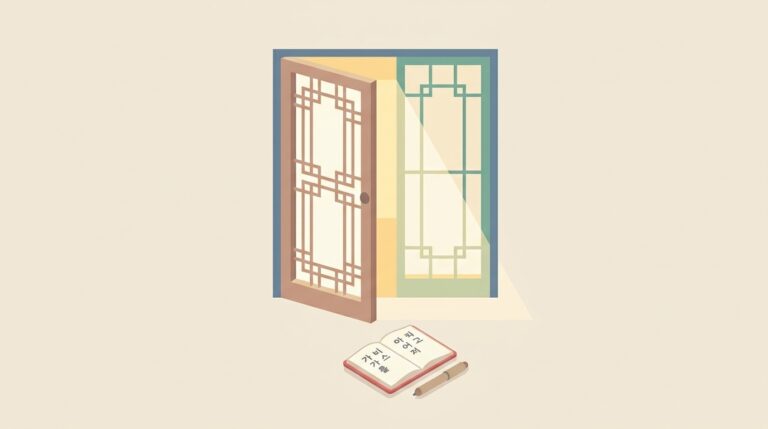
Picture this: You are sitting quietly on the polished wooden floor (daecheongmaru) of a centuries-old Hanok in Bukchon on a crisp autumn morning. The soft morning sunlight does not glare into your eyes; instead, it gently diffuses through the mulberry paper—changhoji (창호지)—casting the intricate geometric shadows of the wooden door lattice (munsal, 문살) across your tea table. It’s breathtaking. You want to describe this transcendental blend of nature, architecture, and light to the elderly master carpenter pouring your green tea. But suddenly, your vocabulary stalls. You hear yourself blurt out: “이 창문… 종이가 하얗고 아주 예뻐요!” (This window… the paper is white and very pretty!).
Inside, you cringe. You’ve passed advanced grammar tests, yet your words sound like an elementary school tourist brochure. How do you articulate the delicate concept of light that permeates rather than shines? How do you express the understated dignity (dan-ahada) of Korean spatial philosophy?
I’ve coached hundreds of advanced learners who hit this exact wall. Korean architectural beauty is rarely loud or flashy; it lives in nuance, negative space, and poetic restraint. In this masterclass, we will unlock the C1-level vocabulary and cultural intuition needed to discuss Hanok doors and paper with the depth, sophistication, and soul of a native connoisseur.
Phase 2: Deep Dive into 3 Core Expressions (C1 Level)
1. 은은하게 스며들다 (Euneunhage seomyeodeulda)
- Pronunciation: [Eun-eun-ha-ge seo-myeo-deul-da] (Think of the soft hum “eun” like the English word ‘earn’ without the r, followed by ‘sum-yeo-deul-da’)
- Meaning: Literal: “To softly seep/permeate into.” | Nuanced: Refers to light, fragrance, or emotion gently saturating an atmosphere without harsh boundaries or sudden force.
- K-Culture Moment: In the historical drama The Red Sleeve (옷소매 붉은 끝동), romantic tension is rarely staged under harsh lighting. The camera lingers on twilight rays softly seeping through the paper partition as shadows intertwine.
- Editor’s Insight: Western architecture often focuses on glass allowing raw sunlight to “illuminate” (비추다) an interior. In Hanok, light doesn’t conquer the room; it 스며든다 (seeps). Using this phrase reveals you understand Korean light as an organic, breathing element.
- Situation Spectrum:
- Casual: ✅ (When admiring cozy ambient light in a cafe)
- Semi-formal: ✅ (During a cultural tour or art review)
- Formal: ✅ (In literary criticism or architectural essays)
- 🤔 Think About It: Does your native language have a single verb that unites liquid absorption and luminous diffusion? How does this reflect the Korean tendency to view natural elements as fluid rather than fixed?
2. 정갈한 여백의 미 (Jeonggalhan yeobaek-ui mi)
- Pronunciation: [Jeong-gal-han yeo-baek-ui mi] (Sounds like ‘jung-gahl-hahn yuh-baek-ee mee’)
- Meaning: Literal: “The beauty of clean/neat blank space.” | Nuanced: The elegance derived from deliberate emptiness, balance, and aesthetic restraint.
- K-Culture Moment: Whenever art historians evaluate BTS leader RM’s art collection—particularly works of the Dansaekhwa (monochrome) movement or traditional white porcelain Moon Jars (dalhangari)—this exact phrase appears in every museum critique.
- Editor’s Insight: 여백 (yeobaek) is not empty or neglected space; it is space left deliberately unfilled so the viewer’s mind can complete the composition. Paired with 정갈하다 (neat, pure, disciplined), it captures the exact aesthetic of Hanok door lattices.
- Situation Spectrum:
- Casual: ⚠️ (Can sound overly poetic for ordering drinks, but great in a refined gallery)
- Semi-formal: ✅ (Perfect for cultural exchanges and interior design discussions)
- Formal: ✅ (Standard terminology in fine art and heritage symposiums)
- 🤔 Think About It: In modern urban cultures, empty space is often seen as “wasted square footage.” What does valuing 여백 reveal about traditional Korean philosophies of mental breathing room?
3. 아늑한 멋을 자아내다 (Aneukhan meos-eul jaanaeda)
- Pronunciation: [Ah-neuk-han meo-seul ja-ah-nae-da] (Pronounce ‘jaanaeda’ smoothly, like weaving a thread from silk)
- Meaning: Literal: “To spin/evoke a cozy, snug taste/flair.” | Nuanced: To organically generate an inviting, understated, and comfortable aesthetic environment.
- K-Culture Moment: In travel documentaries like tvN’s Korean Hostel in Spain or reality shows set in rural traditional homes, hosts often describe the evening warmth cast by Hanok paper doors as 아늑한 멋을 자아낸다.
- Editor’s Insight: The verb 자아내다 originally refers to spinning yarn from a cocoon. When applied to aesthetics (멋), it implies that the coziness is not superficially applied, but spun naturally from the room’s materials—pine wood, mulberry fiber, and warm clay.
- Situation Spectrum:
- Casual: ✅ (Polite conversation with a boutique Hanok stay owner)
- Semi-formal: ✅ (Describing lifestyle and architectural charm)
- Formal: ✅ (Editorial writing, cultural journalism)
- 🤔 Think About It: Why does Korean pair “coziness” (아늑함) with “stylish taste” (멋) instead of treating them as separate comfort and fashion concepts?
Phase 3: Textbook Korean vs Real Korean
Scenario 1: Commenting on how the paper diffuses sunlight
- 📖 교과서 한국어: 햇빛이 종이를 통과해서 방이 매우 밝습니다. (Haetbich-i jong-ireul tong-gwahaeseo bang-i maeu balkseumnida. – Sunlight passes through the paper, so the room is very bright.)
- 🗣️ 진짜 한국어: 창호지 사이로 자연광이 은은하게 감돌아서 눈이 정말 편안하네요. (Changhoji sairo jayeon-gwang-i euneunhage gamdoraseo nun-i jeongmal pyeon-anhaneyo. – The natural light subtly circulates through the changhoji, making it so easy on the eyes.)
- 💡 왜 다를까?: Textbook phrasing treats light as a mechanical phenomenon (passing through paper). Culturally aware native speakers emphasize the gentle sensory texture (감돌다 – to hover/circulate) and bodily relief (눈이 편안하다).
Scenario 2: Admiring the geometric woodwork of the door lattice
- 📖 교과서 한국어: 문살 디자인이 복잡하고 아름답습니다. (Munsal dijain-i bokjaphago areumdapseumnida. – The door lattice design is complicated and beautiful.)
- 🗣️ 진짜 한국어: 격자문살의 짜임새가 군더더기 없이 단아해서 깊은 울림을 줘요. (Gyeokjamunsal-ui jjaimsaega gundeodeogi eopsi dan-ahaeseo gipeun ullim-eul jwoyo. – The joinery of the grid lattice is so neat without excess; it creates a profound resonance.)
- 💡 왜 다를까?: Words like 복잡하다 carry negative baggage (chaotic/complicated). Describing traditional joinery (짜임새) as 군더더기 없이 단아하다 (graceful without clutter) showcases a refined C1 aesthetic eye.
Phase 4: K-Culture Deep Dive & Non-Verbal Manners
4-1. Nunchi & Physical Etiquette: Touching Without Trespassing
Changhoji is remarkably sturdy—crafted from the bast fiber of paper mulberry (daknamu), often treated with fermented starch and botanical oil. Yet, its tactile fragility is symbolic.
* The “Never Poke” Rule: In Korean folklore and sitcoms, children poking wet fingers through changhoji to peek outside is a trope of mischievous disrespect. When visiting a heritage home or temple, never lean directly against the paper or touch the lattice joints with oily fingertips.
* The Non-Verbal Bow of Appreciation: If an artisan or docent opens a lattice door, keep your gaze lowered toward the threshold (munduk, 문턱) for a split second before looking out. Stepping directly onto the wooden door frame (문턱을 밟다) is traditionally believed to bring bad luck and damages the wood. Step cleanly over it.
4-2. Cultural Code: The Art of “Borrowed Scenery” (Chagyeong, 차경)
In Western architectural philosophy, a window is an opening designed to look out toward an external object. In Hanok philosophy, the munsal acts as an active, living frame that “borrows” nature from the outside (차경, 借景). When the paper screens slide open, the garden, distant mountains, and floating clouds are invited into your room like a dynamic ink-wash painting (sumuk-hwa). When closed, the paper filters the world so that exterior bamboo branches cast animated shadows against the translucent screen. You are never completely cut off from nature; you are in a breathing diaphragm with it.
Phase 5: Real-World Roleplay Scenario
Setting: You are visiting the private woodworking studio of Master Park (박 장인), a master lattice craftsman (Somokjang), nestled in an alley in Bukchon Hanok Village.
- Master Park: “이 격자문살을 짜 맞출 땐 못을 전혀 쓰지 않고 오직 결구 방식으로만 조립합니다.” (I gyeokjamunsal-eul jja matchul ttaen mos-eul jeonhyeo sseuji anko ojik gyeolgu bangsik-euro-man joriphamnida. – When fitting this grid lattice together, we never use nails; we assemble it solely using interlocking joints.)
- Learner: 🎭 Leaning forward respectfully with hands clasped in front “못 없이 나무 결만으로 이런 정교한 짜임새를 완성하신다니 경이롭네요.” (Mot eopsi namu gyeolman-euro ireon jeonggyohan jjaimsaereul wanseonghasindani gyeong-iropneyo. – Completing such sophisticated joinery using only the grain of wood without nails is truly wondrous.)
- Master Park: “허허, 고마워요. 하지만 진짜 매력은 여기에 닥나무 창호지를 바른 뒤 햇살을 받을 때 나옵니다.” (Heoheo, gomawoyo. Hajiman jinjja maeryeog-eun yeogie dangnamu changhojireul bareun dwi haetsal-eul badeul ttae naomnida. – Haha, thank you. But the true charm emerges after pasting the mulberry paper onto it and letting the sun hit it.)
- Learner: 🎭 Looking toward the backlit display with an appreciative nod “맞아요. 인위적인 조명과는 달리 빛이 창호지에 은은하게 스며들 때 마음이 차분해지더라고요.” (Maj-ayo. In-wijeogin jomyeonggwa-neun dalli bich-i changhojie euneunhage seomyeodeul ttae ma-eum-i chabunhaejideoragoyo. – Exactly. Unlike artificial lights, when light softly permeates the changhoji, my mind settles down.)
- Master Park: “외국인 손님 중에 창호지의 이 숨 쉬는 결을 알아채는 분은 참 드문데, 식견이 남다르시네요.” (Oeguk-in sonnim jung-e changhoji-ui i sum swineun gyeol-eul arachae-neun bun-eun cham deumunde, sikgyeon-i namdareusineyo. – It is very rare for international visitors to notice the breathing texture of changhoji; you have exceptional discernment.)
- Learner: 🎭 Smiling with modesty, palms slightly lifted “과찬이십니다. 문살 사이의 여백이 주는 아늑한 멋에 푹 빠졌을 뿐입니다.” (Gwachan-isipnida. Munsal sai-ui yeobaek-i juneun aneukhan meos-e puk ppajyeosseul ppun-imnida. – You flatter me. I’ve simply fallen deeply for the cozy elegance created by the space between the lattices.)
- Master Park: “이 문살 창틀 차 한 잔 마시면서 좀 더 눈에 담고 가시지요.” (I munsal changteul cha han jan masimyeonseo jom deo nun-e damgo gasijiyo. – Why don’t you gaze at this window frame a bit longer over a cup of tea before you go?)
- Learner: 🎭 Bowing head gently with a warm smile “선생님의 정성이 깃든 작품을 곁에 두고 마시는 차라니, 더할 나위 없이 영광입니다.” (Seonsaengnim-ui jeongseong-i gitdeun jakpum-eul gyeot-e dugo masineun charani, deohal nawi eopsi yeong-gwang-imnida. – To drink tea beside a masterpiece imbued with your devotion is an absolute honor.)
🔀 Interactive Choice Point
Master Park gently points to an unpasted, raw pine lattice frame on the workbench and asks: “이 무늬는 어떤 느낌을 주는 것 같습니까?” (What kind of feeling does this pattern convey to you?)
- Choice A: “직선이 아주 반듯해서 단순하고 깔끔해 보여요!” (The straight lines are very upright, so it looks simple and clean!)
- Choice B: “화려하지 않으면서도 절제된 조형미와 단아함이 깊게 묻어납니다.” (While not flashy, it deeply radiates disciplined sculptural beauty and graceful serenity.)
- Choice C: “한국 전통 드라마에 자주 나오는 옛날 문 같아서 신기해요.” (It’s fascinating because it looks just like an old door frequently seen in Korean historical dramas.)
Feedback:
- Option A [Risk]: Not wrong, but vocabulary like 단순하다 (simple) borders on calling an artisan’s hand-carved heritage basic. It lacks aesthetic depth.
- Option B [BEST]: Exceptional C1 expression! Phrases like 절제된 조형미 (restrained sculptural beauty) and 단아함 (grace) immediately establish you as someone who comprehends the soul of Korean design.
- Option C [Bad]: Relegates a timeless artisan craft to a tourist gimmick or TV prop. It flattens real heritage into casual entertainment.
Phase 6: 10-Second Emotional Shadowing Drill
Sharpen your cadence, emotional tone, and intonation breaks (/).
[😌 깊은 감탄과 여운을 담아 - With deep admiration and lingering resonance]- 창호지 사이로 / 자연광이 은은하게 감돌아서 / 눈이 정말 편안하네요.
(Changhoji sairo / jayeon-gwang-i euneunhage gamdoraseo / nun-i jeongmal pyeon-anhaneyo.)
- 창호지 사이로 / 자연광이 은은하게 감돌아서 / 눈이 정말 편안하네요.
[🌿 겸손하지만 단호한 확신으로 - With modest yet firm conviction]- 군더더기 없는 문살의 짜임새에서 / 진정한 여백의 미가 / 느껴집니다.
(Gundeodeogi eomneun munsal-ui jjaimsae-eseo / jinjeonghan yeobaek-ui mi-ga / neukkyeojimnida.)
- 군더더기 없는 문살의 짜임새에서 / 진정한 여백의 미가 / 느껴집니다.
[🍵 따뜻하고 포근한 미소로 - With a warm and snug smile]- 한옥 창가에 앉아 있으니 / 공간이 자아내는 아늑한 멋에 / 취하게 되네요.
(Hanok changga-e anja isseuni / gonggan-i jaanaeneun aneukhan meos-e / chwihage doeneyo.)
- 한옥 창가에 앉아 있으니 / 공간이 자아내는 아늑한 멋에 / 취하게 되네요.
Phase 7: K-Culture Mini Dictionary (4 Key Terms)
- 창호지 (Changhoji) [Chang-ho-ji]
- Definition: Traditional Korean paper made from mulberry bark, used on doors and windows.
- Real-world usage: Unlike glass, changhoji breathes; it naturally filters air pollutants and balances interior humidity. In modern Hanok interior styling, you will hear designers praise its 조습 기능 (humidity-regulating function).
- 문살 (Munsal) [Mun-sal]
- Definition: The wooden ribs or framework lattice of a traditional door.
- Real-world usage: Variations include Seasal (slender vertical lines), Gyeokjasal (plaid/crisscross), and Wan-jasal (swastika fretwork). Describing munsal patterns indicates you are looking at architecture as living fine craft.
- 차경 (Chagyeong) [Cha-gyeong]
- Definition: “Borrowed landscape/scenery.”
- Real-world usage: High-end Hanok architects and boutique stay hosts use this constantly. When a window frames an ancient pine tree outside, you say: “이 창문은 차경의 미학을 완벽히 구현했네요” (This window perfectly embodies the aesthetic of borrowed scenery).
- 단아하다 (Dan-ahada) [Dan-ah-ha-da]
- Definition: Elegant, neat, graceful, and unassuming.
- Real-world usage: Widely applied to describe women wearing traditional Hanbok, Joseon white porcelain, and minimalist Hanok doors. It describes beauty that never screams for attention.
Phase 8: Survival Kit for Travelers
Top 3 Survival Expressions for Hanok Enthusiasts
- 창호지가 상하지 않게 문을 어떻게 여닫아야 하나요?
- (Changhojiga sanghaji anke mun-eul eotteoke yeodat-aya hanayo?)
- Pro Tip: Use this when checking into a traditional Hanok stay. Traditional sliding doors (mi-segi) require holding the wooden frame, not touching the paper surface.
- 이 문살 문양에 담긴 특별한 상징적 의미가 있나요?
- (I munsal munyang-e damgin teukbyeolhan sangjingjeok uimiga innayo?)
- Pro Tip: Strike up an instant, high-level conversation with palace guides at Changdeokgung or museum curators.
- 방 안에서 바깥 풍경을 바라보는 차경 포인트가 어디인가요?
- (Bang an-eseo bakkat punggyeong-eul baraboneun chagyeong pointeuga eodi-in-gayo?)
- Pro Tip: Hanok owners take pride in sightlines. Asking for the best perspective will delight them.
Editor’s Travel Note
- Transport & Navigation: To locate hidden Hanok carpentry workshops and secluded tea houses in Bukchon, Seochon, or Jeonju, standard international maps often misplace small alleyway entrances. Ensure you install the Naver Map App Download for pinpoint foot navigation through traditional lanes.
- Footwear & Preservation: Hanok verandas require removing your shoes. Always wear clean, opaque socks (preferably without cartoon prints) when visiting historic estates or artisan workshops to honor the wooden finish.
Phase 9: “A Step Deeper” (Reflective Essay)
In Western classical architecture, monumental stonework and stained glass declare humanity’s triumph over external elements, sealing the resident inside a controlled climate. Hanok, however, conceptualizes architecture as an extension of the biosphere. The wooden lattice does not block the wind; combined with the micro-porous texture of mulberry changhoji, it tempers the winter gales into a gentle, oxygen-rich breeze while catching the sunlight and distributing it softly across papered floors. It is a philosophy that embraces porous boundaries rather than rigid walls.
When we learn to praise Hanok not just as “pretty” or “ancient,” but as an exercise in 절제 (restraint) and 스며듦 (permeation), our Korean language shifts from a transactional tool to a philosophical mirror.
💬 Your Turn: What elements in your own culture’s traditional homes blur the line between interior shelter and exterior nature? Share your reflections in the comments below!
Phase 10: FAQ & Avoiding Misconceptions
Q: Isn’t changhoji just regular paper that tears if it gets wet?
A: Not at all! Traditional Hanji made from the inner bark of mulberry trees features long, intertwining fibers that make it remarkably resilient. When water droplets hit high-grade Hanji, the paper absorbs moisture without immediately disintegrating, contracting tightly again as it dries. In past eras, craftsmen brushed boiled perilla oil onto exterior-facing paper to make it rain-repellent.
Q: Can I use the word “미니멀하다” (minimal) instead of traditional Korean expressions?
A: While urban Koreans frequently use 미니멀하다 (minimalist), using it for Hanok flattens the cultural concept. Minimalist design often implies industrial reduction and stark emptiness. Korean 여백의 미 (the beauty of blank space) represents an active void ripe with potential. Using 단아하다 or 정갈하다 demonstrates far deeper cultural literacy.
Q: Why are the wooden door frames in Hanok built relatively low?
A: Traditional Korean lifestyle was centered on the floor (zashik culture), powered by the underfloor heating system (ondol). Door frames and lattice heights were calculated based on the eye-level of a person seated on a floor cushion (bangseok), framing the outdoor landscape perfectly for someone drinking tea at floor level.
🚨 Common Mistakes Warning Board
- Mistake: Calling all traditional doors simply 문 (mun) or 나무 문 (namu mun).
- Correct Action: Distinguish between 격자문 (grid door), 창호 (paper-window partition), and 대문 (grand entrance gate).
- Mistake: Translating “The light is soft” directly as 빛이 부드러워요 (Bich-i budeureowoyo).
- Correct Action: Use 빛이 은은하게 퍼져요 or 은은하게 스며들어요 to sound like an articulate speaker.
- Mistake: Touching the white paper surface when sliding open Hanok doors.
- Correct Action: Always place your fingers on the wooden handle notch (mun-gori) or outer wooden rim (saldae).
Phase 11: Action Missions & Engagement
- 🥉 Bronze Mission (Solo Mastery): Recite aloud the 3 shadowing sentences from Phase 6 three times each. Pay attention to pausing at the
/slashes. - 🥈 Silver Mission (Community Share): Take a photo of an intriguing window, shadow, or light pattern in your home. Post it on Instagram or our community board with the Korean caption: “창가에 은은하게 스며드는 햇살과 정갈한 여백의 미.”
- 🥇 Gold Mission (Real-world Execution): Visit a traditional Hanok cafe or cultural center. When speaking to the staff, deliberately use the phrase “격자문살이 자아내는 분위기가 참 단아하네요” and observe their impressed reaction!
- 🎮 K-Culture Mission: Watch an episode of the sageuk drama Mr. Sunshine (미스터 션샤인) or The King’s Affection (연모). Spot a scene where characters talk through a Hanok paper partition and identify the silhouette effect.
Phase 12: Interactive Quiz Challenge
Test your mastery of Hanok aesthetics and C1 vocabulary!
1. Contextual Judgment Quiz
You are touring a restored royal pavilion with a Korean architecture professor. You want to express how the simple arrangement of the door lattice creates a serene, clutter-free elegance. Which sentence is the most natural and sophisticated?
* A) 문살이 별로 안 복잡해서 참 심플하고 괜찮네요.
* B) 격자문살의 절제된 짜임새에서 군더더기 없는 단아함이 느껴집니다.
* C) 나무가 많이 안 들어가서 시원해 보이는 장점이 있네요.
🔍 Click to reveal the Answer & Explanation
Correct Answer: B
* Explanation: Option B utilizes elevated C1 vocabulary (절제된 짜임새 – restrained joinery; 군더더기 없는 단아함 – grace without excess). Option A relies on English loanwords (심플하다) that dilute the cultural nuance, while Option C sounds overly casual and misinterprets the structural design as merely “using less wood.”
2. Fill-in-the-Blank Quiz
Complete the following architectural review sentence using the poetic verb learned in Phase 2:
“한옥의 진정한 매력은 자연광이 창호지 사이로 ( ) 실내를 따스하게 감쌀 때 드러납니다.”
* A) 은은하게 스며들어
* B) 거칠게 통과하여
* C) 반짝반짝 빛나면서
🔍 Click to reveal the Answer & Explanation
Correct Answer: A (은은하게 스며들어)
* Explanation: The adverbial phrase 은은하게 스며들어 accurately captures the gentle permeation of natural light across paper fibers. 거칠게 통과하여 means “passing through harshly,” and 반짝반짝 refers to sparkling or twinkling glitter, which does not fit diffused paper lighting.
3. True / False Cultural Etiquette Quiz
- Statement: In traditional Korean architectural philosophy (차경), a window covered with changhoji is treated purely as a barrier to keep out cold air, with no visual or emotional connection to the outside garden when closed.
- True or False?
🔍 Click to reveal the Answer & Explanation
Correct Answer: FALSE
* Explanation: Even when closed, changhoji functions as a screen for dynamic nature; daylight filters inward, and shifting wind, swaying bamboo silhouettes, and rain sounds filter through its fibers, maintaining a constant biological and sensory link with the outdoors.






