

Phase 1: Empathy (Opening Story)
안녕하세요! 매일한글 에디터입니다.
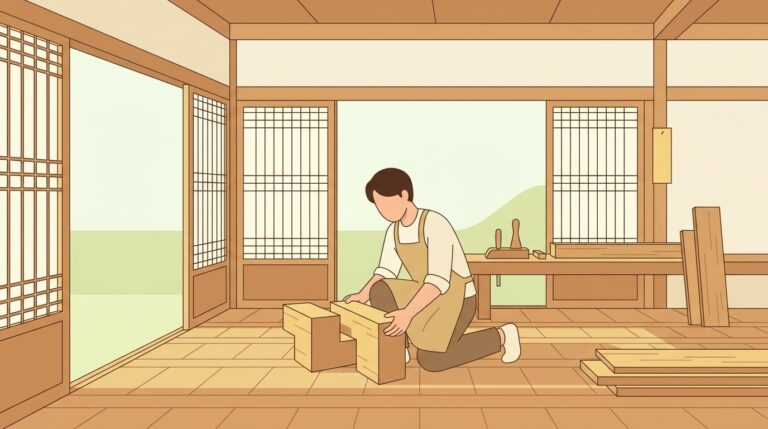
Picture this: You are standing in a sunlit timber workshop tucked into an alley behind Euljiro 4-ga in central Seoul. The air is rich with the earthy, sharp fragrance of fresh pyeonbaek (hinoki cypress) shavings. You’ve decided to tackle one of Korea’s most revered heritage crafts: 짜맞춤 (Jjamatchum)—traditional furniture joinery crafted entirely without nails or synthetic hardware. Armed with a hand chisel and a wooden mallet, you’ve spent three hours cutting a tenon. But when you try to force the joint together, it jams. Frustrated, you reach for sandpaper or a heavier hammer, only for the master artisan (장인) to gently catch your wrist with a chuckle: “나무도 숨을 쉬어야지, 억지로 넣으면 터져요.” (Wood needs to breathe, too; if you force it, it splits.)
Many advanced Korean learners hit an invisible ceiling right here. You can effortlessly discuss macroeconomics or write formal corporate emails, yet the moment you step into a hands-on studio, a specialized maker-space, or a traditional Korean atelier, the conversation shifts into nuanced physical metaphors, sensory verbs, and craft-specific idioms that standard textbooks never teach. This guide draws directly from hands-on workshop field research and consultations with seasoned Seoul woodworkers to elevate your conversational Korean into fluent, culturally resonant C1-level craftsmanship.
Phase 2: In-Depth Analysis of 3 Core Expressions
1. 결을 살리다 (Gyeol-eul sallida)
- Pronunciation: [Gyeol-eul sal-li-da] (Sounds like: “gyul-eul sahl-lee-dah”)
- Meaning: Literal: To keep the wood grain alive. / Actual Nuance: To honor the innate texture, grain, and authentic character of a material (or person) without imposing artificial distortion.
- K-Culture Moment: Frequently heard on Korean lifestyle documentaries (such as EBS 극한직업 [Extreme Job] or MBC 나 혼자 산다 [I Live Alone] artisan segments) when carpenters select asymmetrical timber to craft live-edge tea tables.
- Editor’s Insight: 결 (Gyeol) is a quintessentially Korean concept denoting inherent nature, grain, or rhythm (as in 성결 [temperament] or 숨결 [breath]). Saying “결을 살리다” signals that you do not merely modify raw materials; you respect their natural disposition.
- Situation Spectrum: Casual ✅ | Semi-formal ✅ | Formal ✅
- 🤔 Think About It: Western joinery historically prioritized squaring off timber into uniform, standardized boards. Korean jjamatchum emphasizes working around natural knots (옹이). How does your native language express harmony between human design and natural flaws?
2. 아귀가 딱 들어맞다 (Agwiga ttak deureomatda)
- Pronunciation: [A-gwi-ga ttak deu-reo-mat-da] (Sounds like: “ah-gwee-gah tahk deu-ruh-maht-dah”)
- Meaning: Literal: The matching joints fit together precisely without a seam. / Actual Nuance: Everything clicks into place flawlessly—used equally for interlocking mortise-and-tenons or for perfectly coordinated plans and explanations.
- K-Culture Moment: In K-drama legal thrillers like 비밀의 숲 (Stranger), detectives proclaim an investigation solved when alibis and forensic evidence “아귀가 딱 들어맞는다”.
- Editor’s Insight: 아귀 (Agwi) refers to the interlocking cleft or corner of two joined elements. Paired with the vivid onomatopoeia 딱 (ttak), this expression is far more evocative at the C1 level than the generic 잘 맞다 (to fit well).
- Situation Spectrum: Casual ✅ | Semi-formal ✅ | Formal ⚠️ (Best reserved for expressive speech rather than legal documents)
- 🤔 Think About It: Why does Korean rely on physical structural imagery (like interlocking wood) to express logical coherence in abstract debates?
3. 숫돌에 날을 갈다 (Sutdore nal-eul galda)
- Pronunciation: [Sut-dor-e na-reul gal-da] (Sounds like: “soot-dohl-eh nah-reul gahl-dah”)
- Meaning: Literal: To sharpen a blade upon a whetstone. / Actual Nuance: To meticulously hone one’s tools or cultivate patience and razor-sharp readiness before beginning a critical task.
- K-Culture Moment: In historical dramas (사극), master craftsmen or sword-smiths are shown grinding blades in rhythmic silence before an empire-defining commission.
- Editor’s Insight: In traditional joinery, half of your working hours are spent at the water stone (물숫돌). Korean master woodworkers judge an apprentice’s emotional stability purely by the flat, even bevel on their plane blade (대팻날).
- Situation Spectrum: Casual ⚠️ | Semi-formal ✅ | Formal ✅
- 🤔 Think About It: Grinding tools is viewed not as boring prep work, but as mental conditioning (수양). Does your culture view tool maintenance as purely technical, or also meditative?
Phase 3: Textbook Korean vs. Real Korean
Situation 1: Describing a seamless, interlocking joint without hardware
- 📖 교과서 한국어 (Textbook Korean):
이 두 나무 부품이 못 없이 완벽하게 연결되었습니다.
(I du namu bupumi mot eopsi wanbyeokhage yeongyeoldoeeotseumnida. / These two wood parts are perfectly connected without nails.) - 🗣️ 진짜 한국어 (Real Native Korean):
틈 하나 없이 아귀가 딱 맞아떨어지네요. 손맛이 제대로 느껴집니다.
(Teum hana eopsi agwiga ttak maja-tteoreojineyo. Sonmasi jedaero neukkyeojimnida. / The joint interlocks seamlessly without a millimeter of gap. You can really feel the artisan’s tactile touch.) - 💡 왜 다를까? (Cultural Context): Textbook phrasing relies on mechanical, passive verbs (연결되다). Native woodworkers speak through sensory precision: 틈 하나 없이 (without a single gap) and 손맛 (the tactile hand-feel that cannot be replicated by automated CNC machines).
Situation 2: Choosing timber with organic curves rather than cutting it straight
- 📖 교과서 한국어 (Textbook Korean):
나무가 휘어져 있으니 곧게 잘라내야 합니다.
(Namuga hwieojyeo isseuni gotge jallanaeya hamnida. / The wood is bent, so it must be cut straight.) - 🗣️ 진짜 한국어 (Real Native Korean):
나무 본래의 휨을 억지로 펴지 말고, 이 곡선 자체의 결을 살려봅시다.
(Namu bollae-ui hwimeul eokjiro pyeoji malgo, i gokseon jache-ui gyeol-eul sallyeobopsida. / Instead of forcing the natural bend straight, let’s honor the organic grain of this curve.) - 💡 왜 다를까? (Cultural Context): Traditional Korean woodwork (소목, somok) views timber as an evolving organic partner that reacts to Korea’s four distinct seasons. Forcing wood into rigid geometric submission is considered clumsy craftsmanship.
Phase 4: K-Culture Deep Dive & Non-Verbal Manners
4-1. 눈치 (Nunchi) & Atelier Etiquette
In a traditional Korean woodcraft workshop (공방), physical body language speaks volumes before you strike your first mortise:
* Two-Handed Blade Handover: Never hand a chisel (끌) or marking knife (칼금) blade-first. Hold the metal shank securely in your palm and present the wooden handle toward the recipient using both hands (두 손으로 건네기), bowing your head slightly.
* Reading the Room’s Silence: When an artisan or fellow woodworker is actively planing (대패질) or lining up joints, maintain absolute stillness. Speaking loudly or pacing nearby creates micro-vibrations and breaks the maker’s concentrated focus.
* Respecting Wood Movement: Never refer to timber warping as “ruined” (망했다). In Korean carpentry philosophy, wood responds to moisture. Refer to it respectfully as “wood breathing” (나무가 숨을 쉬어 움직였다).
4-2. Cultural Code: The Heritage of 소목장 (Somokjang)
Traditional Korean furniture making without nails is anchored by 소목장 (Somokjang)—National Intangible Cultural Heritage No. 55. Unlike architecture (대목, daemok), somok deals with indoor furnishings such as bandaji (chests) and sarangbang scholar tables (seogan). Because Korea’s climate swings from sweltering, humid summers to bone-dry Siberian winters, wooden panels naturally swell and contract. If iron nails were used, the rigid metal would tear the expanding wood apart. Interlocking joinery (짜맞춤) allows wood to breathe, shifting fractions of a millimeter over centuries without losing structural integrity.
Phase 5: Real-Life Roleplay Scenario
Setting: Master Park’s Traditional Wood Studio (박 장인의 짜맞춤 공방) in Euljiro. Sunlight filters through Hanji paper screens over rows of Japanese white oak and walnut planks.
Characters:
* Master Park (박 장인): A 65-year-old master artisan with calloused hands, piercing eyes, and an encouraging heart.
* Learner (나): A C1-level enthusiast crafting a traditional scholar’s stationery tray (문갑).
- Turn 1 (Master Park):
자, 이 암장부(mortise) 파낸 자리를 한번 만져보게. 칼선 넘어서 파지 않았나?
(Ja, i amjangbu panaen jarireul hanbeon manjeoboge. Kalseon neomeoseo paji anatna?)
🎭 Peering closely over his reading glasses, running his thumb across the cut timber.
“Now, feel where you chiseled out this mortise. Did you gouge past your marking line?” -
Turn 2 (Learner):
선생님 말씀대로 0.5밀리미터 정도 여유를 두고 팠는데, 수평이 맞는지 조금 불안합니다.
(Seonsaengnim malsseumdaero yeong-jeom-o millimiteo jeongdo yeoyureul dugo panneunde, supyeongi manneunji jogeum buranhamnida.)
🎭 Holding the chisel resting on the bench, maintaining two-handed deference.
“As you instructed, Master, I left about a 0.5mm margin, but I’m slightly worried whether the base is truly level.” -
Turn 3 (Master Park):
그 불안한 마음이 대패와 끌에 그대로 실리는 법이야. 숫돌에 날부터 다시 갈고 와.
(Geu buranhan maeumi daepae-wa kkeure geudaero sillineun beobiya. Sutdore nalbuteo dasi galgo wa.)
🎭 Tapping the blade of your bench chisel lightly with his fingertip.
“That hesitation transfers right onto your plane and chisel. Go hone your blade on the whetstone first.” -
Turn 4 (Learner):
네, 날을 세우고 마음을 가다듬은 뒤에 다시 먹금을 확인하겠습니다.
(Ne, nareul seougo maeumeul gadadeumeun dwie dasi meokgeumeul hwaginhagetsseumnida.)
🎭 Nodding resolutely, moving toward the sharpening pond with both hands holding the chisel.
“Understood. I will sharpen the edge, center my mind, and recheck the ink layout line.” -
Turn 5 (Master Park):
옳지! 서두르면 짜맞춤은 어긋나. 나무를 이기려 들지 말고, 나무 결을 살려야 해.
(Olchi! Seodureumyeon jjamatchumeun eogeunna. Namureul igiryeo deulji malgo, namu gyeoreul sallyeoya hae.)
🎭 Smiling approvingly while passing over a seasoned piece of cherry wood.
“That’s it! If you rush, joinery fails. Don’t try to conquer the timber; bring out its grain.” -
Turn 6 (Learner):
정반 위에서 숫돌을 평평하게 잡은 뒤에, 이 숫장부를 조심스럽게 결합해 봐도 될까요?
(Jeongban wieseo sutdoreul pyeongpyeonghage jabeun dwie, i sutjangbureul josimseureopge gyeolhaphae bwado doelkkayo.)
🎭 Carefully aligning the tenon with the newly cleaned mortise.
“After flattening the stone on the reference plate, may I carefully test-fit this tenon?” -
Turn 7 (Master Park):
나무 망치로 세게 내려치지 말고, 양손으로 지그시 눌러봐. 소리를 들어야지.
(Namu mangchiro sege naeryeochiji malgo, yangsoneuro jigeusi nulleobwa. Sorireul deureoyaji.)
🎭 Leaning in close, placing a hand gently on your shoulder to steady your posture.
“Don’t slam it with the wooden mallet; press down steadily with both palms. Listen to the sound.” -
Turn 8 (Learner):
선생님, 딸깍 소리가 나면서 아귀가 딱 들어맞았습니다! 흔들림이 전혀 없어요.
(Seonsaengnim, ttalkkak soriga namyeonseo agwiga ttak deureomatseumnida! Heundeullimi jeonhyeo eopseoyo.)
🎭 Eyes widening in delight as the joint slides home flush with zero gap.
“Master, it clicked into place and interlocks seamlessly! There isn’t a hint of wobble.”
🔀 Interactive Choice Point
The joint fit is tight, but protruding about 0.3mm above the adjoining frame. How do you respond to Master Park?
- Choice A: “선생님, 튀어나온 부분을 쇠망치로 힘껏 쳐서 밀어 넣겠습니다!”
(I’ll hammer the protruding section in forcefully with an iron hammer!)
👉 Feedback [BAD]: Master Park will wince in horror. Never hit bare furniture timber with a steel hammer; it crushes the wood fibers permanently. Use a wooden mallet (목망치) with a sacrificial block (덧댐목). -
Choice B: “약간 단차가 생겼는데, 평대패로 얇게 밀어 면을 가지런히 맞추면 될까요?”
(There is a slight step; should I shave it down thinly with a smoothing plane to align the surfaces?)
👉 Feedback [BEST]: Exemplary C1 understanding! This proves you recognize precision woodworking technique, respect the material, and communicate with flawless situational etiquette. -
Choice C: “접착제를 듬뿍 바르고 바이스로 꽉 조여서 굳히겠습니다.”
(I will slather glue all over it and clamp it down with a vise until it sets.)
👉 Feedback [RISK]: Traditional joinery relies on exact friction and wood expansion, not glue dumps. Excess glue blocks natural wood movement and stains timber during oil finishing.
Phase 6: 10-Second Emotional Shadowing Drill
Practice these lines aloud, paying close attention to breath pauses marked by /.
- [🧐 진중하고 신중하게 / Focused & Earnest]
나무 결을 거스르지 않고 / 자연스럽게 결을 살려야 / 세월이 흘러도 뒤틀리지 않습니다.
(Namu gyeoreul geoseureuji anko / jayeonseureopge gyeoreul sallyeoya / sewori heulleodo dwiteulliji anseumnida.)
“Only by not defying the grain / and honoring its natural state / will it withstand centuries without warping.” -
[🤩 감탄하며 짜릿하게 / Awe-struck & Thrilled]
못 하나 박지 않았는데 / 틈 하나 없이 / 아귀가 딱 들어맞는 게 / 정말 경이롭네요!
(Mot hana bakji anneunde / teum hana eopsi / agwiga ttak deureomanneun ge / jeongmal gyeong-iropneyo!)
“Not a single nail was driven / yet without a hairline seam / it interlocks so flawlessly / it’s truly miraculous!” -
[😌 겸허하고 단호하게 / Humble & Resolute]
조급한 마음을 버리고 / 숫돌에 날부터 정성껏 갈며 / 손끝의 감각을 깨우겠습니다.
(Jogeupan maeumeul beorigo / sutdore nalbuteo jeongseongkkeot galmyeo / sonkkeut-ui gamgageul kkae-ugetsseumnida.)
“Casting away my impatience / I will carefully hone the blade upon the whetstone / and awaken the intuition in my fingertips.”
Phase 7: K-Culture Mini Dictionary
-
사개맞춤 (Sagae-matchum)
Translation: Interlocking finger joint / Box corner joint.
Usage: The hallmark of traditional Korean chests (ham, bandaji). Four fingers of wood interweave at 90 degrees, offering supreme structural strength against seasonal humidity. -
대패질 (Dae-paejil)
Translation: Hand planing wood.
Usage: Unlike Western push-planes, Korean hand planes are pulled toward your torso. Describing someone’s 대패질 as silky smooth (비단결 같다) is the highest workshop compliment. -
옹이 (Ong-i)
Translation: A knot in timber; an organic burl.
Usage: Figuratively used in everyday Korean to describe deep emotional knots or hard-earned inner resilience: “가슴에 맺힌 옹이를 풀다” (to dissolve the bitter knots accumulated in one’s heart). -
먹줄 (Meokjul)
Translation: Ink marking line (chalk/ink line tool).
Usage: The traditional tool using ink and silk cord to snap crisp, perfectly straight cutting guidelines across long timber. Figuratively signifies an uncompromising moral standard.
Phase 8: Survival Kit for Travelers & DIY Enthusiasts
Top 3 Survival Phrases for Korean Craft Alleys
-
결대로 깎아낼까요, 결 반대로 깎아낼까요?
(Gyeoldaero kkakkanaelkkayo, gyeol bandaero kkakkanaelkkayo?)
“Should I plane this along the grain or against the grain?”
💡 Pro Tip: Always plane with the grain (순결). Asking this demonstrates seasoned workshop awareness. -
짜맞춤 부재 치수가 조금 헐거운데, 쐐기를 박아야 할까요?
(Jjamatchum bujae chisuga jogeum heolgeounde, sswaegireul bagaya halkkayo?)
“The tenon dimension feels slightly loose; should I drive a small wooden wedge into it?”
💡 Pro Tip: Demonstrates sophisticated joinery problem-solving when joints aren’t snug. -
오일 마감 전에 사포 몇 방까지 쳐야 결이 매끄럽게 살까요?
(Oil magam jeone sapo myeot bangkkaji chyeoya gyeori maekkeureopge salkkayo?)
“Before oil finishing, which sandpaper grit should I sand up to so the grain emerges smoothly?”
💡 Pro Tip: “사포 몇 방 (grit number)” is real maker vernacular (e.g., 400-bang, 600-bang).
Editor’s Travel Note: Exploring Seoul’s Wood & Tool Districts
Head straight to Euljiro 4-ga Station (Lines 2 & 5). Step out of Exit 6 into the bustling carpentry and timber street (을지로 목재거리). Before visiting independent woodworking studios, make sure you complete your Naver Map app download to pinpoint tiny alleyway ateliers that Google Maps frequently misses. Most neighborhood lumber mills accept card payment, but for custom hand tool re-edging at sharpening depots (연마소), keep small amounts of cash ready.
Phase 9: “One Step Deeper” (Reflective Essay)
In Western classical mechanics, architecture and furniture are often constructed to conquer nature—iron nails, carbon bolts, and chemical adhesives lock components into motionless rigidity. But traditional Korean joinery (짜맞춤) rests upon an entirely different cosmology: Mutual Adaptation (상생, Sangsaeng).
Wood is treated as an entity that remains alive long after it is felled. In the monsoon rains of July, it swells; during the crisp frosts of January, it contracts. A master carpenter does not fight this movement; they construct joints with micro-allowances so that the parts flex together without rupturing. There is a poignant life lesson here for advanced Korean communicators: fluency is not about rigid perfection or overpowering the conversation with rapid grammar. It is about understanding the 결 (grain) of the people around you, yielding when necessary, and fitting together seamlessly without friction.
💬 Your Turn: Have you ever had to adapt your natural instincts to blend into a new culture or environment? Share your thoughts below in Korean using the expression “결을 살리다”!
Phase 10: FAQ & Common Pitfalls
Q: Can I use “아귀가 맞다” in corporate business meetings?
A: Absolutely. It is highly praised in professional presentations when demonstrating how your quarterly strategy aligns with market research: “데이터와 시장 분석의 아귀가 딱 맞아떨어집니다.” (The data and market analysis align flawlessly.)
Q: What is the linguistic difference between 짜맞춤 (Jjamatchum) and 조립 (Jorip)?
A: 조립 (Assembly) refers to putting together pre-manufactured modular parts using screws and bolts (such as IKEA furniture). 짜맞춤 specifically denotes high-level artisan timber joinery interlocking solely through mortise, tenon, and dovetail woodworking.
Q: Why do Korean craftsmen say “나무를 만진다” (touching wood) instead of “나무를 만든다” (making wood)?
A: 만지다 (to handle/work with) conveys humility. It implies you are working collaboratively with the existing material rather than arrogantly claiming you “created” the timber.
🚨 Common Mistakes (경고판)
- Mistake: Using 틀어지다 and 뒤틀리다 interchangeably when describing timber vs. human trust.
Correction: While both describe warping, 사이가 틀어지다 is used for broken personal relationships, whereas wood distortion is specifically 목재가 뒤틀리다. - Mistake: Pronouncing 아귀 as 아구 in formal speeches.
Correction: 아구 is common dialect/slang; stick strictly to standard 아귀 (Agwi) in formal presentations. - Mistake: Calling nail-free joinery 못 없는 가구 (furniture without nails).
Correction: Use the authentic terminology: 전통 짜맞춤 가구 (traditional interlocking joinery furniture).
Phase 11: Action Mission & Engagement
- 🥉 Bronze Mission (Solo Practice): Stand before a mirror and practice the 3 Shadowing Drill sentences from Phase 6, focusing on natural pauses at the
/marks. - 🥈 Silver Mission (Social Sharing): Post a photo of your favorite wooden furniture or workspace on Instagram/Threads with the caption: “내 삶의 결을 살리는 시간.” Tag
@DailyHangul! - 🥇 Gold Mission (Real-world Challenge): Visit a local woodworking shop or carpentry cafe in Korea, and ask the craftsman: “이 가구는 어떤 짜맞춤 기법으로 제작되었나요?” (Which joinery technique was used to craft this furniture?)
- 🎮 K-Culture Mission: Watch an episode of the lifestyle documentary 한국기행 (Korea Travel) or search “전통 짜맞춤 가구 장인” on YouTube. Spot how many times the master uses the word “결”!
Phase 12: Interactive Quiz Challenge
1. Situational Judgment
Which sentence would be most appropriate when a fellow artisan successfully fits a complex joint without leaving any visible gaps?
* A) 가구가 아주 조립되었습니다. (Gaguga aju joripdoeeotseumnida.)
* B) 틈새 하나 없이 아귀가 딱 들어맞네요! (Teumsae hana eopsi agwiga ttak deureomanneyo!)
* C) 못을 박지 않아서 매우 약해 보입니다. (Moseul bakji anaseo maeu yakhae boimnida.)
2. Fill-in-the-Blank
상대방의 개성과 타고난 성격을 억지로 바꾸려 하지 않고 존중할 때, 우리는 흔히 “그 사람의 ( )을/를 살린다”라고 표현합니다.
3. True or False (Cultural Nuance)
True or False? Traditional Korean woodcraft uses synthetic epoxy glue to ensure timber joints never shift under seasonal humidity.
👉 Click here for Answer & Detailed Explanation
-
Answer: B
Explanation: “틈새 하나 없이 아귀가 딱 들어맞네요!” is the authentic, sophisticated C1 praise for seamless joinery. Option A sounds mechanical, while Option C is insulting to a joinery craftsman. -
Answer: 결 (Gyeol)
Explanation: 결을 살리다 applies both to timber grain and to honoring an individual’s innate temperament. -
Answer: False
Explanation: Traditional 짜맞춤 avoids rigid synthetic resins; joints are designed with friction tolerances and natural fish glue (어로풀) or rice glue to let the wood breathe and adapt across summer and winter cycles.







