

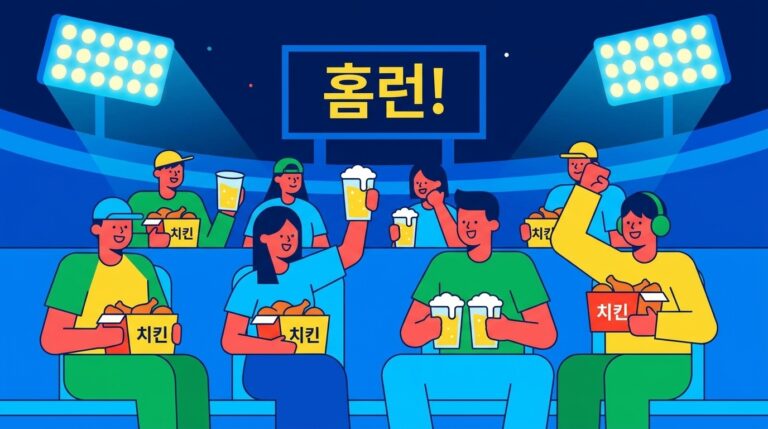
Phase 1: Empathy
안녕하세요! 매일한글 에디터입니다.
Imagine this: You are standing in the middle of Jamsil Baseball Stadium in Seoul. The thunderous chant of twenty thousand fans reverberates right through your chest. The team cheer song is blasting, yellow and blue thundersticks are slapping together in sync, and right in front of you sits a crisp, steaming box of seasoned Korean fried chicken beside a frosty cup of draft beer. It is sensory overload in the most wonderful Korean way possible.
Then comes the moment of truth. The wandering beer vendor carrying a keg on his back (maekju-boy) is zipping down the concrete steps at lightning speed. Your seat neighbor is adjusting their banner, and you are trying to squeeze through an impossibly tight row while holding your chicken box with both hands. You want to ask for boneless chicken next time, you need extra wet wipes, and you want to offer a piece of fried chicken to the friendly stranger celebrating a home run beside you—yet your mind freezes.
Does textbook Korean like “이것을 주십시오” (Please give me this) work here? Technically, yes. But does it capture the electric, warm-hearted, communal soul of a KBO ballpark? Not even close.
Having brought dozens of foreign friends and intermediate learners to KBO games over the past decade, I have seen learners with high intermediate grammar get paralyzed simply because ballpark ordering moves at 150 km/h. This guide is crafted directly from those real-life dugout experiences. By the end of this lesson, you will not only order ballpark snacks effortlessly, but you will also speak with the casual rhythm, warmth, and confidence of a seasoned local fan.
Phase 2: Deep Dive into 3 Core Expressions
1. 여기 맥주 하나 추가해 주세요! (Yeogi maekju hana chugahae juseyo!)
- Pronunciation: [Yeo-gi maek-ju ha-na chu-ga-hae ju-se-yo!] (Sound analogy: Think of “Yo-gi” like Yogi Bear, “Maek-ju” like making juice, and “Chu-ga” like chugging your drink!)
- Meaning: “One more beer over here, please!” (Literal: Here, beer, one, add, please do).
- K-Culture Moment: You will hear this yelled across rows whenever the wandering beer vendor walks down the bleachers during inning changes in hit variety shows like A Clean Sweep (최강야구).
- Editor’s Insight: While beginners rely on “맥주 더 주세요” (Maekju deo juseyo), intermediate (B2) speakers level up by using the Sino-Korean verb 추가하다 (chugahada – to add). It sounds brisk, proactive, and perfectly suited for noisy environments where vendors need immediate clarity on quantity and item.
- Situation Spectrum: Casual (✅) | Semi-formal (✅) | Formal (⚠️)
- 🤔 Think About It: In many Western stadiums, ordering requires walking to concourses or quiet individual seat service. Why does Korean stadium culture celebrate loud, direct, communal call-and-response ordering right across rows?
2. 자리 좀 비켜주실 수 있나요? (Jari jom bikyeojusil su innayo?)
- Pronunciation: [Ja-ri jom bi-kyeo-ju-sil su in-na-yo?] (Sound analogy: “Bi-kyeo” sounds almost like gliding through the word “secure” without the s: bi-kyeo).
- Meaning: “Could you please excuse me / make a little room for me to pass?”
- K-Culture Moment: Seen in countless romantic K-dramas where the lead characters squeeze past each other in cramped stadium seats, carefully shielding hot tteokbokki and beer.
- Editor’s Insight: The verb 비키다 (bikida) means “to step aside.” Used bluntly, it can sound demanding (“비켜요!”). However, wrapping it in the polite honorific request pattern -아/어 주실 수 있나요? and seasoning it with the conversational buffer 좀 (jom – just a little) turns a potentially abrasive intrusion into smooth, considerate etiquette.
- Situation Spectrum: Casual (🚫 – too distant for friends) | Semi-formal (✅ – absolute gold standard for strangers) | Formal (✅)
- 🤔 Think About It: Notice how Korean creates personal space not by demanding physical rights, but by politely asking others for a cooperative favor. How does this reflect Korea’s collective consideration (배려, baeryeo)?
3. 식기 전에 얼른 먹어요! (Sikgi jeone eolleun meogeoyo!)
- Pronunciation: [Sik-gi jeo-ne eol-leun meo-geo-yo!] (Sound analogy: “Sik-gi” sounds like “sick geek” without the k, and “eol-leun” flows like “all-learn”).
- Meaning: “Let’s dig in quickly before it gets cold!”
- K-Culture Moment: The moment food delivery arrives at the outfield picnic tables, cheering pauses for two minutes because the integrity of crispy fried batter is sacred.
- Editor’s Insight: Korean culinary culture places supreme importance on food temperature (온도감). The adverb 얼른 (eolleun – promptly/without delay) conveys warm affection, encouraging your companions to indulge immediately rather than waiting on formalities while the food loses its crunch.
- Situation Spectrum: Casual (✅) | Semi-formal (✅) | Formal (⚠️ – slightly too familiar for strict corporate superiors)
- 🤔 Think About It: Why is urging someone to eat quickly considered polite and caring in Korea, whereas in some cultures it might be perceived as rushing your guests?
Phase 3: Textbook Korean vs. Real Korean
Situation 1: Asking if food can be delivered directly to your stadium seat
- 📖 교과서 한국어 (Textbook): “이 음식을 제 좌석으로 배달해 줄 수 있습니까?” (I eumsigeul je jwaseogeuro baedalhae jul su isseumnikka? / Can you deliver this food to my seat?)
- 🗣️ 진짜 한국어 (Real-Life B2): “혹시 자리로 배달도 되나요?” (Hoksi jariro baedaldo doenayo? / By any chance, do you guys deliver to the seats too?)
- 💡 왜 다를까? (Why the difference?): Real stadium kiosks are packed and fast-paced. Native speakers soften inquiries with the magic cushion 혹시 (hoksi – by chance) and wrap the question with the concise, versatile pattern ~도 되나요? instead of stiff textbook honorifics.
Situation 2: Sharing snacks with enthusiastic fans sitting next to you
- 📖 교과서 한국어 (Textbook): “이 치킨을 당신과 함께 나누어 먹고 싶습니다.” (I chikineul dangsingwa hamkke nanueo meokgo sipseumnida. / I want to share this chicken with you.)
- 🗣️ 진짜 한국어 (Real-Life B2): “이것 좀 드셔보실래요? 같이 먹어요!” (Igeot jom deusyeobosillaeyo? Gachi meogeoyo! / Would you like to try some of this? Let’s eat together!)
- 💡 왜 다를까? (Why the difference?): Using the pronoun 당신 (dangsin) with a stranger in person is awkward and sometimes confrontational. Natural Korean skips unnecessary second-person pronouns entirely and extends hospitality using the respectful honorific verb 드시다 (deusida).*
Phase 4: K-Culture Deep Dive & Non-Verbal Manners
4-1. Nunchi & Stadium Gestures
Stadium aisles in Korea are notoriously narrow. To navigate like an insider:
* The Squeeze Bow: When passing in front of seated spectators, tilt your head and upper torso forward at roughly 15 degrees, keeping your elbows tucked tightly against your ribs.
* The Cup Shield: If carrying two open beer cups, place one hand curved over the lidless rim as a psychological barrier against stray elbows.
* Batter’s Count Awareness (Nunchi #1): Never stand up to get food or squeeze past people when the count is full (3 balls, 2 strikes) or during a bases-loaded play. Wait until the play concludes, a foul ball flies out, or the inning turns over. Blocking someone’s view during a crucial swing will cost you serious stadium karma!
4-2. Cultural Code: Food is the Real Main Event
In the KBO league, the expression “야구는 거들 뿐, 먹으러 간다” (Baseball is merely an excuse; we come to eat!) is a universal truth. KBO venues are essentially open-air food festivals with live sports playing in the background.
* At Jamsil, fans place pre-orders for 삼겹살 정식 (freshly grilled pork belly sets with lettuce and ssamjang delivered straight to the aisle).
* At Gocheok Sky Dome, the superstar is the legendary 크림새우 (crisp cream shrimp).
* Food delivery apps even allow courier drop-offs at designated stadium ticket gates. Enjoying Chimaek is not just snacking—it is the central ritual that turns strangers sitting in Row 12 into singing comrades by the 7th inning.
Phase 5: Interactive Roleplay Scenario
Setting: 5th inning field cleaning time at Jamsil Stadium. The score is tied 3-3. The fragrance of garlic fried chicken hangs thick in the evening breeze. You are sitting next to Minji (민지), your hyper-enthusiastic Korean coworker who takes stadium food just as seriously as home runs.
- 민지: 드디어 클리닝 타임이네요! 함성 질렀더니 배고파 죽겠어요. (Deudieo keullining taim-ineyo! Hamseong jilleotdeoni baegopa jukgesseoyo.)
🎭 Stretches her arms, fans herself with her cheer towel, and turns toward you with gleaming eyes.
“Finally field cleaning time! Shouting all those cheer chants has me starving to death.” -
You: 저도요! 아까 주문한 치킨 슬슬 도착할 때 되지 않았어요? (Jeodoyo! Akka jumunhan chikin seulseul dochakhal ttae doeji anasseoyo?)
🎭 Check your smartphone screen while checking the gate concourse.
“Me too! Shouldn’t the chicken we ordered earlier be arriving right about now?” -
민지: 맞아요! 제가 픽업존 가서 가져올게요. 맥주보이 지나가면 생맥주 두 잔만 먼저 사주실래요? (Majayo! Jega pikeopjon gaseo gajyeoolgeyo. Maekjuboi jinagamyeon saengmaekju du janman meonjeo sajusillaeyo?)
🎭 Pulls her hair back into a ponytail and grabs her phone to sprint toward the concourse.
“Right! I’ll run to the pickup zone and grab it. If the beer boy passes by, could you grab two draft beers first?” -
You: 맡겨주세요. 순살 치킨이랑 먹으려면 시원한 맥주가 필수죠! (Matgyeojuseyo. Sunsang chikineirang meogeoryeomyeon siwonhan maekjuga pilsujyo!)
🎭 Give a confident nod and scan the bleachers for the mobile keg dispenser.
“Leave it to me. Cold draft beer is an absolute must with boneless chicken!” -
민지 (Returning 5 minutes later): 짜잔! 갓 튀긴 마늘치킨 가져왔어요. 냄새 대박이죠? (Jjajan! Gat twigin maneulchikin gajyeowasseoyo. Naemsae daebagijyo?)
🎭 Carefully steps into the row, balancing a steaming cardboard box and wet wipes.
“Ta-da! Freshly fried garlic chicken is here. Doesn’t this smell incredible?” -
You: 와, 대박! 식기 전에 얼른 먹어요. 맥주도 준비 완료했어요. (Wa, daebak! Sikgi jeone eolleun meogeoyo. Maekjudo junbi wallyohaesseoyo.)
🎭 Open the chicken box lid and hand over a cold draft beer with both hands.
“Whoa, incredible! Let’s eat quickly before it cools down. Draft beers are locked and loaded too.” -
민지: 센스 짱! 옆자리 분들도 치킨 냄새 맡으셨나 봐요. 이것 좀 나눠드릴까요? (Senseu jjang! Yeopjari bundeuldo chikin naemsae mateusyeonna bwayo. Igeot jom nanwodeurilkkayo?)
🎭 Glances sideways with a friendly smile at the neighboring elderly couple cheering for the same team.
“Top-tier sense! Looks like our neighbors caught the aroma too. Should we offer them some?” -
You: 좋아요. 제가 “이것 좀 드셔보실래요?” 하고 먼저 건네볼게요! (Joayo. Jega “Igeot jom deusyeobosillaeyo?” hago meonjeo geonneobolgeyo!)
🎭 Take a small clean cup with chicken pieces and turn warmly to your neighbor.
“Sounds great. I’ll offer it first saying, ‘Would you like to try some of this?’!”
🔀 Interactive Decision Point
Right as you hand the beer to Minji, the batter cracks a towering drive toward your section! The crowd roars to its feet. What do you do?
- Option A: Shield the open food box with your forearm, firmly grip the beer base, and yell: “맥주 사수 완료!” (Beer defense successful!)
- Feedback (Best): 🌟 Brilliant! You protected the sacred ballpark feast, demonstrated quick reflexes, and made everyone laugh. Minji crowns you the ultimate stadium companion.
- Option B: Leap straight up with both arms in the air, sending draft beer splashing onto the back of the fan in row 11.
- Feedback (Bad): 💥 Disaster! Sticky beer down a stranger’s neck ruins the vibe. You will spend the next two innings bowing and apologizing repeatedly (연신 고개 숙여 사과).
- Option C: Freeze like a statue, stare at the ball, and let your cup tilt sideways onto your own jeans.
- Feedback (Risk): ⚠️ Damp disaster. Your chicken remains safe, but you’ll spend the rest of the 9 innings sitting on cold, beer-soaked denim.
Phase 6: 10-Second Emotion Shadowing Drill
Practice reading these out loud, observing the breath pauses marked by /:
[🔥 흥분되고 다급하게 / Excited & Urgently]- “저기요! / 여기 생맥주 두 잔만 / 얼른 추가해 주세요!”
- (Jeogiyo! / Yeogi saengmaekju du janman / eolleun chugahae juseyo!)
[🍗 군침 돌며 다정하게 / Mouthwatering & Warmly]- “치킨 갓 튀겨서 바삭해요. / 식기 전에 / 얼른 드셔보세요!”
- (Chikin gat twigyeoseo basakhaeyo. / Sikgi jeone / eolleun deusyeoboseyo!)
[🙏 정중하고 조심스럽게 / Courteous & Apologetic]- “죄송하지만, / 음식 들고 있어서 / 자리 좀 비켜주실 수 있나요?”
- (Joesonghajiman, / eumsik deulgo isseoseo / jari jom bikyeojusil su innayo?)
Phase 7: K-Culture Mini Dictionary
- 치맥 (Chimaek)
- Meaning: Portmanteau of 치킨 (Chicken) + 맥주 (Beer).
- Real-World Usage: The undisputed cultural anchor of modern Korean leisure. In business and social life, asking “오늘 치맥 콜?” (Chimaek today, you in?) is the quickest informal bonding proposal.
- 맥주보이 (Maekjuboi)
- Meaning: The roaming beer vendor carrying a pressurized portable draft keg backpack.
- Real-World Usage: Unique to Korean ballparks. When the weather hits 30°C in July, spotting a maekjuboi coming down your aisle feels like seeing an oasis in the desert.
- 직관 (Jikgwan)
- Meaning: Watching a game in person live at the stadium (short for 직접 관람).
- Real-World Usage: Frequently contrasted with 집관 (Jipgwan – watching from home). Korean fans will often post on social media: “오늘 경기 직관 승요 완료!” (Attended live today, victory fairy status confirmed!).
- 순살 (Sunsal)
- Meaning: Boneless meat (pure meat without bones).
- Real-World Usage: Crucial food vocabulary across Korea. At ballparks, eating bone-in chicken (뼈치킨) without a table is an Olympic balancing struggle. Always specify 순살 when ordering takeaway for bleacher seating.
Phase 8: Survival Kit for Travelers
Top 3 Ballpark Survival Expressions
- “순살로 변경해 주세요.” (Sunsallo byeongyeonghae juseyo. / Please change this to boneless.)
- Pro Tip: Always ask this when ordering fried chicken at stadium stalls to keep your hands clean and disposal effortless.
- “물티슈 좀 넉넉히 주실 수 있나요?” (Multtisyu jom neongneokhi jusil su innayo? / Could you give me a few extra wet wipes?)
- Pro Tip: Saucy garlic/yangnyeom chicken in a stadium with wind means sticky fingers are guaranteed.
- “분리수거 어디서 해요?” (Bunniseugeo eodiseo haeyo? / Where do I sort and dispose of the trash?)
- Pro Tip: Korean stadiums strictly enforce waste separation (cans, food waste, plastics) at concourse exit gates.
Editor’s Travel Note
- App Navigation: Stadium concourses can be labyrinths. Download and install the [Naver Map app on App Store or Google Play] to locate specific food vendors inside stadiums like Jamsil, Suwon KT Wiz Park, or Incheon SSG Landers Field.
- Smart Ordering: Many stadiums utilize QR codes plastered directly onto the seat backs in front of you. Scanning them lets you order food directly to an express concourse locker without missing an entire half-inning waiting in line!
- Cashless Stadiums: KBO venues are almost 100% cashless. Make sure your international credit card or T-Money card has contactless functionality enabled before arriving at the turnstiles.
Phase 9: A Step Deeper (Reflection)
In Korean society, the concept of 식구 (Sikgu, literally “eating mouths”) defines family not by shared blood, but by who shares a table. When you share food at a Korean baseball game, the stadium bleachers turn into an expansive, collective dining table. Hierarchies, age differences, and formality dissolve over cardboard boxes of fried chicken and cold plastic cups of lager.
Offering a piece of chicken or passing a beer across five strangers is a manifestation of 정 (Jeong, communal affection). In a world that often leans toward individual space, Korean baseball food culture invites you to lean outward and partake in collective joy.
💬 Your Turn: Have you ever experienced sharing food with complete strangers at a sporting event or festival in your country? How does that compare to the communal atmosphere of KBO games? Share your stories in the comments below!
Phase 10: FAQ & Avoiding Misunderstandings
Q: Can I bring outside food and drinks into Korean baseball stadiums?
A: Yes! KBO stadiums permit outside food, which is why many fans buy fried chicken from local street vendors outside the gates. However, strict beverage limits apply: glass bottles and hard liquor are banned. Canned beer and PET bottles (usually limited to 1 liter per person with an alcohol content under 6%) are permitted, though security may inspect your cooler bag at the gate.
Q: What is the cleanest way to dispose of food waste inside the stadium?
A: Do not throw half-eaten chicken bones or sauce into general trash cans. Look for the concourse sorting stations labeled 음식물 쓰레기 (Food Waste) for leftover food, and throw the cardboard boxes and plastic beer cups into 종이류 (Paper) and 플라스틱 (Plastics) respectively.
Q: Can I buy single cans of beer inside the stadium seating area?
A: Roaming maekjuboy vendors only pour fresh draft beer directly into cups from their backpack kegs. If you want individual cans or snacks like dried squid (오징어) and chips, you must visit the concourse convenience stores (GS25 or CU) located behind the seating sections.
🚨 Common Mistakes Alert
| Mistake | Why It Causes Trouble | Correct Action |
|---|---|---|
| Ordering bone-in chicken for bleacher seats | Chicken bones roll around, hands get greasy, and disposal is clumsy. | Always say: “순살로 주세요” (Boneless, please). |
| Calling wandering vendors with “야!” (Hey!) | Extremely impolite and abrasive in public. | Wave your hand gently and call: “저기요!” or “사장님!” |
| Standing up right during a pitcher’s windup | Blocks the line of sight for 10 rows behind you. | Wait for the play to finish or wait for the 3-out inning switch. |
Phase 11: Action Mission & Engagement
Put your learning into immediate practice with this three-tier challenge:
- 🥉 Bronze Mission: Record a 5-second voice memo saying “식기 전에 얼른 먹어요!” with high energy and natural cadence.
- 🥈 Silver Mission: Leave a comment below roleplaying your favorite Korean stadium snack order using the pattern “혹시 [snack name] 배달도 되나요?”.
- 🥇 Gold Mission: Visit a local Korean fried chicken restaurant or KBO watch party, and when your food lands, warmly say to your friends: “식기 전에 얼른 드세요!”.
🎮 K-Culture Mission: Watch an episode of baseball variety shows like A Clean Sweep (최강야구) or search for “잠실야구장 먹방” (Jamsil Baseball Stadium Mukbang) on YouTube, and spot at least two expressions we covered today!
Phase 12: Interactive Quiz Challenge
Test your intermediate stadium savvy! Choose your answers, then expand the toggle below to check your score.
- Situational Judgement: You are sitting in the middle of Row 8 holding hot tteokbokki and need to get back to your seat. What is the most natural, polite phrase to say to seated spectators?
- (A) 저리 가세요! (Jeori gaseyo!)
- (B) 자리 좀 비켜주실 수 있나요? (Jari jom bikyeojusil su innayo?)
- (C) 여기서 비켜야 합니다. (Yeogiseo bikyeoya hamnida.)
- Fill-in-the-Blank: You want to ask the kiosk vendor if you can switch your chicken order to boneless.
- “치킨 혹시 _______(으)로 변경 가능한가요?”
- True / False: In KBO stadiums, sharing a portion of your snacks or wet wipes with the fans sitting directly next to you is considered rude and intrusive.
- (True / False)
👉 Click here to reveal the answers and explanations!
- Correct Answer: (B)
- Explanation: “자리 좀 비켜주실 수 있나요?” combines the softener 좀 with polite indirect request grammar. Option (A) is an aggressive command (“Go away!”), and (C) sounds like an unnatural robotic rule.
- Correct Answer: 순살 (Sunsal)
- Explanation: 순살 means boneless meat. The full sentence: “치킨 혹시 순살로 변경 가능한가요?” (Is it possible to change the chicken to boneless?).
- Correct Answer: False
- Explanation: It is warmly embraced! Offering clean snacks or wet wipes to neighbors who share your team’s cheers is one of the quickest ways to experience genuine Korean stadium Jeong (정).
- Explanation: It is warmly embraced! Offering clean snacks or wet wipes to neighbors who share your team’s cheers is one of the quickest ways to experience genuine Korean stadium Jeong (정).







