

안녕하세요! 매일한글 에디터입니다.
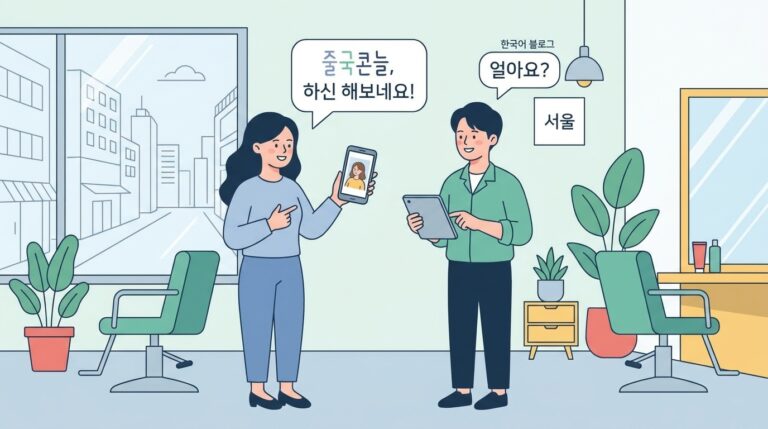
Imagine this: You finally booked an appointment at that ultra-aesthetic hair salon in Seongsu-dong or Hongdae after saving dozens of Pinterest photos of your favorite K-pop idols and K-drama stars. You sit down in front of the illuminated mirror, draped in a sleek cape, with butterflies in your stomach. The stylist greets you with a warm smile and asks, “어떤 스타일 원하세요?” (What style are you looking for?). You nervously unlock your phone, shove the screen toward them, and freeze. You want their soft layers and curtain bangs, but you don’t want to sound rude, overly demanding, or accidentally ask for a complete buzz cut.
Every foreign traveler and expat in Seoul has experienced this exact moment of panic. Navigating a Korean hair salon (미용실, miyongsil) shouldn’t feel like an exam. With the right conversational tools, showing a reference picture becomes a collaborative, creative consultation rather than a stressful guessing game. Based on real classroom feedback from hundreds of intermediate learners at Daily Hangul, this guide will give you the exact vocabulary, cultural nunchi (눈치), and conversational finesse to walk out of that salon looking like a million bucks.
Phase 2: Core Expressions Deep Dive
1. 사진처럼 해주세요 (Sajin-cheoreom hae-juseyo)
- Pronunciation: [Sajin-cheoreom hae-juseyo] (Sounds like: sah-jin + chuh-rum like ‘churro-yum’ + hae-joo-seh-yo)
- Meaning: “Please make it look like the picture.” (Literal: Like the picture, please do it.)
- K-Culture Moment: You’ll hear this in slice-of-life dramas whenever a character enters a salon before a makeover montage or a blind date.
- Editor’s Insight: While direct, adding “해주세요” makes it polite. However, saying only this can sound slightly abrupt to an experienced Korean designer who prefers considering your face shape. Pair it with a gentle smile!
- Situation Spectrum: Casual 🚫 | Semi-formal ✅ | Formal ⚠️
- 🤔 Think About It: In your home culture, do you expect hair stylists to copy a photo exactly, or do you ask them to interpret it for you?
2. 이 스타일로 하고 싶은데, 제 얼굴형에 어울릴까요? (I seutail-ro hago sipeunde, je eolgulhyeong-e eoullilkkayo?)
- Pronunciation: [I seutail-ro ha-go si-peun-de, je eol-gul-hyeong-e eo-ul-lil-kka-yo?]
- Meaning: “I’d like this style, but do you think it would suit my face shape?”
- K-Culture Moment: A signature consultation line used by Korean beauty vloggers discussing customized haircuts (맞춤 커트) in Gangnam studios.
- Editor’s Insight: Korean stylists pride themselves on contouring haircuts around bone structure. This question flatters the stylist’s professional expertise, shifting the conversation from a mechanical request to a high-end consultation.
- Situation Spectrum: Casual ⚠️ | Semi-formal ✅ | Formal ✅
- 🤔 Think About It: Notice how Korean speakers often soften a request by stating their desire with “~고 싶은데” (…I want to, but) before asking for advice. How does this compare to how you ask for advice in English?
3. 머리 길이는 최대한 살려주세요 (Meori girineun choedaehan sallyeo-juseyo)
- Pronunciation: [Meo-ri gi-ri-neun choe-dae-han sal-lyeo-ju-se-yo]
- Meaning: “Please preserve as much length as possible.” (Literal: For hair length, please bring it to life/spare it to the maximum.)
- K-Culture Moment: The relatable plea made by anyone who has watched a hairdresser cut off four inches instead of just trimming dead ends.
- Editor’s Insight: The verb “살리다” literally means “to rescue or keep alive.” In beauty jargon, it means “to preserve/accentuate.” Using this shows you speak authentic, native-level salon Korean!
- Situation Spectrum: Casual ⚠️ | Semi-formal ✅ | Formal ✅
- 🤔 Think About It: Why do you think Korean uses the vivid verb “to keep alive” (살리다) when referring to maintaining hair length or adding volume?
Phase 3: Textbook Korean vs. Real-World Korean
Situation 1: Asking if a photo style is achievable
- 📖 교과서 한국어 (Textbook): 이 머리 모양을 만들 수 있습니까? (I meori moyang-eul mandeul su itsseumnikka? / Can you make this hair shape?)
- 🗣️ 진짜 한국어 (Real-World): 이 사진 느낌으로 가능할까요? (I sajin neukkim-euro ganeunghalkkayo? / Would it be possible to get this photo’s vibe?)
- 💡 왜 다를까? (Why is it different?): Koreans emphasize “느낌” (vibe/feeling) in aesthetic contexts. Hair texture varies, so asking if the overall “mood” can be captured sounds far more natural and realistic than asking to recreate an exact mechanical shape.
Situation 2: Asking for layered trimming
- 📖 교과서 한국어 (Textbook): 층을 내어 깎아 주십시오. (Cheung-eul naeeo kkakka jusipsio. / Please cut it into floors/layers.)
- 🗣️ 진짜 한국어 (Real-World): 레이어드로 가볍게 쳐주세요. (Reieodeuro gabyeopge chyeo-juseyo. / Please thin it out lightly with layered cuts.)
- 💡 왜 다를까? (Why is it different?): Modern salons use loan words like “레이어드” (layered) and dynamic verbs like “치다” (to trim/thin out swiftly). “깎다” sounds like you’re shaving wood or peeling an apple!
Phase 4: K-Culture Deep Dive & Non-Verbal Manners
4-1. 눈치 (Nunchi) & Polite Salon Body Language
When showing your phone screen, hold it with both hands rather than thrusting it forward with one hand. Maintain a slight tilt so the stylist can view it comfortably while you are seated. Look at their eyes through the mirror rather than turning your neck around abruptly while scissors or combs are near your head! A small nod of agreement accompanied by “네, 맞아요” (Yes, that’s right) establishes instant rapport.
4-2. The Infamous “손이고 (Son-i-go)” Reality Check
In K-Beauty culture, one of the most famous salon acronyms is “손이고” (Son-i-go), short for “손님, 이건 고데기예요” (Customer, this style was done with a curling iron, not a perm). K-drama actresses and K-pop stars often have stylists curling their hair every thirty minutes on set. When you show a dreamy loose wave photo, your stylist might gently tell you that a permanent wave will look slightly tighter in reality. Knowing this beforehand prevents heartbreak and helps you appreciate their honesty!
Phase 5: Real-World Roleplay Scenario
- Setting: “Salon de Seoul” in Sinsa-dong. Stylist Min-woo approaches your chair with a fresh cup of iced corn silk tea.
- 민우 쌤 (Stylist): 🎭 웃으며 가운을 여며준다 (Smiles while fastening your cape)
안녕하세요! 오늘 어떤 스타일 생각하고 오셨어요?
(Annyeonghaseyo! Oneul eotteon seutail saenggakhago osyeosseoyo?)
“Hello! What kind of style did you have in mind today?” -
당신 (You): 🎭 두 손으로 휴대폰을 보여주며 (Showing your phone screen with both hands)
인스타그램에서 봤는데, 이 사진 느낌으로 가능할까요?
(Inseutageuraem-eseo bwanneunde, i sajin neukkim-euro ganeunghalkkayo?)
“I saw this on Instagram—would it be possible to get this photo’s vibe?” -
민우 쌤 (Stylist): 🎭 사진을 유심히 살핀 후 머리카락을 만져본다 (Inspects the photo closely, then touches your hair)
아, 허쉬컷에 C컬 들어간 스타일이네요! 고객님 모질에도 잘 어울릴 것 같아요.
(A, heoswi-keose C-keol deureogan seutairineyyo! Gogaengnim mojiredo jal eoullil geot gatayo.)
“Ah, it’s a hush cut with C-curls! I think it will match your hair texture nicely.” -
당신 (You): 🎭 안도하며 미소 짓는다 (Smiles with relief)
다행이네요! 그런데 제 얼굴형에도 잘 어울릴까요?
(Dahaeng-ineyyo! Geureonde je eolgulhyeong-edo jal eoullilkkayo?)
“What a relief! But do you think it will flatter my face shape as well?” -
민우 쌤 (Stylist): 🎭 거울 속 손님의 턱선을 체크하며 (Checks your jawline in the mirror)
네! 사이드뱅으로 옆 광대를 살짝 커버해주면 얼굴이 훨씬 갸름해 보일 거예요.
(Ne! Saaideubaeng-euro yeop gwangdaereul saljjak keobeohaejumyeon eolguri hwolssin gyareumhae boil geoyeyo.)
“Yes! If we add side bangs to soften the cheekbones, your face will look much slimmer.” -
당신 (You): 🎭 기쁜 표정으로 고개를 끄덕인다 (Nods happily)
좋아요. 그런데 머리 길이는 최대한 살려주시면 좋겠어요.
(Joayo. Geureonde meori girineun choedaehan sallyeojusimyeon jokesseoyo.)
“Sounds great. Just please keep as much hair length as possible.” -
민우 쌤 (Stylist): 🎭 분무기로 물을 뿌리며 준비한다 (Mists hair with water spray)
걱정 마세요. 상한 끝부분만 1cm 정도 다듬고 층만 가볍게 칠게요.
(Geokjeong maseyo. Sanghan kkeutbubunman 1cm jeongdo dadeumgo cheungman gabyeopge chilkeyo.)
“Don’t worry. I’ll just trim about 1cm of damaged ends and layer it lightly.” -
당신 (You): 🎭 거울을 보며 밝게 대답한다 (Answers brightly while looking into the mirror)
네, 원장님만 믿을게요! 예쁘게 해주세요.
(Ne, wonjangnimman mideulgeyo! Yeppeuge hae-juseyo.)
“Great, I trust your hands! Please make it look pretty.”
🔀 Interactive Branch Point: How would you react if the stylist says the photo requires bleaching?
- Option A: “탈색은 머릿결 상해서 싫은데, 염색만으로 비슷한 색 안 될까요?” (I don’t want bleach because of hair damage; can we get a similar color with regular dye?)
- 👉 Feedback (Best): Perfect balance! You set clear boundaries while inviting alternative solutions.
- Option B: “그냥 사진이랑 똑같이 무조건 해주세요!” (Just do it identical to the picture no matter what!)
- 👉 Feedback (Bad): Disregarding professional advice risks frying your hair and sounds demanding.
- Option C: “네, 그냥 알아서 다 해주세요.” (Yes, just do whatever you think is best.)
- 👉 Feedback (Risk): You might walk out with platinum blonde hair and a hefty bill you weren’t prepared for!
Phase 6: 10-Second Emotion Shadowing Drill
-
Drill 1 [😊 설레고 조심스럽게 / Excited & Polite]:
이 사진 느낌으로 / 가능할까요?
(I sajin neukkim-euro / ganeunghalkkayo?) -
Drill 2 [🤔 전문가의 의견을 구하며 / Seeking Professional Advice]:
제 얼굴형에 / 어울릴까요?
(Je eolgulhyeong-e / eoullilkkayo?) -
Drill 3 [🥺 간절하고 진지하게 / Earnest & Hopeful]:
길이는 / 최대한 살려주세요!
(Girineun / choedaehan sallyeo-juseyo!)
Phase 7: K-Culture Mini Dictionary
- 손이고 (Son-i-go): “Customer, this is styled with a curling iron.” Used whenever a client shows an unrealistically perfect salon reference photo.
- 기장 (Gijang): Hair length. Commonly heard in “기장 추가” (length surcharge for perms/coloring).
- 쌤 (Ssaem): An affectionate, colloquial shortening of 선생님 (Teacher). Commonly used to address stylists (e.g., “민우 쌤”).
- 뿌리볼륨펌 (Ppuri-bollyum-peom): Root volume perm. Korea’s secret weapon for keeping flat hair bouncy throughout the humid seasons.
Phase 8: Traveler’s Survival Kit
Survival Expressions TOP 3
- 다듬기만 해주세요. (Dadeumgiman hae-juseyo.) – Just a trim, please. (Pro Tip: Use when you only want split ends removed without losing length).
- 앞머리는 눈썹 아래로 잘라주세요. (Apmmeorineun nunsseop araero jalla-juseyo.) – Please cut my bangs below the eyebrow. (Pro Tip: Bangs shrink when dry, so specifying “below the eyebrow” prevents micro-bang disasters).
- 샴푸 시원하게 해주셔서 감사합니다. (Syampu siwonhage haejusyeoseo gamsahamnida.) – Thank you for the refreshing shampoo. (Pro Tip: A polite compliment that delight salon assistants).
Editor’s Travel Note
Most trendy Korean hair salons require reservations. Install the 네이버 지도 앱 다운로드 to easily book salon slots via “Naver Booking” (네이버 예약), where you can view stylist portfolios and discount coupons. Most salons in tourist hubs accept foreign credit cards, but having cash or local payment ready for small tips (though tipping is not customary in Korea!) is never required.
Phase 9: “One Step Deeper” (Reflective Essay)
In many Western cultures, a haircut is an exercise in personal autonomy—you specify the inches, and the barber executes your command. In Korea, however, a visit to the hair salon is rooted in harmony, relational aesthetics, and deference to the craftsperson’s trained eye. Stylists do not just cut hair; they actively sculpt a silhouette that complements your facial balance and personal atmosphere (bunwigi). When you ask, “제 얼굴형에 어울릴까요?” you step inside this collaborative cultural space, honoring the designer’s artistry.
💬 Your Turn: Have you ever experienced a haircut consultation in another country? How did it compare to this Korean approach? Share your thoughts below!
Phase 10: FAQ & Avoiding Misunderstandings
Q: Can I bring multiple reference photos or should I only show one?
A: Bringing 2 to 3 photos is actually better! One photo for the overall silhouette, one for the bangs, and one for the hair color gives your stylist a precise vision of what elements you love.
Q: What if my Korean isn’t fluent enough to understand their suggestions?
A: Stylists will happily use mirror gestures, their hands, and photo references on their own tablet. Simply say, “한국어를 조금만 천천히 말씀해 주세요” (Please speak Korean a little slowly).
Q: Is tipping customary at Korean hair salons?
A: No! Tipping is not expected or practiced in Korean salons. The price listed on the menu or booking page includes all service taxes.
🚨 Common Mistakes TOP 3
- ❌ Mistake 1: Saying “머리를 깎아주세요” (Shave my hair). -> Correct Action: Say “머리 다듬어주세요” (Trim my hair) or “커트해 주세요” (Please give me a cut).
- ❌ Mistake 2: Keeping silent when water temperature or head massage pressure hurts. -> Correct Action: Speak up comfortably: “물이 조금 뜨거워요” (The water is a bit hot).
- ❌ Mistake 3: Assuming the final cost won’t change. -> Correct Action: Always ask beforehand: “기장 추가 비용이 있나요?” (Is there an extra charge for hair length?).
Phase 11: Action Mission & Engagement
- 🥉 Bronze Mission: Practice saying “이 사진 느낌으로 가능할까요?” 5 times in front of your bathroom mirror.
- 🥈 Silver Mission: Save a Korean hairstyle reference from Instagram or Pinterest and write out your dream salon request in the comments below using today’s expressions.
- 🥇 Gold Mission: Walk into a real Korean salon (or your local salon) and use at least two phrases from this lesson during your consultation!
- 🎮 K-Culture Mission: Watch the first episode of any makeover-themed K-Drama and spot when someone points at a celebrity photo and says “~처럼 해주세요”!
Phase 12: Interactive Quiz Challenge
Test what you’ve learned today!
1. Situational Judgment:
You want to ask the stylist to maintain your current hair length as much as possible while layering it. Which phrase should you say?
A) 머리 다 깎아주세요.
B) 머리 길이는 최대한 살려주세요.
C) 머리를 짧게 쳐주세요.
2. Fill-in-the-Blank:
“이 사진 _________ 가능할까요?” (Would it be possible to get this photo’s vibe?)
Hint: The Korean word for ‘feeling’ or ‘vibe’.
3. True or False Culture Check:
In Korea, “손이고” (Son-i-go) means the hairstyle can easily be duplicated with an everyday perm without any heat styling tools.
👉 Click to reveal answers & explanations!
- Answer: B | “머리 길이는 최대한 살려주세요” accurately asks to preserve length. Option A means to shave/cut it all off, and Option C asks for a short cut.
- Answer: 느낌으로 (neukkim-euro) | “이 사진 느낌으로 가능할까요?” is the most natural way to consult on a photo’s mood.
- Answer: False | “손이고” stands for “Customer, this is done with a curling iron” (손님, 이건 고데기예요), meaning it cannot be achieved with just a perm!







