

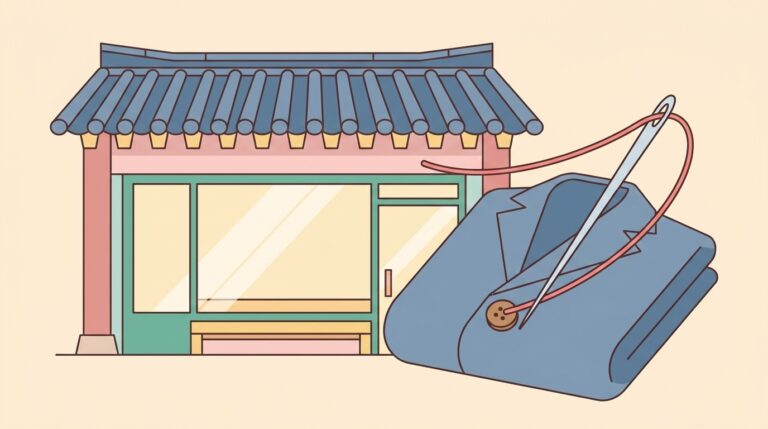
Phase 1: Empathy (Story-immersive Opening)
안녕하세요! It’s your Daily Hangul editor here.
Picture this: You are in Seoul, getting dressed for a dreamy day of cafe-hopping in the trendy alleys of Seongsu-dong. You slip on your favorite minimalist trench coat, adjust the collar in front of the mirror, and reach down to button it up. Pop. With a tiny bounce, your main button snaps off, spinning dramatically across the floor and landing under your bed.
Your heart drops. In your native language, you’d casually ask the front desk or pop into a corner store for a needle and thread without breaking a sweat. But in Korea? How do you say “A button came off” without sounding like a robotic grammar translation? Do you say “attach a button” or “sew a button”? How do you ask a friendly neighborhood laundry master to fix it before your dinner date?
Don’t let a missing button derail your Korean style! Based on real scenarios faced by our B1-level learners, this survival masterclass will equip you with authentic, natural expressions and local cultural etiquette. You will know exactly how to handle fashion emergencies with charm, speed, and effortless fluency.
Phase 2: Deep Dive into 3 Key Expressions
1. 단추가 떨어졌어요 (Danchuga tteoreojyeosseoyo)
- Pronunciation: [Dan-chu-ga tteo-reo-jyeo-sso-yo] (Think of the English word ‘dan’ as in dance, ‘chu’ like chew, and ‘tteo’ with a sharp double-t pop like saying ‘t-top’ fast!)
- Meaning: Literal: “The button has fallen.” / Real Nuance: “A button popped off!” or “I lost a button.”
- K-Culture Moment: Seen in romantic K-dramas when the male lead rushes to an important meeting, only for his button to snap, prompting the female lead to step in with emergency repairs.
- Editor’s Insight: Korean uses the verb 떨어지다 (tteoreojida – to fall/drop) rather than “lost” (잃어버리다) because buttons physically detach and drop from garments. Using 떨어지다 sounds 100% natural.
- Situation Spectrum: Casual ✅ | Semi-formal ✅ | Formal ✅
- 🤔 Think About It: In English, we often say “My button fell off.” In Korean, the button is the subject taking the action (단추가 떨어지다). How does shifting agency to the object change how you perceive accidents?
2. 단추 좀 달아 주실 수 있나요? (Danchu jom dara jusil su innayo?)
- Pronunciation: [Dan-chu jom da-ra ju-sil su in-na-yo]
- Meaning: Literal: “Could you please attach a button for me?” / Real Nuance: “Could you sew this button on for me, please?”
- K-Culture Moment: Asking the veteran owner of a local neighborhood alteration shop (세탁소) to fix your shirt within twenty minutes before your shoot or interview.
- Editor’s Insight: English speakers often reach for the direct dictionary translation 꿰매다 (kkwemaeda – to sew/stitch). While technically accurate, native Koreans almost exclusively use the verb 달다 (dalda – to hang/attach/affix) when dealing with buttons, pins, or badges. Using 달다 instantly elevates your Korean to native level!
- Situation Spectrum: Casual ⚠️ | Semi-formal ✅ | Formal ✅
- 🤔 Think About It: Why does Korean consider sewing a button an act of “attaching” (달다) rather than just “stitching” (꿰매다)? It reflects a mindset focused on the end result: making the garment whole again.
3. 혹시 반짇고리 있어요? (Hoksi banjitgori isseoyo?)
- Pronunciation: [Hok-si ban-jit-go-ri i-sseo-yo]
- Meaning: Literal: “By any chance, do you have a sewing basket?” / Real Nuance: “Do you happen to have a mini sewing kit?”
- K-Culture Moment: Whispering to hotel receptionists, Airbnb hosts, or helpful convenience store clerks when an outfit emergency strikes late at night.
- Editor’s Insight: 반짇고리 (banjitgori) is a beautiful traditional Korean word referring to a small box or pouch containing needles, threads, thimbles, and safety pins. Adding 혹시 (hoksi – by any chance) softens your tone dramatically, showing gentle politeness.
- Situation Spectrum: Casual ✅ | Semi-formal ✅ | Formal ✅
- 🤔 Think About It: Traditional Korean households kept intricate banjitgori made of mulberry paper or lacquered wood. Even in today’s digital era, the word remains the standard term for quick sewing kits.
Phase 3: Textbook Korean vs. Real Korean
Situation 1: Expressing that you need to fix the button
- 📖 교과서 한국어 (Textbook): 단추를 바느질해야 합니다. (Danchureul baneujilhaeya hamnida.) – “I must sew the button.”
- 🗣️ 진짜 한국어 (Real-life): 단추 달아야 돼요. (Danchu daraya dwaeyo.) – “I need to get this button on.”
- 💡 왜 다를까? Textbook Korean treats 바느질하다 (to needle-sew) as the default activity. However, spoken Korean favors the combination of the practical verb 달다 (to attach) with the everyday obligation form -아야/어야 되다.
Situation 2: Dropping clothes off at a repair shop
- 📖 교과서 한국어 (Textbook): 이 옷의 수선을 요청합니다. (I osui suseoneul yocheonghamnida.) – “I request the alteration of these clothes.”
- 🗣️ 진짜 한국어 (Real-life): 이거 단추 수선 좀 맡기려고요. (Igeo danchu suseon jom matgiryeogoyo.) – “I’d like to leave this here for a quick button repair.”
- 💡 왜 다를까? Real Koreans express delegating work to specialists using the verb 맡기다 (matgida – to entrust/drop off). The ending -려고요 softly implies your intention without sounding like a rigid business contract.
Phase 4: K-Culture Deep Dive & Non-verbal Manners
4-1. 눈치 (Nunchi) & Gestures: Handling Wardrobe Malfunctions Gracefully
If you discover a detached button while in a public place—such as an office, university seminar, or wedding hall—avoid making a dramatic scene. Use your Nunchi (social intuition) to quietly check your surroundings.
* Presenting the item: When handing your coat or shirt to a hotel concierge, convenience store clerk, or alteration shop master, always hold the garment with both hands (두 손으로) while folding it neatly so the damaged area faces upward.
* Point subtly: Rather than shaking the fabric, point lightly with your fingers while maintaining soft eye contact and giving a slight bow of the head to signal politeness.
4-2. Cultural Code: The Magical Neighborhood 세탁소 (Setakso)
In Korea, dry cleaners (세탁소, Setakso) are not just places where clothes get washed. They are vibrant community hubs run by master tailors with decades of experience in 옷수선 (garment alterations). If your button falls off, you don’t have to throw the clothes away or struggle alone! For typically 1,000 to 3,000 KRW (less than $3 USD), a local Sajangnim (shop owner) will hand-stitch your button in under three minutes, often matching the exact thread thickness. You will spot these cozy stores in every residential alleyway marked with a glowing hanger or iron sign.
Phase 5: Real-life Roleplay Scenario
Setting: A cozy, steam-filled neighborhood alteration and dry-cleaning shop in Yeonnam-dong, Seoul.
NPC: 사장님 (Sajangnim – Mr. Park, a warm master tailor in his late 50s with a tape measure around his neck).
- Turn 1 (Learner): 안녕하세요! 저기, 코트 단추가 떨어져서 왔는데요. (Annyeonghaseyo! Jeogi, koteu danchuga tteoreojyeoseo wanneundeyo.)
🎭 Both hands gently offering the folded wool coat, pointing toward the chest area.
(Hello! Excuse me, I came because a button fell off my coat.) -
Turn 2 (Sajangnim): 어서 와요! 어디 봐요. 아이고, 실이 다 풀렸네. 떨어진 단추는 챙겨 왔어요? (Eoseo wayo! Eodi bwayo. Aigo, siri da pullyeonne. Tteoreojin danchuneun chaenggyeo wasseoyo?)
🎭 Takes the coat with a warm smile and examines the loose thread.
(Welcome! Let’s take a look. Ah, the threads came completely undone. Did you bring the fallen button with you?) -
Turn 3 (Learner): 네, 여기 단추 챙겨 왔어요. 지금 바로 단추 좀 달아 주실 수 있나요? (Ne, yeogi danchu chaenggyeo wasseoyo. Jigeum baro danchu jom dara jusil su innayo?)
🎭 Handing over the spare button carefully.
(Yes, I brought the button right here. Could you sew it on for me right now?) -
Turn 4 (Sajangnim): 그럼요! 금방 달아 줄 테니까 저기 의자에 잠깐 앉아 있어요. (Geureomyo! Geumbang dara jul tenikka jeogi uijae jamkkan anja isseoyo.)
🎭 Gestures toward a cushioned wooden chair while picking up a matching navy thread.
(Of course! I will sew it on in a jiffy, so take a seat over there for a moment.) -
Turn 5 (Learner): 정말 감사합니다! 혹시 다른 단추들도 헐렁한지 한번 봐주실 수 있어요? (Jeongmal gamsahamnida! Hoksi dareun danchudeuldo heolleonghanji hanbeon bwajusil su isseoyo?)
🎭 Bowing head slightly with sincere eyes.
(Thank you so much! Could you perhaps check if the other buttons are loose as well?) -
Turn 6 (Sajangnim): 센스 있네! 셋째 단추도 간당간당하네. 그것도 단단하게 다시 꿰매 줄게요. (Senseu inne! Setjjae danchudo gandang-gangdanghane. Geugeotdo dandan-hage dasi kkwemae julgeyo.)
🎭 Nodding approvingly and tightening the other loose button with deft fingers.
(Good sense! The third button is dangling on the verge of falling, too. I will stitch that one tightly for you as well.) -
Turn 7 (Learner): 와, 사장님 손 진짜 빠르시네요! 얼마예요? (Wa, sajangnim son jinjja ppareusineyo! Eolmayeyo?)
🎭 Stepping forward with payment card ready.
(Wow, you work so fast, Sajangnim! How much is it?) -
Turn 8 (Sajangnim): 뭘요! 2천 원만 줘요. 조심히 입고 다녀요! (Mwolyo! Icheon-wonman jwoyo. Josimhi ipgo danyeoyo!)
🎭 Hands back the neatly buttoned coat.
(Don’t mention it! Just give me 2,000 won. Take care wearing it!)
🔀 Interactive Branching Choice:
What would you say if you accidentally lost the button and have no replacement?
- Option A: “단추를 잃어버렸는데, 비슷한 단추로 달아 주실 수 있나요?” (Danchureul ireobeoryeonneunde, biseutan danchuro dara jusil su innayo?)
- Option B: “새 옷으로 바꿔 주세요.” (Sae oseuro bakkwo juseyo.)
- Option C: “단추 없으니까 그냥 꿰매 주세요.” (Danchu eopseunikka geunyang kkwemae juseyo.)
Feedback:
* Option A (Best): Perfect! You explain that you lost the original button and ask if they can match a similar spare button from their shop stash. Tailors keep hundreds of spare buttons!
* Option B (Bad): Disastrous! Demanding a new coat from an alteration shop owner will cause utter confusion.
* Option C (Risk): Awkward! Sewing the hole shut without a button will ruin the cut and silhouette of your coat.
Phase 6: 10-Second Emotion Shadowing Drill
Practice these lines out loud, honoring the emotional markers and natural slash (/) pause points:
- [😱 당황하고 다급하게 / Panicked & Urgent]
어떡하지? / 재킷 단추가 / 똑 떨어졌어!
(Eotteokhaji? / Jaekit danchuga / ttok tteoreojyeosseo!)
“What should I do? / My jacket button / snapped right off!” -
[🙏 조심스럽고 공손하게 / Polite & Respectful]
저기 실례지만, / 단추 좀 / 달아 주실 수 있을까요?
(Jeogi sillyejiman, / danchu jom / dara jusil su isseulkkayo?)
“Excuse me, / but could you / possibly attach this button for me?” -
[💡 반가움과 안도감 / Relieved & Delighted]
다행이다! / 다이소에서 / 휴대용 반짇고리를 / 찾았어요!
(Dahaeng-ida! / Daiso-eseo / hyudaeyong banjitgorireul / chajasseoyo!)
“What a relief! / At Daiso, / a portable sewing kit / I found!”
Phase 7: K-Culture Mini Dictionary
- 단추 (Danchu): Button. Used for shirt, coat, or sleeve buttons. In computer tech, it also refers colloquially to physical clickable buttons.
- 반짇고리 (Banjitgori): Traditional sewing kit. Usually contains needles (바늘), multiple color threads (실), small scissors (쪽가위), and safety pins (옷핀).
- 옷수선 (Ot-suseon): Clothes alterations and mending. Look for this exact sign outside shops when shortening hems or repairing tears.
- 세탁소 (Setakso): Local laundry and dry-cleaning store. In Korea, 95% of Setakso also specialize in expert alterations (수선).
Phase 8: Survival Kit for Travelers
Top 3 Survival Phrases:
- 혹시 옷핀 있어요? (Hoksi otpin isseoyo?)
- Pro Tip: If you are in a rush and cannot sew right now, ask convenience store staff for an 옷핀 (safety pin) to pin it from the inside discreetly.
- 단추가 헐렁해요. (Danchuga heolleonghaeyo.)
- Pro Tip: Use this when a button hasn’t dropped yet, but feels loose and wobbly.
- 수선하는 데 얼마나 걸려요? (Suseonhaneun de eolmana geollyeoyo?)
- Pro Tip: Crucial when dropping off an item at a Setakso so you know whether to wait on the bench or come back later.
Editor’s Travel Note:
When looking for emergency repair tools, head to the nearest Daiso or open your smartphone to find a nearby dry cleaner by [downloading the Naver Map app and searching 옷수선]. Convenience stores like GS25 and CU often carry mini sewing kits (휴대용 반짇고리 세트) near the travel toiletry rack for around 2,000 to 3,000 KRW.
Phase 9: “One Step Deeper” (Reflective Essay)
In many Western cities, repairing a loose button often requires either doing it yourself at home or paying hefty specialty tailoring fees. In Korea, the ubiquitous presence of the neighborhood 세탁소 reflects a culture that values everyday convenience, resourcefulness, and community interconnectedness (Jeong, 정). The elderly tailor who mends your coat in three minutes while asking if you’ve eaten lunch represents a timeless slice of urban Korean warmth that remains vibrant amidst sparkling skyscrapers.
💬 Your Turn: Have you ever experienced an unexpected fashion emergency while traveling? How did people in that culture help you solve it? Share your story in the comments below!
Phase 10: FAQ & Common Mistakes
Q: Can I buy a sewing kit at any Korean convenience store?
A: Yes! Most major convenience stores (CU, GS25, 7-Eleven) stock compact travel sewing kits (휴대용 반짇고리) in the personal hygiene/travel amenities section. If you can’t spot it, show the clerk the word: “반짇고리 있어요?”
Q: How much does it typically cost to sew a button on at a Korean dry cleaner?
A: If you bring the detached button with you, it typically costs between 1,000 KRW and 3,000 KRW per button. Some kind tailors will even stitch it for free if you are already having other clothes dry-cleaned or hemmed!
Q: What should I say if the button completely disappeared and I don’t have a spare?
A: Say: “단추를 잃어버렸는데, 비슷한 걸로 달아 주실 수 있나요?” (Danchureul ireobeoryeonneunde, biseutan geollo dara jusil su innayo? – “I lost the button; could you attach a similar one?”). Most alteration shops keep a box full of spare buttons.
🚨 Common Mistakes Alert (외국인 학습자 흔한 실수 TOP 3)
- Mistake: Saying 단추를 붙여 주세요 (Danchureul buchyeo juseyo).
- Why it’s wrong: 붙이다 means to stick or glue with adhesive (like stickers or tape). Using it for a button sounds like you want to superglue it to your coat!
- Correct Action: Always use 달아 주세요 (Dara juseyo).
- Mistake: Saying 단추가 죽었어요 (Danchuga jugeosseoyo).
- Why it’s wrong: Literal translation of slang like “my button died.” In Korean, objects don’t “die” in this context.
- Correct Action: Say 단추가 떨어졌어요 (Danchuga tteoreojyeosseoyo).
- Mistake: Forgetting to bring the original button.
- Why it’s wrong: High-end coats have unique branded buttons. If it falls, pick it up immediately and put it in your coin purse.
- Correct Action: Hand both the garment and button together while saying: “단추 챙겨 왔어요” (Danchu chaenggyeo wasseoyo).
Phase 11: Action Missions & Engagement
- 🥉 Bronze Mission (Self-Practice): Look into your mirror with your favorite coat, hold an imaginary button, and say 단추가 떨어졌어요. 달아야 돼요! three times out loud with clear intonation.
- 🥈 Silver Mission (Social Sharing): Share an Instagram Story or tweet of your outfit of the day with the Korean caption: 오늘 코디 완벽! 단추 조심하자! (Today’s styling is perfect! Let’s watch out for buttons!).
- 🥇 Gold Mission (Real Life): Walk into a local Daiso or convenience store during your next trip to Korea and ask a staff member where the sewing supplies are: 실례지만 반짇고리 어디에 있어요?
- 🎮 K-Culture Mission: Watch an episode of a slice-of-life K-drama (like Reply 1988 or Crash Landing on You) and listen for family members shouting for someone to sew or mend their clothes!
Phase 12: Interactive Quiz Challenge
Test your knowledge with these 3 rapid-fire questions!
1. Situational Judgment: Your button came off right before an important interview in Gangnam. You spot a nearby 세탁소. What is the most natural sentence to say to the owner?
* (A) 단추를 풀로 붙여 주세요.
* (B) 단추가 떨어졌는데, 지금 바로 달아 주실 수 있나요?
* (C) 새 옷으로 만들어 주세요.
2. Fill-in-the-Blank: Complete the sentence with the correct verb particle:
“단추가 헐렁해서 다시 단단하게 (_______) 돼요.”
* (A) 떨어져야
* (B) 버려야
* (C) 달아야
3. True or False Culture Check: In Korea, if you lose a button, you can only get it fixed at department stores.
* True / False
👉 Click to reveal answers & explanations!
- Answer: (B)
- Explanation: Asking if they can attach the button right now using 달아 주실 수 있나요 is polite, natural, and directly addresses the urgent situation.
- Answer: (C) 달아야
- Explanation: 달아야 돼요 means “need to attach/sew on.” The sentence means: “The button is loose, so I need to attach it tightly again.”
- Answer: False
- Explanation: Neighborhood dry cleaners (세탁소) and small alteration shops (옷수선) are located in practically every residential street across Korea, providing cheap and ultra-fast button repairs!
- Explanation: Neighborhood dry cleaners (세탁소) and small alteration shops (옷수선) are located in practically every residential street across Korea, providing cheap and ultra-fast button repairs!







