

Phase 1: Empathy (Story-Driven Opening)
안녕하세요! 매일한글 에디터입니다.
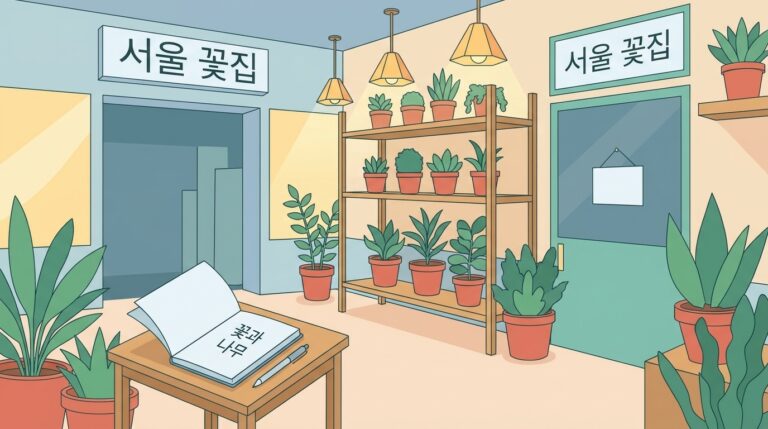
Picture this: You are taking a leisurely stroll through a picturesque alley in Seoul—perhaps in Yeonnam-dong or Samcheong-dong—and catch the fresh, dewy scent of damp soil and eucalyptus. You step toward a cozy boutique flower shop with floor-to-ceiling glass windows, bathed in soft afternoon light. You spot the most adorable potted succulent resting in a handmade terracotta pot. You want to bring one back to your studio apartment or gift it to your Korean friend as a housewarming gesture.
Then, hesitation hits. Your palms start to sweat. You realize your Korean textbook only taught you sentences like “이것은 꽃입니다” (This is a flower). How do you ask if this little plant can survive with indirect sunlight? How do you ask how often it needs water without sounding like a robotic encyclopedia? You freeze, awkwardly smile at the florist, and step back outside empty-handed.
Don’t worry, you are not alone! Over the past decade of coaching learners at Daily Hangul, this exact scenario has been one of the most frequently confessed “shopping freezes.” Buying a potted plant (화분) in Korea is an intimate, sensory cultural experience. In this guide, tailored specifically to A2 learners, you will master the 3 golden phrases and insider etiquette needed to walk into any neighborhood flower shop and walk out with a thriving green companion.
Phase 2: 3 Key Expressions Deep Dive
1. 키우기 쉬운 화분 있어요? (Ki-u-gi swi-un hwa-bun iss-eo-yo?)
- Pronunciation: [Ki-u-gi swi-un hwa-bun iss-eo-yo?] (Think of: Kee-oo-gee she-oon hwa-boon eess-uh-yo? – smooth and light)
- Meaning: Literal: “Is there an easy-to-raise flowerpot?” | Natural Nuance: “Do you have any low-maintenance, beginner-friendly potted plants?”
- K-Culture Moment: In slice-of-life K-dramas like Summer Strike or Because This Is My First Life, characters moving into new spaces frequently visit cozy neighborhood plant shops and ask this exact sentence to start their indoor garden without stress.
- Editor’s Insight: Notice the verb 키우다 (ki-u-da). While in English we often say “grow plants,” Koreans use 키우다, the very same verb used for raising children and pets! This single word reflects how Koreans treat houseplants as living companions rather than mere furniture.
- Situation Spectrum:
- Casual (반말): 🚫 키우기 쉬운 화분 있어? (Too blunt with shop owners!)
- Semi-formal (해요체): ✅ 키우기 쉬운 화분 있어요? (Polite, natural, and warm.)
- Formal (하십시오체): ⚠️ 키우기 쉬운 화분이 있습니까? (A bit stiff for a neighborhood floral shop.)
- 🤔 Think About It: In English, we often say “hard to kill.” In Korean, the focus is on “easy to raise tenderly.” How does framing plants as something you nurture change the way you interact with them?
2. 물은 얼마나 자주 줘요? (Mul-eun eol-ma-na ja-ju jwo-yo?)
- Pronunciation: [Mul-eun eol-ma-na ja-ju jwo-yo?] (Think of: Mool-eun uhl-mah-nah jah-joo jwo-yo? – crisp ‘mool’ like cool)
- Meaning: Literal: “As for water, how often do I give it?” | Natural Nuance: “How often should I water this?”
- K-Culture Moment: On Korean YouTube home-café and desk-styling vlogs, creators introduce their windowsill plants and explain their care routine with: “물은 일주일에 한 번 줘요” (I water it once a week).
- Editor’s Insight: Koreans do not have a dedicated single verb meaning “to water.” Instead, we say 물(을) 주다 (mul-eul ju-da), literally “to give water.” You are providing hydration as a gift of care.
- Situation Spectrum:
- Casual: 🚫 물 얼마나 자주 줘? (Rude to use with a florist.)
- Semi-formal: ✅ 물은 얼마나 자주 줘요? (The golden standard.)
- Formal: ⚠️ 물은 얼마나 자주 주어야 합니까? (Grammatically sound, but sounds like a science test question.)
- 🤔 Think About It: We “give water” (물 주다) just like we “give heart and love” (마음을 주다). How does treating hydration as an active gift affect your daily plant care?
3. 선물용으로 추천해 주세요. (Seon-mul-yong-eu-ro chu-cheon-hae ju-se-yo.)
- Pronunciation: [Seon-mul-yong-eu-ro chu-cheon-hae ju-se-yo.] (Think of: Suhn-mool-yong-eu-ro choo-chun-hae joo-seh-yo.)
- Meaning: Literal: “Please recommend for gift purpose.” | Natural Nuance: “Could you recommend something that would make a great gift?”
- K-Culture Moment: In workplace rom-coms like Business Proposal, colleagues celebrating promotions or visiting a newly opened café bring potted plants adorned with elegant satin ribbons.
- Editor’s Insight: The suffix -용 (-yong) means “for the use/purpose of.” Telling the florist it is for a gift immediately triggers them to consider plant symbolism (good luck, clean air) and offer decorative wrapping.
- Situation Spectrum:
- Casual: 🚫 선물용으로 추천해 줘. (Only for very close friends.)
- Semi-formal: ✅ 선물용으로 추천해 주세요. (Perfect for asking for professional guidance.)
- Formal: ⚠️ 선물용으로 추천을 부탁드립니다. (Very polite, often heard in corporate corporate flower deliveries.)
- 🤔 Think About It: In many Western countries, a bouquet of cut flowers is the default gift. Why do you think living potted plants are just as popular as gifts in Korean culture?
Phase 3: Textbook Korean vs. Real Korean
Situation 1: Asking About Sunlight Needs
- 📖 교과서 한국어: 이 식물은 햇빛을 많이 필요로 합니까? (I sing-mul-eun haet-bich-eul manh-i pil-yo-ro ham-ni-kka? – Does this plant require a lot of sunlight?)
- 🗣️ 진짜 한국어: 이거 햇빛 많이 봐야 돼요? (I-geo haet-bbit manh-i bwa-ya dwae-yo? – Does this need to see a lot of sun?)
- 💡 왜 다를까?: Textbooks favor abstract Sino-Korean nouns like “필요로 하다” (to require). Native Korean speakers use active, sensory expressions like “햇빛을 보다” (to see the sunlight) together with the conversational helper grammar -야 돼요 (must/needs to).
Situation 2: Requesting Gift Packaging
- 📖 교과서 한국어: 그것을 포장하여 주십시오. (Geu-geos-eul po-jang-ha-yeo ju-sip-si-o. – Please package that.)
- 🗣️ 진짜 한국어: 선물할 거라 예쁘게 포장해 주세요. (Seon-mul-hal geo-ra ye-ppeu-ge po-jang-hae ju-se-yo. – It’s a gift, so please wrap it nicely for me.)
- 💡 왜 다를까?: Functional commands ending in -십시오 sound cold and bureaucratic in boutique shops. Explaining your situation with -(으)ㄹ 거라 (“because it will be…”) invites the florist into your story, resulting in thoughtful styling, ribbons, and care cards.
Phase 4: K-Culture Deep Dive & Non-Verbal Manners
4-1. 눈치 (Nunchi) & Gestures
- The Two-Handed Cradle: Korean plant studios curate aesthetic ceramic pots (토분 – terracotta pots). Never pick up a pot by its fragile stem or with one careless hand. Support the base gently with both hands. This shows respect for the florist’s craftsmanship.
- Palm Pointing: When pointing out a plant on a high shelf, avoid jabbing a single index finger directly at the foliage. Instead, extend your hand palm-up toward the plant.
- Reading the Shop Pace: Florists in Korea are often busy trimming stems or arranging soil in the back. When you enter, give a small nod and a cheerful “안녕하세요!” (Hello!). Take 30 seconds to browse on your own before asking questions; this gives them time to finish their task and assist you warmly.
4-2. Cultural Code: The Housewarming Plant (집들이 화분)
In Korean urban culture, visiting someone’s new home (집들이 – jip-deul-i) requires bringing a gift. While toilet paper and detergent were retro classics (symbolizing endless prosperity and cleansing), lush indoor plants are today’s favorite gift. Plants like the 금전수 (Geumjeonsu – Money Tree / ZZ Plant) symbolize financial wealth, while 스투키 (Stuckyi) and 산세베리아 (Sansevieria) represent clean air and indestructible vitality. Giving a potted plant tells the host: “May your home be healthy, serene, and prosperous.”
Phase 5: Real-Life Roleplay Scenario
Setting: Yeonnam Greenery, a warm indie plant shop tucked in a residential alley in Mapo-gu, Seoul. Calming bossa nova plays softly, terracotta pots line natural pine shelves, and the aroma of cedar fills the room.
Characters:
* You: A learner living in Seoul looking for an easy plant for your room.
* Min-ji (민지): A cheerful, 30-something florist wearing a canvas gardening apron.
- You: 안녕하세요! 저… 키우기 쉬운 화분 있어요? (An-nyeong-ha-se-yo! Jeo… ki-u-gi swi-un hwa-bun iss-eo-yo?)
“Hello! Um… do you have any potted plants that are easy to raise?”
🎭 Action: [Bow slightly at the entrance, gesturing gently toward the windowsill] -
Min-ji: 네, 어서 오세요! 식물 처음 키워보세요? (Ne, eo-seo o-se-yo! Sing-mul cheo-eum ki-wo-bo-se-yo?)
“Yes, welcome! Is it your first time raising a plant?”
🎭 Action: [Wipes gardening shears on a cloth, walks over with a friendly smile] -
You: 네, 초보자예요. 방에 햇빛이 많이 안 들어와요. (Ne, cho-bo-ja-ye-yo. Bang-e haet-bbit-i manh-i an deul-eo-wa-yo.)
“Yes, I’m a beginner. Not much sunlight comes into my room.”
🎭 Action: [Smiles shyly and rests both hands in front] -
Min-ji: 그러면 이 ‘스투키’나 ‘테이블야자’ 어떠세요? 그늘에서도 잘 자라요. (Geu-reo-myeon i ‘seutu-ki’na ‘te-i-beul-ya-ja’ eo-tteo-se-yo? Geu-neul-e-seo-do jal ja-ra-yo.)
“In that case, how about this ‘Stuckyi’ or ‘Parlor Palm’? They grow well even in shaded spots.”
🎭 Action: [Lightly points palm-up toward two sculptural ceramic pots on a low table] -
You: 귀엽네요! 물은 얼마나 자주 줘요? (Gwi-yeop-ne-yo! Mul-eun eol-ma-na ja-ju jwo-yo?)
“They’re cute! How often do I give water?”
🎭 Action: [Leans forward slightly to admire the smooth round pot] -
Min-ji: 스투키는 한 달에 한 번만 흠뻑 주시면 돼요. 아주 편해요! (Seutu-ki-neun han dal-e han beon-man heum-ppeok ju-si-myeon dwae-yo. A-ju pyeon-hae-yo!)
“For the Stuckyi, you only need to soak it thoroughly once a month. It’s super easy!”
🎭 Action: [Mimes a light watering motion and nods reassuringly] -
You: 좋아요, 이걸로 할게요. 선물할 거라 예쁘게 포장해 주세요! (Joh-a-yo, i-geol-ro hal-ge-yo. Seon-mul-hal geo-ra ye-ppeu-ge po-jang-hae ju-se-yo!)
“Great, I’ll take this one. It’s a gift, so please wrap it nicely!”
🎭 Action: [Nods enthusiastically and takes out your card wallet] -
Min-ji: 네! 선물 카드랑 식물 관리 메모도 같이 넣어드릴게요. (Ne! Seon-mul ka-deu-rang sing-mul gwan-ri me-mo-do gat-i neo-eo-deu-ril-ge-yo.)
“Sure! I’ll include a gift card and plant care notes together inside.”
🎭 Action: [Carefully lifts the pot from the base and brings it to the wrapping counter]
🔀 Interactive Decision Fork
Min-ji asks you: “들고 가기 편하게 쇼핑백에 담아드릴까요?” (Shall I put it in a shopping bag so it’s easy to carry?). How do you respond?
- Choice A: “네, 담아주세요. 감사합니다!” (Yes, please put it in. Thank you!)
- Feedback: 🌟 Best Choice! Clear, polite, and practical. Plants can be heavy or tip over on the bus or subway; Korean florists have special rigid paper bags with plant holders inside.
- Choice B: “그냥 줘.” (Just give it.)
- Feedback: ❌ Bad Choice! This uses rude informal speech (반말) without an honorific ending. It sounds disrespectful to a shop owner.
- Choice C: “주머니에 넣을게요.” (I will put it into my pocket.)
- Feedback: ⚠️ Risk! Unless you are buying a 2-inch mini-cactus, ceramic pots will spill soil all inside your coat or backpack!
Phase 6: 10-Second Emotional Shadowing Drill
Read these out loud! Focus on the pause markers (/) and embody the emotion tag:
- [😊 기쁘고 신나게 – Cheerful & Bright]
“안녕하세요! / 키우기 쉬운 화분 / 있어요? /”
(An-nyeong-ha-se-yo! / Ki-u-gi swi-un hwa-bun / iss-eo-yo? /) -
[🥺 궁금하고 진지하게 – Curious & Attentive]
“이거 / 물은 얼마나 / 자주 줘요? /”
(I-geo / mul-eun eol-ma-na / ja-ju jwo-yo? /) -
[🥰 다정하고 기대에 차서 – Warm & Anticipatory]
“선물할 거라 / 예쁘게 / 포장해 주세요! /”
(Seon-mul-hal geo-ra / ye-ppeu-ge / po-jang-hae ju-se-yo! /)
Phase 7: K-Culture Mini Dictionary
- 반려식물 (Ban-ryeo-sing-mul) | Companion Plant
- Usage: Built from 반려 (companion/life partner, like in 반려견 pet dog) + 식물 (plant). It highlights the modern emotional bond between urban Koreans and their beloved house plants.
- 분갈이 (Bun-gal-i) | Repotting
- Usage: Moving an overgrown plant into a larger pot with fresh soil. In spring, flower shops hang signs saying: “분갈이 해드립니다” (Repotting service available here).
- 토분 (To-bun) | Terracotta Pot
- Usage: Unglazed earthen pots loved by Korean plant hobbyists because their porous clay walls “breathe,” preventing root rot.
- 개업 화분 (Gae-eop hwa-bun) | Business Opening Plant
- Usage: Tall, grand potted plants (like rubber trees or money trees) sent to friends or partners opening a new restaurant, café, or office.
Phase 8: Survival Kit for Travelers
TOP 3 Survival Phrases
- 깨지지 않게 포장해 주세요. (Kkae-ji-ji anh-ge po-jang-hae ju-se-yo.)
- Meaning: “Please wrap it safely so it doesn’t break.”
- Pro Tip: Crucial if you plan to carry fragile ceramic pots on crowded subway lines or taxis.
- 카드로 결제할게요. (Ka-deu-ro gyeol-je-hal-ge-yo.)
- Meaning: “I will pay by card.”
- Pro Tip: Nearly 100% of Korean flower shops accept credit/debit cards, even for inexpensive purchases.
- 관리 방법 적어주실 수 있나요? (Gwan-ri bang-beop jeok-eo-ju-sil su iss-na-yo?)
- Meaning: “Could you write down the care instructions for me?”
- Pro Tip: Florists are happy to jot down watering frequency on a mini memo card or sticker on the pot.
Editor’s Travel Note
Before wandering through trendy neighborhoods like Seongsu or Yeonnam, open the 네이버 지도 앱 다운로드 (Naver Map App Download) and search for 꽃집 (flower shop) or 식물가게 (plant studio).
Important border regulation note: International customs laws strictly forbid taking live plants with soil across borders. If you are a traveler visiting Korea temporarily, look for preserved moss frames (스칸디아모스), dried floral cards, or artificial desktop planters as wonderful souvenirs to take home!
Phase 9: “한 발 더 깊이” (One Step Deeper)
In recent years, the term 반려식물 (companion plant) has exploded across Korean media. In dense metropolises like Seoul, where many young adults live in modest single-person studios (1인 가구) with pet restrictions, caring for a small plant brings invaluable psychological grounding—a phenomenon dubbed “식물 테라피” (plant therapy). Tending to a living thing that grows quietly amid Korea’s hyper-fast ppalli-ppalli (빨리빨리) culture provides an anchor of gentle mindfulness. When you step into a Korean flower shop and ask for a plant, you aren’t merely buying decor; you are taking part in a shared cultural ritual of intentional care.
💬 Your Turn: Have you ever raised a plant in your bedroom or study space? If you were browsing a Seoul plant boutique right now, which plant would you pick? Share your thoughts in the comments below!
Phase 10: FAQ & Avoiding Misunderstandings
Q: Can I haggle over plant prices at trendy neighborhood flower shops?
A: No. Unlike traditional outdoor wholesale markets like Yangjae Flower Market (양재꽃시장), neighborhood boutique studios have fixed prices. The price tags reflect not only the plant itself, but the designer ceramic pot, curated soil mix, and specialized labor.
Q: What does the florist mean when they say “겉흙이 마르면 물 주세요”?
A: This is the most common advice in Korea! 겉흙 (geot-heulk) means the “topsoil.” The sentence translates to: “Water it when the topsoil feels completely dry.” You can check by lightly touching the top inch of dirt with your finger.
Q: Can I freely snap photos inside the floral shop?
A: While most florists love having their aesthetic arrangements photographed, always ask first: “사진 찍어도 돼요?” (Sa-jin jjik-eo-do dwae-yo? – May I take pictures?). Never point your camera directly at staff or other customers.
🚨 흔한 실수 (Common Mistakes)
- Mistake: Asking for a potted plant by saying “꽃 주세요” (Give me a flower).
- Correct Action: A cut flower is 꽃 (kkot), but a potted houseplant is 화분 (hwa-bun) or 식물 (sing-mul). Ask for a 화분!
- Mistake: Carrying the pot by the foliage or plant stem.
- Correct Action: Always support the bottom of the pot with both hands (두 손으로 받치기).
- Mistake: Forgetting to specify sunlight conditions in your home.
- Correct Action: Mention your room’s light level beforehand (“방에 햇빛이 잘 안 들어와요” – My room doesn’t get much sun).
Phase 11: Action Missions
- 🥉 Bronze Mission (Solo Practice): Stand in front of your mirror and practice saying: “키우기 쉬운 화분 있어요?” three times with a bright, friendly smile.
- 🥈 Silver Mission (Social Media): Snap a picture of a houseplant or park tree, post it to your Instagram Story, and add the Korean caption: “내 반려식물! 키우기 쉬워요 🌱” (My companion plant! It’s easy to raise).
- 🥇 Gold Mission (Real-Life Application): The next time you walk into a flower shop or Korean market, use: “선물용으로 추천해 주세요!” to ask for a recommendation.
- 🎮 K-Culture Mission: While watching your next K-Drama or a Korean vlog, spot a potted plant on someone’s desk. Listen closely to see if characters mention watering it (물 주다) or repotting (분갈이)!
Phase 12: Interactive Quiz Challenge
Test your knowledge before your next plant shop visit!
1. Situational Judgment
You want a plant that won’t die easily in your dim bedroom. What should you say to the florist?
* A) “제일 비싼 꽃다발 주세요.” (Give me the most expensive flower bouquet.)
* B) “키우기 쉽고 그늘에서 잘 자라는 화분 있어요?” (Do you have an easy plant that grows well in shade?)
* C) “물 매일 줘야 하는 화분 주세요.” (Give me a plant that needs water every single day.)
👉 Click to Reveal Answer & Explanation
Answer: B!
* Explanation: Choice B combines 키우기 쉽다 (easy to raise) and 그늘 (shade), making it the ideal request for low-light rooms. Choice A asks for cut flowers, and Choice C will result in root rot for most beginner houseplants!
2. Fill-in-the-Blank
Complete the sentence to ask how often to water a plant:
“이거 ______은 얼마나 자주 줘요?”
👉 Click to Reveal Answer & Explanation
Answer: 물 (Mul – Water)
* Explanation: In Korean, watering a plant is expressed as “giving water” (물을 주다), so “물은 얼마나 자주 줘요?” is the natural, native phrasing.
3. True or False
In Korean culture, giving a potted plant (화분) as a housewarming gift (집들이 선물) is considered rude because it gives the host extra chores.
👉 Click to Reveal Answer & Explanation
Answer: False!
* Explanation: Potted plants are one of the most cherished housewarming gifts in Korea! They symbolize thriving prosperity, clean living, and long-lasting vitality for the new home.







