

Phase 1: Empathy (Story-Immersive Opening)
안녕하세요! 매일한글 (Daily Hangul) editor here!
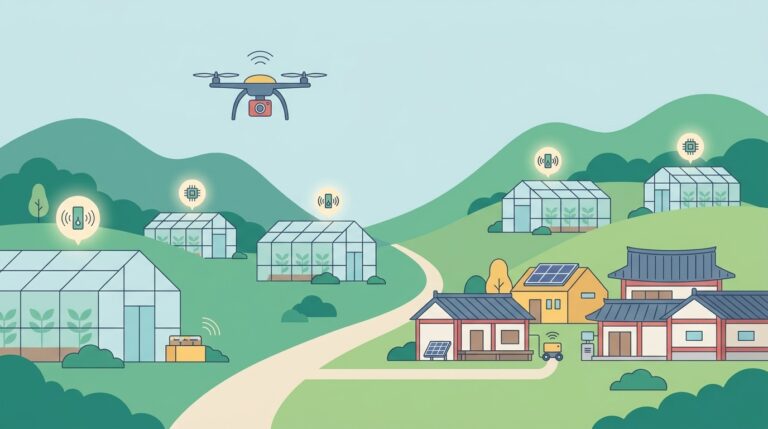
Picture this: You are standing in the middle of an emerald green, picturesque pear orchard in Naju or a tranquil garlic farm in Uiseong. The mist is rising over the hills, resembling a quintessential scene from Little Forest (리틀 포레스트) or Hometown Cha-Cha-Cha (갯마을 차차차). But look closer—overhead, autonomous agricultural drones are calibrating pesticide dispersion via GPS, and inside a nearby vinyl greenhouse, an elderly farmer in his late seventies is monitoring automated nutrient injection through an AI-powered tablet.
Welcome to South Korea’s groundbreaking Smart Village (스마트 빌리지) revolution. As Korea tackles rapid demographic aging and regional revitalization, its rural landscapes are becoming hyper-connected testbeds for GovTech and AgriTech.
For advanced Korean learners (C2 level), professionals, and policy researchers, however, navigating this space presents a unique linguistic hurdle. How do you discuss high-level socio-technical paradigms—like algorithmic farming and elder digital inclusion—without sounding like an aloof academic, while still respecting the deep-seated communal hierarchies of rural Korea?
Drawing from years of coaching foreign regional development specialists and corporate consultants in Korea, this guide unpacks the sophisticated rhetoric, nuanced sociolinguistic registers, and cultural etiquette needed to master the discourse of Korea’s rural digital transformation. Let’s elevate your Korean to the highest professional tier!
Phase 2: Core Expressions Deep Dive (C2 Level)
1. 디지털 격차를 해소하다 (Dijeiteol gyeokchareul haesohada)
- Pronunciation: [디지털 격차를 해소하다] (dee-jee-teol gyeok-cha-reul hae-so-ha-da — sounds like “gyeok” as in “yolk” with a hard ‘g’, and “hae-so” with a smooth breathy release).
- Meaning: Literally “To resolve the digital gap.” Contextually, it refers to systemic policy interventions that provide digital literacy, infrastructure, and device accessibility to marginalized rural demographics.
- K-Culture Moment: Frequently heard in policy documentaries on KBS or during keynote panels at local provincial innovation summits when discussing rural welfare initiatives.
- Editor’s Insight: While beginners use 쉬운 표현 (simple expressions) like “인터넷을 가르쳐 주다” (to teach the internet), a C2 speaker employs 해소하다 (to resolve/dissolve a structural bottleneck) to show command over macro-level socio-economic discourse.
- Situation Spectrum: Casual 🚫 | Semi-formal ⚠️ | Formal/Academic ✅
- 🤔 Think About It: In your native culture, is technological adaptation among seniors viewed primarily as an individual responsibility or as a communal/state-led imperative as in Korea?
2. 스마트 팜 기술을 접목하다 (Seumateu pam gisureul jeommokhada)
- Pronunciation: [스마트 팜 기술을 점모카다] (seu-ma-teu pam gee-sul-eul jeom-mo-ka-da — note the aspiration linking: 접목하다 is pronounced [점모카다]).
- Meaning: Literally “To graft smart farm technology onto [traditional farming].” Nuanced meaning: Harmoniously fusing cutting-edge IoT/AI mechanisms with time-tested agrarian experience.
- K-Culture Moment: Used by young urban returnees (귀농 청년) featured on shows like Docu Prime who revitalize their family’s traditional persimmon or strawberry orchards using automated sensor telemetry.
- Editor’s Insight: The verb 접목하다 (to graft) is a botanical metaphor deeply appreciated in formal Korean discourse when two seemingly disparate concepts (traditional labor + modern algorithms) are unified organically.
- Situation Spectrum: Casual ⚠️ | Semi-formal ✅ | Formal/Professional ✅
- 🤔 Think About It: Why does the Korean language often favor organic, biological metaphors (접목, 자생력) when describing digital infrastructure?
3. 농촌의 자생력을 강화하다 (Nongchoneui jasaengnyeogeul ganghwahada)
- Pronunciation: [농촌의 자생녀글 강화하다] (nong-chon-eui ja-saeng-nyeog-eul gang-hwa-ha-da — observe the nasalization where 력 changes to [녁] after 생).
- Meaning: Literally “To strengthen the rural sector’s self-generating/sustainable power.” In context: Fostering long-term ecological and economic self-reliance through tech rather than temporary government subsidies.
- K-Culture Moment: Found in public sector briefings and administrative proposals addressing the existential crisis of rural depopulation (지방 소멸 위기).
- Editor’s Insight: 자생력 (自生力) captures the philosophical ethos of Korean community resilience (Pumasi and Saemaul Movement roots). Using this word instantly flags you as someone who grasps Korea’s modernization history.
- Situation Spectrum: Casual 🚫 | Semi-formal ⚠️ | Formal/Policy Debate ✅
Phase 3: Textbook Korean vs. Real-World Korean
Scenario 1: Proposing Smart Technology Adoption in Local Villages
- 📖 교과서 한국어 (Textbook Korean):
농촌에 첨단 기술을 도입해야 합니다. (Nongchone cheomdan gisureul doiphaeya hamnida.)
“We must introduce high technology into rural areas.” - 🗣️ 진짜 한국어 (Real-World C2 Korean):
현장 중심의 맞춤형 스마트화를 안착시켜야 합니다. (Hyeonjang jungsimui matchumhyeong seumateuhwareul anchaksikyeoya hamnida.)
“We need to firmly anchor field-centric, tailored smart transformation.” - 💡 왜 다를까? (Why is it different?):
Simply saying 도입하다 sounds like a top-down, bureaucratic decree. Real industry leaders use 현장 중심 (field-centered) and 안착시키다 (to ensure soft landing/settlement) to honor the agency of local farmers.
Scenario 2: Addressing Elderly Technological Hesitancy
- 📖 교과서 한국어 (Textbook Korean):
어르신들이 기계 사용을 어려워합니다. (Eoreosindeuri gigye sayongeul eoryeowohamnida.)
“Elders find using machines difficult.” - 🗣️ 진짜 한국어 (Real-World C2 Korean):
고령층의 디지털 문해력을 제고할 수 있는 포용적 접근이 선행되어야 합니다. (Goryeongcheungui dijeiteol munhaeryeogeul jegohal su inneun poyongjeok jeopgeuni seonhaengdoeeoya hamnida.)
“An inclusive approach aimed at elevating digital literacy among the elderly must precede this.” - 💡 왜 다를까? (Why is it different?):
C2 Korean discourse replaces colloquial deficit-based phrasing with human-centered socio-technical policy terms: 디지털 문해력 제고 (elevating digital literacy) and 디지털 포용 (digital inclusion).
Phase 4: K-Culture Deep Dive & Non-Verbal Manners
4-1. 눈치 (Nunchi) & Non-Verbal Etiquette with Village Elders (이장님)
When presenting smart village solutions or IoT systems in regional Korea, your primary stakeholder is often the 이장님 (Ijang-nim / Village Headman) or the head of the 부녀회 (Women’s Association).
- The Two-Handed Device Presentation: When demonstrating a mobile app or sensor dashboard on a tablet to an elder, hold the tablet with both hands, slightly bowing your head, and position the screen at a comfortable lower angle so they don’t feel intimidated.
- Deference to Tacit Wisdom: Never say “이 기술이 어르신 방식보다 훨씬 효율적입니다” (This tech is much more efficient than your method). This violates agrarian harmony. Instead, frame the algorithm as a supportive tool: “어르신의 오랜 영농 노하우를 데이터로 구현했습니다” (We translated your decades of farming know-how into data).
4-2. Cultural Code: The Evolution from ‘Saemaul’ to ‘Smart Village’
In the 1970s, Korea transformed its rural regions through the Saemaul Undong (New Village Movement), driven by communal labor (근면·자조·협동). Today’s Smart Village Project is the 21st-century digital counterpart. While global views often see smart tech as cold and isolating, Korean rural digitization intentionally incorporates community centers—such as the 스마트 경로당 (Smart Senior Center) equipped with remote healthcare kiosks and VR recreation rooms—maintaining the traditional collectivist safety net (정, Jeong).
Phase 5: Real-World Roleplay Scenario
Setting: A community meeting room inside the Smart Agricultural Technology Center in Yeongcheon, Gyeongsangbuk-do.
Characters:
* Alex (알렉스): Smart Village Global Consultant.
* Village Headman Park (박 이장님): A respected 72-year-old traditional apple orchard farmer who is skeptical yet curious about IoT moisture sensor deployment.
- Turn 1 (박 이장님):
알렉스 씨, 우리 동네 노인네들이 스마트폰 글씨도 잘 안 보이는데, 밭에 센서를 심는다고 농사가 절로 됩니까?
(Alex-ssi, uri dongne noinnedeur-i seumateupon geulssido jal an boineunde, bate senseoreul simneundago nongsa-ga jeollo doemnikka?)
“Mr. Alex, the folks in our village can barely read smartphone screens. Will planting sensors in the field make the crops grow on their own?”
🎭 [팔짱을 끼고 의구심 섞인 표정으로 헛기침을 하며 / Crossing arms with a skeptical gaze, clearing throat] -
Turn 2 (알렉스):
이장님, 염려하시는 바를 충분히 이해합니다. 다만 이번 사업은 농사를 기계에 맡기려는 것이 아니라, 이장님의 수십 년 노하우를 스마트 기기가 보조하도록 설계되었습니다.
(Ijang-nim, yeomryeohasineun bareul chungbunhi ihaehamnida. Daman ibeon sa-eobeun nongsareul gigyee matgiryeoneun geosi anira, ijang-nimui susip nyeon nohaureul seumateu gigiga bojohadorok seolgyedoeeotseumnida.)
“Village Headman, I completely understand your concern. This project isn’t about surrendering farming to machines, but rather designing smart tools to assist your decades of invaluable experience.”
🎭 [두 손을 공손히 모으고 부드러운 미소로 눈을 맞추며 / Clasping hands politely, maintaining warm eye contact] -
Turn 3 (박 이장님):
보조라… 그래도 화면 보고 물 주고 온도 맞추는 게 손에 익을지 걱정이 앞서네.
(Bojora… geuraedo hwamyeon bogo mul jugo ondo matchuneun ge sone igeulji geokjeongi apseone.)
“An assistant, you say… Still, I worry whether checking a screen to water crops and adjust temperatures will ever feel natural to our hands.”
🎭 [턱을 괴고 화면을 물끄러미 바라보며 / Resting chin on hand, gazing curiously at the tablet] -
Turn 4 (알렉스):
그래서 저희가 직관적인 대형 터치 인터페이스와 음성 지원 기능을 탑재하여 진입 장벽을 대폭 낮췄습니다.
(Geuraeseo jeohuiga jikgwanjeogin daehyeong teochi inteopeiseuwa eumseong jiwon gineungeul tapjaehayeo jinip jangbyeog-eul daepok natchwotseumnida.)
“That is precisely why we integrated an intuitive large-scale touch interface and voice recognition to drastically lower the entry barrier.”
🎭 [태블릿을 두 손으로 받쳐 어르신 눈높이에 맞춰 보이며 / Supporting the tablet with both hands, lowering it to the elder’s eye level] -
Turn 5 (박 이장님):
말로 해도 물이 켜진단 말이지? 마을 경로당에서도 다 같이 원격으로 확인할 수 있고?
(Mallo haedo muri kyeojindan mariji? Maeul gyeongnodangeseodo da gachi wongyeogeuro hwag-inhal su itgo?)
“You mean water turns on just by voice? And we can verify it remotely together at the village community center?”
🎭 [눈을 동그랗게 뜨며 태블릿에 손을 뻗어보며 / Eyes widening with curiosity, reaching a finger out toward the screen] -
Turn 6 (알렉스):
네, 맞습니다. 스마트 경로당과 연계하여 공동 모니터링 체계를 구축함으로써 고령층의 영농 부담을 실질적으로 덜어드리고자 합니다.
(Ne, matseumnida. Seumateu gyeongnodanggwa yeon-gyehayeo gongdong moniteoring chegyereul guchukhameurosseo goryeongcheungui yeongnong budameul siljiljeogeuro deoreodeurigojo hamnida.)
“Precisely. By linking this with the Smart Senior Center to build a collective monitoring system, we aim to substantially alleviate the farming burden for elderly residents.”
🎭 [고개를 깊게 끄덕이며 확신에 찬 어조로 / Nodding deeply with an assured, respectful tone] -
Turn 7 (박 이장님):
허허, 세상 참 좋아졌구먼. 우리 동네 젊은 귀농인들하고 합심해서 한번 시범 설치를 해보지 그래.
(Heoheo, sesang cham joajyeotgumeon. Uri dongne jeolmeun gwinong-indeulhago hapsimhaeseo hambeon sibeom seolchireul haeboji geurae.)
“Haha, the world has truly improved. Let’s join forces with the young returnee farmers in our village and try a pilot installation.”
🎭 [호탕하게 웃으며 알렉스의 어깨를 가볍게 두드리며 / Laughing heartily, patting Alex gently on the shoulder] -
Turn 8 (알렉스):
믿고 맡겨주셔서 감사합니다, 이장님. 지역 실정에 부합하는 지속 가능한 모델로 보답하겠습니다.
(Mitgo matgyeojusyeoseo gamsahamnida, ijang-nim. Jiyeok siljeong-e buhap-haneun jisok ganeunghan model-ro bodap-hagetseumnida.)
“Thank you for placing your trust in us, Village Headman. We will deliver a sustainable model tailored specifically to local field realities.”
🎭 [상체를 15도 숙여 정중히 인사하며 / Bowing torso 15 degrees in formal appreciation]
🔀 Interactive Branching Point
If the Village Headman still expressed hesitation at Turn 3, how would you respond?
- Choice A: “이 기술을 쓰지 않으면 다른 마을과의 경쟁에서 뒤처지게 됩니다.” (If you don’t use this tech, you will fall behind other villages.)
- Choice B: “어르신들의 피로도를 줄여드리고, 자녀분들이 객지에서도 안심할 수 있도록 원격 관리를 돕는 시스템입니다.” (It reduces your fatigue and allows your children in the city to feel at ease knowing your farm is managed safely.)
- Choice C: “알고리즘의 오차 범위가 0.1% 미만이므로 걱정하실 필요가 전혀 없습니다.” (The algorithm’s margin of error is under 0.1%, so you don’t need to worry at all.)
Feedback & Strategy Analysis:
* Choice A (Bad/Risk): Creates unnecessary pressure and insults the communal pride of the village. Violates non-confrontational rural etiquette.
* Choice B (Best ✅): Masterful C2 appeal! It bridges modern functionality with traditional filial and family reassurance (효, Hyo).
* Choice C (Technocratic/Dry): Emphasizing technical statistics alienates non-technical elders who value empathy over data precision.
Phase 6: 10-Second Emotional Shadowing Drill
Master the intonation and pauses (/) of sophisticated macro-level discourse.
- Sentence 1:
[💼 당당하고 설득력 있게 / Confidently & Persuasively]
스마트 빌리지의 성패는 / 첨단 기술의 도입 자체가 아니라 / 주민들의 수용성에 달려 있습니다.
(Seumateu billijieui seongpaeneun / cheomdan gisurui doip jachega anira / jumindeurui suyongseonge dallyeo itseumnida.)
“The success or failure of a Smart Village / depends not on the installation of advanced tech itself / but on the receptive buy-in of the local residents.” -
Sentence 2:
[🤝 따뜻하고 공감하며 / Warmly & Empathetically]
어르신들의 소중한 영농 경험에 / 디지털 기술을 덧입혀 / 살기 좋은 농촌을 만들겠습니다.
(Eoreosindeurui sojunghan yeongnong gyeongheome / dijeiteol gisureul deonniphyeo / salgi joeun nongchoneul mandulgetseumnida.)
“By overlaying digital technology / onto the precious farming experience of our elders / we will build a thriving rural community.”
Phase 7: K-Culture Mini Dictionary
- 스마트 경로당 (Smart Gyeongnodang)
Translation: Smart Senior Center.
Usage: Community hubs in rural Korea upgraded with IoT health-check kiosks, metaverse physical therapy, and video communication screens linking distant families. - 귀농귀촌 (Gwinong-Gwichon)
Translation: Returning to farming and rural living.
Usage: A major demographic phenomenon where millennials and retirees leave Seoul to start high-tech agricultural ventures in provincial towns. - 융복합 산업 (Yungbokhap Saneop)
Translation: 6th Industrialization / Integrated Convergence Industry.
Usage: Combining primary agriculture (production), secondary manufacturing (processing), and tertiary services (tourism/smart experience). - 디지털 포용 (Dijeiteol Poyong)
Translation: Digital Inclusion.
Usage: A national policy paradigm ensuring vulnerable groups (seniors, regional farmers) are not alienated by rapid AI and automated transitions.
Phase 8: Field Specialist & Traveler Survival Kit
Top 3 Survival Phrases for Rural Field Research
- 혹시 마을 회관에 공용 와이파이가 지원되나요?
(Hoksi maeul hoegwane gong-yong wai-pa-iga jiwondoenayo?)
“Does the village hall support public Wi-Fi?”
Pro Tip: Essential when setting up IoT field diagnostics in remote valleys. - 어르신, 스마트 기기 다루실 때 불편한 점은 없으세요?
(Eoreosin, seumateu gigi darusil ttae bulpyeonhan jeomeun eopseuseyo?)
“Elder, are there any inconveniences when you operate smart devices?”
Pro Tip: The standard empathetic opening phrase for UX and policy field interviews. - 시범 농가 실증 데이터는 어디서 열람할 수 있습니까?
(Sibeom nongga siljeung deiteoneun eodiseo yeollamhal su itseumnikka?)
“Where can I review the empirical demonstration data for the pilot farms?”
Pro Tip: Highly formal C2 inquiry when collaborating with the Rural Development Administration (농촌진흥청).
Editor’s Field Note
When venturing out to examine Smart Village test sites (like Smart Farm Innovation Valleys in Gimje, Sangju, or Miryang), public transit can be sparse. Make sure to download the 네이버 지도 (Naver Map) 앱 다운로드 to track local 수요응답형 버스 (DRT / Demand-Responsive Transit / 똑버스), which uses dynamic algorithms to pick up rural passengers on demand.
Phase 9: “One Step Deeper” (Thinking Prompt)
At first glance, hyper-individualized automated algorithms might seem to clash with Korea’s ancient collectivist traditions like Pumasi (품앗이, mutual communal labor sharing) and Dure (두레, communal farming collectives). Yet, what makes Korea’s Smart Village model fascinating is that technology is deliberately engineered to revitalize these social bonds rather than dismantle them. When a village elder’s automated greenhouse detects a frost warning, the alert synchronizes with the Smart Village Hall so young tech-savvy neighbors can step in to help.
💬 Your Turn: How does your home country manage the balance between agricultural modernization and the preservation of traditional rural culture? Leave a comment below using the phrase 자생력을 강화하다!
Phase 10: FAQ & Common Pitfalls
Q: Is the term ‘시골’ (Sigol) considered impolite when discussing rural digitalization?
A: In casual conversation with close peers, 시골 (countryside) is affectionate. However, in professional or C2 academic contexts, use 농촌 (Rural/Agrarian area), 지방 (Regions/Provinces), or 지역 사회 (Local community) to maintain professional gravity.
Q: What is the difference between ‘스마트 팜’ (Smart Farm) and ‘스마트 빌리지’ (Smart Village)?
A: A Smart Farm strictly denotes automated agricultural production systems (IoT greenhouses, livestock climate control). A Smart Village encompasses the entire regional ecosystem, including telehealth for senior centers, DRT transit networks, and digital administrative hubs.
Q: How do I address the head of a rural village politely in high-level conversation?
A: Always address them as 이장님 (Ijang-nim) or 부녀회장님 (Bunyeo-hoejang-nim). Never address them simply as 아저씨 or 할아버지 in official or semi-formal working environments.
🚨 흔한 실수 (Common Mistakes) Top 3
- Mistake: Saying “기술을 가르쳐 줘야 합니다” in formal presentations.
- Correct Action: Use “디지털 역량 강화를 도모해야 합니다” (Promote capacity building) or “문해력을 제고해야 합니다”.
- Mistake: Translating “Grafting technology” as “기술을 붙이다”.
- Correct Action: Use the established sociolinguistic metaphor 접목하다 (to graft/fuse).
- Mistake: Demanding rapid answers from village elders using aggressive Palli-Palli speed.
- Correct Action: Respect rural cadence (느림의 미학); allow pauses and provide generous conversational space.
Phase 11: Action Missions
- 🥉 Bronze Mission (Solo Practice): Read Phase 6 Shadowing sentences aloud 5 times, focusing on natural pauses at
/and maintaining polite honorific pitch. - 🥈 Silver Mission (Social Sharing): Write a 2-sentence summary of your view on rural AI adoption on your language journal or social media using 디지털 격차를 해소하다.
- 🥇 Gold Mission (Real-world Implementation): In your next Korean professional meeting or exchange, introduce the concept of 현장 중심의 스마트화 when discussing technology adoption.
- 🎮 K-Culture Mission: Watch an episode of a documentary like KBS Human Theater (인간극장) or Docu Insight set in a rural area, and spot at least two instances where modern mobile technology intersects with traditional rural life.
Phase 12: Interactive Quiz Challenge
1. Situational Decision Quiz
You are delivering a presentation to provincial government officials regarding rural smart healthcare. Which opening sentence demonstrates authentic C2 proficiency?
* (A) 시골 할머니들이 병원 가기 힘드니까 컴퓨터를 놔줘야 합니다.
* (B) 의료 취약 지역의 접근성 한계를 극복하기 위해 스마트 원격 케어 인프라를 확충해야 합니다.
* (C) 최신 IT 기술을 모르면 농촌 주민들이 크게 손해를 봅니다.
2. Fill-in-the-Blank
농촌의 지속 가능한 발전을 위해서는 단순한 자금 지원을 넘어 지역사회의 ( )을/를 강화하는 정책이 필요하다.
(Hint: The innate power of an organism/community to survive and thrive autonomously)
3. True / False Cultural Quiz
- [T / F] The Korean Smart Village initiative focuses exclusively on agricultural automation and does not allocate resources to elder welfare or village community centers.
🔍 정답 및 해설 (Click to Reveal Answers & Detailed Explanations)
- Answer: (B)
- Explanation: Choice (B) utilizes refined high-level sociolinguistic vocabulary (의료 취약 지역, 접근성 한계 극복, 인프라 확충), perfectly suited for C2 administrative and consulting presentations. Choice (A) is overly simplistic, while (C) is condescending.
- Answer: 자생력 (Jasaengnyeok)
- Explanation: 자생력 (Self-sustainability / resilience) is the exact term used to denote self-generating structural vitality in Korean regional economics.
- Answer: False (F)
- Explanation: The core uniqueness of Korea’s Smart Village framework lies in its convergence of AgriTech with social safety nets—exemplified by Smart Gyeongnodang (IoT-enabled community senior centers) and digital health monitoring.
- Explanation: The core uniqueness of Korea’s Smart Village framework lies in its convergence of AgriTech with social safety nets—exemplified by Smart Gyeongnodang (IoT-enabled community senior centers) and digital health monitoring.







