

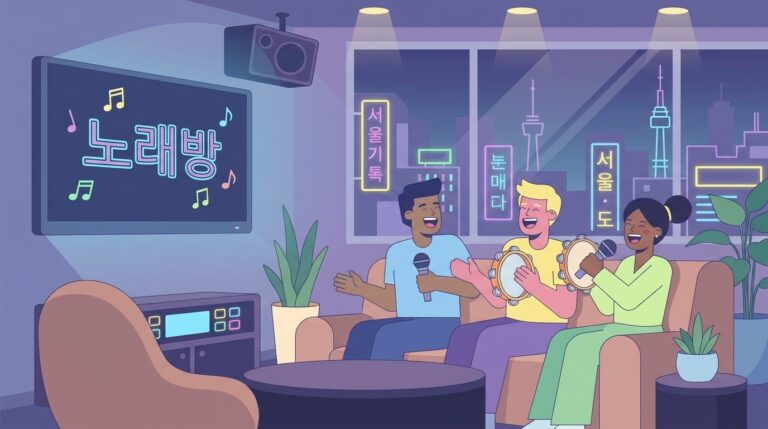
Master Korean Noraebang: The Ultimate Beginner Survival Guide for K-Nightlife
Phase 1: Empathy (Story-Driven Opening)
안녕하세요! 매일한글 에디터입니다. (Hello! I’m your Daily Hangul editor.)
Picture this: It’s 11 PM on a breezy Friday night in Hongdae, Seoul. You’ve just finished a sizzling Korean BBQ feast with your new Korean friends or coworkers. Bellies full of Samgyeopsal, you step out into the dazzling neon streets. Suddenly, someone pumps their fist into the air and shouts, “2차 가자!” (Let’s go for round two!) Before you can even process what round two means, the whole group cheers in unison: “노래방 가자!” (Let’s go to Noraebang!)
Your heart skips a beat. Panic kicks in. “Wait, karaoke? In front of everyone? What if I don’t know any Korean songs? What do I say to the staff? What if I ruin the vibe?”
Take a deep breath—I’ve been in your shoes, and so have thousands of our global learners! Korean Noraebang (노래방, singing room) isn’t an audition for K-Pop Star; it’s Korea’s ultimate social bonding ritual and stress-relief sanctuary. You don’t need vocal perfection; you just need the right cultural cues and a handful of magic A1 phrases. By the end of this guide, you will walk into any Noraebang with absolute confidence, get free bonus time from the owner, and earn cheers from everyone in the room!
Phase 2: Core Expressions Deep Dive
Here are the 3 most essential Korean phrases you need to conquer your first Noraebang experience!
1. 노래방 가자! (Noraebang gaja!)
- Pronunciation: [No-rae-bang ga-ja] (Sound analogy: Think of singing “No-Ray” + “Bang” as in a loud pop, followed by “Gah-Jah” like “Gotcha!”)
- Meaning: Literal: Singing room let’s go! | Actual Nuance: “Let’s hit the karaoke!”
- K-Culture Moment: Heard right after dinner or drinks when the party moves to round two (2차) in every iconic K-Drama squad outing.
- Editor’s Insight: The suffix
-자(-ja) is an informal, friendly “let’s” ending. Use this with friends, classmates, or same-age peers when you want to spark high energy. - Situation Spectrum:
- Casual (Friends): ✅ Perfect
- Semi-formal (Polite): ⚠️ Use 노래방 가요! (Noraebang gayo!)
- Formal (Boss/Elder): 🚫 Use 노래방 가실까요? (Noraebang gasilkkayo?)
- 🤔 Think About It: In many Western cultures, karaoke is a planned event or a brave solo stage. In Korea, suggesting Noraebang is an invitation into a private room to break social boundaries together. How does group singing help people bond in your culture?
2. 서비스 주세요! (Seobiseu juseyo!)
- Pronunciation: [Seo-bi-seu ju-se-yo] (Sound analogy: “Sir-bee-sue” + “Jew-say-yo”)
- Meaning: Literal: Service, please! | Actual Nuance: “Please give us extra bonus minutes for free!”
- K-Culture Moment: When your timer is down to 5 minutes, you tap the front counter intercom or smile at the owner to get an extra 20 to 30 minutes tacked onto your screen.
- Editor’s Insight: In Korea, “Service” (서비스) doesn’t mean customer service—it means a free gift or complimentary item. At a traditional Noraebang, owners almost always grant extra time if you ask politely with a bright smile!
- Situation Spectrum:
- Casual (Direct to owner): ⚠️ A bit too blunt
- Semi-formal (Polite standard): ✅ 서비스 주세요!
- Formal (Ultra polite): ✅ 서비스 조금만 더 주실 수 있나요? (Could you give us a little service?)
- 🤔 Think About It: Korea has a deep cultural concept of Jeong (정, warm affection and generosity). Business owners love giving small freebies to create a warm relationship. Is giving free bonus items common in your hometown?
3. 1절만 불러요! (Il-jeol-man bulleoyo!)
- Pronunciation: [Il-jeol-man bul-leo-yo] (Sound analogy: “Eel-jol-mahn” + “Bool-luh-yo”)
- Meaning: Literal: Sing only verse 1! | Actual Nuance: “Let’s only sing up to the first chorus to save time!”
- K-Culture Moment: When time is running out and ten people still have songs queued up on the remote, everyone agrees to press the cancel button right after verse 1 ends.
- Editor’s Insight: Noraebang time is precious! If someone sings a 6-minute slow ballad all the way to the end, the party mood can dip. Cutting to 1절 (verse 1) lets everyone share the mic.
- Situation Spectrum:
- Casual: ✅ 1절만 하자! (Il-jeol-man haja!)
- Semi-formal: ✅ 1절만 불러요! (Il-jeol-man bulleoyo!)
- Formal: ⚠️ 1절만 부르겠습니다. (I will sing only the first verse.)
- 🤔 Think About It: Group dynamics in Korea value collective enjoyment over individual spotlight. Passing the mic quickly reflects considerate community awareness.
Phase 3: Textbook Korean vs. Real Korean
Don’t sound like an automated robotic translator! Let’s compare stiff textbook lines with what real Koreans say on a night out.
Situation 1: Suggesting karaoke after dinner
- 📖 Textbook Korean: 우리 노래 연습장에 갈까요? (Uri norae yeonseupjange galkkayo? – Shall we go to the singing practice facility?)
- 🗣️ Real Korean: 2차 노래방 콜? (I-cha noraebang kol? – Round two karaoke, you in?)
- 💡 Why is it different? Nobody calls it 노래 연습장 in casual conversation; it’s always 노래방 (or 코노 for coin karaoke). Adding the English slang word 콜 (Call = “I’m down!”) instantly makes you sound like a cool local.
Situation 2: Asking for extra free time
- 📖 Textbook Korean: 무료 시간을 연장해 주시겠습니까? (Muryo siganeul yeonjanghae jusigesseumnikka? – Would you extend free time?)
- 🗣️ Real Korean: 사장님, 서비스 팍팍 주세요! (Sajangnim, seobiseu pak-pak juseyo! – Boss, please give us tons of bonus time!)
- 💡 Why is it different? The onomatopoeia 팍팍 (pak-pak) conveys doing something generously and with full energy. Calling the owner 사장님 (Sajangnim – Boss) establishes friendly rapport.
Phase 4: K-Culture Deep Dive & Non-Verbal Manners
4-1. Nunchi (눈치) & Tambourine Etiquette
- The Tambourine Wingman: When someone else is singing, your hands shouldn’t be idle! Grab the tambourine (탬버린) and tap it along to the beat. This shows active support and high energy.
- Do Not Mic-Hog: Never pick three songs in a row. Add one song, pass the giant remote controller (리모컨) to the person beside you, and wait for your turn.
- The Magic of the Echo: If someone hits a killer high note or struggles halfway through, sing the chorus backup vocals or cheer with “오~!” (Ohhh!) to boost their confidence.
4-2. Coin Noraebang (코노) vs. Traditional Noraebang
- Coin Noraebang (코인 노래방 / Kono): Perfect for 1-2 people. You pay per song (usually 500 to 1,000 KRW for 2-3 songs) or for 30 minutes. It is self-service, quick, and zero pressure.
- Group Noraebang (일반 노래방): Rented by the hour (15,000–30,000 KRW/hr). Comes with plush couches, party lights, tambourines, free snacks, and the holy grail of 서비스 (bonus time)!
Phase 5: Real-World Roleplay Scenario
Setting the Scene
- Location: A neon-lit Noraebang in Hongdae on Friday night.
- Characters:
- Minjun (민준): Your high-energy Korean coworker who lives for karaoke.
- You (A1 Korean Explorer): Ready to sing your favorite song and have fun.
[Turn 1] Minjun: 🎭 (Pushes open the soundproof door and tosses you a tambourine)
"오늘 스트레스 다 풀자! 노래방 가자!"
(Oneul seuteureseu da pulja! Noraebang gaja!)
"Let's blow off all our stress today! Let's go to Noraebang!"

[Turn 2] You: 🎭 (Smiling warmly, catching the tambourine)
"좋아요! 신나요!"
(Joayo! Sinnayo!)
"Sounds good! I'm so excited!"

[Turn 3] Minjun: 🎭 (Hands over the giant remote control)
"먼저 한 곡 골라! 무슨 노래 할래?"
(Meonjeo han gok golla! Museun norae hallae?)
"Pick a song first! What song do you want to sing?"

[Turn 4] You: 🎭 (Typing carefully on the English remote menu)
"BTS 노래 불러요!"
(BTS norae bulleoyo!)
"I'll sing a BTS song!"

[Turn 5] Minjun: 🎭 (Shaking his tambourine vigorously to the intro beat)
"오, 대박! 같이 부르자!"
(O, daebak! Gachi bureuja!)
"Oh, awesome! Let's sing together!"

[Turn 6] You: 🎭 (Finishing verse 1 and laughing)
"1절만 불러요! 다음 사람!"
(Il-jeol-man bulleoyo! Daeum saram!)
"Let's only do verse 1! Next person!"

[Turn 7] Minjun: 🎭 (Checking the timer showing 3 minutes left)
"벌써 시간 끝났네? 아쉽다!"
(Beolsse sigane kkeutnanne? Aswipda!)
"Time is already up? What a pity!"

[Turn 8] You: 🎭 (Pressing the counter intercom with a cheerful tone)
"사장님, 서비스 주세요!"
(Sajangnim, seobiseu juseyo!)
"Boss, please give us bonus time!"
🔀 Interactive Decision Branch
What do you say when someone asks you to sing, but you are super nervous?
- Option A: “노래 싫어요! 절대 안 해요.” (I hate singing! I will never do it.)
- 🚫 Feedback (Bad): Too rigid and abrupt. It dampens the communal party mood instantly.
- Option B: “저 한국 노래 잘 몰라요. 팝송 불러도 돼요?” (I don’t know Korean songs well. May I sing a pop song?)
- 🏆 Feedback (Best): Polite, proactive, and natural. Noraebang machines have thousands of English and global pop songs!
- Option C: “그냥 가만히 있을게요.” (I will just stay still.)
- ⚠️ Feedback (Risk): People might worry that you aren’t having fun and feel uncomfortable.
Phase 6: 10-Second Emotional Shadowing Drill
Practice reading these out loud, pausing at each / mark and infusing the suggested emotion!
[😊 Hyped & Energetic]- 노래방 / 가자! (No-rae-bang / ga-ja!) — “Let’s hit Noraebang!”
[🥺 Cute & Pleading]- 사장님! / 서비스 / 팍팍 / 주세요~ (Sa-jang-nim! / seo-bi-seu / pak-pak / ju-se-yo~) — “Boss! Please give us lots of bonus time~”
[🤝 Considerate & Cheerful]- 우리 / 1절만 / 불러요! (U-ri / il-jeol-man / bul-leo-yo!) — “Let’s just sing the first verse!”
Phase 7: K-Culture Mini Dictionary
- 2차 (I-cha) | Round Two (After-party)
- The second venue of the night, traditionally a Noraebang, pub, or dessert spot after dinner.
- 코노 (Kono) | Coin Noraebang (Short for 코인 노래방)
- Booth-style karaoke rooms where students and solo singers spend pocket change per song.
- 탬버린 (Taembeorin) | Tambourine
- The mandatory rhythm instrument placed in every Korean Noraebang room to hype up the singer.
- 떼창 (Ttechang) | Group Sing-Along / Crowd Chorus
- Singing the chorus together at the top of your lungs. A hallmark of Korean live concerts and Noraebang.
Phase 8: Traveler’s Survival Kit
Top 3 Survival Phrases
- 리모컨 어디 있어요? (Rimokon eodi isseoyo?) — “Where is the remote control?”
- Pro Tip: Look under the songbook or beside the charger stand on the table.
- 마이크 커버 있어요? (Maiku keobeo isseoyo?) — “Do you have microphone covers?”
- Pro Tip: Noraebangs provide hygienic disposable cloth covers at the counter.
- 물 하나 주세요. (Mul hana juseyo.) — “Please give me one bottle of water.”
- Pro Tip: Hydration is key before tackling high-energy K-Pop choruses!
Editor’s Travel Note
- Finding Noraebangs: Search for “노래방” or “코인노래방” directly on the Naver Map App Download to find the highest-rated rooms nearby.
- Brand Navigation: Popular machine brands are TJ Media (태진) and Geumyoung (금영). Press the “국가별 (Country/Language)” button to switch the screen menu to English.
- Payment: Most modern Coin Noraebangs take international credit cards and T-Money cards right inside the booth.
Phase 9: “One Step Deeper” (Cultural Reflection)
In Western individualist contexts, singing solo in front of peers can trigger stage fright. In Korea, however, Noraebang is an equalizer. Corporate hierarchies, age gaps, and formal honorific barriers soften inside that dark room under spinning disco lights. When your boss shakes a tambourine while you sing off-key, you aren’t evaluated on pitch; you are appreciated for your Heung (흥, infectious joy and spirit). It is a sacred space designed to release emotional tension (Han, 한) and build unpretentious human connection.
💬 Your Turn: What song would be your ultimate go-to track if you stepped into a Seoul Noraebang right now? Drop your song title in the comments below!
Phase 10: FAQ & Common Mistakes
Q: Do Korean karaoke rooms have English or international pop songs?
A: Yes! Both TJ Media and Geumyoung machines feature massive international catalogs, including the latest US Billboard hits, British pop classics, Japanese anime OSTs, and Latin tracks. You can search by English song title or artist name.
Q: How do I get free “Service” time at a Noraebang?
A: Keep the room lively, be polite when greeting the counter staff, and avoid leaving right when the timer hits 0. Owners monitoring from the desk often push bonus minutes directly to your screen if they see you having fun!
Q: Can I go to a Noraebang alone in Korea?
A: Absolutely! That is precisely what 코노 (Coin Noraebang) is for. Thousands of locals practice singing alone or blow off work stress for 20 minutes before heading home.
🚨 Common Mistakes Alert
- Mistake: Singing all 5 minutes of a song while everyone else sits silently.
- Correct Action: Keep the room involved or hit 취소 (Cancel) after verse 1 to rotate turns quickly.
- Mistake: Taking off the microphone cover.
- Correct Action: Keep the sanitized cover on the mic for hygiene.
- Mistake: Panicking when the screen displays 0 minutes.
- Correct Action: Wait 30 seconds! The screen often resets to +20분 (20 bonus minutes) automatically.
Phase 11: Action Mission & Engagement
- 🥉 Bronze Mission: Practice saying “노래방 가자!” with high energy in front of your mirror 3 times.
- 🥈 Silver Mission: Save your favorite Korean pop song on Spotify or YouTube and find its Korean title.
- 🥇 Gold Mission: Walk into a local Coin Noraebang or Korean karaoke venue and order a room using “노래방 가요!”
🎮 K-Culture Mission: In your next K-Drama episode, spot the scene where characters head to 2차 (Round 2) and count how many tambourines are being shaken!
Phase 12: Interactive Quiz Challenge
Question 1: Situation Check
You are at a Hongdae Noraebang with friends. The timer shows 2 minutes remaining, but your group wants to sing more. What is the best phrase to say to the front desk?
* A) 마이크 없어요! (Maiku eopseoyo!)
* B) 사장님, 서비스 주세요! (Sajangnim, seobiseu juseyo!)
* C) 1절만 불러요! (Il-jeol-man bulleoyo!)
👉 Click to view the Answer & Explanation
Correct Answer: B) 사장님, 서비스 주세요!
Explanation: 서비스 주세요 is the standard, friendly way to ask for complimentary bonus minutes in Korean nightlife. A means “There is no microphone,” and C means “Let’s sing only verse 1.”
Question 2: Fill in the Blank
Complete the natural spoken Korean phrase to invite a friend to karaoke:
“오늘 밤에 ____ 가자!” (Let’s go to karaoke tonight!)
👉 Click to view the Answer & Explanation
Correct Answer: 노래방 (Noraebang)
Explanation: 노래방 (Singing room) completes the sentence: 오늘 밤에 노래방 가자! (Let’s go to Noraebang tonight!).
Question 3: Cultural True or False
True or False: In Korea, going to a Noraebang alone is considered rude and taboo.
👉 Click to view the Answer & Explanation
Correct Answer: False
Explanation: Solo karaoke in 코노 (코인 노래방) is an extremely popular, socially celebrated way to unwind and practice singing across Korea!







