

Phase 1: Empathy (Story-Immersive Opening)
안녕하세요! 매일한글 에디터입니다. (Hello! This is your Daily Hangul editor.)
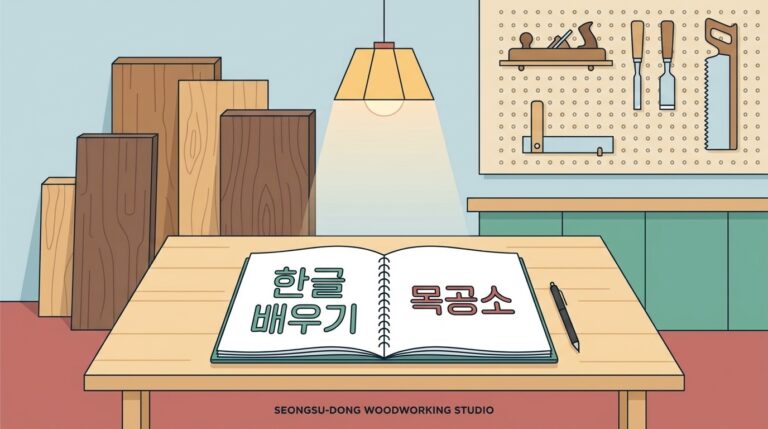
Picture this: You find yourself in a sunlit, aromatic woodworking studio (공방, gongbang) tucked away in the trendy alleys of Seongsu-dong or the historic lumber alleys of Euljiro. You’ve decided to move past flat-pack, particle-board furniture and craft your very own heirloom wooden table. You proudly approach the seasoned master craftsman (공방장님, gongbangjang-nim) and say, “이 나무로 테이블 만들고 싶어요!” (I want to make a table with this wood!).
He squints, rubs the grain with his thumb, and asks you a barrage of questions: “수종은 뭘로 보셨어요? 통원목으로 가실 건가요, 아니면 집성목? 사계절 온습도 변화 때문에 수축 팽창이랑 뒤틀림 감안하셔야 할 텐데…” (What wood species were you looking at? Are you going with live-edge solid slab or finger-joint laminated wood? You’ll need to account for shrinkage, expansion, and warping due to seasonal humidity shifts…)
Suddenly, your standard conversational Korean freezes. Terms like 수종 (wood species), 원목 (solid wood), 뒤틀림 (warping), and 옹이 (wood knot) swirl around you. In Korea, woodworking and timber selection are steeped in specialized terminology, centuries-old traditional joinery philosophy (짜맞춤, jjamatchum), and acute awareness of Korea’s dramatic four-season climate.
This C1-level guide is built directly from interviews with master carpenters and real feedback from international learners navigating Korean timber markets. By mastering these expressions, you will not only choose the perfect timber with professional confidence, but also converse with artisans as an equal, earning instant respect in any studio across Korea.
Phase 2: Core 3 Expressions In-Depth Analysis
1. 원목 특유의 나뭇결과 뒤틀림을 감안하셔야 해요. (Wonmok teugyui namutgyeolgwa dwiteullimeul gamanhasyeoya haeyo.)
- Pronunciation: [Won-mok teu-gyu-ui na-mut-gyeol-gwa dwi-teul-li-meul ga-man-ha-syeo-ya hae-yo] (Think of ‘won-mok’ like ‘one-mork’, and ‘gaman’ like ‘command’ without the ‘d’—gently flowing into a soft advice rhythm.)
- Meaning: Literal: “You must take into account the unique grain and warping inherent to solid wood.” | Actual Nuance: A sophisticated, professional caution reminding a client or fellow crafter that authentic solid timber is an active, “breathing” material prone to climate-induced movement.
- K-Culture Moment: Heard frequently in lifestyle shows like I Live Alone (나 혼자 산다) or home-renovation K-Dramas when celebrities consult high-end custom furniture designers.
- Editor’s Insight: 감안하다 (to factor in / take into account) is a staple C1 verb in design and craftsmanship. Pairing it with 특유의 (inherent / unique to) signals that you understand natural wood imperfections are features, not defects.
- Situation Spectrum: Casual ⚠️ | Semi-formal ✅ | Formal ✅
- 🤔 Think About It: In many Western markets, warping is seen purely as a defect to be engineered away. Why do Korean artisans view seasonal movement (숨 쉬는 나무 – wood that breathes) as a philosophical dialogue between nature and living spaces?
2. 집성목 대신 하드우드 통원목으로 짜 맞추고 싶어요. (Jipseongmok daesin hadeu-wudeu tong-wonmogeuro jja matchugo sipeoyo.)
- Pronunciation: [Jip-seong-mok dae-sin ha-deu-u-deu tong-won-mo-geu-ro jja mat-chu-go si-peo-yo] (Pronounce ‘jja’ with a crisp, tensed double ‘jj’ sound, like ‘tcha’ in matcha.)
- Meaning: Literal: “Instead of glued laminated timber, I want to join-fit it using solid hardwood slabs.” | Actual Nuance: Expresses a clear, elevated aesthetic preference for traditional mortise-and-tenon craftsmanship without hardware or engineered glues.
- K-Culture Moment: Used by woodworking enthusiasts and connoisseurs browsing traditional furniture workshops in Bukchon Hanok Village.
- Editor’s Insight: 집성목 refers to laminated finger-jointed timber, whereas 통원목 refers to a solid slab. Using the compound verb 짜 맞추다 (to join/interlock without nails) demonstrates deep familiarity with high-end woodworking.
- Situation Spectrum: Casual ✅ | Semi-formal ✅ | Formal ✅
- 🤔 Think About It: How does the linguistic choice between 못을 박다 (to drive nails) and 짜 맞추다 (to interlock/join) reflect traditional Korean values of harmony and durability over speed?
3. 수종에 따라 유분과 밀도가 달라서 마감재를 잘 골라야 해요. (Sujonge ttara yubungwa mildoga dallaseo magamjaereul jal gollaya haeyo.)
- Pronunciation: [Su-jong-e tta-ra yu-bun-gwa mil-do-ga dal-la-seo ma-gam-jae-reul jal gol-la-ya hae-yo] (Rhyme ‘su-jong’ softly with ‘soup song’ without the p.)
- Meaning: Literal: “Because oil content and density vary depending on the wood species, you need to select the finishing material carefully.” | Actual Nuance: A technical assertion explaining why one cannot use a single finishing coat (e.g., hardwax oil vs. polyurethane vs. natural lacquer 옻칠) indiscriminately across different woods.
- K-Culture Moment: Common in specialized woodworking YouTube channels (like 목수 토크 / 공방 브이로그) when discussing the finishing stages of walnut, teak, or red pine.
- Editor’s Insight: 수종 (species of tree/wood) is a refined Sino-Korean term far superior to simply saying 나무 종류 (types of trees) in an artisan setting.
- Situation Spectrum: Casual ⚠️ | Semi-formal ✅ | Formal ✅
- 🤔 Think About It: How does recognizing the unique chemical properties (유분, 밀도) of timber mirror the broader Korean conversational etiquette of adapting one’s register according to the listener’s background?
Phase 3: Textbook Korean vs Real Korean
Situation 1: Inquiring About Wood Durability & Scratch Resistance
- 📖 교과서 한국어:
- 이 나무는 단단해서 흠집이 안 나나요?
- (Is this wood hard, so it doesn’t get scratched?)
- 🗣️ 진짜 한국어:
- 소프트우드 계열이라 찍힘이나 스크래치에 취약한 편인가요?
- (So-peut-eu-u-deu gye-yeol-i-ra jjik-him-i-na seu-keu-rae-chi-e chwi-yak-han pyeon-in-ga-yo? / Since this belongs to the softwood category, is it relatively vulnerable to dents and scratches?)
- 💡 왜 다를까?: Native artisans categorize woods instantly into 하드우드 (hardwoods like oak, walnut, ash) and 소프트우드 (softwoods like pine, cedar). Using technical markers like ~계열이라 (belonging to the category of) and 찍힘에 취약하다 (vulnerable to denting) demonstrates C1 technical fluency.
Situation 2: Discussing Seasonal Warping or Moisture Stability
- 📖 교과서 한국어:
- 여름과 겨울에 나무 모양이 변합니까?
- (Does the shape of the wood change in summer and winter?)
- 🗣️ 진짜 한국어:
- 함수율 관리가 안 되면 장마철에 휨 현상이 생기기 쉽지 않나요?
- (Ham-su-yul gwan-ri-ga an doe-myeon jang-ma-cheol-e hwim hyeon-sang-i saeng-gi-gi swip-ji an-na-yo? / If moisture content isn’t properly controlled, isn’t it prone to warping during the monsoon season?)
- 💡 왜 다를까?: In Korea, seasonal humidity variance is extreme. Asking about 함수율 (equilibrium moisture content) and 휨 현상 (warping phenomenon) specifically regarding 장마철 (the summer monsoon season) shows true contextual mastery of Korean woodworking reality.
Phase 4: K-Culture Deep Dive & Non-Verbal Manners
4-1. 눈치 (Nunchi) & Timber Studio Etiquette
When entering a Korean 목공소 (wood mill) or 가구 공방 (furniture studio):
1. The Grain Stroke (결 쓰다듬기): Never tap or knock abruptly on raw solid wood slabs with your knuckles as if testing a hollow door. Instead, gently caress the surface along the grain (나뭇결 방향) with your open palm while keeping a low, admiring posture. This non-verbally signals respect for the raw timber.
2. Inspecting End Grain (마구리면 확인): Experienced woodworkers always inspect the cut ends (마구리면) to examine growth rings and check for heartwood (심재) versus sapwood (변재). Looking at this edge before discussing pricing shows the craftsman that you cannot be easily misled.
3. Acknowledging the Master’s Expertise: When a craftsman mentions “나무가 성질이 좀 있어서…” (This wood has quite a temperamental nature…), nod slowly and respond with “수축 팽창이 심한 수종인가 보네요” (I see, it must be a species with heavy shrinkage and expansion). This validation builds instant rapport.
4-2. Cultural Code Analysis: The Renaissance of “짜맞춤” in Contemporary Korea
In recent years, traditional Korean joinery (짜맞춤) has evolved from an endangered heritage craft into a high-status lifestyle hobby among young Korean professionals seeking mindfulness (힐링). Unlike Western joinery which heavily incorporates dowels, biscuits, and screws, traditional Korean woodworking relies on interlocking mortise-and-tenon joints designed to accommodate the heavy humidity swings of the Korean peninsula without splitting. Understanding 원목의 물성 (the physical properties of solid wood) is considered synonymous with understanding the balance between human habitation and nature.
Phase 5: Real-Life Roleplay Scenario
Setting: Master Kim’s woodworking studio (김 공방장님의 목공방) in Seongsu-dong. Raw timber slabs of White Oak, Walnut, and Hinoki line the walls. Scent of linseed oil and cedar hangs in the air.
Characters:
* 김 공방장 (Master Kim): A veteran craftsman with 30 years of woodworking experience.
* 민우 (Minwoo): A discerning client seeking to build a custom dining table.
Turn 1
* 김 공방장: 어서 오세요! 이번에 맞추실 6인용 식탁, 구상해 두신 수종이 따로 있으십니까?
(Eoseo oseyo! Ibeone matchusil yukin-yong siktak, gusanghae dusin sujongi ttaro isseusimnikka?)
(Welcome! For the 6-seater dining table you plan to commission, do you have a specific wood species in mind?)
🎭 따뜻한 미소를 지으며 원목 슬랩 쪽을 손으로 가리킨다.
Turn 2
* 민우: 네, 처음에는 화이트 오크를 생각했는데요, 월넛 특유의 중후한 색감도 마음에 걸려서 고민 중이에요.
(Ne, cheoeumeneun hwaiteu okeureul saenggakhaenneundeyo, wolneot teugyui junghuhan saekgamdo maeume geollyeoseo gomin jung-ieyo.)
(Yes, initially I thought of White Oak, but the profound, dignified color tone unique to Walnut has also caught my eye, so I’m debating.)
🎭 두 원목 샘플을 번갈아 바라보며 신중하게 손끝으로 결을 만진다.
Turn 3
* 김 공방장: 둘 다 하드우드라 내구성은 탁월하지만, 화이트 오크는 도관이 뚜렷해서 나뭇결이 생생하고, 월넛은 치수 안정성이 뛰어나 변형이 적은 편이죠.
(Dul da hadeu-wudeura naeguseong-eun tagwolhajiman, hwaiteu okeuneun dogwani tturyeothaeseo namutgyeori saengsaenghago, wolneoteun chisu anjeongseong-i ttwieona byeonhyeong-i jeogeun pyeon-ijyo.)
(Both are hardwoods with exceptional durability. However, White Oak has distinct pores creating vivid wood grains, while Walnut boasts superior dimensional stability with minimal warping.)
🎭 대패질 된 오크 단면을 보여주며 결의 차이를 짚어준다.
Turn 4
* 민우: 그렇군요. 저희 집이 겨울철에 난방을 세게 틀어서 건조한 편인데, 통원목 갈라짐이 걱정되네요.
(Geureokunyo. Jeohui jibi gyeoulcheore nanbangeul sege teureoseo geonjohan pyeon-inde, tong-wonmok gallajimi geokjeongdoeneyo.)
(I see. Our home tends to be dry because we turn up the floor heating (Ondol) high in winter, so I’m worried about solid wood cracking.)
🎭 살짝 걱정스러운 표정으로 공방장님을 응시한다.
Turn 5
* 김 공방장: 온돌 난방 환경이라면 집성 방식을 솔리드 집성으로 가시거나, 통원목 하부에 나비장(Chabi-jang)과 보강 철물을 덧대는 구조를 추천합니다.
(Ondol nanbang hwan-gyeong-iramyeon jipseong bangsigeul sollideu jipseong-euro gasigeona, tong-wonmok habue nabijang-gwa bogang cheolmureul deottaeneun gujoreul chucheonhamnida.)
(In an Ondol heating environment, I recommend either solid-strip lamination or reinforcing the bottom of the live-edge slab with butterfly keys and structural hardware.)
🎭 스케치북을 펼쳐 보강 구조 도면을 가볍게 그려 보인다.
Turn 6
* 민우: 역시 그렇군요! 그럼 수축 팽창을 자연스럽게 유도하도록 하부 프레임 결합부에 8자 철물을 써 주실 수 있나요?
(Yeoksi geureokunyo! Geureom suchuk paengchangeul jayeonseureopge yudohadorok habu peureim gyeolhappue palja cheolmureul sseo jusil su innayo?)
(As expected! In that case, could you use figure-8 fasteners on the subframe connections to allow natural expansion and contraction?)
🎭 눈을 반짝이며 구조적 디테일을 정확히 짚는다.
Turn 7
* 김 공방장: 허허, 손님께서 목공의 기본 원리를 아주 정확하게 꿰뚫고 계시네요. 마감은 천연 오일로 결을 살려 드릴까요?
(Heoheo, sonnimkkeseo mokgong-ui gibon wonrireul aju jeonghwakhage kkwetullko gyesineyyo. Magameun cheon-yeon oillo gyeoreul sallyeo deurilkkayo?)
(Haha! You clearly possess a thorough grasp of fundamental woodworking principles. Shall we finish it with natural oil to highlight the raw grain?)
🎭 감탄한 듯 껄껄 웃으며 고개를 끄덕인다.
Turn 8
* 민우: 네, 오일 마감으로 부탁드립니다. 시간이 지나면서 생기는 자연스러운 태닝과 에이징을 즐기고 싶거든요.
(Ne, oil magameuro butakdeurimnida. Sigani jinamyeonseo saenggineun jayeonseureoun taeninggwa eijing-eul jeulgigo sipeogeodeunyo.)
(Yes, please finish with natural oil. I want to savor the natural patina and aging that develops over time.)
🎭 만족스러운 미소를 지으며 주문서에 서명한다.
🔀 Interactive Branching Point
If the master craftsman asks you: “상판에 옹이(Knot)나 크랙이 살짝 들어간 자연스러운 부재를 선호하시나요, 아니면 깔끔하게 선별된 무결점 부재를 원하시나요?”
- Option A: “아무거나 상관없으니 제일 싼 걸로 대충 맞춰 주세요.” (Doesn’t matter, just match whatever is cheapest.)
- 👉 Feedback [BAD]: Dismisses the craftsmanship and insults the artisan’s curatorial pride. This reduces a bespoke commission to cheap commodity haggling.
- Option B: “저는 옹이와 자연스러운 결의 흐름이 살아있는 라이브 엣지(Live Edge) 느낌이 훨씬 매력적인 것 같아요.” (I think a live-edge feel featuring natural knots and grain flow is far more charming.)
- 👉 Feedback [BEST]: Articulates an aesthetic appreciation for timber individuality, inviting the master to choose an expressive, artistic slab for you.
- Option C: “크랙은 무조건 불량 아닌가요? 티끌 하나 없는 완벽한 부재가 아니면 곤란합니다.” (Aren’t cracks unconditionally defective? It would be problematic unless it’s a completely flawless piece.)
- 👉 Feedback [RISK]: While valid for industrial laminates, demanding zero organic variation in solid wood makes you seem unaware of solid timber’s nature, causing tension with boutique artisans.
Phase 6: 10-Second Emotion Shadowing Drill
Practice these natural rhythm pauses (/) along with emotional milestones to sound like an authentic design connoisseur:
- [🪵 차분하고 전문적인 어조 / Calm & Professional]
- “사계절이 뚜렷한 한국 기후 특성상 / 함수율 관리와 수축 팽창을 / 반드시 계산에 넣어야 합니다.”
- (Sagyejeori tturyeothan hanguk gihu teukseongsang / hamsuyul gwanrigwa suchuk paengchangeul / bandeusi gyesane neoeoya hamnida.)
- [✨ 감탄과 미적 안목을 담아 / Expressing Tasteful Admiration]
- “월넛의 심재와 변재가 이루는 대비가 / 참 고풍스럽고 매력적이네요.”
- (Wolneot-ui simjaewa byeonjaega iruneun daebiga / cham gopungseureopgo maeryeokjeogineyo.)
- [🤝 신뢰감 있는 의사결정 / Decisive & Trusting Tone]
- “인공 도료보다는 / 천연 오일 마감으로 / 나무 본연의 숨구멍을 살려 주셨으면 합니다.”
- (Ingong doryobodaneun / cheon-yeon oil magameuro / namu bon-yeon-ui sumgumeong-eul sallyeo jusyeosseumyeon hamnida.)
Phase 7: K-Culture Mini Dictionary (4 Key Terms)
| Term (Hangul + Romanization) | Professional Translation | Practical Industry & Everyday Usage |
|---|---|---|
| 1. 통원목 (Tong-wonmok) | Solid Live-Edge Timber Slab | Refers to unlaminated, single-slab solid wood sliced directly from a tree log. Used when sourcing premium dining tables (우드슬랩) or high-end counters. |
| 2. 수축 팽창 (Suchuk paengchang) | Shrinkage and Expansion | Technical term for timber movement caused by ambient humidity. Crucial when designing joinery tolerances for floor-heated Korean apartments. |
| 3. 짜맞춤 (Jjamatchum) | Traditional Interlocking Joinery | The craft of joining timber pieces using complex mortise-and-tenon interlocking methods without chemical fasteners or metallic nails. |
| 4. 오일 마감 (Oil magam) | Penetrating Natural Oil Finish | Applying linseed, tung, or mineral hardwax oils to penetrate wood vessels (도관) rather than coating it with film-forming polyurethane. |
Phase 8: Survival Kit for DIY Woodworkers & Travelers
Top 3 Survival Expressions
- “재단 치수(mm)대로 정확하게 켜 주실 수 있나요?”
- (Jaedan chisudaero jeonghwakhage kyeo jusil su innayo?)
- Pro Tip: In timber yards (목재소), wood is cut using verbs like 켜다 (to rip cut along the grain) and 자르다 (to cross cut across the grain). Dimensions are strictly in millimeters.
- “샌딩은 몇 방(Grit)까지 마감해 주시나요?”
- (Saending-eun myeot bangkkaji magamhae jusinayo?)
- Pro Tip: In Korean workshops, sandpaper grit rating is referred to with the counter 방 (e.g., 220방, 400방).
- “집성 방식이 핑거조인트인가요, 솔리드인가요?”
- (Jipseong bangsigi ping-geojointeuingayo, sollideuingayo?)
- Pro Tip: Finger-joint laminated wood (핑거조인트 집성목) shows zigzag joint patterns, while solid-strip laminated timber (솔리드 집성목) features clean, uninterrupted lengthwise boards.
Editor’s Travel Note: Navigating Euljiro Timber Street
When sourcing custom wood slabs in Seoul, visit the historic wood and hardware alleys around Euljiro 4-ga Station. Download the Naver Map app for navigating Euljiro timber alleys to locate specialized lumber yards like 동양목재 or hardware specialty stores. Cash or direct bank transfer (계좌이체) is often preferred for custom precision cuts in small-scale timber alleys, though major design studios accept credit cards seamlessly.
Phase 9: “A Step Deeper” (Reflective Cultural Essay)
In traditional Korean architecture and woodwork, timber is never perceived as passive, dead building material. Korean craftsmen view wood as an organic entity that continues to breathe and mature across generations (숨을 쉬며 나이를 먹는 생명체). Instead of obsessing over artificial symmetry or chemically sealing wood against all natural movement, traditional Korean aesthetics embrace subtle warps, knots, and patina as the wood’s genuine life chronicle. This reverence for organic imperfection—deeply rooted in Korea’s heritage—explains why master woodworkers respect a client who honors the timber’s natural movement.
💬 Your Turn: Have you ever worked with solid wood in your home country? How does the philosophy of managing wood movement in your culture compare with Korea’s emphasis on 짜맞춤 and natural adaptation? Share your thoughts in the comments below!
Phase 10: FAQ & Common Mistakes
Q: What is the crucial difference between 원목 (Wonmok) and MDF/PB in Korean furniture shopping?
A: 원목 strictly designates real solid wood (including both single slabs and glued solid-strip laminates). In contrast, MDF (중밀도 섬유판) and PB (파티클보드) are engineered wood composites coated with printed vinyl sheets or veneer (무늬목). If you want authentic timber that ages gracefully, always confirm by asking: “시트지 마감이 아니라 진짜 원목 맞나요?” (Is this genuine solid wood, not a vinyl sheet finish?).
Q: Why do Korean woodworkers emphasize “Ondol” (온돌) resistance when selecting table wood?
A: Korea’s ubiquitous floor heating (온돌, Ondol) creates a microclimate where heat rises directly from the floor, drastically drying out the air during winter. This intense temperature and humidity disparity between the floor and ceiling causes untreated or poorly joined solid wood to cup or crack rapidly. Therefore, timber for Korean interiors must undergo rigorous kiln drying (인공 건조, KD) down to a moisture content of around 8–10%.
Q: How do I politely ask an artisan to adjust their cut without offending their expertise?
A: Use indirect honorific phrasing with the conditional ~해 주실 수 있는지 여쭙다: “공방장님, 혹시 하부 결합 부위를 관통 장부(Through Tenon) 방식으로 변경해 주실 수 있는지 여쭤봐도 될까요?” (Master, may I politely inquire if the lower joint could possibly be adjusted to a through-tenon method?). This frames the request as a collaborative inquiry rather than a critique.
🚨 흔한 실수 (Common Mistakes) Warning Board
- ❌ Mistake 1: Calling all wood “나무” (Namu) when ordering materials.
- 👉 Correct Action: Differentiate the species (수종) using specific terms like 월넛 (Walnut), 화이트 오크 (White Oak), 애쉬/물푸레나무 (Ash), or 소나무/홍송 (Red Pine).
- ❌ Mistake 2: Confusing “합판” (Plywood) with “원목” (Solid Wood).
- 👉 Correct Action: 합판 refers to thin cross-laminated veneer sheets. Solid wood slabs are designated as 통원목 or 원목 판재.
- ❌ Mistake 3: Saying “나무가 부러졌어요” (The wood broke) when referring to seasonal hairline cracks.
- 👉 Correct Action: Use the precise technical term: “나무에 실크랙/갈라짐이 생겼어요” (A hairline crack has formed in the wood).
Phase 11: Action Missions & Community Engagement
- 🥉 Bronze Mission (Solo Practice): Stand in front of a wooden furniture piece in your home. Describe its wood grain (나뭇결), finish (오일/우레탄 마감), and firmness (하드우드/소프트우드) aloud in 3 complete Korean sentences using Phase 6 drills.
- 🥈 Silver Mission (Social Media): Take a photo of your favorite wooden cafe table or DIY project. Post it on Instagram with the caption: “원목 특유의 나뭇결이 참 매력적이다. #매일한글 #목공DIY #원목가구” and tag
@DailyHangul. - 🥇 Gold Mission (Real-World Execution): Visit a local woodworking studio (공방) or timber market. Inquire about their wood species using the phrase: “이 테이블 상판은 어떤 수종의 통원목으로 제작되었나요?”.
- 🎮 K-Culture Mission: Watch an episode of a Korean architectural design show (like 건축탐구 집 on EBS) and listen for how Korean architects describe timber respiration (나무의 호흡 and 뒤틀림 방지).
Phase 12: Interactive Quiz Challenge
Question 1: Situational Judgment
Which sentence is the most natural and culturally adept way to explain to a carpenter that you want to prevent winter cracking caused by floor heating?
* (A) 온돌 때문에 나무가 죽을 수 있으니 플라스틱으로 코팅해 주세요.
* (B) 겨울철 온돌 난방으로 인한 건조를 고려해서, 수축 팽창에 유연한 결합 구조로 부탁드립니다.
* (C) 한국 겨울은 너무 추우니까 나무에 못을 아주 많이 박아 주세요.
Question 2: Fill-in-the-Blank
하드우드인 오크는 _______(이)가 뚜렷하여 자연스러운 나뭇결의 입체감이 살아납니다.
(Hint: The microscopic vascular tubes in wood that transport sap and water.)
Question 3: True or False Cultural Quiz
True or False: In Korean traditional joinery (짜맞춤), hammering metallic nails deep into solid hardwood joints is considered the supreme mark of master craftsmanship.
👉 Click here to reveal answers and explanations!
Answer Key & Explanations
- Question 1 Answer: (B)
- Explanation: Option (B) accurately utilizes advanced C1 terminology (온돌 난방, 수축 팽창, 유연한 결합 구조) while maintaining professional decorum. Option (A) is inaccurate, and Option (C) violates proper solid wood mechanics.
- Question 2 Answer: 도관 (Pores / Vessels)
- Explanation: 도관 (導管, vessels/pores) determine the ring-porous texture (환공재) of hardwoods like oak and ash, providing distinct grain patterns.
- Question 3 Answer: False
- Explanation: Traditional 짜맞춤 relies on precise mortise-and-tenon interlocking designs without a single metallic nail, allowing the timber to expand and contract harmoniously across Korea’s four seasons.







