

Phase 1: Empathy (Story Immersion)
안녕하세요! 매일한글 에디터입니다. (Hello! I am your Daily Hangul editor.)
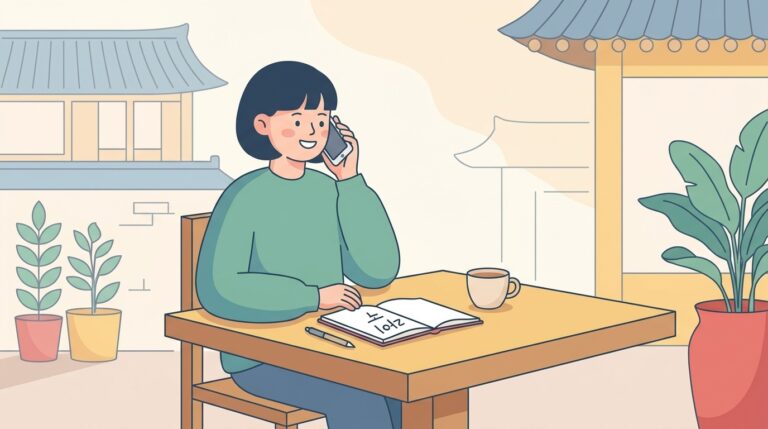
Picture this: You are traveling in Seoul, starving after walking 20,000 steps through Bukchon Hanok Village. You decide to call a famous local fried chicken joint to place a takeout order. Your heart beats fast as you dial the digits. The ringing stops, and a raspy, deep voice answers: “여보세요? 누구세요? (Yeoboseyo? Nuguseyo? – Hello? Who is this?)”
Suddenly, your mind goes completely blank. You realize you typed the wrong area code. You panic, sweat drips down your neck, and before you know it, you just smash the red “end call” button. We have all been there! Hanging up abruptly can make you feel guilty, while lingering in awkward silence is pure agony. Over the past 10 years of coaching Korean learners, I’ve found that mastering just one simple, polite sentence instantly transforms your phone anxiety into effortless confidence. Let’s fix that awkward panic today!
Phase 2: Core 3 Expressions Deep-Dive
1. 죄송합니다, 전화를 잘못 걸었어요. (Joesonghamnida, jeonhwaleul jalmot georeosseoyo.)
- Pronunciation: [Joe-song-ham-ni-da, jeon-hwa-reul jal-mot geo-reo-sseo-yo] (Think of ‘jalmot’ like ‘jahl-mote’ and ‘georeosseoyo’ like ‘guh-ruh-ssuh-yo’)
- Meaning: Literal: “I am sorry, I placed the phone call wrongly.” / Nuance: “I’m so sorry, I have dialed the wrong number.”
- K-Culture Moment: In K-Dramas like Business Proposal, when a main character nervously dials their boss by mistake instead of their best friend, this is the exact polite line whispered before frantically hanging up.
- Editor’s Insight: The word 잘못 (jalmot) means “incorrectly” or “by mistake.” Adding -었어요 (-eosseoyo) puts it in the past tense, politely taking responsibility for the slip-up.
- Situation Spectrum: Casual: ⚠️ (Use ‘미안, 잘못 걸었어’) | Semi-formal: ✅ | Formal: ✅
- 🤔 Think About It: In English, we often say “I think I have the wrong number.” Why do you think Korean directly starts with an apology like 죄송합니다 (Joesonghamnida) before explaining the mistake?
2. 전화 잘못 거셨어요. (Jeonhwa jalmot geosyeosseoyo.)
- Pronunciation: [Jeon-hwa jal-mot geo-syeo-sseo-yo] (Sound tip: ‘geo-syeo’ rhymes with ‘shaw’)
- Meaning: Literal: “You have dialed wrongly.” / Nuance: “You have reached the wrong number.”
- K-Culture Moment: When a stranger calls a K-Drama heroine looking for a mysterious debt collector, she calmly replies with this phrase to clear the misunderstanding.
- Editor’s Insight: The honorific infix -시- (-si-) is embedded in 거셨어요 (geosyeosseoyo). Even though the caller made the mistake, you still honor them respectfully.
- Situation Spectrum: Casual: ⚠️ | Semi-formal: ✅ | Formal: ✅
- 🤔 Think About It: Notice how Korean uses honorifics even when pointing out another person’s mistake on the phone. How does this reflect the Korean emphasis on keeping interpersonal harmony (gibun)?
3. 혹시 … 씨 아니신가요? (Hoksi … ssi anisingayo?)
- Pronunciation: [Hok-si … ssi a-ni-sin-ga-yo] (Say ‘Hok-si’ like ‘hawk-see’)
- Meaning: Literal: “By any chance, are you not Mr./Ms. …?” / Nuance: “Is this not [Name]?”
- K-Culture Moment: Classic romantic comedy scene where the protagonist calls a crush, realizes the voice sounds different, and double-checks who picked up.
- Editor’s Insight: 혹시 (Hoksi) is a magic Korean buffer word meaning “by any chance” or “perchance.” It softens any awkward inquiry instantly.
- Situation Spectrum: Casual: ✅ (with 친구/chingu) | Semi-formal: ✅ | Formal: ✅
- 🤔 Think About It: Adding 혹시 (Hoksi) removes bluntness. What filler or buffer words do you use in your native language when you are unsure?
Phase 3: Textbook Korean vs Real Korean
Situation 1: Realizing you called a stranger
- 📖 교과서 한국어 (Textbook): 제가 실수로 다른 번호에 통화했습니다. (Jega silsuro dareun beonhoe tonghwahaetseumnida. – I have communicated with a different number by mistake.)
- 🗣️ 진짜 한국어 (Real-Life): 아, 죄송합니다! 제가 잘못 걸었어요. (A, joesonghamnida! Jega jalmot georeosseoyo. – Ah, I’m sorry! I dialed the wrong number.)
- 💡 왜 다를까? (Why is it different?): Textbook phrasing uses heavy sino-Korean nouns (통화/tonghwa), whereas real Koreans use the natural exclamation 아 (Ah) and everyday verb 잘못 걸다 (jalmot geolda).
Situation 2: Someone calls you asking for someone else
- 📖 교과서 한국어 (Textbook): 귀하는 번호를 혼동하셨습니다. (Gwihaneun beonhoreul hondonghasyeotseumnida. – You have confused the number.)
- 🗣️ 진짜 한국어 (Real-Life): 저, 전화 잘못 거신 것 같아요. (Jeo, jeonhwa jalmot geosin geot gat-ayo. – Um, I think you might have called the wrong number.)
- 💡 왜 다를까? (Why is it different?): Koreans rarely say “You are wrong” directly. Using ~것 같아요 (~geot gat-ayo / it seems like) softens the correction so nobody loses face.
Phase 4: K-Culture Deep Dive & Non-Verbal Manners
4-1. 눈치 (Nunchi) & Phone Etiquette
Have you ever seen Koreans bowing repeatedly while talking on their smartphones on the subway? Even though the person on the other end cannot see them, physical politeness translates into vocal tone! When you realize you made a wrong call:
1. Do not hang up silently (칼차단 / Kalchadan style). That is considered very rude.
2. Slightly lower your vocal pitch and nod your head slightly as you say “죄송합니다 (Joesonghamnida).” The physical gesture naturally softens your acoustic delivery.
4-2. Cultural Code: The K-Drama “Wrong Number” Trope
In Korean entertainment, misdialed phone numbers are legendary plot devices. From mystery thrillers where a missed call connects two people across timelines, to romance dramas where a drunken dial leads to confession, phone numbers hold emotional weight. Koreans treat phone communication with deep personal warmth, making a swift, polite apology essential when entering someone else’s personal digital space.
Phase 5: Real-Life Role-Play Scenario
Setting: You are trying to call your Guesthouse Host in Hongdae, but accidentally misdialed the last digit and reached Minho, a busy Seoul cafe owner.
- Turn 1 (Minho): 여보세요? 카페 브루입니다. (Yeoboseyo? Kape Beuru-imnida.)
🎭 Answering briskly while steam hisses in the background.
“Hello? This is Cafe Brew.” - Turn 2 (You): 여보세요? 혹시 김민수 사장님 아니세요? (Yeoboseyo? Hoksi Kim Minsu sajangnim aniseyo?)
🎭 Holding phone with both hands, sounding puzzled.
“Hello? By any chance, is this not Manager Kim Minsu?” - Turn 3 (Minho): 네? 아닌데요. 여기 카페인데요. (Ne? Anindeyo. Yeogi kape-indeyo.)
🎭 Checking phone screen with a curious tone.
“Pardon? No it isn’t. This is a cafe.” - Turn 4 (You): 아, 정말 죄송합니다! 제가 전화를 잘못 걸었어요. (A, jeongmal joesonghamnida! Jega jeonhwaleul jalmot georeosseoyo.)
🎭 Quickly bowing your head out of instinct.
“Ah, I am truly sorry! I dialed the wrong number.” - Turn 5 (Minho): 아, 괜찮습니다. 번호 다시 확인해 보세요. (A, gwaenchansseumnida. Beonho dasi hwaginhae boseyo.)
🎭 Speaking in a softer, reassuring tone.
“Ah, it’s completely fine. Please double-check the number.” - Turn 6 (You): 네, 감사합니다. 좋은 하루 보내세요! (Ne, gamsahamnida. Joeun haru bonaeseyo!)
🎭 Smiling brightly into the microphone.
“Yes, thank you. Have a great day!” - Turn 7 (Minho): 네, 들어가세요~ (Ne, deureogaseyo~)
🎭 Ending smoothly with standard Korean polite closing.
“Yes, take care~” - Turn 8 (You): 네! (Ne!)
🎭 Hanging up gracefully without lingering.
“Yes!”
🔀 Interactive Choice Point
What will you say when the other person says “여기는 카페인데요 (This is a cafe)”?
* Option A: “아, 죄송합니다. 잘못 걸었습니다! (Ah, joesonghamnida. Jalmot georeotseumnida!)”
👉 Feedback [Best]: Crisp, crystal clear, respectful, and native-level.
* Option B: “누구세요? (Nuguseyo? / Who are you?)”
👉 Feedback [Bad]: Highly confrontational and blunt since you initiated the call!
* Option C: “그냥 끊을게요. (Geunyang kkeuneulgeyo / I’ll just hang up.)”
👉 Feedback [Risk]: Sounds dismissive and abrupt to Korean ears.
Phase 6: 10-Second Emotion Shadowing Drill
Practice these with natural pause points (/) and dynamic emotion:
[😳 Flustered & Quick]
“아, 죄송합니다! / 제가 번호를 / 잘못 눌렀어요!”
(A, joesonghamnida! / Jega beonhoreul / jalmot nulleosseoyo! – Ah, I’m sorry! / I pressed / the wrong number!)-
[🙏 Polite & Calming]
“전화 / 잘못 거신 것 같아요. / 확인해 보세요~”
(Jeonhwa / jalmot geosin geot gat-ayo. / Hwaginhae boseyo~ – I think / you called the wrong number. / Please check again~) -
[😊 Cheerful & Clean Departure]
“죄송합니다, / 좋은 하루 / 보내세요!”
(Joesonghamnida, / joeun haru / bonaeseyo! – Sorry about that, / have a / wonderful day!)
Phase 7: K-Culture Mini Dictionary
- 통화 (Tonghwa) | Phone conversation/call
Everyday usage: When you can’t talk right now, text: “지금 통화 어려워요 (I can’t talk on the phone right now).” - 잘못 걸다 (Jalmot geolda) | To misdial / call wrongly
Everyday usage: The foundational verb phrase for phone blunders (걸다 = to dial/make a call). - 부재중 전화 (Bujaejung jeonhwa) | Missed call
Everyday usage: You’ll see this notification on your smartphone when a Korean delivery driver tries contacting you. - 끊다 (Kkeunta) | To hang up / disconnect
Everyday usage: Used casually among friends: “나 먼저 끊을게! (I’ll hang up first!)”
Phase 8: Traveler’s Survival Kit
Survival TOP 3 Phrases
- 죄송합니다, 잘못 걸었어요. (Joesonghamnida, jalmot georeosseoyo.)
Pro Tip: Memorize this as a single continuous musical phrase. - 몇 번으로 거셨어요? (Myeot beoneuro geosyeosseoyo?)
Pro Tip: Use this if a stranger keeps calling you insistently. - 다시 걸겠습니다. (Dasi geolgetseumnida.)
Pro Tip: Means “I will call again”—great when the connection is bad.
Editor’s Travel Note
When traveling in South Korea, saving local phone numbers in your contacts using Naver Map search for verified store contact numbers saves you from manual dialing errors. Also, if you need customer support, many companies prefer text inquiries via KakaoTalk channel consultation guides, which eliminates phone call jitters entirely!
Phase 9: “One Step Deeper” (Reflections on Korean Culture)
In Korean culture, the phone line is an intimate extension of physical personal space. Because speech levels reflect social relationships, speaking on the phone with a complete stranger places you in an ambiguous zone. By immediately using formal apologies (죄송합니다) and softening clauses (-것 같아요), Koreans establish mutual safety and prevent discomfort before it even starts.
💬 Your Turn: Have you ever accidentally called or texted the wrong number in Korea or in your hometown? What happened? Share your story in the comments below!
Phase 10: FAQ & Common Mistakes
Q: What should I say before hanging up after a wrong call?
A: Simply add “죄송합니다, 들어가세요 (Joesonghamnida, deureogaseyo)” or “좋은 하루 보내세요 (Joeun haru bonaeseyo)”. It leaves a warm impression even after an error!
Q: What does “들어가세요 (Deureogaseyo)” mean at the end of a phone call?
A: Literally it means “please go inside,” but over the phone, it is the standard, courteous Korean way of saying “Goodbye / Take care.”
Q: Can I just say “미안해요 (Mianhaeyo)” to strangers?
A: To strangers on the phone, 죄송합니다 (Joesonghamnida) is much safer and more polite than 미안해요, which can sound too casual.
🚨 Common Mistakes (흔한 실수)
- ❌ Mistake 1: Abruptly hanging up without saying a word.
👉 Correct Action: Say “아, 잘못 걸었습니다 (Ah, jalmot georeotseumnida)” before hanging up. - ❌ Mistake 2: Saying “누구세요? (Who are you?)” when you made the call.
👉 Correct Action: Ask gently with “혹시 … 맞으신가요? (Is this … ?)”. - ❌ Mistake 3: Using 반말 (informal talk) like “잘못 걸었어” to older people/strangers.
👉 Correct Action: Always keep the polite ending -요 (-yo) or -습니다 (-seumnida).
Phase 11: Action Missions
- 🥉 Bronze Mission (Solo Practice): Record yourself saying “죄송합니다, 전화를 잘못 걸었어요” with a sincere, apologetic tone 3 times.
- 🥈 Silver Mission (Social Connection): Leave a voice note or sentence in our study community using 혹시 (Hoksi) to ask a polite question.
- 🥇 Gold Mission (Real-Life Mastery): The next time someone calls or messages you with a wrong number, reply politely in Korean using “전화 잘못 거셨어요”!
- 🎮 K-Culture Mission: Watch any episode of a contemporary K-Drama (like Crash Landing on You or Hospital Playlist) and spot a character saying “여보세요” or ending with “들어가세요”.
Phase 12: Interactive Quiz Challenge
Question 1: You picked up a phone call from an unknown number asking for “철수 (Cheolsu)”. What is the most natural, polite response?
* (A) 누구세요? (Nuguseyo?)
* (B) 전화 잘못 거셨어요. (Jeonhwa jalmot geosyeosseoyo.)
* (C) 전화하지 마세요. (Jeonhwahaji maseyo.)
👉 Click to reveal Answer & Explanation
Correct Answer: (B)
(A) is too blunt, and (C) means “Don’t call me,” which is overly aggressive. (B) politely notifies the caller that they reached the wrong party!
Question 2: Fill in the blank:
“아, 정말 죄송합니다. 제가 번호를 잘못 ________.” (I dialed/pressed the wrong number)
* (A) 먹었어요 (meogeosseoyo)
* (B) 눌렀어요 (nulleosseoyo)
* (C) 잤어요 (jasseoyo)
👉 Click to reveal Answer & Explanation
Correct Answer: (B) 눌렀어요 (nulleosseoyo)
누르다 means ‘to press’. ‘번호를 잘못 누르다’ means to press/dial the wrong digits.
Question 3: True or False?
In Korea, bowing your head while apologizing on the phone is considered useless since the listener cannot see you.
👉 Click to reveal Answer & Explanation
Correct Answer: False!
Koreans often bow naturally while talking on the phone because body language shapes vocal warmth and sincerity!







