

Phase 1: Empathy (Story-Driven Opening)
안녕하세요! 매일한글 에디터입니다. (Hello! This is your Daily Hangul editor.)
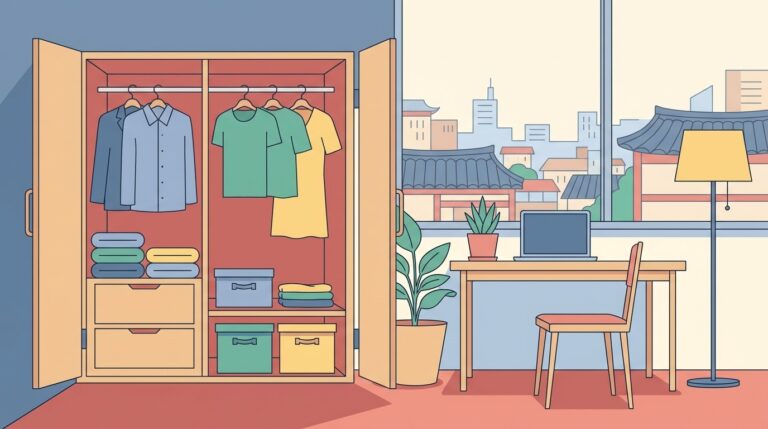
Have you ever stood in front of your closet on a brisk autumn morning in Seoul, surrounded by overflowing winter parkas, oversized knits, and summer linen shirts, feeling completely overwhelmed? You mutter to yourself, “I have a whole wardrobe full of clothes, yet nothing to wear!” This is the exact moment every Korean resident experiences twice a year during hwanjeolgi (환절기 – change of seasons).
Decluttering your closet in Korea isn’t just about tidying up a room; it’s a cultural ritual deeply connected to hyper-seasonal dressing, cozy studio apartment (officetel) living, and the massive local phenomenon of secondhand swapping on Karrot Market (당근마켓). Based on our feedback from hundreds of intermediate learners living in Korea, expressing closet cleanup in Korean often feels clunky because textbook phrases like “나는 옷을 청소합니다” sound robotic and unnatural to native ears. By mastering today’s guide, you’ll learn how natural, conversational Korean captures the exact feeling of refreshing your wardrobe, letting go of unloved items, and chatting like a stylish local insider.
Phase 2: Top 3 Core Expressions Deep Dive
1. 옷장 정리 좀 해야겠어요 (Otjang jeongni jom haeyagess-eoyo)
- Pronunciation: [Ot-jjang jeong-ni jom hae-ya-gess-eo-yo] (Think: “Oat-jahng jung-nee jom hae-yah-gess-uh-yo”)
- Meaning: Literal: “I think I should do a little closet arrangement.” vs Real Nuance: “My wardrobe is a mess / It’s time for a seasonal closet overhaul.”
- K-Culture Moment: You’ll hear this constantly in Korean lifestyle vlogs and K-Dramas when the protagonist stares at a mountain of laundry on their bed before undertaking a massive weekend cleaning spree.
- Editor’s Insight: The word 좀 (jom) softens the sentence so you don’t sound overly aggressive or dramatic, while -아/어야겠어요 (-a/eoyagess-eoyo) expresses a polite personal resolution.
- Situation Spectrum: Casual (옷장 정리 좀 해야겠어) ✅ | Semi-formal (옷장 정리 좀 해야겠어요) ✅ | Formal (옷장 정리를 해야겠습니다) ⚠️
- 🤔 Think About It: In English, we often say “I need to clean out my closet.” Why do you think Korean uses the word 정리 (jeongni – organize/arrange) rather than just 청소 (cheongso – cleaning) when dealing with wardrobes?
2. 안 입는 옷은 버리거나 당근에 팔려고요 (An imneun oseun beorigeona dang-geun-e pallyeogoyo)
- Pronunciation: [An im-neun o-seun beo-ri-geo-na dang-geu-ne pal-lyeo-go-yo] (Think: “Ahn eem-noon oh-soon buh-ree-guh-nah Dahng-goon-eh pahl-lyuh-go-yo”)
- Meaning: Literal: “Clothes I don’t wear, I intend to throw away or sell on Karrot.” vs Real Nuance: “I’m purging unworn clothes by trashing some and listing the good ones on Karrot Market.”
- K-Culture Moment: Seen frequently in variety shows like I Live Alone (나 혼자 산다) where celebrities declutter their homes and take photos of jacket tags to sell them to friendly neighbors.
- Editor’s Insight: 당근에 팔다 (dang-geun-e palda) has become a ubiquitous verb in modern South Korea. Notice how the grammar pattern -거나 (-geona) links two alternative actions naturally without pausing.
- Situation Spectrum: Casual ✅ | Semi-formal ✅ | Formal 🚫
- 🤔 Think About It: Karrot Market (Danggeun) builds community trust by restricting trades to a 6km local radius. How does this shape how Koreans talk about letting go of personal belongings?
3. 계절이 바뀌어서 옷을 싹 바꿨어요 (Gyejeor-i bakkwieoseo oseul ssak bakkweosseoyo)
- Pronunciation: [Gye-jeo-ri ba-kwi-eo-seo o-seul ssak ba-kwo-sseo-yo] (Think: “Gyeh-juhl-ee bah-kwee-uh-suh oh-sul Ssak! bah-kwuh-ssuh-yo”)
- Meaning: Literal: “Because the season changed, I completely swapped my clothes.” vs Real Nuance: “I did a total seasonal wardrobe turnover!”
- K-Culture Moment: A standard Monday morning greeting at Korean offices and university campuses when everyone suddenly appears wearing thick puffer coats instead of trench coats.
- Editor’s Insight: The adverb 싹 (ssak) gives a satisfying punch to the sentence, mimicking the sound and feeling of a clean, complete sweep. It turns a boring factual sentence into a vivid, relatable statement.
- Situation Spectrum: Casual ✅ | Semi-formal ✅ | Formal ⚠️
- 🤔 Think About It: Korea has four distinct, sharp seasons. How does rapid seasonal shift influence the way Koreans view their daily attire compared to your home country?
Phase 3: Textbook Korean vs. Real-Life Korean
Situation 1: Deciding whether to keep or give away an old sweater
- 📖 교과서 한국어 (Textbook): 이 옷은 너무 오래되었으니 쓰레기통에 넣겠습니다. (I will put this clothing into the trash can because it is too old.)
- 🗣️ 진짜 한국어 (Real-Life): 이거 유행도 지났고 안 입은 지 오래돼서 그냥 비우려고요. (Ige yuhangdo jinatgo an ibeun ji oraedwaeseo geunyang biuryeogoyo. – “This is out of style and I haven’t worn it in ages, so I’m just gonna clear it out.”)
- 💡 왜 다를까? (Why the difference?): Native speakers rarely say “put in the trash can.” Instead, using the trendy minimalist verb 비우다 (biuda – to empty/declutter) sounds much more refined and natural.
Situation 2: Asking a friend if they want an item you bought by mistake
- 📖 교과서 한국어 (Textbook): 당신은 이 원피스를 무료로 받고 싶습니까? (Do you want to receive this dress for free?)
- 🗣️ 진짜 한국어 (Real-Life): 사이즈 미스로 한 번도 안 입은 건데, 혹시 너 입을래? 나눔할게! (Saijeu miseuro han beondo an ibeun geonde, hoksi neo ibeullae? Nanumhalge! – “I bought the wrong size and never wore it once—do you want it? I’ll give it to you for free!”)
- 💡 왜 다를까? (Why the difference?): Using 나눔하다 (nanumhada – to share/give away warmly) conveys generosity and camaraderie, whereas textbook literal translation sounds like an awkward commercial transaction.
Phase 4: K-Culture Deep Dive & Non-verbal Manners
4-1. 눈치 (Nunchi) & Gestures: Closet Purging Etiquette
When sorting clothes with a Korean friend, flatmate, or posting online:
* Inspecting Items with Two Hands: If you are offering clothes to a friend or showing an item on video, hold the shoulders or collar with both hands and tilt it gently toward the light. Saying “상태 진짜 깨끗해 (It’s in really clean condition)” while demonstrating respect for the garment shows high nunchi.
* Gentle Rejection Gesture: If a friend offers you clothes you don’t want, don’t say a flat “No.” Cross your palms lightly at chest height, tilt your head, and say: “마음은 고마운데 내 스타일은 아니라 아쉽다!” (Thanks so much for thinking of me, but unfortunately it’s not quite my style!)
4-2. Culture Code: The “Danggeun Fever” and Green Collection Bins
In South Korea, you will see bright green metal boxes on street corners called 의류수거함 (uiryu sugeoham – Clothing Donation/Collection Bins). While convenient, locals follow strict unspoken rules: only clean, reusable clothing, shoes, and blankets go inside (no damaged rags or wet items). Furthermore, Karrot Market has elevated clothing decluttering into a social joy. If you give items away for zero won, you earn Manner Temperature (매너온도) points, turning closet cleaning into a badge of neighborhood goodwill!
Phase 5: Real-Life Roleplay Scenario
- Setting: A sunny Saturday afternoon in an officetel in Hongdae. You and your trendy Korean friend Minji (민지) are surrounded by clothes hangers and storage boxes.
-
Minji: 와, 너 옷장 터지겠다! 이번 주말에 날 잡고 정리하자고 한 거 진짜 잘했다. (Wa, neo otjang teojigetda! Ibeon jumare nal japgo jeongnihajago han geo jinjja jalhaetda. – “Whoa, your closet is about to burst! It was such a great idea to set aside time this weekend to organize it.”)
🎭 Minji pulls a puffy padded jacket from a hanging rack, chuckling.
- You: 맞아요. 봄이 왔는데 아직도 패딩이 걸려 있어서 답답했어요. (Majayo. Bomi wanneunde ajikdo paedangi geollyeo isseoseo dapdaphaesseoyo. – “Right. Spring is here, but padded coats are still hanging, so it felt so suffocating.”)
- Minji: 일단 계절별로 분류부터 하자. 이 트렌치코트는 이번 시즌에 입을 거야? (Ildan gyejeolbyeolloTCPTCP bunryubuteo haja. I teurenchikoteuneun ibeon sijeone ibeul geoya? – “Let’s classify them by season first. Are you going to wear this trench coat this season?”)
- You: 음… 예쁘긴 한데 품이 좀 커서 잘 안 입게 되더라고요. (Eum… yeppeugin hande pumi jom keoseo jal an ipge doedeoragoyo. – “Hmm… it’s pretty, but the fit is a bit too loose, so I end up not wearing it much.”)
- Minji: 그러면 아깝게 두지 말고 당근에 올려봐! 상태 좋은데? (Geureomyeon akkapge duji malgo danggeune ollyeobwa! Sangtae joeunde? – “Then don’t let it go to waste, try listing it on Karrot! The condition is great!”)
🎭 Minji taps on her smartphone screen, demonstrating the camera angle.
- You: 좋은 생각이에요! 만 원에 올리면 금방 팔리겠죠? (Joeun saenggagieyo! Man wone ollymyeon geumbang palligetjyo? – “Great idea! If I list it for 10,000 KRW, it’ll sell quickly, right?”)
- Minji: 완전 꿀템이지! 그리고 저기 늘어난 티셔츠들은 의류수거함에 넣거나 버리자. (Wanjeon kkultemiji! Geurigo jeogi neureonan tisyeocheudeureun uiryusugeohame neotgeona beorija. – “Total bargain gem! And let’s toss those stretched-out T-shirts into the clothing collection bin or trash them.”)
- You: 네! 오늘 안 입는 옷 싹 정리하고 저녁에 맛있는 거 먹어요. (Ne! Oneul an imneun ot ssak jeongnihago jeonyeoge masinneun geo meogeoyo. – “Yes! Let’s completely clear out the unworn clothes today and eat something delicious for dinner.”)
🔀 Interactive Choice Point
Minji hands you a colorful sweater with the tag still attached that you bought on impulse last year. What do you say?
- Option A: “이거 텍도 안 뗀 새 옷인데, 너 어울릴 것 같아. 가질래?” (Ige tekdo an tten sae osinde, neo eoullil geot gata. Gajillae?)
- Option B: “이거 쓰레기니까 그냥 버려줘.” (Ige sseureginikka geunyang beoryeojwo.)
- Option C: “이거 비싸게 샀으니까 너한테 5만 원에 팔게.” (Ige bissage sasseunikka neohante oman wone palge.)
Detailed Feedback:
* Option A (Best): Super natural and friendly! Offering a brand-new item with tags (텍 안 뗀 새 옷) as a warm gift builds immense rapport.
* Option B (Bad): Disrespectful to call a brand-new item “trash” (쓰레기), and asking a friend to throw away your personal clutter is rude.
* Option C (Risk): Trying to push an unwanted impulse purchase onto a close friend for money damages jeong (정 – personal warmth) in casual settings.
Phase 6: 10-Second Emotion Shadowing Drill
Practice matching the cadence, pause slashes (/), and natural emotion of native speakers:
[😮💨 한숨 쉬며 피곤하게 - Sighing with mild overwhelm]- 옷장에 옷은 많은데… / 진짜 입을 옷이 하나도 없네. (Otjange oseun maneunde… / jinjja ibeul osi hanado eomne.)
- “There are so many clothes in the closet… / but I seriously have nothing to wear.”
[✨ 눈을 반짝이며 신나게 - Eyes sparkling with excitement]- 안 입는 옷 / 당근에 올렸더니 / 5분 만에 팔렸어! (An imneun ot / danggeune ollyeotdeoni / obun mane pallyeosseo!)
- “I posted my unworn clothes on Karrot / and they sold in just five minutes!”
[💪 개운하고 결단력 있게 - Refreshing and determined]- 이번 주말에 / 옷장 싹 다 비우고 / 계절 옷 꺼낼 거야. (Ibeon jumare / otjang ssak da biugo / gyejeol ot kkeonael geoya.)
- “This weekend / I’m sweeping out the entire closet / and pulling out my seasonal clothes.”
[🥰 다정하게 배려하며 - Warmly and thoughtfully]- 이거 한 번도 안 입은 옷인데 / 혹시 너 필요해? (Igeo han beondo an ibeun osinde / hoksi neo piryohae?)
- “I’ve never worn this piece once / do you happen to need it?”
Phase 7: K-Culture Mini Dictionary
- 당근마켓 (Danggeun Market – [Dang-geun Ma-ket]) | Karrot Market
- Korea’s favorite GPS-based peer-to-peer marketplace. It is commonly abbreviated as 당근 (Danggeun) and used as a verb: “당근 하실래요?” (Would you like to trade on Karrot?)
- 의류수거함 (Uiryu sugeoham – [Ui-ryu Su-geo-ham]) | Neighborhood Clothing Collection Bin
- Found along residential streets in Korea. Designed for wearable garments, shoes, and bags to be recycled or donated.
- 득템 (Deuktem – [Deuk-tem]) | Great Find / Lucky Bargain
- A blend of Korean Deuk (gain) and English Item. Used whenever you score a fabulous second-hand outfit or vintage coat for cheap.
- 환절기 (Hwanjeolgi – [Hwan-jeol-gi]) | Change of Seasons / In-Between Season
- The fluctuating transition periods between seasons (spring/autumn) when temperature swings prompt nationwide closet turnovers.
Phase 8: Survival Kit for Travelers & Expats
Top 3 Survival Expressions
- 이거 혹시 무료 나눔인가요? (Igeo hoksi muryo nanumingayo?)
- Pronunciation: [Ee-guh hohk-shee moo-ryoh nah-noom-eeng-gah-yoh?]
- Pro Tip: Use this on Karrot Market or local expat groups when checking if a listed wardrobe item is free.
- 종량제 봉투에 담아서 버려야 하나요? (Jongnyangje bongtue damaseo beoryeoya hanayo?)
- Pronunciation: [Jong-nyang-jeh bong-too-eh dah-mah-suh buh-ryuh-yah hah-nah-yoh?]
- Pro Tip: If clothes are stained or unwearable, they must be discarded in government-approved standard waste bags (종량제 봉투).
- 옷 정리용 압축팩 어디에 있어요? (Ot jeongniyong apchukpaek eodie isseoyo?)
- Pronunciation: [Oht jung-nee-yong ahp-chook-pack uh-dee-eh eess-uh-yoh?]
- Pro Tip: Essential for Daiso shopping trips to buy vacuum compression bags for bulky winter padding.
Editor’s Travel Note
- If you are living or studying in Korea, check out the 네이버 지도 앱 다운로드 to locate your nearest Daiso for storage bins, and install the 당근 앱 다운로드 to experience real Korean neighborly exchanges! Remember that bulky items like suitcases or large mattresses require special district disposal stickers (폐기물 스티커).
Phase 9: A Step Deeper (Reflection)
In modern Korea, the rapid turnover of fashion trends (often called Ppallippalli culture meets K-Fashion) creates a fascinating contrast with the traditional virtue of 나눔 (Nanum – sharing). While compact studio apartments require ruthless decluttering, Korean consumers rarely throw quality items in the trash; instead, they circulate them back into the community through neighborhood apps and localized trading. This shift proves that organizing a closet in Seoul is not just personal sanitation—it is an active participation in a warm, circular neighborhood economy.
💬 Your Turn: How do you handle unworn clothes in your home country? Do you use local trading apps like Karrot, or do you prefer donating to thrift shops? Share your thoughts below in Korean using ~하거나 (~geona)!
Phase 10: FAQ & Avoiding Misunderstandings
Q: Can I put shoes and bags into the green street bins (의류수거함)?
A: Yes! You can put wearable pairs of shoes (tied together so they don’t separate), bags, and blankets into the 의류수거함. However, you must not put pillows, duvets (som-ibul), wheel-attached luggage, or severely damaged clothes inside.
Q: What is the difference between 옷을 정리하다 and 옷을 청소하다?
A: In Korean, clothes are objects of organization (정리 – jeongni), not sweeping/scrubbing (청소 – cheongso). Saying “옷을 청소하다” sounds like you are cleaning the fabric with a mop! Always use 옷장/옷을 정리하다 for organizing.
Q: How do I politely haggle when selling or buying clothes on Karrot?
A: To ask for a gentle discount, say: “혹시 조금 네고(할인) 가능할까요?” (Hoksi jogeum nego ganeunghalkkayo?). If you want to state firm pricing, write: “네고 문의는 정중히 사양합니다.” (Price negotiation inquiries are politely declined.)
🚨 Common Mistakes TOP 3
- Mistake: Saying “옷을 버리러 가요” when taking good clothes to a friend.
- Correction: Use “옷 나눔하러 가요” (Ot nanumhareo gayo) to show care and generosity.
- Mistake: Confusing 갈아입다 (gara-ipda – change clothes on body) with 정리하다 (jeongnihada – sort out closet).
- Correction: Use 옷을 갈아입다 when changing your outfit, and 계절 옷을 바꾸다/정리하다 when switching your seasonal wardrobe.
- Mistake: Calling second-hand trading “쓰레기 판매” (selling garbage).
- Correction: Always use “중고 거래” (Junggo georae – second-hand trade) or “당근 거래”.
Phase 11: Action Missions & Engagement
- 🥉 Bronze Mission (Solo Shadowing): Stand before your closet and recite aloud: “계절이 바뀌었으니까 이번 주말에 옷장 싹 정리해야겠어요!”
- 🥈 Silver Mission (SNS Snap): Take a photo of one clothing item you want to declutter and post a story with the caption: “사이즈 미스로 나눔합니다! #옷장정리 #당근”
- 🥇 Gold Mission (Live Interaction): If you are in Korea, open Karrot Market or an expat forum and search for “옷장 정리” or “무료 나눔” to see how real Seoulites describe clothing conditions!
🎮 K-Culture Mission: Watch any modern K-Drama or variety show clip where characters move houses or clean up for spring. Listen closely for the word “싹 (ssak)” or “버리다 (beorida)”!
Phase 12: Interactive Quiz Challenge
1. Situational Judgment:
You want to tell your coworker that you packed away all your winter clothes and brought out your summer dresses because of the warm weather. What is the most natural B1 sentence?
* (A) 옷을 쓰레기통에 다 넣었어요.
* (B) 날씨가 더워져서 여름 옷으로 싹 바꿨어요.
* (C) 옷장을 청소해서 옷이 하나도 없어요.
2. Fill in the Blank:
안 입는 옷은 친구에게 주_______ 당근마켓에 팔 거예요. (I will give unworn clothes to a friend OR sell them on Karrot.)
* (A) -거나 (-geona)
* (B) -지만 (-jiman)
* (C) -는데 (-neunde)
3. Cultural True/False:
True or False: In Korea, you can throw ripped pillows, mattresses, and blankets all together into the neighborhood green clothing bin (의류수거함).
👉 Click here to check the answers & explanations!
- Answer: (B)
- Explanation: 여름 옷으로 싹 바꿨어요 expresses the total seasonal turnover naturally with vivid intermediate phrasing.
- Answer: (A) -거나
- Explanation: The connective suffix -거나 (-geona) is used with verbs to list alternate options (Give to friend OR sell).
- Answer: False
- Explanation: Pillows and large bedding with thick batting must not be placed in the 의류수거함; they require standard volume-rate garbage bags or large waste stickers.
- Explanation: Pillows and large bedding with thick batting must not be placed in the 의류수거함; they require standard volume-rate garbage bags or large waste stickers.







