

Phase 1: Empathy (Story-Driven Opening)
안녕하세요! 매일한글 에디터입니다.
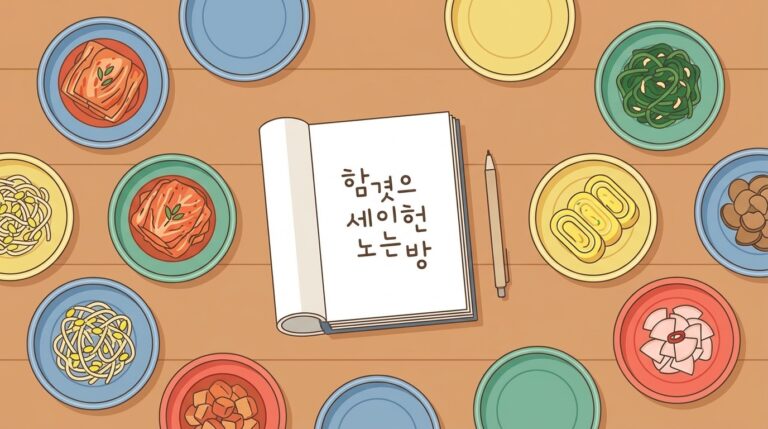
Picture this: You are seated in a lively, sizzling Korean BBQ spot in Euljiro, Seoul. Within minutes of ordering, your table transforms into a vibrant mosaic of small ceramic dishes—crunchy fermented kimchi, glossy sweet-and-salty glazed fish cakes (eomuk-bokkeum), seasoned spinach, and a fluffy rolled omelet (gyeran-mari). You take a bite of the fish cakes, and before your grilled pork belly is even half-cooked, the little bowl is completely empty.
You desperately want more, but you suddenly freeze. Is banchan really free in Korea? If I ask for more, will they look at me like I am taking advantage of them? How on earth do I ask without sounding rude or demanding?
If you have ever stared awkwardly at an empty side dish wondering whether you should wave down the server or just stay quiet, you are definitely not alone! Navigating the legendary Korean “unlimited banchan refill” culture is one of the biggest culture shocks and psychological hurdles for intermediate learners. In this guide, backed by real-world dining scenarios and native linguistic nuances, you will learn the exact phrases, cultural tact (nunchi), and insider etiquette to enjoy side dishes like a true local.
Phase 2: 3 Core Expressions in Deep Context
1. 이모님, 이 반찬 리필 좀 부탁드려요.
- Pronunciation: Imo-nim, i banchan ripil jom butakdeuryeoyo. (Sounds like: “Ee-mo-neem, ee bahn-chahn ree-peel johm boo-tahk-deu-ryeo-yo”)
- Meaning: Literal: “Auntie, please do a refill of this side dish.” / Actual Nuance: A warm, respectful, and endearing request for a side dish refill in casual and neighborhood restaurants.
- K-Culture Moment: You will hear this exact phrasing in slice-of-life K-Dramas like Hospital Playlist or Reply 1988 whenever characters bond over comforting neighborhood meals.
- Editor’s Insight: Calling a female restaurant manager or server Imonim (maternal aunt) instantly establishes warmth. However, reserve this for casual, traditional eateries; in chic modern bistros, stick to Jeogiyo (저기요) or Sajangnim (사장님).
- Situation Spectrum: Casual (✅) / Semi-formal (✅) / Formal (🚫)
- 🤔 Think About It: Why does Korean society use familial terms like “Aunt” (Imo) to address complete strangers in hospitality settings?
2. 혹시 반찬 셀프 코너가 따로 있나요?
- Pronunciation: Hoksi banchan selpeu koneoga ttaro innayo? (Sounds like: “Hohk-shee bahn-chahn sell-peu koh-neo-gah ddah-ro een-nah-yo?”)
- Meaning: Literal: “By any chance, is there a separate self-service side dish corner?” / Actual Nuance: Politely checking whether you should serve yourself instead of making the staff run back and forth.
- K-Culture Moment: In popular Korean YouTube food vlogs, foodies always scan the room for the Selpeu Bar (셀프 바) to grab extra pickled radishes without interrupting busy rush hours.
- Editor’s Insight: Starting with Hoksi (혹시 – By any chance) instantly softens your inquiry and shows high Nunchi (social intuition). Staff love customers who ask this before waving frantically.
- Situation Spectrum: Casual (✅) / Semi-formal (✅) / Formal (⚠️)
- 🤔 Think About It: How does self-service banchan reflect modern Korea’s balance between speedy efficiency (Ppalli-ppalli) and endless hospitality?
3. 이거 너무 맛있어서 그런데 조금만 더 주실 수 있나요?
- Pronunciation: Igeo neomu masisseoseo geureonde jogeumman deo jusil su innayo? (Sounds like: “Ee-geo neo-moo mah-shee-ssuh-suh geu-reon-day joh-geum-mahn duh joo-sheel soo een-nah-yo?”)
- Meaning: Literal: “This is so delicious, so could you give me just a little bit more?” / Actual Nuance: A charming, highly effective compliment-request hybrid that guarantees a generous refill.
- K-Culture Moment: In variety shows like Baek Jong-won’s Alley Restaurant, guests praise homemade seasonal side dishes with this phrase, instantly putting a proud smile on the cook’s face.
- Editor’s Insight: The word Jogeumman (조금만 – just a little) is a cultural humble modifier. Asking for “just a little” demonstrates modesty, which ironically motivates the owner to give you a mountain of food.
- Situation Spectrum: Casual (✅) / Semi-formal (✅) / Formal (✅)
- 🤔 Think About It: In English dining, we often state direct requests (“Could we get more bread?”). Why does Korean culture wrap requests inside compliments and minimizing words?
Phase 3: Textbook Korean vs. Real Korean
Situation 1: Asking for more side dishes at your table
- 📖 교과서 한국어 (Textbook): 반찬을 더 주십시오. (Banchan-eul deo jusipsio. – “Give more side dishes.”)
- 🗣️ 진짜 한국어 (Real-world): 사장님, 김치 조금만 더 갖다주세요~ (Sajangnim, gimchi jogeumman deo gatdajuseyo~ – “Boss, could we please have a little more kimchi~?”)
- 💡 왜 다를까? (Why the difference?): Textbook imperative endings like -sipsio sound stiff, cold, and authoritarian. In real life, native speakers specify the exact banchan name, address the owner kindly as Sajangnim, and soften the sentence with Jogeumman and a sing-song -juseyo.
Situation 2: Checking if side dishes are complimentary
- 📖 교과서 한국어 (Textbook): 이 반찬은 무료입니까? (I banchan-eun muryo-imnikka? – “Is this side dish free of charge?”)
- 🗣️ 진짜 한국어 (Real-world): 이거 리필 되는 거예요? (Igeo ripil doeneun geoyeyo? – “Is this item refillable?”)
- 💡 왜 다를까? (Why the difference?): The term Muryo (무료) feels overly formal and transactional, like a legal disclaimer. Everyday Koreans use the loanword Ripil (리필 – refill) to naturally check whether a specific side dish can be topped up.
Phase 4: K-Culture Deep Dive & Non-Verbal Manners
4-1. 눈치 (Nunchi) & Dining Table Body Language
- The Subtle Bowl Lift: When asking a passing server for a refill, slightly lift the empty dish with both hands or gesture toward it gently. This avoids loud shouting and prevents miscommunication.
- Scan the Room for Signboards: Before calling someone over, look around the walls. If you spot signs saying “추가 반찬은 셀프입니다” (Additional side dishes are self-service) or “드실 만큼만 적당히” (Take only what you can eat), walk to the stainless steel counter with your plate.
- Two-Handed Acceptance: When the server brings your freshly filled dish, hold or steady the plate with both hands and nod slightly while saying Gamsahamnida (감사합니다).
4-2. Cultural Code: Jeong (정) & The Banchan Philosophy
In Western gastronomy, side dishes are often secondary à la carte additions billed separately. In Korea, side dishes are an extension of Jeong (정)—a deep-seated collective affection and generous hospitality rooted in Korea’s agricultural history. A table without abundant banchan is traditionally seen as inhospitable. Refills are not treated as a loss of profit by restaurant owners; rather, asking for a refill is proof that you genuinely love the cook’s handiwork (Son-mat).
Phase 5: Real-World Roleplay Scenario
- Setting: “Halmeoni’s Sundubu Jjigae” (Grandmother’s Soft Tofu Stew), a bustling eatery in Jongno, Seoul. The rich scent of sesame oil and bubbling spicy stew fills the air.
- Character: Imo Sun-hee (50s, energetic, hospitable restaurant owner).
-
[Turn 1] Learner: 저기요, 사장님! 주문한 찌개 나왔는데 너무 맛있어요!
(Jeogiyo, sajangnim! Jumunhan jjigae nawanneunde neomu masisseoyo! / “Excuse me, boss! The stew just came out and it is delicious!”)
🎭 Smiling brightly while giving a small nod toward the stew -
[Turn 2] Imo Sun-hee: 아이고, 입맛에 맞는다니 다행이네! 밥 모자라면 편하게 말해요~
(Aigo, immase manneundani dahaengine! Bap mojaramyeon pyeonhage malhaeyo~ / “Oh my, I am so glad it suits your taste! Let me know if you need more rice!”)
🎭 Wiping her hands on her apron with a hearty laugh -
[Turn 3] Learner: 혹시 이 어묵볶음 너무 맛있어서 그런데, 조금만 더 주실 수 있나요?
(Hoksi i eomuk-bokkeum neomu masisseoseo geureonde, jogeumman deo jusil su innayo? / “By any chance, this stir-fried fish cake is so good, could we have a little more?”)
🎭 Holding the empty ceramic plate gently with both hands -
[Turn 4] Imo Sun-hee: 당연하지! 우리 집 어묵은 매일 아침 내가 직접 볶아서 인기 최고야. 바로 갖다줄게.
(Dangyeonhaji! Uri jip eomug-eun maeil achim naega jikjeop bokkaseo ingi choegoya. Baro gatdajulge. / “Of course! I stir-fry our fish cakes myself every morning; they are our top hit. Coming right up!”)
🎭 Taking the dish cheerfully -
[Turn 5] Learner: 감사합니다! 그런데 혹시 다른 반찬은 셀프 코너에서 가져오면 되나요?
(Gamsahamnida! Geurende hoksi dareun banchan-eun selpeu koneo-eseo gajyeoomyeon doenayo? / “Thank you! By the way, should I get other side dishes from the self corner?”)
🎭 Looking over politely toward the side station -
[Turn 6] Imo Sun-hee: 깍두기랑 콩나물은 저기 셀프 바에 가득 있으니까 마음껏 갖다 먹어!
(Kkakdugirang kongnamur-eun jeogi selpeu ba-e gadeuk isseunikka maeumkkeot gatda meogeo! / “The radish kimchi and bean sprouts are plenty at the self-bar over there, so eat as much as you like!”)
🎭 Pointing toward the stainless-steel side dish bar -
[Turn 7] Learner: 네! 먹을 만큼만 딱 덜어 올게요.
(Ne! Meogeul mankeumman ttak deoreo olgeyo. / “Got it! I will take just the amount I can finish.”)
🎭 Standing up with a respectful smile -
[Turn 8] Imo Sun-hee: 어쩜 말도 예쁘게 하네! 천천히 맛있게 먹고 가요~
(Eojjeom maldo yeppeuge hane! Cheoncheonhi masitge meokgo gayo~ / “My goodness, you speak so delightfully! Take your time and enjoy your meal~”)
🎭 Giving a motherly thumbs-up and placing a piled-high dish of fish cakes on the table
🔀 Interactive Decision Branch
What would you say if the restaurant is packed and the owner looks super busy?
- Choice A: “사장님! 여기 반찬 5접시 한꺼번에 더 가져오세요!” (Shouting for 5 plates of refills at once.)
- ❌ Bad: Demanding large quantities loudly disrupts service and violates banchan etiquette.
- Choice B: “이모님, 저기 셀프 코너 이용해도 될까요? 먹을 만큼만 담아올게요.” (Asking if you can use the self-bar.)
- 🏆 Best: Considerate, polite, and demonstrates that you understand the “eat what you take” rule.
- Choice C: Sitting silently and staring at the empty bowl for 20 minutes, hoping someone notices telepathically.
- ⚠️ Risk: You leave unsatisfied, and the restaurant staff might worry you didn’t enjoy your meal!
Phase 6: 10-Second Emotion Shadowing Drill
Practice matching the exact rhythm and emotional tone using the slash marks (/) for breath pauses:
[😊 Cheerful & Flattering]- “사장님 / 이거 너무 맛있어서 그런데 / 조금만 더 주실 수 있나요? /”
- (Sajangnim / igeo neomu masisseoseo geureonde / jogeumman deo jusil su innayo?)
[👀 Observant & Respectful]- “혹시 / 반찬 추가는 / 셀프 코너를 이용하면 될까요? /”
- (Hoksi / banchan chuganeun / selpeu koneoreul iyonghamyeon doelkkayo?)
[🙏 Heartfelt & Polite]- “감사합니다! / 남기지 않고 / 맛있게 다 먹겠습니다! /”
- (Gamsahamnida! / namgiji anko / masitge da meokgetseumnida!)
Phase 7: K-Culture Mini Dictionary
- 무한 리필 (Muhan Ripil) | Unlimited Refills / All-You-Can-Eat
- Common in BBQ spots and traditional dining. Unlike standard buffets, Muhan Ripil refers to endless refills of a specific dish or side dish.
- 셀프 바 / 셀프 코너 (Selpeu Ba / Selpeu Koneo) | Self-Service Station
- The stainless-steel buffet bar where diners freely refill basic condiments, garlic, ssamjang, and side dishes.
- 밑반찬 (Mit-banchan) | Basic Staple Side Dishes
- Everyday, long-lasting banchan (like pickled radishes, salted seafood, seasoned beans) prepared in advance to anchor a meal.
- 손맛 (Son-mat) | Hand-Taste (Culinary Soul / Intuitive Cooking Skill)
- The unique, heartfelt flavor a cook imparts through their hands and seasoning instincts rather than standardized measuring spoons.
Phase 8: Traveler Survival Kit
Survival Expressions Top 3
- 반찬 좀 더 주세요. (Banchan jom deo juseyo. – “Please give us some more side dishes.”)
- Pro Tip: Make eye contact, smile, and slightly tilt the empty plate to specify which dish you want.
- 셀프예요? (Selpeuyeyo? – “Is this self-service?”)
- Pro Tip: Perfect short phrase when you see a counter with tongs and bowls but aren’t 100% sure.
- 김치 진짜 시원하고 맛있어요! (Gimchi jinjja siwonhago masisseoyo! – “The kimchi is truly refreshing and delicious!”)
- Pro Tip: Calling kimchi Siwonhada (refreshing/crisp) is the ultimate native compliment to a Korean chef.
Editor’s Travel Note
- Finding Generous Local Spots: Open your navigation app and search for 백반 맛집 (Baekban Matjib). Baekban refers to home-style set meals famous for serving 6–12 fresh banchan varieties for under 10,000 KRW. Check out authentic local reviews via the 네이버 지도 앱 다운로드 to find hidden neighborhood gems.
- Settling the Bill: In Korea, you never pay at the dining table. When finished, walk up to the register near the front door to pay.
Phase 9: “A Step Deeper” (Cultural Humanities Essay)
The Korean banchan system is far more than a commercial gimmick offering “free food”; it is a living cultural artifact of communal solidarity (Dure and Pumasi). In historic agrarian Korea, sharing seasonal harvests across village tables cemented survival and mutual trust. When an elder or restaurant owner heaps extra food onto your table, they are extending an invitation to belong. Asking for a banchan refill with gratitude is not considered greedy—it is an active participation in an enduring social dance of reciprocal care.
💬 Your Turn: What is the dining refill etiquette in your home country? Would asking for free side dishes be considered strange or completely normal? Share your cultural perspective in the comments below!
Phase 10: FAQ & Common Mistakes
Q: Are all side dishes in Korean restaurants refillable for free?
A: The vast majority of everyday banchan (kimchi, seasoned bean sprouts, pickled radishes, fish cakes) are 100% free and refillable. However, high-cost luxury side dishes—such as raw marinated crab (ganjang-gejang), whole fried fish, or large meat dishes (tteokgalbi)—usually incur an additional charge for extra orders. If an item has a designated re-order price on the wall menu, it is not free.
Q: How many times can I politely ask for a banchan refill?
A: Asking 1 to 2 times per side dish is completely standard and warmly welcomed. While there is no legal limit, asking 4–5 times for labor-intensive side dishes without ordering more main food can strain hospitality. As long as you finish everything you take without leaving food waste, 2 refills are the sweet spot!
Q: What does “드실 만큼만 적당히” mean at the self-bar?
A: It translates to “Please take only a suitable amount that you will eat.” Because banchan is offered generously for free, leaving massive mounds of uneaten side dishes is considered disrespectful and environmentally irresponsible.
🚨 Common Mistakes Alert
- Calling Staff with “Yah!” (야!): Never yell “Yah!” or snap your fingers. Use the tabletop call button (Ding-dong) or say Jeogiyo (저기요) softly with a raised hand.
- Piling Mountains at the Self-Bar: Avoid taking massive portions right away. Take small helpings and go back multiple times.
- Asking to Pack Free Banchan To-Go: Free banchan is strictly for dine-in consumption. Asking staff to pack leftover free side dishes into takeout boxes is considered poor etiquette.
Phase 11: Action Missions
- 🥉 Bronze Mission (Solo Drill): Stand in front of a mirror and practice saying “이모님, 김치 조금만 더 갖다주세요~” with a warm smile 3 times.
- 🥈 Silver Mission (Social Sharing): Snap a photo of a Korean table spread and share it on Instagram or Threads with the tags #밑반찬 (Mitbanchan) and #무한리필 (Muhanripil).
- 🥇 Gold Mission (Real-Life Test): Visit an authentic Korean restaurant, locate the self-bar or use your new refill phrase with the staff, and finish your meal clean!
- 🎮 K-Culture Media Mission: Watch an episode of a foodie K-drama like Let’s Eat or Itaewon Class and spot how characters interact with side dishes and call buttons!
Phase 12: Interactive Quiz Challenge
Test your mastery of Korean banchan culture! Click each question to reveal the correct answer and detailed explanation.
Q1. Situation Judgment: You finished your favorite side dish, but the restaurant is very busy. What should you do first?
👉 Click to view the correct answer and feedback!
- Correct Action: First, look around the dining hall for a “Self Bar” (Selpeu Bar) or sign indicating “추가 반찬은 셀프”. If there is a self-bar, take your plate and serve yourself. If not, press the call button or catch a server’s eye politely using “저기요, 사장님!”
- Explanation: Checking for self-service before calling busy staff shows great Nunchi and dining etiquette.
Q2. Fill-in-the-Blank: Complete the polite compliment-request phrase.
“이거 너무 ________ 그런데 조금만 더 주실 수 있나요?”
👉 Click to view the missing word!
- Answer: 맛있어서 (masisseoseo – because it is so delicious)
- Full Sentence: 이거 너무 맛있어서 그런데 조금만 더 주실 수 있나요?
- Explanation: Pairing your refill request with the reason (“It’s so tasty!”) makes the server happy to bring you extra.
Q3. Cultural True/False: In Korea, it is polite to take huge piles of side dishes at the self-bar even if you might not finish them, just to show enthusiasm.
👉 Click to reveal True or False!
- Answer: False (X)
- Explanation: Korean food culture deeply values preventing food waste (Eumsik-mul sseuregi). It is far more polite to take modest portions and refill your plate several times as needed.







