

Phase 1: Empathy (Story Immersion Opening)
안녕하세요! Welcome back to Daily Hangul! It’s your friendly local guide and editor here.
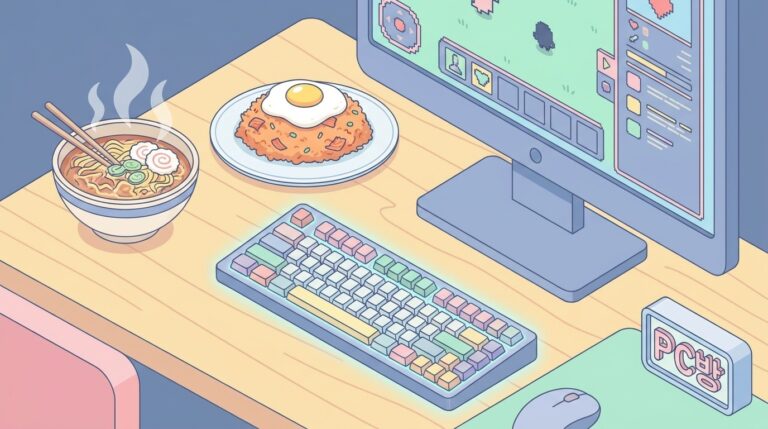
Picture this: You step into a neon-lit PC Bang (피씨방) in the vibrant streets of Sinchon after a long day of sightseeing. You sit down in an ultra-plush leather gaming chair, put on your headset, and turn on the monitor. But instead of the sound of video game spells and gunfire catching your attention, your nose catches a mouthwatering aroma: sizzling pork belly, sweet and spicy tteokbokki, and deep-fried dumplings.
You glance around and realize half the room isn’t just playing games—they are eating full restaurant-grade meals. On your screen, a vibrant pop-up food menu appears featuring over 80 dishes. You want to try that famous Kimchi Fried Rice with a half-cooked egg, but you freeze. How do I customize my toppings? Do I pick it up at the counter, or will they bring it over? What if I want to ask the staff for their signature dish?
If you’ve ever felt intimidated by the surprisingly elite culinary world of Korean PC bangs, you are not alone! In this guide, we break down essential B1-level expressions, cultural tips, and unspoken PC bang etiquette so you can order like a seasoned local gamer-foodie. Let’s dig in!
Phase 2: Core Expressions Deep Dive
1. 여기서 제일 잘 나가는 메뉴가 뭐예요? (Yeogi-seo jeil jal naganeun menyu-ga mwoyeyo?)
- Pronunciation: Yeo-gi-seo jay-il jal na-ga-neun meh-nyu-ga mwo-yeh-yo? (Think of jal na-ga-neun as “smoothly running out the door” like hotcakes!)
- Meaning: Literal: “What is the menu that goes out best here?” | Actual: “What’s your most popular/best-selling dish here?”
- K-Culture Moment: Seen in countless Korean variety shows like Hangout with Yoo (놀면 뭐하니?) where guests visit trendy PC bangs and ask the staff for their signature item.
- Editor’s Insight: Instead of asking for the “delicious” menu (masinneun menu), Koreans use jal naganeun (fast-selling/popular). It implies social proof and crowd-tested quality!
- Situation Spectrum: Casual (⚠️ with close friends change to 뭐야?) | Semi-formal (✅ Standard polite
-요) | Formal (⚠️)- 🤔 Think About It: In English, we often ask “What do you recommend?” but Korean frequently references collective popularity (잘 나가는). What does this tell us about trend sensitivity in Korean culture?
2. 계란 후라이 반숙으로 추가해 주세요. (Gyeran hurai bansuk-euro chugahae juseyo.)
- Pronunciation: Gyeh-ran hoo-ra-ee ban-soo-geu-ro choo-ga-hae joo-seh-yo.
- Meaning: Literal: “Please add fried egg as half-cooked.” | Actual: “Please add a sunny-side-up / soft-boiled fried egg on top.”
- K-Culture Moment: When ordering the legendary PC bang Jjapaguri (instant black bean noodles) or Kimchi Bokkeumbap, bursting a golden yolk (반숙) over the noodles is the ultimate comfort food ritual.
- Editor’s Insight: 반숙 (bansuk) means half-cooked (runny yolk), while 완숙 (wansuk) means fully cooked hard yolk. Using the particle (으)로 specifies your desired preparation state.
- Situation Spectrum: Casual (✅) | Semi-formal (✅) | Formal (✅)
- 🤔 Think About It: How does food texture preference reflect cultural comfort food traditions across different countries?
3. 음식 자리로 가져다주시나요? (Eumsik jari-ro gajyeodajusinayo?)
- Pronunciation: Eum-sik ja-ri-ro ga-jyeo-da-joo-si-na-yo?
- Meaning: Literal: “Do you bring the food to the seat?” | Actual: “Will the food be delivered directly to my seat?”
- K-Culture Moment: First-time foreign visitors often wait awkwardly by the counter, while Korean gamers simply order on-screen and wait for the delivery tray to slide right next to their keyboard.
- Editor’s Insight: The honorific infix -시- shows polite deference to the staff worker, keeping your tone respectful and soft.
- Situation Spectrum: Casual (🚫) | Semi-formal (✅) | Formal (✅)
- 🤔 Think About It: Why do you think modern Korean service spaces prioritize delivering food directly to personal computer stations?
Phase 3: Textbook Korean vs Real Korean
Situation 1: Ordering customized food at the PC Bang
- 📖 교과서 한국어 (Textbook): “이 라면을 주문하고 싶습니다. 치즈를 넣어 주세요.” (I ramyeon-eul jumunhago sipseumnida. Chijeu-reul neoeo juseyo. – I want to order this ramen. Please put cheese in it.)
- 🗣️ 진짜 한국어 (Real-Life): “라면에 치즈 추가해서 하나 주문할게요.” (Ramyeon-e chijeu chugahaeseo hana jumunhalgeyo. – I’ll order one ramen with extra cheese added, please.)
- 💡 Why the difference? Textbook phrasing sounds like an excerpt from a grammar test. Real locals link their requests using connecting particles like ~해서 (having added…) and polite intent ~(으)ㄹ게요.
Situation 2: Checking on your pending order
- 📖 교과서 한국어 (Textbook): “제 음식이 언제 준비됩니까?” (Je eumsik-i eonje junbidoebnikka? – When will my food be prepared?)
- 🗣️ 진짜 한국어 (Real-Life): “혹시 제 주문 들어갔나요?” (Hoksi je jumun deureogatnayo? – Excuse me, did my order go through?)
- 💡 Why the difference? Directly asking “When is it ready?” sounds impatient. Using 혹시 (by any chance) and asking if the order “went into the system” (주문 들어갔나요?) shows considerate nunchi (tact).
Phase 4: K-Culture Deep Dive & Non-Verbal Etiquette
4-1. 눈치 (Nunchi) & Spatial Etiquette
- Keep the volume down: Most people in a PC bang wear noise-cancelling headsets. If you must talk to the staff or your buddy, use a moderate, indoor tone.
- Clear a landing strip: Before your food arrives, push your keyboard back slightly and shift your mouse pad to leave room for the food tray.
- Settling payment: If paying in cash or physical card upon delivery, hand over your payment with both hands (or one hand supporting the elbow of the other) as a polite gesture to the hardworking part-timer (알바생).
4-2. The “PC-To-Rang” (PC-Restaurant) Phenomenon
In Korea, PC bangs have evolved far beyond simple internet cafes. They are now officially dubbed PC-To-Rang (PC방 + 레스토랑). Due to intense competition, PC bang franchises hire part-timers who specialize in cooking deep-fried chicken tenders (chibap), handmade hotdogs, and artisanal milkshakes. Some franchises even boast specialized kitchen equipment that rivals mid-scale diners!
Phase 5: Real-World Roleplay Scenario
- Setting: “Level Up PC Lounge” in Hongdae. 8:00 PM. Glowing keyboards, clicking mice, and the rich smell of fried garlic.
- Characters:
- Alex (알렉스): An international student playing games with friends.
- Ji-ho (지호): The seasoned PC Bang part-timer and secret culinary wizard.
[1] 지호 (Staff): 🎭 (Approaching Alex's seat with a tray)
                 주문하신 김치볶음밥 나왔습니다.
                 (Jumunhasin gimchibokkeumbap nawasseumnida.)
                 "Here is the Kimchi Fried Rice you ordered."

[2] 알렉스 (Alex): 🎭 (Taking off one earphone and smiling)
                 감사합니다! 혹시 단무지 조금 더 주실 수 있나요?
                 (Gamsahamnida! Hoksi danmuji jogeum deo jusil su innayo?)
                 "Thank you! By any chance, could I get a little more pickled radish?"

[3] 지호 (Staff): 🎭 (Nodding politely)
                 네, 바로 가져다드릴게요. 결제는 선불로 하셨죠?
                 (Ne, baro gajyeodadeurilgeyo. Gyeoljeneun seonbullo hasyeotjyo?)
                 "Sure, I'll bring it right away. You paid in advance, right?"

[4] 알렉스 (Alex): 🎭 (Nods)
                 네, 컴퓨터에서 카드로 결제했어요!
                 (Ne, keompyuteo-eseo kadeuro gyeoljehaesseoyo!)
                 "Yes, I paid by card directly on the computer screen!"

[5] 지호 (Staff): 🎭 (Handing over the extra side dish with both hands)
                 여기 단무지입니다. 맛있게 드세요!
                 (Yeogi danmuji-imnida. Masikke deuseyo!)
                 "Here is the pickled radish. Enjoy your meal!"

[6] 알렉스 (Alex): 🎭 (Glancing at the delicious aroma)
                 와, 냄새 대박이네요! 잘 먹겠습니다.
                 (Wa, naemsae daebag-ineyoyo! Jal meokgetseumnida.)
                 "Wow, the smell is incredible! Thank you for the meal."

[7] 지호 (Staff): 🎭 (Smiles with pride)
                 저희 매장 인기 메뉴예요. 다 드시면 그릇은 자리에 두세요.
                 (Jeohui maejang ingi menyuyeyo. Da deusimyeon geureos-eun jarie duseyo.)
                 "It's our store's top hit! When you're done, just leave the tray at your desk."

[8] 알렉스 (Alex): 🎭 (Giving a slight bow)
                 네, 알겠습니다. 수고하세요!
                 (Ne, algetseumnida. Sugohaseyo!)
                 "Got it. Thank you for your hard work!"
🔀 Interactive Decision Branch
Imagine Ji-ho is taking your order at the counter because the screen system had a glitch. What do you say?
- Option A: “저기요, 라면에 치즈랑 떡 사리 추가해 주세요.” (Jeogiyo, ramyeon-e chijeu-rang tteok sari chugahae juseyo.)
- 👉 Feedback (BEST): Natural, polite, and uses the culinary word 사리 (noodle/rice-cake add-ons) perfectly!
- Option B: “야! 제일 맛있는 거 줘.” (Ya! Jeil masinneun geo jwo.)
- 👉 Feedback (BAD): Rude informal speech (반말) used towards a staff member. Never use this!
- Option C: “이것을 조리해 주십시오.” (Igeos-eul jorihae jusipsio.)
- 👉 Feedback (RISK): Too archaic and robotic. Sounds like a historical drama warrior ordering food!
Phase 6: 10-Second Emotion Shadowing Drill
Practice saying these lines with the indicated emotional markers and natural breath pauses (/):
[😋 Hungry & Excited]
“라면에 / 계란 반숙으로 / 추가해 주세요!”
(Ramyeon-e / gyeran bansuk-euro / chugahae juseyo!)-
[🤔 Polite & Inquiring]
“혹시 / 여기서 제일 잘 나가는 메뉴가 / 뭐예요?”
(Hoksi / yeogi-seo jeil jal naganeun menyu-ga / mwoyeyo?) -
[😊 Grateful & Friendly]
“자리로 가져다주셔서 / 감사합니다! / 잘 먹겠습니다.”
(Jari-ro gajyeoda-jusyeoseo / gamsahamnida! / Jal meokgetseumnida.)
Phase 7: K-Culture Mini Dictionary
- PC토랑 (PC-torang) [Noun]: A portmanteau of PC방 and 레스토랑. Refers to modern PC cafes famous for serving gourmet-quality meals beyond simple snacks.
- 반숙 (Bansuk) [Noun]: Soft-boiled egg or sunny-side-up with a runny yolk. (Antonym: 완숙 (Wansuk) – hard-boiled).
- 꿀조합 (Kkul-johap) [Noun]: Literally “honey combination.” Refers to the ultimate pairing of foods (e.g., Jjapaguri + cheese + fried egg).
- 선불 / 후불 (Seonbul / Hubul) [Noun]: Seonbul means prepaying for food or computer time; Hubul means settling your bill when you check out.
Phase 8: Survival Kit for Travelers
TOP 3 PC Bang Survival Phrases
- 식사 주문 어디서 해요? (Siksa jumun eodiseo haeyo?) – “Where do I order food from?” (Pro Tip: Most PC bangs let you click the food icon on the top right corner of the monitor screen.)
- 물은 셀프인가요? (Mul-eun selpeu-ingayo?) – “Is water self-service?” (Pro Tip: Water dispensers and paper cups are almost always located near the restroom or counter.)
- 다 먹은 그릇은 어디에 둬요? (Da meogeun geureos-eun eodie dwoyo?) – “Where should I put the empty dishes?”
Editor’s Travel Note
- Finding Great PC Bangs: Search for “PC방” on the Naver Map App. Look for places with tags like 프리미엄 좌석 (premium seating) or high user ratings for food reviews.
- Card Readers: Most PC screens now feature built-in IC card readers directly beside the keyboard. You can simply tap your overseas Visa/Mastercard without visiting the counter!
Phase 9: “One Step Deeper” (Reflective Question)
Korean PC bangs are a fascinating reflection of Korea’s hyper-efficient ppalli-ppalli (빨리빨리 – hurry, hurry) culture merged with supreme comfort. In a single cubicle, you get high-speed internet, ergonomic relaxation, and hot restaurant meals delivered in under ten minutes. It showcases how Korean public spaces continuously reinvent themselves into all-in-one lifestyle hubs.
💬 Your Turn: What is your country’s equivalent of an all-in-one comfort hangout space? Would you ever order a full steak or pasta meal while gaming at a computer cafe? Let us know in the comments below!
Phase 10: FAQ & Common Mistakes (FAQ Schema)
Q: Can I pay with an international credit card for PC bang food?
A: Yes! Most modern Korean PC bang food ordering systems accept foreign credit cards through their desktop terminal or central kiosk. If your card fails, simply pay cash directly to the part-timer upon food delivery.
Q: Do I need to bring my dirty tray back to the kitchen counter?
A: It depends on the store. At modern PC cafes, the staff will clean up your tray after you log off. However, if there is a designated tray return station (퇴식구), returning it shows great courtesy!
Q: What is the most iconic PC bang food to try on my first visit?
A: You cannot go wrong with 치킨마요 덮밥 (Chicken Mayo Rice Bowl) or 짜파게티 + 계란 반숙 + 치즈 (Jjapaghetti with runny egg and cheddar cheese).
🚨 Common Mistakes Warning Board
- ❌ Mistake 1: Standing up and shouting across the room to order food.
👉 Correct Action: Use the desktop software interface to click and order your food silently. - ❌ Mistake 2: Saying “계란 익혀주세요” (Cook the egg) and expecting a soft yolk.
👉 Correct Action: Explicitly specify “계란 반숙으로 해주세요” for a runny yolk or “완숙” for fully cooked. - ❌ Mistake 3: Forgetting to select drink sets.
👉 Correct Action: Look out for 세트 메뉴 (Set menus) where an iced Americano or iced tea (아이스티) is included at a discounted price.
Phase 11: Action Mission & Engagement
- 🥉 Bronze Mission (Solo Practice): Read Phase 6’s Shadowing Drills out loud three times until you can say 계란 후라이 반숙으로 추가해 주세요 in under 3 seconds.
- 🥈 Silver Mission (Social Challenge): Screenshot your favorite Korean PC Bang food combination from social media and write its name in Korean in our comments!
- 🥇 Gold Mission (Real Life / Immersion): Visit a Korean PC Bang (or a Korean diner) and successfully order a customized dish using the phrase ~추가해 주세요.
- 🎮 K-Culture Mission: Watch a clip of Korean celebrities visiting a PC bang on YouTube (search: 연예인 PC방 먹방) and spot how many times they order food.
Phase 12: Interactive Quiz Challenge
1. Situational Judgment:
You want to ask the staff which food is the most popular in this PC cafe. Which sentence is the most natural?
* (A) 여기서 제일 비싼 거 주세요.
* (B) 여기서 제일 잘 나가는 메뉴가 뭐예요?
* (C) 당신이 좋아하는 밥을 요리하세요.
2. Fill in the Blank:
“라면에 치즈 ______ 하나 주문할게요.” (I’d like to order one ramen with cheese added.)
* (A) 추가해서
* (B) 없애서
* (C) 버려서
3. True or False:
In modern Korean PC bangs, food is typically ordered through desktop screen pop-ups rather than ordering verbally at the front counter. (True / False)
👉 Click here to reveal answers & explanations!
- Answer: (B) – 여기서 제일 잘 나가는 메뉴가 뭐예요? is the natural, culturally authentic way to ask for bestsellers. (A means ‘give me the most expensive thing’, C means ‘cook the meal you like’).
- Answer: (A) 추가해서 – 추가하다 means ‘to add’. Adding ~해서 connects the action smoothly.
- Answer: True – Nearly all modern PC cafes operate via integrated desktop ordering systems!







