

Phase 1: 공감 (Story-Immersive Opening)
안녕하세요! 매일한글 에디터입니다. (Hello! This is your Daily Hangul editor.)
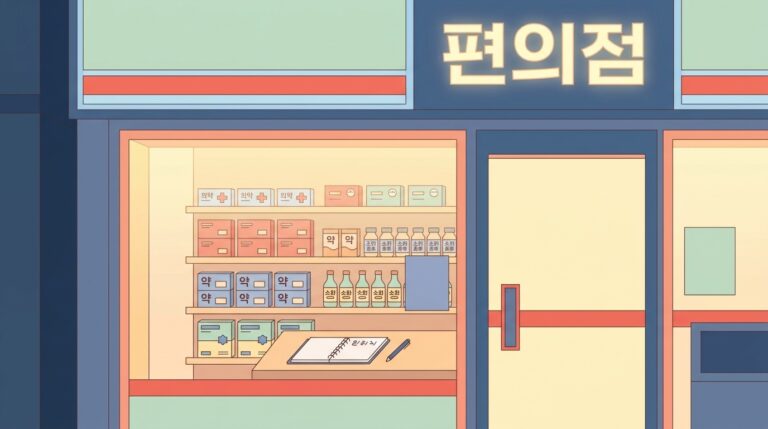
Picture this: It is 11:45 PM on a chilly Friday in Seoul. You spent your day exploring the royal grounds of Gyeongbokgung, followed by a delicious, spicy feast of tteokbokki and chimaek (fried chicken and beer) in Hongdae. But just as you get back to your Airbnb, your head starts throbbing with a sharp headache, or perhaps your stomach feels heavy and bloated. You look around, but every local pharmacy (yakguk, 약국) in the alley has pulled down its steel shutters for the night.
In many countries, finding emergency over-the-counter medicine late at night without an urgent care visit is a logistical nightmare. But in South Korea, you spot the bright, welcoming glow of a GS25, CU, or 7-Eleven just around the corner. Yes, Korean convenience stores carry essential emergency medicine (sangbiyak, 상비약)!
However, walking up to the counter and asking for the right relief can feel intimidating if you do not know the exact Korean phrases—especially when medicine is often kept behind the cashier’s counter due to local regulations. In this guide, tailored for B2 intermediate learners, we will break down authentic expressions, cultural nuances of the Korean convenience store medical system, and subtle conversational cues so you can get exactly what you need with calm confidence.
Phase 2: 핵심 표현 3선 심층 분석 (Top 3 Core Expressions)
1. 혹시 두통약 있어요? (Hoksi dutong-yak isseoyo?)
- Pronunciation: Hok-shi doo-tong-yak ee-sseo-yo? (Sounds like: Hoke-shee doo-tong-yahk ee-ssuh-yo — imagine ‘hok’ rhyming with ‘folk’ without the ‘l’ sound).
- Meaning: Literal: “By any chance, do you have headache medicine?” | Nuance: A polite, gentle inquiry that avoids sounding demanding or abrupt.
- K-Culture Moment: You will often hear this in K-Dramas like Hospital Playlist or Our Blues when a character rushes into a small mart late at night looking for fever or pain medication for a sick friend.
- Editor’s Insight: The starter word 혹시 (Hoksi) is the ultimate politeness cushion in Korean. Instead of bluntly saying “두통약 주세요” (Give me headache medicine), opening with “혹시… 있어요?” softens your tone, acknowledging that convenience stores only carry a limited inventory of basic medicines.
- Situation Spectrum: Casual (⚠️ 혹시 두통약 있어? — friends only) | Semi-formal (✅ 혹시 두통약 있어요? — perfect for retail clerks) | Formal (✅ 혹시 두통약 구비되어 있습니까? — overly stiff for convenience stores).
- 🤔 Think About It: Notice how Korean speakers almost always add softening adverbs like 혹시 before asking for availability. How does your native language soften direct requests to service staff?
2. 종합감기약 하나만 주세요 (Jonghap-gamgiyak hanaman juseyo)
- Pronunciation: Jong-hap-gam-gi-yak ha-na-man joo-seh-yo (Sounds like: Jong-hahp gahm-gee-yahk ha-na-mahn joo-seh-yo).
- Meaning: Literal: “Please give me just one multi-symptom cold medicine.” | Nuance: A clear, polite order specifying comprehensive cold relief (fever, chills, runny nose).
- K-Culture Moment: Seen in Slice-of-Life K-dramas where an overworked office worker catches the seasonal flu and picks up a box of Pancold-A (판콜에이) alongside warm canned honey-citron tea from the heated display cabinet.
- Editor’s Insight: The particle -만 (-man) literally means “only/just.” In Korean service interactions, adding -man to numbers (e.g., 하나만, just one) softens the request, making you sound modest and polite rather than entitled.
- Situation Spectrum: Casual (🚫 감기약 줘) | Semi-formal (✅ 종합감기약 하나만 주세요) | Formal (✅ 종합감기약 한 통 부탁드립니다).
- 🤔 Think About It: Under South Korean pharmaceutical law, convenience stores are legally permitted to sell only one package per customer for safety reasons. Using 하나만 naturally aligns with local legal protocol!
3. 속이 더부룩해서 그런데, 소화제 있을까요? (Sogi deoburu-khaeseo geureonde, sohwaje isseulkkayo?)
- Pronunciation: Sog-ee duh-boo-rook-hae-seo geu-ruhn-deh, so-hwa-jeh eess-eul-kka-yo?
- Meaning: Literal: “My stomach feels bloated/stuffy, so… would you happen to have a digestive aid?” | Nuance: Explaining your physical symptom first before asking, which allows the clerk to point out whether you need pills or a liquid digestive drink.
- K-Culture Moment: After a massive Korean BBQ dinner or midnight yasik (야식) delivery feast, characters in variety shows like I Live Alone frequently grab a bottle of liquid digestive medicine (Gas Hwalmyeongsu or Whal Myung Su) from the corner store.
- Editor’s Insight: 더부룩하다 (Deoburukhada) is an evocative B2-level descriptive verb meaning heavy indigestion, gas, or fullness. Stating your symptom with ~해서 그런데 (because of X, so…) gives natural context.
- Situation Spectrum: Casual (⚠️ 속 안 좋아, 소화제 줘) | Semi-formal (✅ 속이 더부룩해서 그런데, 소화제 있을까요?) | Formal (✅ 소화 불량 증상이 있어 소화제를 찾고 있습니다).
- 🤔 Think About It: Korean has distinct sensory adjectives for stomach discomfort: 속이 쓰리다 (heartburn/sour), 속이 더부룩하다 (bloated/indigestion), 체하다 (acute indigestion). Why do you think Korean cuisine culture developed such precise bodily descriptions?
Phase 3: 교과서 한국어 vs 진짜 한국어 (Textbook vs Real Korean)
Situation 1: Asking if pain relievers are in stock
- 📖 교과서 한국어 (Textbook): “진통제가 있습니까? 어디에 진열되어 있습니까?” (Jintongjega itsseumnikka? Eodie jin-yeoldoeeo itsseumnikka? — “Do you have analgesics? Where are they displayed?”)
- 🗣️ 진짜 한국어 (Real Korean): “혹시 타이레놀이나 진통제 있을까요?” (Hoksi Tairenor-ina jintongje isseulkkayo? — “By any chance, would you have Tylenol or a painkiller?”)
- 💡 왜 다를까? (Why is it different?): Native speakers rarely speak in dry declarative grammar (~있습니까) in a 24-hour store. Instead, they reference brand names like 타이레놀 (Tylenol) directly and end with the soft speculative interrogative ~있을까요?.
Situation 2: Asking for pain-relief patches or bandages
- 📖 교과서 한국어 (Textbook): “근육통을 치료하는 파스와 일회용 밴드를 구매하고자 합니다.” (Geunyuktong-eul chiryohaneun paseuwa ilhoeyong baendeureul gumahehagoja hamnida. — “I wish to purchase pain relief patches and disposable bandages for muscle aches.”)
- 🗣️ 진짜 한국어 (Real Korean): “사장님, 파스랑 대일밴드 어디 쪽에 있어요?” (Sajangnim, paseurang daeil-baendeu eodi jjoge isseoyo? — “Boss, which section has pain patches and band-aids?”)
- 💡 왜 다를까? (Why is it different?): In everyday Korea, “대일밴드” (Daeil Band) is the universal eponym for adhesive bandages (like Band-Aid in English), and addressing store owners warmly as 사장님 (Sajangnim) creates instant rapport.
Phase 4: K-Culture 딥다이브 & 비언어적 매너 (K-Culture Deep Dive)
4-1. 눈치 (Nunchi) & Gestures at the Convenience Store Counter
- Where to Look: In Korea, basic medicines are designated as Safety Emergency Medications (안전상비의약품). They are legally restricted to 13 specific items (fever reducers, cold medicine, digestive tablets, and pain-relief patches) and are almost always placed in a locked acrylic box right behind the cash register, not on general open shelves.
- Two-Handed Delivery: When receiving medicine or paying by physical credit card, hand it over with both hands, or support your right forearm lightly with your left hand. This demonstrates respect and consideration.
- Respecting the 1-Item Rule: Do not ask for three boxes of Tylenol. The POS terminal barcode will literally block transactions with multiple packs of the same medicine. If you need more, politely ask for directions to a 24-hour late-night pharmacy (달빛어린이병원 / 심야약국).
4-2. Cultural Code: The Late-Night Lifesaver in K-Drama
In Korean media, convenience stores are communal sanctuaries. When characters experience emotional turmoil or physical fatigue in dramas like My Liberation Notes or Extraordinary Attorney Woo, the convenience store is where they recharge. Grabbing a warm drink from the heated counter warmer (온장고) alongside emergency medicine is a signature gesture of caring for someone (챙겨주다).
Phase 5: 실전 롤플레이 시나리오 (Real Role-Play Scenario)
Setting: It is 1:15 AM at a bright GS25 convenience store in Mapo-gu, Seoul. You walk in holding your forehead, feeling feverish and achy.
Characters: You (Learner) & Minho (The friendly, attentive night-shift clerk).
- You: 안녕하세요! 저 혹시… 머리가 좀 지끈거리는데 두통약 있을까요?
(Annyeonghaseyo! Jeo hoksi… meoriga jom jikkeon-georineunde dutong-yak isseulkkayo?)
“Hello! Excuse me, by any chance… my head is throbbing a bit, would you happen to have headache medicine?”
🎭 [Touching your temple slightly with an apologetic, tired expression] -
Minho: 아, 머리 아프세요? 타이레놀 준비되어 있어요. 파란색이랑 빨간색 있는데 어떤 걸로 드릴까요?
(A, meori apeuseyo? Tairenol junbidoeeo isseoyo. Paransaek-irang ppalgansaek inneunde eotteon geollo deurilkkayo?)
“Ah, do you have a headache? We have Tylenol available. We have regular 500mg and extended-release, which one would you like?”
🎭 [Glancing behind the counter and unlocking the medicine cabinet] -
You: 아, 열도 좀 나는 것 같아서 기본 타이레놀로 하나만 주세요.
(A, yeoldo jom naneun geot gataseo gibon Tairenor-ro hanaman juseyo.)
“Ah, I think I have a slight fever too, so please give me just one pack of basic Tylenol.”
🎭 [Nodding respectfully and stepping closer to the register] -
Minho: 네, 타이레놀 500밀리 하나 드릴게요. 혹시 다른 불편하신 곳은 없으세요?
(Ne, Tairenol obaek-milli hana deurilgeyo. Hoksi dareun bulpyeonhasin goseun eopseuseyo?)
“Alright, here is one pack of Tylenol 500mg. Is there anywhere else you are uncomfortable?”
🎭 [Scanning the barcode on the counter] -
You: 혹시 속도 약간 더부룩한데, 마시는 소화제도 같이 살 수 있나요?
(Hoksi sokdo yakgan deoburu-khande, masineun sohwajedo gachi sal su innayo?)
“By any chance, my stomach is also feeling slightly bloated; can I buy a liquid digestive aid together with this?”
🎭 [Pointing towards the beverage cooler area] -
Minho: 그럼요! 저기 음료 냉장고 옆이나 온장고에 까스활명수랑 베나치오 있어요. 따뜻한 걸로 가져다 드릴까요?
(Geureomyo! Jeogi eumryo naengjanggo yeop-ina onjanggo-e Ggas Hwalmyeongsu-rang Benachio isseoyo. Ttatteuthan geollo gajyeoda deurilkkayo?)
“Of course! Over by the beverage cooler or in the heated cabinet, we have Gas Hwalmyeongsu and Benachio. Shall I grab a warm one for you?”
🎭 [Pointing warmly towards the heated cabinet display] -
You: 네, 따뜻한 까스활명수로 부탁드릴게요. 정말 감사합니다!
(Ne, ttatteuthan Ggas Hwalmyeongsu-ro butakdeurilgeyo. Jeongmal gamsahamnida!)
“Yes, a warm Gas Hwalmyeongsu would be great, please. Thank you so much!”
🎭 [Smiling with relief and preparing your card with both hands] -
Minho: 네, 합쳐서 6,500원입니다. 약 드시고 푹 쉬세요!
(Ne, hapchyeoseo yukcheon-obaek-won-imnida. Yak deusigo puk swiseyo!)
“Yes, that will be 6,500 KRW in total. Please take the medicine and get plenty of rest!”
🎭 [Handing over the receipt and items with a supportive nod]
🔀 인터랙티브 분기점 (Interactive Branching)
What do you say if you want to buy an extra pack of Tylenol for your travel buddy back at the hotel?
- Choice A: “친구 것도 필요해서 그런데 두 통 같이 결제해 주세요.” (Chingu geotdo piryohaeseo geureonde du tong gachi gyeoljehae juseyo.)
- ⚠️ Risk Feedback: The cashier will politely explain: “죄송하지만 법적으로 1인당 1통만 구매 가능하세요” (Sorry, but legally only 1 box per person is allowed). You will have to do separate transactions or have your friend come in person.
- Choice B: “혹시 타이레놀 한 통 더 살 수 있는 방법이 있을까요?” (Hoksi Tairenol han tong deo sal su inneun bangbeobi isseulkkayo?)
- 💡 Bad Feedback: While grammatically polite, this puts the clerk in an awkward position because POS systems are strictly audited under convenience store medicine sales regulations.
- Choice C: “아, 1인당 1통 제한 맞죠? 친구한테 직접 와서 하나 더 사라고 할게요!” (A, irindang iltong jehan matjyo? Chingu-hante jikjeop waseo hana deo sarago halgeyo!)
- 🌟 Best Feedback: Demonstrates high cultural awareness and linguistic fluency! The clerk will be relieved that you understand the store policy without requiring extra explanation.
Phase 6: 10초 감정 섀도잉 드릴 (10-Second Shadowing Drill)
Practice these natural rhythm pauses (marked with /) and embody the emotional stage directions:
[🥺 아프고 조심스럽게 - Painful & hesitant]
“저 혹시… / 머리가 너무 지끈거려서 그러는데, / 두통약 있을까요?”
(Jeo hoksi… / meoriga neomu jikkeon-georyeoseo geureonde, / dutong-yak isseulkkayo?)-
[🙏 공손하고 안도하며 - Polite & relieved]
“기본 타이레놀로 / 하나만 주시고요, / 따뜻한 소화제도 / 같이 계산해 주세요.”
(Gibon Tairenor-ro / hanaman jusigoyo, / ttatteuthan sohwajedo / gachi gyesanhae juseyo.) -
[😊 감사함을 담아 밝게 - Warm & grateful]
“약 챙겨주셔서 / 정말 감사합니다. / 안녕히 계세요!”
(Yak chaeng-gyeojusyeoseo / jeongmal gamsahamnida. / Annyeonghi gyeseyo!)
Phase 7: K-Culture 미니 사전 (Mini Dictionary)
-
안전상비의약품 (Anjeon sangbi uiyakpum)
- Definition: Safety Emergency Medications. A designated legal category of 13 basic non-prescription drugs allowed for sale in 24-hour convenience stores since November 2012 in South Korea.
- Real-life usage: Look for the green or blue cross logo marked “안전상비의약품” near the register.
- 판콜에이 (Pancold-A) & 판피린 (Panpyrin)
- Definition: South Korea’s iconic over-the-counter liquid and tablet cold medications.
- Real-life usage: When you feel body aches, chills, or a scratchy throat coming on after walking through Seoul’s winter breezes, asking for “판콜에이” is standard practice.
- 까스활명수 (Ggas Hwalmyeongsu)
- Definition: A traditional herbal effervescent digestive drink developed over 120 years ago.
- Real-life usage: Widely drank immediately after heavy barbecue, fried food, or feeling bloated. At convenience stores, look in the heated cabinet (온장고) for a soothing warm bottle.
- 파스 (Paseu)
- Definition: Transdermal analgesic/anti-inflammatory medicated patches for muscle strain and back pain (derived from the German word Pflaster).
- Real-life usage: If you walked 25,000 steps around Bukchon Hanok Village and Namsan Tower, ask for “쿨파스” (cooling patch) or “핫파스” (warming patch).
Phase 8: 여행자를 위한 생존 키트 (Traveler’s Survival Kit)
Top 3 Survival Expressions
- “타이레놀 있어요?” (Tairenol isseoyo? — “Do you have Tylenol?”)
- Pro Tip: Tylenol 500mg is the universal pain/fever reliever recognized across all Korean convenience store chains.
- “파스 어디에 걸려있어요?” (Paseu eodie geollyeo-isseoyo? — “Where are the pain patches hanging?”)
- Pro Tip: Unlike oral pills, patches (파스) are sometimes displayed on regular hanging racks near toiletries or bandages.
- “마시는 감기약도 있나요?” (Masineun gamgiyakdo innayo? — “Do you also have drinkable cold medicine?”)
- Pro Tip: Liquid options like Pancold-A act quickly and are easy to swallow before sleeping.
Editor’s Travel Note
- If you need medical supplies outside convenience store hours or require prescription drugs, check the official government healthcare finder via the 응급의료정보제공 e-Gen 앱 다운로드 to locate late-night emergency pharmacies (심야약국) near your location.
- For navigation between 24-hour pharmacies in Seoul, use the 카카오맵 지도 앱 다운로드 for real-time operating hours and route planning.
- Credit cards, Apple Pay (at GS25/CU/7-Eleven), and T-Money transport cards are seamlessly accepted for convenience store medicine purchases.
Phase 9: “한 발 더 깊이” (Reflective Essay)
In South Korea, the 24-hour convenience store is more than just a retail outpost; it serves as a decentralized social safety net. When pharmacies shut down, the modest acrylic cabinet beside the cashier ensures that solitary residents, late-night workers, and foreign travelers are never stranded in physical distress. The meticulous restriction of selling only one pack per transaction reflects the delicate balance Korean society maintains between individual convenience (pyeon-ui, 편의) and community public health responsibility (gonggong bogun, 공공보건). Next time you step into a glowing convenience store at 2 AM, take a moment to appreciate this quiet infrastructure of care.
💬 Your Turn: Have you ever needed medicine unexpectedly while traveling abroad? What surprised you most about Korean convenience stores compared to your home country? Share your stories in the comments below!
Phase 10: FAQ & 오해 방지 (FAQ Schema)
Q: Why can’t I find medicine on the regular open shelves at GS25 or CU?
A: By South Korean law, Safety Emergency Medications must be kept under the direct supervision of the store clerk to prevent misuse and theft. They are usually stored in a transparent locked case behind or directly next to the cash register. Simply ask the cashier at the counter.
Q: Can I buy multiple boxes of pain relievers if my whole family is sick?
A: No. Korean regulations strictly limit purchases of emergency over-the-counter drugs to one single packaging unit per customer per visit. The point-of-sale register will automatically restrict scanning multiple units. If multiple people need medicine, each person should purchase their own package.
Q: Can minors (under 12) purchase emergency medicine at Korean convenience stores?
A: No. In South Korea, convenience store safety medicine cannot legally be sold to children under 12 years of age. Adults must accompany young travelers to make the purchase.
🚨 흔한 실수 (Common Mistakes) 경고판
- Mistake: Searching through cosmetic and shampoo aisles for Tylenol.
- 👉 Correct Action: Walk straight to the checkout counter and ask the clerk: “혹시 상비약 있어요?” (Hoksi sangbiyak isseoyo?).
- Mistake: Demanding strong prescription-grade antibiotics or specialized eye drops.
- 👉 Correct Action: Convenience stores only carry 13 basic items (fever, cold, digestion, pain patch). For prescription drugs, visit a Yakguk (약국) during daytime hours.
- Mistake: Using aggressive, blunt commands like “타이레놀 내놔요” or “약 줘”.
- 👉 Correct Action: Always cushion your speech with “혹시 ~ 있을까요?” or “~ 하나만 주세요.”
Phase 11: 액션 미션 & 참여 유도 (Action Mission)
- 🥉 Bronze Mission (Solo Practice): Stand in front of your mirror and practice the phrase: “혹시 두통약 하나만 주시겠어요?” with soft, natural intonation three times.
- 🥈 Silver Mission (Shadowing & Recording): Record yourself reading Turn 1 and Turn 3 of the Phase 5 dialogue on your smartphone voice memos, focusing on smooth transitions around “~해서 그런데”.
- 🥇 Gold Mission (Real-World Execution): On your next visit to a Korean convenience store, locate the Safety Emergency Medication (안전상비의약품) logo or purchase a warm bottle of Gas Hwalmyeongsu from the heated cabinet using natural Korean!
🎮 K-Culture Mission: Watch a contemporary K-drama episode (e.g., Hospital Playlist or Business Proposal) and spot a scene where someone visits a convenience store or drinks a small brown bottle of digestive medicine. Note how they interact with the cashier!
Phase 12: 인터랙티브 퀴즈 챌린지 (Interactive Quiz Challenge)
Q1. Situation Judgment: You have an upset stomach after dinner and enter a CU convenience store. Which sentence is the most natural and polite way to ask for digestive medicine?
* A) 소화제 세 개 빨리 주세요.
* B) 속이 좀 더부룩해서 그런데, 혹시 소화제 있을까요?
* C) 나는 아프니까 약을 당장 판매하십시오.
Q2. Fill-in-the-Blank: Complete the polite softening particle:
“타이레놀 [ ] 주세요.” (Hint: “Just one, please”)
* A) 하나만
* B) 하나도
* C) 하나씩
Q3. True or False: In Korea, you can buy up to 5 boxes of Tylenol at a convenience store in a single purchase as long as you pay with a credit card.
* (True / False)
🔍 Click to view Answers & Explanations (정답 및 해설 보기)
- Q1 Answer: B — “속이 좀 더부룩해서 그런데, 혹시 소화제 있을까요?” provides symptom context and uses gentle, polite phrasing (혹시 ~ 있을까요?). Option A is too demanding and violates the 1-pack rule; Option C is stiff and unnatural.
- Q2 Answer: A (하나만) — Adding the delimiter -만 (-man) creates the polite nuance of “just one pack, please.”
- Q3 Answer: False — South Korean pharmaceutical regulations legally restrict convenience store emergency medicine purchases to one pack per customer per transaction, regardless of payment method!







