

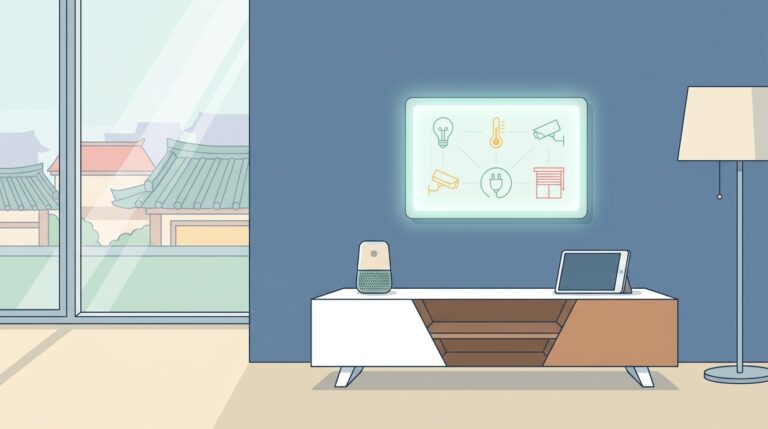
Phase 1: Empathy (Welcome to Hyper-Connected Korea!)
안녕하세요! 매일한글 에디터입니다.
Imagine this: You’ve just unpacked your bags in a sleek, newly built apartment in Gangnam or Pangyo Techno Valley. You walk up to the wall-mounted screen—the quintessential Korean Wallpad (월패드)—and stare at icons for ventilation, floor heating, lighting, and elevator calling. Later at work or in a tech meetup, your Korean colleagues are casually discussing IoT 연동 (IoT integration) and 원격 제어 (remote control) like it’s second nature. You understand the basic words for ‘internet’ and ‘machine,’ but when the conversation shifts to sophisticated C1-level tech architecture, system ecosystems, and everyday automation routines, you find yourself nodding along blankly.
Mastering C1-level IoT expressions isn’t just about sounding like a software engineer; it’s about navigating daily life in the world’s most wired society. Based on feedback from hundreds of our advanced expats working in Korea’s IT and startup sectors, mastering authentic IoT phrasing instantly bridges the gap between sounding like a stiff textbook learner and commanding respect as a fluent, tech-literate professional. Let’s upgrade your Korean tech vocabulary today!
Phase 2: Top 3 Core IoT Expressions In-Depth
1. 스마트홈 앱에 기기를 연동하다 (Seumateuhom aebe gigireul yeondonghada)
- Pronunciation: [Seu-ma-teu-hom ae-be gi-gi-reul yeon-dong-ha-da] (Pronounce ‘yeon’ like the ‘yeo’ in ‘yearn’ + ‘dong’ like the chime sound)
- Meaning: Literal: “To link/interlock devices to a smart home app” | Natural Nuance: To seamlessly sync, integrate, or bridge IoT hardware with a software ecosystem.
- K-Culture Moment: In K-dramas like Start-Up or Search: WWW, tech developers stand before glass whiteboards discussing how their smart security system “연동되고 있습니다” (is being integrated).
- Editor’s Insight: The Sino-Korean word 연동 (連動 – Yeondong) implies an organic, interconnected movement where triggering one element automatically operates another. It is vastly more professional than the basic verb 연결하다 (to simply connect physically or digitally).
- Situation Spectrum: Casual: ⚠️ (Use 연동해) | Semi-formal: ✅ | Formal: ✅
- 🤔 Think About It: In English, we often say “sync,” “pair,” or “link.” How does the concept of 연동 (interlocked motion) reflect Korea’s emphasis on cohesive, automated harmony?
2. 원격으로 제어하다 (Won-gyeog-euro jeeohada)
- Pronunciation: [Won-gyeo-geu-ro je-eo-ha-da] (Pronounce ‘won’ like ‘one’, ‘gyeog’ like ‘ge-uk’, and ‘je-eo’ smoothly)
- Meaning: Literal: “To control from a distant boundary” | Natural Nuance: To remotely monitor and control smart devices via cloud networks.
- K-Culture Moment: When a character in a modern apartment thriller adjusts their living room boiling system (보일러) or pet feeder while still riding the subway home, they are utilizing 원격 제어.
- Editor’s Insight: 제어하다 (制御하다 – Jeeohada) elevates your speech above 다루다 (handle) or 조작하다 (manipulate buttons). It highlights system-level authority and operational command.
- Situation Spectrum: Casual: ⚠️ (Use 밖에서 켜다/끄다) | Semi-formal: ✅ | Formal: ✅
- 🤔 Think About It: Why does Korean tech culture distinguish so sharply between manual manipulation (조작) and automated governance (제어)?
3. 자동화 루틴을 설정하다 (Jadonghwa lutin-eul seoljeonghada)
- Pronunciation: [Ja-dong-hwa ru-ti-neul seol-jeong-ha-da] (Roo-teen-eul seol-jeong-ha-da)
- Meaning: Literal: “To establish an automation routine” | Natural Nuance: To configure custom smart home triggers (e.g., ‘Good Morning’ or ‘Leaving Home’ presets).
- K-Culture Moment: Tech vloggers showcasing their Seoul officetel setups often demonstrate how their curtains open and espresso machines brew automatically when their morning routine activates.
- Editor’s Insight: The loanword 루틴 (routine) paired with Sino-Korean 자동화 (automation) and 설정 (configuration) is the gold standard phrase used across Korean UI/UX platforms like Samsung SmartThings and LG ThinQ.
- Situation Spectrum: Casual: ✅ | Semi-formal: ✅ | Formal: ✅
- 🤔 Think About It: How does the integration of English loanwords like ‘루틴’ into formal Korean syntax reflect modern Korean business-tech bilingualism?
Phase 3: Textbook Korean vs. Real Native Korean
Situation 1: Explaining Smart Home Convenience
- 📖 교과서 한국어 (Textbook): “사물인터넷 기술 덕분에 집안 기기들이 서로 정보를 교환하여 편리합니다.” (Samurinteonet gisul deokbune jiban gigideuri seoro jeongboreul gyohwanhayeo pyeonrihamnida. – Due to IoT technology, household devices exchange info with each other conveniently.)
- 🗣️ 진짜 한국어 (Real Native): “가전들을 스마트홈으로 싹 연동해 두니까 알아서 척척 돌아가서 완전 편해요.” (Gajeondeureul seumateuhomeuro ssak yeondonghae dunikka araseo cheokcheok doragaseo wanjeon pyeonhaeyo. – Since I linked all appliances to the smart home system, everything runs like clockwork on its own; it’s super convenient.)
- 💡 왜 다를까? (Why the difference?): Natives use vivid adverbs like 싹 (completely/all at once) and 알아서 척척 (smoothly and autonomously) rather than stiff academic clauses.
Situation 2: Discussing Remote HVAC Management
- 📖 교과서 한국어 (Textbook): “휴대전화 애플리케이션으로 난방 장치의 온도를 조절할 수 있습니다.” (Hyudejeonhwa aepeullikeisyeoneuro nanbang jangchiui ondoreul jojeolhal su itseumnida. – You can adjust the heating unit temperature with a mobile application.)
- 🗣️ 진짜 한국어 (Real Native): “퇴근길에 앱으로 보일러 원격 제어 돌려놓으면 집에 도착했을 때 딱 훈훈해요.” (Toegeungire aebeuro boilleo wongyeok jeeo dollyeonoh-eumyeon jibe dochakhaesseul ttae ttak hunhunhaeyo. – If you turn on remote boiler control on your way home from work, it’s perfectly cozy right when you arrive.)
- 💡 왜 다를까? (Why the difference?): C1 Korean speakers anchor tech utility to sensory real-world outcomes (e.g., 훈훈하다 – pleasant warmth) and habitual commutes (퇴근길).
Phase 4: K-Culture Deep Dive & Non-Verbal Manners
4-1. Nunchi (눈치) & Gestures in Tech Environments
- The ‘Wallpad Gesture’: When showing a guest your Korean apartment, do not aggressively tap the touch wallpad. A gentle, flat two-finger touch or light index tap accompanied by a slight head tilt indicates technical competence without appearing impatient.
- Smart Meeting Etiquette: In Korean IT meetings, when presenting IoT integrations, use both hands with palms facing slightly upward when gesturing toward an architecture diagram on a screen. Pointing with a single sharp finger looks combative.
4-2. Cultural Code: The ‘Apartment Ecosystem’ & Contactless Life
Korean apartments (아파트) are the testing grounds for global IoT innovation. From 스마트 도어락 (smart door locks that unlock via smartphone geofencing) to automated parking guidance systems that alert your living room wallpad the moment your car passes the basement gate, IoT is not a hobbyist novelty—it is the baseline infrastructure of urban Korean life.
Phase 5: Real-Life Roleplay Scenario
Setting: Pangyo Tech Valley smart showroom office. Team Lead Park Min-jun (박민준 팀장) is reviewing an IoT integration project with you.
- Turn 1 (Min-jun): “이번 스마트 오피스 프로젝트에서 조명하고 공조 시스템 연동 작업은 어디까지 진행됐나요?” (Ibeon seumateu opiseu peurojekteueseo jomyeonghago gongjo siseutem yeondong jageobeun eodikaji jinhaengdwaennayo? – How far has the integration of lighting and HVAC systems progressed in this smart office project?)
🎭 태블릿 모니터를 응시하며 안경을 고쳐 쓴다. - Turn 2 (You): “현재 센서 데이터 수집까지 끝났고, 메인 허브에 기기들을 연동하는 단계입니다.” *(Hyeonjae senseo deiteo sujipkkaji kkeutnatgo, mein heobeue gigideureul yeondonghaneun dangye-imnida. – We’ve finished collecting sensor data and are currently at the stage of syncing the devices with the main hub.)
🎭 공손하게 손을 모으고 고개를 끄덕인다.` - Turn 3 (Min-jun): “좋네요. 사용자가 모바일 앱으로 원격 제어할 때 딜레이(지연 시간)는 문제없을까요?” (Jonne-yo. Sayongjaga mobail aebeuro wongyeok jeeohal ttae dillei-neun munjeeopseulkkayo? – Sounds good. Will there be any issues with latency when users control it remotely via mobile app?)
🎭 의자를 살짝 돌려 당신을 진지하게 쳐다본다. - Turn 4 (You): “초저지연 프로토콜을 적용해서 원격 제어 반응 속도를 0.2초 이내로 단축시켰습니다.” *(Chojeojiyeon peurotokoreul jeok-yonghaeseo wongyeok jeeo baneung sokdoreul 0.2cho inaero danchuksikyeosseumnida. – We applied ultra-low latency protocols to reduce the remote control response time to under 0.2 seconds.)
🎭 차분하고 또렷한 어조로 답변한다.` - Turn 5 (Min-jun): “훌륭합니다. 그럼 사용자가 직접 자동화 루틴을 커스텀할 수도 있나요?” (Hullyunghamnida. Geureom sayongjaga jikjeop jadonghwa lutineul keoseuteomhal sudo innayo? – Excellent. Then can users also customize their own automation routines directly?)
🎭 만족스러운 미소를 지으며 메모한다. - Turn 6 (You): “네, 출퇴근 모드나 취침 모드 같은 자동화 루틴을 직관적으로 설정할 수 있도록 UI를 구성했습니다.” *(Ne, chultoegeun modeuna chwichim modeu gateun jadonghwa lutineul jikgwanjeogeuro seoljeonghal su itdorok UI-reul guseonghaesseumnida. – Yes, we configured the UI so users can intuitively set automation routines like commute or sleep modes.)
🎭 화면 시연을 가리킨다.` - Turn 7 (Min-jun): “보안 취약점이나 기기 간 충돌 문제만 한 번 더 검증해 주시면 완벽하겠네요.” *(Boan chwiakjeomina gigi gan chungdol munjeman han beon deo geomjeonghae jusimyeon wanbyeokhagennayo. – If you verify security vulnerabilities and inter-device conflict once more, it will be perfect.)
🎭 어깨를 가볍게 토닥이며 격려한다.` - Turn 8 (You): “네, 보안 프로토콜 최종 점검 후 금일 퇴근 전까지 보고서 올리겠습니다!” (Ne, boan peurotokol choejong jeomgeom hu geumil toegeun jeonkkaji bogoseo olligesseumnida! – Understood, I will inspect security protocols and submit the final report before clocking out today!)
🎭 미소를 띠며 정중하게 인사한다.
🔀 Interactive Branching Point
Min-jun asks if third-party legacy appliances can also be synced: “혹시 기존 구형 가전제품들도 이 시스템에 연동시킬 방법이 있을까요?”
- Option A: “구형 가전은 스마트 플러그나 IR 리모컨 허브를 경유하면 무리 없이 연동 제어 가능합니다.” (Guhyeong gajeoneun seumateu peulleogeuna IR rimokeon heobeureul gyeong-yuhamyeon muri eopsi yeondong jeeo ganeunghamnida.)
- Feedback (Best! 🌟): Flawless C1 technical response. You suggested concrete bridge hardware (스마트 플러그/IR 허브) and professional grammar.
- Option B: “옛날 기계는 아예 안 돼요. 다 새로 사야 합니다.” (Yennal gigyeneun aye an dwaeyo. Da saero saya hamnida.)
- Feedback (Bad ❌): Too blunt, dismissive, and shows a lack of technical problem-solving phrasing.
- Option C: “연결은 되는데 잘 고장 날 수도 있어서 장담 못 하겠습니다.” (Yeon-gyeoreun doeneunde jal gojang nal sudo isseoseo jangdam mot hagesseumnida.)
- Feedback (Risk ⚠️): Creates unnecessary anxiety and sounds hesitant rather than analytical.
Phase 6: 10-Second Emotion Shadowing Drill
Practice matching rhythm and pitch inflection with these native audio blueprints:
- [🤖 차분하고 전문적인 비즈니스 톤 – Calm & Professional]
- “모바일 앱에 / 기기를 연동해 두면, / 외부에서도 / 실시간 모니터링이 가능합니다.”
- (Moba-il aebe / gi-gi-reul yeon-dong-hae du-myeon, / oe-bu-e-seo-do / sil-si-gan mo-ni-teo-ring-i ga-neung-ham-ni-da.)
- [🤩 감탄하며 실생활 편의를 칭찬할 때 – Enthusiastic Admiration]
- “퇴근 시간에 맞춰서 / 에어컨 켜지게 / 자동화 루틴 걸어뒀더니 / 삶의 질이 확 달라졌어요!”
- (Toe-geun si-ga-ne mat-chwo-seo / e-eo-keon kyeo-ji-ge / ja-dong-hwa ru-ti-neul geo-reo-dwot-deo-ni / sam-ui ji-ri hwak dal-la-jyeot-seo-yo!)
- [🧐 논리적으로 개선점을 제안할 때 – Analytical Proposition]
- “기기간 호환성 문제를 해결하려면 / 통합 IoT 표준 플랫폼을 / 우선적으로 구축해야 합니다.”
- (Gi-gi-gan ho-hwan-seong mun-je-reul hae-gyeol-ha-ryeo-myeon / tong-hap IoT pyo-jun peul-laet-po-meul / u-seon-jeok-eu-ro gu-chuk-hae-ya ham-ni-da.)
Phase 7: K-Culture Mini Tech Dictionary
- 월패드 (Wallpad) | Home Automation Tablet Console | The central touchscreen installed in Korean apartment walls controlling elevators, security cameras, lighting, gas shutoffs, and vehicle entry.
- 스마트 플러그 (Smart Plug) | IoT Power Outlet | An intelligent socket that connects ordinary non-smart appliances to Wi-Fi to monitor electricity usage and enable remote power cutoff.
- 홈 IoT (Home IoT) | Smart Home Ecosystem | The generalized term used across Korean telecom providers (KT, SKT, LG U+) for residential IoT packages.
- 초연결 사회 (Choyeon-gyeol Sahoe) | Hyper-Connected Society | A frequent C1-level sociotechnical buzzword describing Korea’s ubiquitous integration of 5G, AI, and IoT in daily municipal life.
Phase 8: Survival Kit for Travelers & Expats
Top 3 Survival Phrases
- “월패드로 엘리베이터 호출 좀 해주시겠어요?” (Wol-pae-deu-ro el-li-be-i-teo ho-chul jom hae-ju-si-get-seo-yo?)
- Pro Tip: Use this when leaving a Korean friend’s apartment to call the elevator from inside before putting on your shoes!
- “스마트 도어락 배터리 방전됐을 때 9V 건전지로 열 수 있나요?” (Seu-ma-teu do-eo-rak bae-teo-ri bang-jeon-dwaet-seul ttae gu-bol-teu geon-jeon-ji-ro yeol su in-na-yo?)
- Pro Tip: If your digital door lock dies, touch a 9V rectangular battery to the external emergency terminals while keying in your code.
- “숙소 조명이랑 보일러 IoT 연동이 끊겼는데 재설정 어떻게 하나요?” (Suk-so jo-myeong-i-rang bo-il-leo IoT yeon-dong-i kkeun-kyeot-neun-de jae-seol-jeong eo-tteok-ke ha-na-yo?)
- Pro Tip: Essential for Airbnbs and smart serviced residences if the Wi-Fi drops.
Editor’s Travel Note
When living in or visiting Korea, manage your living space by referring to the official 스마트싱스 앱 다운로드 및 연동 가이드 to control local appliances effortlessly.
Phase 9: “One Step Deeper” (Sociocultural Reflection)
Korea’s obsession with IoT technology is not merely a byproduct of strong semiconductor manufacturing; it is deeply rooted in the cultural ethos of 빨리빨리 (Pali-Pali – Hurry-Hurry) and the demand for effortless efficiency in dense urban living. In a society where high-rise apartment complexes house millions in close proximity, IoT provides personalized autonomy and security without physical friction. Automating routine domestic chores allows Koreans to reclaim precious mental bandwidth in an intensely fast-paced environment.
💬 Your Turn: In your home country, do people embrace connected smart home ecosystems as eagerly as Koreans do with their apartment wallpads? Leave your thoughts in the comments below!
Phase 10: FAQ & Common Mistakes
Q: What is the difference between ‘연결하다’ and ‘연동하다’?
A: 연결하다 (Yeon-gyeol-hada) simply means to connect (like plugging a cord into a socket or connecting to Wi-Fi). 연동하다 (Yeon-dong-hada) means two systems are synchronized such that action in System A triggers a coordinated reaction in System B.
Q: Can I use ‘컨트롤하다’ instead of ‘제어하다’?
A: Yes, 컨트롤하다 is understood informally, but in professional IT contexts, tech pitches, or C1 writing, 원격 제어 (remote control) or 통제/제어 is significantly more precise and natural.
Q: How do I express setting a trigger like ‘When I arrive home, turn on the lights’?
A: Use the grammatical pattern ‘-(으)ㄹ 때 ~되도록 루틴을 걸다/설정하다’ (e.g., 귀가할 때 조명이 켜지도록 자동화 루틴을 걸어뒀어요).
🚨 Common Mistakes Board
- ❌ Mistake 1: Saying “핸드폰과 냉장고를 결합했어요” (Used ‘combine/merge’ physically).
- ✅ Correct Action: Use “스마트폰과 냉장고를 연동했어요.”
- ❌ Mistake 2: Saying “보일러를 멀리서 조종해요” (Used ‘pilot/steer an aircraft’ for smart devices).
- ✅ Correct Action: Use “보일러를 원격으로 제어해요.”
- ❌ Mistake 3: Saying “문 열리는 기계를 스마트하게 만들었어요.”
- ✅ Correct Action: Use “스마트 도어락을 설치했어요.”
Phase 11: Action Missions
- 🥉 Bronze Mission (Solo Practice): Stand in front of your air conditioner or lamp and practice saying: “기기를 스마트홈 앱에 연동하고 원격으로 제어해 보겠습니다.” three times.
- 🥈 Silver Mission (Community Engagement): Share a photo of your smart device or app setup on Instagram or X with the caption: #매일한글 #IoT연동 #자동화루틴설정.
- 🥇 Gold Mission (Real-world Challenge): Next time you talk with a Korean friend or colleague, describe one automated routine you use every day in Korean using the word 연동.
- 🎮 K-Culture Mission: Watch an episode of a modern drama (e.g., King the Land or Doom at Your Service) and spot three instances of smart wallpads, digital door locks, or voice-assisted IoT devices.
Phase 12: Interactive Quiz Challenge
1. Situational Judgment
Which sentence is most natural and professional when reporting smart office development?
* A) 기계들을 줄로 묶어서 같이 움직이게 했습니다.
* B) IoT 센서와 조명 시스템을 메인 허브에 완벽하게 연동시켰습니다.
* C) 핸드폰으로 기계를 손으로 만지작거리고 있습니다.
🔍 Click here for Answer & Explanation
Correct Answer: B
Explanation: Option B uses advanced C1 terminology (연동시켰습니다 – integrated/synced) and technical accuracy (IoT 센서, 조명 시스템, 메인 허브). Option A and C sound overly childish and inaccurate.
2. Fill-in-the-Blank
“퇴근 후 집에 들어오면 자동으로 공기청정기가 켜지도록 ( )을 설정했습니다.”
🔍 Click here for Answer & Explanation
Correct Answer: 자동화 루틴 (Jadonghwa lutin)
Explanation: An automated sequence triggered by an event (like returning home) is called an 자동화 루틴 (automation routine).
3. True / False Cultural Check
Statement: In Korean apartments, the ‘Wallpad’ (월패드) is only used for intercom calls and cannot control heating or elevators.
🔍 Click here for Answer & Explanation
Correct Answer: False (F)
Explanation: Modern Korean wallpads are sophisticated IoT hubs capable of calling elevators, controlling HVAC, tracking parked cars, monitoring energy usage, and connecting with mobile apps.






