

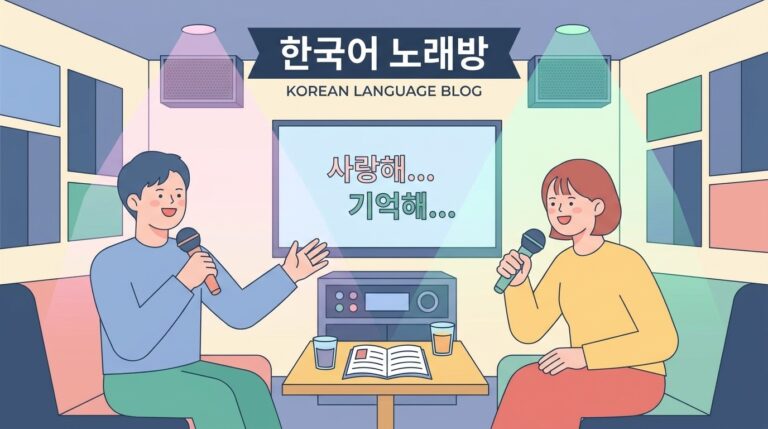
Master Korean Karaoke Ballads with Confidence: Essential Beginner Phrases for Noraebang
Phase 1: Empathy & Storytelling Opening
안녕하세요! 매일한글 에디터입니다. (Hello! It’s your Daily Hangul editor.)
Picture this: You are sitting in a cozy, dimly lit Noraebang (노래방, Korean karaoke room) in the bustling streets of Hongdae with your Korean friends. The upbeat dance tracks have faded, the disco ball slows its spin, and the iconic opening piano chords of a classic K-Drama ballad begin to play. Your friend grabs the microphone with both hands, closes their eyes, and pours their heart out.
Suddenly, everyone is immersed in deep emotion. When the song ends, your friend shyly hands you the second microphone and asks if you want to sing a ballad next. Your mind goes blank. How do you compliment their heartfelt singing? How do you ask to sing along, or suggest a slow song without sounding awkward? Many beginner learners feel overwhelmed by the fear of making mistakes in this quintessentially Korean social setting.
Don’t worry! Singing ballads in Korea is not about vocal perfection—it is about shared emotion, warmth, and connection (Jeong, 정). Based on real feedback from dozens of beginner students, this guide will equip you with simple, high-impact A1 Korean phrases and cultural etiquette to navigate any Noraebang ballad session like a natural local friend.
Phase 2: Deep Dive into 3 Core Expressions
1. 노래 진짜 잘해요! (Norae jinjja jalhaeyo!)
- Pronunciation: [Noh-rae jin-jja jal-hae-yo] (Sounds like “No-ray jean-jjah jal-hay-yo”)
- Meaning: Literal: “Song really well do!” | Real Nuance: “You’re such an amazing singer!”
- K-Culture Moment: Use this immediately after your friend finishes hitting the high emotional note in a classic ballad OST.
- Editor’s Insight: In Korean culture, quick and enthusiastic praise helps break the ice. The word
진짜(jinjja, really) adds warm, genuine authenticity to your compliment.- Situation Spectrum:
- Casual: 노래 진짜 잘해! (Norae jinjja jalhae!) ✅ (with close friends)
- Semi-formal: 노래 진짜 잘해요! (Norae jinjja jalhaeyo!) ✅ (standard polite)
- Formal: 노래를 정말 잘하십니다. (Noraereul jeongmal jalhasimnida.) ⚠️ (often too stiff for karaoke)
- 🤔 Think About It: Why do Koreans prioritize complimenting passion and emotion rather than technical pitch perfection?
2. 발라드 좋아해요? (Balladeu joahaeyo?)
- Pronunciation: [Bahl-lah-deu joh-ah-hae-yo] (Sounds like “Bahl-lah-deu jo-ah-hay-yo”)
- Meaning: Literal: “Ballad like?” | Real Nuance: “Are you into slow ballads? / Do you want to sing a ballad?”
- K-Culture Moment: Handing the song selection remote control (rimokon, 리모컨) to a friend before searching for the next track.
- Editor’s Insight: This uses the fundamental A1 verb ending
-좋아해요?(Do you like…?). It shows considerate karaoke etiquette by asking what genre your companions prefer before queuing songs.- Situation Spectrum:
- Casual: 발라드 좋아해? (Balladeu joahae?) ✅
- Semi-formal: 발라드 좋아해요? (Balladeu joahaeyo?) ✅
- Formal: 발라드를 좋아하십니까? (Balladeureul joahasimnikka?) ⚠️
- 🤔 Think About It: How does asking about someone’s music taste open up deeper conversational bonding in your own culture?
3. 같이 불러요! (Gachi bulleoyo!)
- Pronunciation: [Gah-chi bool-luh-yo] (Sounds like “Gah-chee bool-luh-yo”)
- Meaning: Literal: “Together sing!” | Real Nuance: “Let’s sing together! / Duet with me!”
- K-Culture Moment: When a popular chorus starts and you want everyone in the room to join in for a heartwarming group singalong.
- Editor’s Insight: Note that
같이is pronounced [가치 / Gachi] due to palatalization. Inviting others to sing relieves stage fright and turns a solo performance into a communal bonding memory.- Situation Spectrum:
- Casual: 같이 불러! (Gachi bulleo!) ✅
- Semi-formal: 같이 불러요! (Gachi bulleoyo!) ✅
- Formal: 함께 부르시죠. (Hamkke bureusijo.) ⚠️
- 🤔 Think About It: Why is shared participation (우리, We/Us) more valued in Korean social outings than individual spotlighting?
Phase 3: Textbook Korean vs. Real Korean
Situation 1: Inviting someone to take the turn to sing
- 📖 Textbook Korean:
노래를 부르십시오.(Noraereul bureusipsio. – Please sing a song.) - 🗣️ Real Korean:
노래 불러줘요!(Norae bulleojwoyo! – Sing a song for us! / Please sing!) - 💡 Why different?: Textbook imperatives sound like commands or formal ceremony announcements. Real Koreans use the soft
-아/어 줘요ending, which feels friendly, encouraging, and affectionate.
Situation 2: Reacting to a very moving, sad ballad
- 📖 Textbook Korean:
이 노래는 매우 감동적입니다.(I noraeneun maeu gamdongjeogimnida. – This song is very moving.) - 🗣️ Real Korean:
눈물 날 뻔했어요!(Nunmul nal ppeonhaesseoyo! – I almost cried!) - 💡 Why different?: While the textbook phrase sounds like a written literary review, native speakers express deep resonance with relatable, physical expressions like “almost tearing up.”
Phase 4: K-Culture Deep Dive & Non-verbal Manners
4-1. Noraebang Nunchi (눈치) & Body Language
- Tame the Tambourine: When someone sings an upbeat dance song, shaking the tambourine is encouraged. However, during an emotional ballad, put the tambourine down! Instead, turn on your smartphone flashlight and gently wave it side to side.
- Two-Handed Microphone Hold: Holding the mic with both hands while slightly bowing your head shows emotional sincerity and humility.
- Screen Courtesy: Position yourself so you do not block the lyrics displayed on the monitor, especially if the singer is reading Romanized subtitles or Hangul.
4-2. The Soul of the K-Ballad (감성, Gamseong)
In Korea, ballads are not just slow songs; they are a national emotional release. Whether it is an iconic K-Drama soundtrack (OST) or a legendary hit by ballad royalty like Sung Si-kyung or Paul Kim, ballads tap into Han (한, deep shared sorrow) and emotional healing. Singing along or actively listening is considered a true sign of friendship.
Phase 5: Real-World Roleplay Scenario
Setting: A trendy Coin Noraebang (코인노래방) in Sinchon. You are sitting next to your Korean language exchange partner, Minho (민호).
- Turn 1 (Minho): 🎭 [Holds up the remote control and scrolls through the ballad chart]
민호: 발라드 좋아해요? (Balladeu joahaeyo?)
(Do you like ballads?) -
Turn 2 (You): 🎭 [Nods warmly with a smile]
나: 네! 한국 발라드 진짜 좋아해요. (Ne! Hanguk balladeu jinjja joahaeyo.)
(Yes! I really like Korean ballads.) -
Turn 3 (Minho): 🎭 [Selects a famous drama OST and presses start]
민호: 그럼 이 노래 알아요? 같이 불러요! (Geureom i norae arayo? Gachi bulleoyo!)
(Then do you know this song? Let’s sing together!) -
Turn 4 (You): 🎭 [Takes the second microphone with two hands]
나: 알아요! 하지만 먼저 불러줘요. (Arayo! Hajiman meonjeo bulleojwoyo.)
(I know it! But please sing first.) -
Turn 5 (Minho): 🎭 [Sings the heartfelt verse passionately and hits the high chorus note]
민호: …사랑해요~ 🎵 (…Saranghaeyo~)
(…I love you~) -
Turn 6 (You): 🎭 [Claps hands softly and waves phone flashlight]
나: 와, 노래 진짜 잘해요! 감동이에요! (Wa, norae jinjja jalhaeyo! Gamdongieyo!)
(Wow, you sing really well! I’m so touched!) -
Turn 7 (Minho): 🎭 [Laughs shyly and passes the chorus line to you]
민호: 고마워요! 이제 다음 소절 불러봐요! (Gomawoyo! Ije daeum sojeol bulleobwayo!)
(Thanks! Now try singing the next verse!) -
Turn 8 (You): 🎭 [Takes a deep breath and sings enthusiastically]
나: 네, 같이 불러요! (Ne, gachi bulleoyo!)
(Yes, let’s sing together!)
🔀 Interactive Decision Point
After Minho finishes his impressive emotional ballad solo, what do you do next?
- Option A: Put your microphone down, check your social media notifications, and say nothing.
- Option B: Clap your hands enthusiastically and say:
노래 진짜 잘해요! 눈물 날 뻔했어요!(Norae jinjja jalhaeyo! Nunmul nal ppeonhaesseoyo!) - Option C: Grab the tambourine and shake it as loud as possible right next to the microphone while yelling loudly.
Feedback:
* Option A (Bad): Breaking eye contact and ignoring their emotional effort damages the mood.
* Option B (Best!): Giving heartfelt praise and acknowledging their emotional performance builds instant friendship!
* Option C (Risk): Excessive loud noise during a slow, sensitive ballad ruins the ambient vibe (gamseong).
Phase 6: 10-Second Emotion Shadowing Drill
Practice these natural rhythm pauses (/) with the indicated emotional tones:
[🥺 감미롭고 조심스럽게 - Sweet & Gentle]
발라드 / 좋아해요? (Balladeu / joahaeyo?)-
[👏 진심으로 감탄하며 - Genuine Admiration]
와! / 노래 / 진짜 / 잘해요! (Wa! / Norae / jinjja / jalhaeyo!) -
[🤝 밝고 다정하게 - Warm & Encouraging]
우리 / 같이 / 불러요! (Uri / gachi / bulleoyo!)
Phase 7: K-Culture Mini Dictionary
- 코노 (Kono) (Noun): Short for
코인 노래방(Coin Noraebang). Automated karaoke booths where you pay per song (e.g., 1,000 KRW for 2–3 songs), extremely popular among students and solo singers. - 떼창 (Ttechang) (Noun): Singing along together in unison as a group or crowd. A staple of Korean concert and karaoke culture.
- 감성 (Gamseong) (Noun): Sentimentality, emotional vibe, or atmosphere. Used when praising mood-rich ballads or aesthetic spaces.
- 간주 점프 (Ganju-jeompeu) (Phrase/Button): “Interlude Skip.” A vital button on Korean karaoke remotes to jump straight past long instrumental pauses to save time.
Phase 8: Traveler’s Survival Kit
Survival Remote Controls TOP 3
시작(Sijak) – Start / Play | Pro Tip: Press this green button immediately after entering your 4-to-5-digit song number.취소(Chwiso) – Cancel / Stop | Pro Tip: Stops the song right away if you picked the wrong track.예약(Yeyak) – Reserve / Queue | Pro Tip: Queues your song so it plays smoothly right after the current song ends.
Editor’s Travel Note
- Finding Nearby Rooms: Search for
코인노래방on the Naver Map navigation application for Korea to find highly rated, clean coin karaoke rooms nearby. - Payment Tip: Most modern coin karaoke rooms accept Korean credit cards, T-Money, and 1,000 KRW cash bills.
Phase 9: A Step Deeper (Reflection)
In many Western cultures, karaoke is often treated as comedy, late-night party fun, or a solo spotlight. In Korea, Noraebang is a therapeutic social sanctuary. Here, hierarchical workplace stress and daily pressures dissolve into shared melodies. When you sing a ballad in Korea, you are not being judged on technical pitch; you are opening a window into your heart, inviting others to share in the emotion.
💬 Your Turn: What is your all-time favorite K-Drama OST or Korean ballad that you would love to sing at a Noraebang? Leave your song in the comments below!
Phase 10: FAQ & Common Mistakes
Q: What if I can’t read Hangul fast enough on the karaoke screen?
A: Most modern Korean karaoke machines (like TJ Media and Geumyoung) display English pop songs, and many Korean ballad selections offer optional Romanized subtitles or phonetic guides. You can also search song titles directly in English on the remote keyboard!
Q: Is it rude to reserve a song while someone else is singing?
A: Not at all! In fact, pressing 예약 (Reserve) is the polite standard. Just make sure you never press 시작 (Start) while another person is in the middle of their song, as that will abruptly cut off their music.
Q: Can I go to a Noraebang alone to practice Korean ballads?
A: Absolutely! 혼코노 (Hon-kono, solo coin karaoke) is a huge trend in Korea. It is the perfect low-pressure environment for beginner learners to practice Korean pronunciation and singing.
🚨 Common Mistakes TOP 3
- ❌ Mistake 1: Shaking the tambourine during slow ballads.
- 💡 Correct Action: Set the tambourine aside and wave your smartphone flashlight gently.
- ❌ Mistake 2: Pressing
취소(Cancel) on someone else’s song.- 💡 Correct Action: Only cancel your own songs unless the singer explicitly asks you to skip the outro.
- ❌ Mistake 3: Monopolizing the mic with 5 consecutive songs.
- 💡 Correct Action: Take turns in round-robin order to keep the group dynamic fun and balanced.
Phase 11: Action Mission & Engagement
- 🥉 Bronze Level: Practice saying
노래 진짜 잘해요!out loud 5 times using the shadowing drill. - 🥈 Silver Level: Look up a 1-minute clip of a famous K-Drama ballad (e.g., Crash Landing on You or Goblin OST) and sing the chorus line.
- 🥇 Gold Level: Visit a Coin Noraebang or record yourself singing a simple ballad chorus and share your practice progress!
🎮 K-Culture Mission: Search for the phrase 발라드 명곡 (Legendary Ballad Masterpieces) on YouTube or Spotify, pick one song, and identify the word 사랑 (Love) or 눈물 (Tears) in the lyrics.
Phase 12: Interactive Quiz Challenge
Q1. Situation Judgment
Your friend just finished singing a heartbreaking ballad. What is the most polite and natural reaction?
a) 취소해 주세요! (Please cancel it!)
b) 노래 진짜 잘해요! (You sing really well!)
c) 발라드 부르십시오. (Sing a ballad.)
👉 Click to view Answer & Explanation
Answer: b) 노래 진짜 잘해요!
Explanation: Complimenting their singing directly with enthusiasm builds great friendship and fits the warm Noraebang atmosphere.
Q2. Fill in the Blank
Complete the sentence to invite your friend to sing together:
우리 ____ 불러요! (Let’s sing together!)
👉 Click to view Answer & Explanation
Answer: 같이 (Gachi)
Explanation: 같이 means “together”. Combined with 불러요 (sing), it creates the welcoming phrase “Let’s sing together!”
Q3. True or False
During a slow Korean ballad, shaking the tambourine loudly is considered good manners.
(True / False)
👉 Click to view Answer & Explanation
Answer: False
Explanation: For slow, emotional ballads, it is better to listen attentively or gently wave your smartphone flashlight to preserve the emotional ambiance (gamseong).







