

Phase 1: Empathy & Cultural Immersion
안녕하세요! 매일한글 에디터입니다. (Hello! I’m your Daily Hangul editor.)
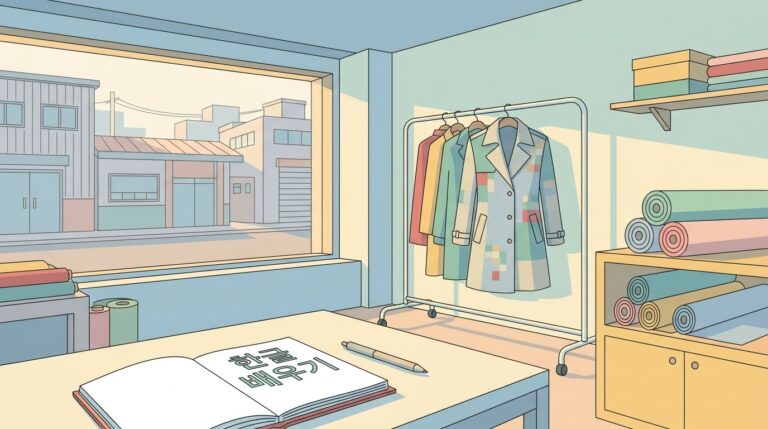
Picture this: You are standing inside a sunlit, industrial-chic concept atelier tucked in the red-brick alleys of Seongsu-dong (성수동)—Seoul’s bustling epicenter of bespoke fashion and creative disruption. Around you, sleek creative directors and trend-savvy curators sip oat-milk flat whites while scrutinizing an avant-garde trench coat constructed from discarded military tents and deadstock hanbok silk.
You want to jump into the conversation. You want to articulate how the brand effortlessly balances zero-waste ethics with runway-ready deconstructionism. But suddenly, your vocabulary feels trapped in basic textbook territory: “이 옷은 재활용해서 예뻐요” (This clothing is pretty because it’s recycled). It sounds like an elementary school presentation rather than the sharp, sophisticated critique of an industry insider.
At the C2 level, discussing fashion in Korea isn’t just about describing garments; it’s about navigating the intersection of hyper-modern market dynamics, consumer psychology, and nuanced aesthetic philosophy. Korean fashion discourse moves fast, weaving socio-cultural value codes with high-register industry jargon. This master guide—built upon real-world feedback from global fashion buyers, designers, and advanced learners—will empower you to articulate design aesthetics, deconstruct circular business models, and command respect in any high-level creative discourse in Seoul.
Phase 2: Top 3 Core C2 Expressions for Upcycling Fashion
1. 지속 가능한 미학을 구현하다 (Jisok ganeunghan mihageul guhyeonhada)
- Pronunciation: [Ji-sok ga-neung-han mi-ha-geul gu-hyeon-ha-da] (Think of ‘mi-hak’ flowing effortlessly like the English word ‘me-hack’, delivering a grounded, intellectual cadence).
- Meaning: Literally: “To embody/realize sustainable aesthetics.” | Nuance: Captures the intentional synthesis where sustainability ceases to be a mere technical constraint and becomes an elevated artistic philosophy.
- K-Culture Moment: Used by creative directors during Seoul Fashion Week panel discussions or featured in high-end design retrospectives on W Korea and Vogue Korea.
- Editor’s Insight: The verb 구현하다 (to realize/actualize a vision into concrete form) elevates standard descriptive speech into sophisticated executive discourse.
- Situation Spectrum: Casual 🚫 | Semi-formal ⚠️ | Formal ✅
- 🤔 Think About It: How does your native language distinguish between “green design” as an eco-label versus an intrinsic high-art philosophy?
2. 가치 소비를 견인하다 (Gachi sobireul gyeon-in-hada)
- Pronunciation: [Ga-chi so-bi-reul gyeon-in-ha-da] (Pronounce ‘gyeon-in’ with a crisp, assertive onset, like the initial burst in ‘gear-in’).
- Meaning: Literally: “To tow/drive value-driven consumption.” | Nuance: Refers to leading or catalyzing a market trend where consumers buy products that reflect their personal ethics and socio-environmental values.
- K-Culture Moment: Frequently highlighted in business analyses discussing MZ-generation (MZ세대) buying behaviors in Hyundai Seoul and Seongsu pop-ups.
- Editor’s Insight: 견인하다 (to tow/propel forward) is a high-impact business verb. Pair it with 가치 소비 (conscious/ethical consumerism) to instantly sound like an industry strategist.
- Situation Spectrum: Casual 🚫 | Semi-formal ✅ | Formal ✅
- 🤔 Think About It: In Korean retail, consumer ethics are framed around “value alignment” (가치). Does your culture view ethical purchasing as individual morality or collective market disruption?
3. 해체주의적 재해석을 거치다 (Haeche-ju-ui-jeok jae-hae-seog-eul geochida)
- Pronunciation: [Hae-che-ju-ui-jeok jae-hae-seo-geul geo-chi-da] (Flow smoothly over ‘hae-che’, letting the vowels glide cleanly without harsh aspiration).
- Meaning: Literally: “To undergo deconstructive reinterpretation.” | Nuance: Describes the artisanal process of dismantling existing materials or garments to create an entirely new silhouette imbued with cultural narrative.
- K-Culture Moment: Mentioned in fashion magazines when describing custom rework stage outfits for high-concept K-Pop groups like aespa, NewJeans, or BTS.
- Editor’s Insight: 해체주의 (deconstructivism) paired with 재해석 (reinterpretation) proves you understand contemporary high-fashion lexicon beyond standard upcycling cliches.
- Situation Spectrum: Casual ⚠️ | Semi-formal ✅ | Formal ✅
- 🤔 Think About It: How does breaking down old structures in design parallel linguistic deconstruction in cross-cultural communication?
Phase 3: Textbook Korean vs. Real Native C2 Korean
Scenario 1: Explaining the Material & Craftsmanship
- 📖 Textbook Korean: 이 옷은 버려진 원단을 다시 사용해서 환경 친화적이고 디자인도 독특합니다. (I oseun beoryeojin wondaneul dasi sayonghaeseo hwangyeong chinhwajeogigo dijaindo dokteukhamnida.) — “This piece uses discarded fabric again, so it is eco-friendly and has a unique design.”
- 🗣️ Real Native C2 Korean: 폐자재에 아카이브적 가치를 부여해서, 해체와 재구성을 통해 독보적인 실루엣을 완성했네요. (Pyejajae-e aka-ibujeok gachireul buyeohaeseo, haechewa jaeguseongeul tonghae dokbojeogin sillu-eseul wanseonghaenneyo.) — “By imparting archival value to discarded materials, they’ve achieved an unmatched silhouette through deconstruction and restructuring.”
- 💡 Why the Difference? C2 discourse avoids generic terms like “eco-friendly” (친환경) in favor of nuanced conceptual terminology (아카이브적 가치, 해체와 재구성), demonstrating aesthetic authority.
Scenario 2: Discussing Premium Pricing & Market Viability
- 📖 Textbook Korean: 업사이클링 제품이라서 손이 많이 가기 때문에 가격이 비쌉니다. (Eopsaikeulling jepum-iraseo son-i mani gagi ttaemune gageog-i bissamnida.) — “Because it is an upcycled product, it takes a lot of manual work, so the price is expensive.”
- 🗣️ Real Native C2 Korean: 공정의 희소성과 커스텀 헤리티지를 감안하면, 충분히 시장에서 납득 가능한 프라이싱입니다. (Gongjeong-ui hisoseonggwa keoseuteom heritijireul gamanhamyeon, chungbunhi sijang-eseo naptteuk ganeunghan peuraising-imnida.) — “Considering the scarcity of the production process and the custom heritage, this pricing is entirely justifiable in the market.”
- 💡 Why the Difference? Native industry professionals substitute raw adjectives like “비싸다” (expensive) with sophisticated business assessments (납득 가능한 프라이싱, 희소성).
Phase 4: K-Culture Deep Dive & Non-Verbal Nuance
4-1. Nunchi (눈치) & Professional Body Language in Design Spaces
When evaluating high-end upcycled pieces in Korean design showrooms:
* The Textile Touch (촉각적 감상): Never grab garments abruptly. Lightly touch the seam or lining with two fingers while subtly nodding. This signals respect for artisanal labor (공예적 가치).
* Subtle Tone Modulation: Maintain a steady, calm, low-to-mid vocal pitch when delivering critique. In Korean creative circles, overly loud exclamations can seem performative; measured praise conveys profound connoisseurship (안목).
4-2. Cultural Code: The Convergence of K-Pop Stage Styling & Circular Fashion
In Seoul’s fashion landscape, upcycling is no longer confined to gritty underground DIY movements. Top-tier K-Pop stylists actively collaborate with zero-waste ateliers to dismantle vintage military gear, traditional hanbok fabrics, and sports jerseys into one-of-a-kind stage couture. This symbiotic relationship between high-speed pop culture and slow-fashion ethos has accelerated consumer acceptance, turning upcycled rework into the ultimate symbol of individuality (개성) and conscious status (개념 소비).
Phase 5: Real-Life C2 Roleplay Scenario
Setting: A private curation salon in Seongsu-dong.
Characters:
* 민서 (Min-seo): Creative Director of an avant-garde circular fashion label.
* 알렉스 (Alex): Global Fashion Consultant & Buyer (You).
[Scene: Min-seo presents a tailored jacket constructed from upcycled sailcloth and vegetable-tanned deadstock leather.]

민서: 이번 컬렉션은 버려지는 해양 폐기물에 모던한 테일러링을 접목해 봤어요. 실용성과 조형미의 균형을 맞추는 게 관건이었죠.
(Ibeon keollekseon-eun beoryeojineun haeyang pyegimure modeonhan teilleoring-eul jeopmokhae bwasseoyo. Siryongseonggwa johyeongmi-ui gyunhyeong-eul matchuneun ge gwangeoni-eotjyo.)
"For this collection, we merged discarded marine waste with modern tailoring. The key challenge was striking a balance between utility and sculptural aesthetics."
🎭 [민서는 원단의 독특한 질감을 가리키며 알렉스의 반응을 살핀다.]

알렉스: 단순히 친환경적인 메시지에 머무르지 않고, 소재의 질감을 감각적으로 살려낸 점이 인상적이네요.
(Dansunhi chinhwangyeongjeogin mesijie meomureuji anko, sojae-ui jilgameul gamgakjeogeuro sallyeonaen jeom-i insangjeogineyo.)
"What strikes me is that it doesn't just stop at an eco-friendly message; you’ve artistically accentuated the raw tactile texture of the material."

민서: 알아봐 주셔서 기쁘네요. 다만 양산 단계에서 단가 책정과 공정 효율화 사이의 간극을 좁히는 게 숙제예요.
(Arabwa jusyeoseo gippeuneyo. Daman yangsan dangye-eseo danga chaekjeonggwa gongjeong hyoyulhwa sai-ui gangeugeul jobhineun ge sukjeyeoyo.)
"I'm glad you noticed. However, bridging the gap between unit pricing and process efficiency during mass production remains our homework."

알렉스: 핸드메이드 특유의 헤리티지를 고려할 때, 타깃 소비층의 가치 소비 성향을 공략한다면 충분히 시장성이 있다고 봅니다.
(Haendeumeideu teuk-yu-ui heritijireul goryeohal ttae, tagit sobicheung-ui gachisobi seonghyang-eul gongnyakhandamyeon chungbunhi sijangseong-i itdago bomnida.)
"Given the distinctive heritage of handmade craftsmanship, if you target the value-driven consumption habits of our demographic, it possesses strong market viability."
🔀 Interactive Decision Point: How do you advise Min-seo on scaling up?
- Choice A (Pragmatic Commercialist): “공정을 단순화해서 단가를 무조건 낮추고 대량 생산에 집중하시죠.” (Let’s simplify processes, slash unit costs at all costs, and focus on mass volume.)
- Choice B (Visionary Strategist – BEST): “희소성을 극대화한 리미티드 드롭(Limited Drop) 전략으로 브랜드의 하이엔드 포지셔닝을 공고히 하는 건 어떨까요?” (How about solidifying the brand’s high-end positioning through a limited-drop strategy that maximizes rarity?)
- Choice C (Academic Idealist): “수익성보다는 환경 보호라는 순수한 이상주의를 유지하는 것이 브랜드의 의무입니다.” (Maintaining pure environmental idealism over profitability is the brand’s true moral duty.)
Feedback:
* Choice A (Bad): Strips the brand of its artisanal soul and reduces upcycling to cheap fast fashion, undermining Min-seo’s creative vision.
* Choice B (Best): Balances luxury positioning, artisanal scarcity, and realistic profit margins in the contemporary Korean fashion landscape.
* Choice C (Risk): Ignores business realities; dismissing profitability can alienate commercial partners in professional curation meetings.
Phase 6: 10-Second Emotional Shadowing Drill
Practice reading these rhythmically with natural intonation breaks (/) and distinct emotion markers:
[🧐 지적이고 확신에 찬 어조로 / Intellectual & Confident]
“지속 가능한 패션이 / 단순한 트렌드를 넘어 / 패러다임의 전환을 이끌고 있습니다.”
(Jisok ganeunghan paesyeoni / dansunhan teurendeureul neomeo / paereodaim-ui jeonhwan-eul igkeulgo itseumnida.)
“Sustainable fashion is moving beyond a mere trend / driving a true paradigm shift.”-
[✨ 감탄하며 섬세하게 / Admiring & Tactile]
“소재의 거친 물성을 / 이토록 정교한 실루엣으로 / 재해석해 낸 안목이 놀랍네요.”
(Sojae-ui geochin mulseong-eul / itorok jeonggyohan sillu-eseuro / jaehae-seokhae naen anmogi nollapneyo.)
“The keen eye required / to reinterpret such raw material textures / into this delicate silhouette is astonishing.” -
[💼 예리한 비즈니스 톤으로 / Sharp Business Tone]
“친환경이라는 명분만으로는 부족합니다. / 시장 경쟁력과 디자인 완성도가 수반되어야 하죠.”
(Chinhwangyeong-iraneun myeongbunman-eoroneun bujokhamnida. / Sijang gyeongjaengnyeokkwa dijain wanseongdoga subandoeeoya hajyo.)
“A noble eco-friendly cause alone is not enough. / It must be accompanied by market competitiveness and design mastery.”
Phase 7: K-Culture Mini Dictionary (Key Concepts)
- 새활용 (Saehwalyong) — Koreanized Upcycling
Usage: The pure Korean governmental and cultural term for upcycling (literally “new utilization”), widely used in institutional design exhibitions and public eco-initiatives. - 가치소비 (Gachisobi) — Conscious / Value-Aligned Consumerism
Usage: The dominant market phenomenon where buyers willingly pay a premium for items that support ethical, vegan, or circular principles. - 커스텀 리워크 (Keoseuteom Riwokeu) — Custom Rework
Usage: Streetwear and high-fashion term describing one-off pieces reconstructed from vintage or deadstock garments. - 필환경 (Pilhwangyeong) — Green-as-a-Must (Essential Environment)
Usage: A portmanteau of 필수 (essential) and 환경 (environment), expressing that eco-consciousness is no longer an optional choice (친환경) but a mandatory survival strategy.
Phase 8: Fashion Explorer’s Survival Kit
Top 3 Survival Lines for Showrooms & Design Discussions
- “이 제품의 원단 소싱 히스토리가 궁금합니다.”
(I jepum-ui wondan sosing hiseutori-ga gung-geumhamnida.)
Pro Tip: Use this in independent design studios to ask about where and how their upcycled deadstock materials were sourced. - “원오프(One-off) 피스인가요, 아니면 스몰 배치(Small-batch) 생산인가요?”
(One-off piseuingayo, animyeon small-batch saengsan-ingayo?)
Pro Tip: Inquiring about limited edition status signals that you understand production volume dynamics. - “해체주의 디테일이 테일러링과 아주 조화롭게 어우러지네요.”
(Haecheju-ui diteil-i teilleoring-gwa aju johwaropge eoureojineyo.)
Pro Tip: A refined, C2-level compliment sure to earn immediate respect from Korean showroom curators.
Editor’s Travel Note
When visiting Seoul’s design districts (Seongsu, Hannam, and Euljiro), download the Naver Map application to search for curated keywords like “업사이클링 편집숍” (Upcycling Concept Stores) or “지속가능 브랜드 쇼룸” (Sustainable Brand Showrooms). Most high-end ateliers offer tax-free documentation and use biodegradable or cloth-wrap packaging—feel free to say “포장은 최소한으로 간소하게 해주셔도 됩니다” (You can keep the packaging minimal) to practice your zero-waste ethos in real time!
Phase 9: “One Step Deeper” (Sociocultural Reflection)
Korea’s modern upcycling boom is not merely an imported Western concept; it resonates deeply with ancient cultural heritage. For centuries, traditional Korean households practiced the art of Jogakbo (조각보)—sewing leftover scraps of silk and ramie into geometric wrapping cloths (Bojagi) imbued with wishes for longevity and good fortune. Modern Korean upcycling design effortlessly bridges this centuries-old frugality with Seoul’s hyper-futuristic streetwear landscape.
💬 Your Turn: How does your home culture approach the balance between vintage preservation, sustainability, and ultra-fast contemporary trends? Share your thoughts below in Korean!
Phase 10: FAQ & Common Mistakes
Q: Isn’t ‘재활용’ (Jaehwalyong) the same as ‘업사이클링’ (Upcycling)?
A: Not in elevated discourse. 재활용 refers to basic mechanical recycling (e.g., crushing bottles into raw plastic pellets). 새활용 or 업사이클링 refers specifically to adding aesthetic, creative, and functional value through thoughtful design reinterpretation.
Q: When is it appropriate to use the term ‘필환경’ (Pilhwangyeong)?
A: Use it in formal presentations, retail analysis, or socio-cultural essays when arguing that environmental sustainability is an indispensable business requirement rather than a peripheral marketing gimmick.
Q: How can I describe bespoke reworked garments naturally?
A: Instead of saying “수제 옷” (handmade clothes), use industry terms such as 커스텀 리워크 피스 (Custom rework piece) or 아카이브 기반의 해체주의 디자인 (Archive-based deconstructive design).
🚨 Common Mistakes Alert
- Mistake: Calling high-end rework “중고 옷” (used/secondhand clothes).
Correction: Refer to the garments as 빈티지 아카이브 (Vintage archive) or 업사이클 피스 (Upcycled piece). - Mistake: Overusing “그린 (Green)” as a standalone adjective.
Correction: Employ compound nouns like 지속 가능성 (Sustainability) or 친환경 가치 (Eco-friendly value). - Mistake: Pronouncing English loanwords with heavy Western stress in Korean sentences.
Correction: Blend terms like 디테일 (di-te-il) and 헤리티지 (he-ri-ti-ji) smoothly into standard Korean pitch-accent.
Phase 11: Action Missions
- 🥉 Bronze Mission (Self-Practice): Record your voice reading Shadowing Drill #2 three times, focusing on fluid pronunciation of “해체주의적 재해석”.
- 🥈 Silver Mission (Social Share): Find a photo of an upcycled outfit online and post a 2-sentence critique on your social media using the keywords 가치 소비 and 실루엣.
- 🥇 Gold Mission (Real-World Execution): Next time you visit a boutique or interact with a Korean fashion creator online, ask them about their design sourcing using our survival phrase: “이 제품의 원단 소싱 히스토리가 궁금합니다.”
- 🎮 K-Culture Mission: Watch a recent K-Pop behind-the-scenes styling vlog (e.g., on YouTube) and spot at least one custom-reworked garment made from deadstock materials.
Phase 12: Interactive Quiz Challenge
1. Situation Judgment
Question: You are negotiating with a Korean showroom buyer who worries that upcycled garments might look unrefined. Which statement best reassures them with C2 elegance?
* A) “재활용이라서 조금 더럽게 보일 수도 있습니다.” (Because it’s recycled, it might look a bit dirty.)
* B) “원자재의 아카이브적 특성을 살리되, 섬세한 테일러링을 더해 하이엔드 완성도를 확보했습니다.” (While preserving the archival characteristics of the raw materials, we secured high-end perfection through delicate tailoring.)
* C) “어차피 환경을 위한 것이니 구매자가 이해해야 합니다.” (Since it’s for the environment anyway, the buyer should just understand.)
2. Fill-in-the-Blank
Question: MZ세대의 적극적인 ( ) 성향이 지속 가능한 패션 브랜드의 시장 확대를 이끌고 있다. (The active [ ] propensity of the MZ generation is driving the market expansion of sustainable fashion brands.)
3. True or False Cultural Trivia
Statement: In Korean corporate fashion analysis, ‘필환경’ means environmental initiatives are strictly optional and secondary to rapid fast-fashion production. (T/F)
👉 Click here to reveal Answers & Explanations!
- Situation Judgment: B (It balances material authenticity with refined craftsmanship, using advanced business terminology).
- Fill-in-the-Blank: 가치 소비 (Value-driven consumption / Conscious consumerism).
- Cultural Trivia: False (필환경 means sustainability is an absolute imperative/necessity, derived from 필수 + 환경).







