

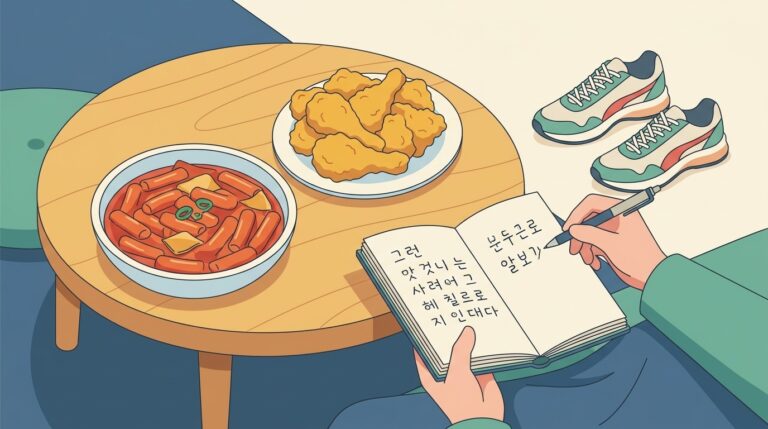
Korean Diet Culture: Don’t Fall into the Cheat Day Trap! Essential Phrases for Foodies
Phase 1: Empathy (Story-Driven Opening)
안녕하세요! 매일한글 에디터입니다. (Hello! It’s your Daily Hangul editor.)
Picture this: You have been disciplined all week in Seoul. You ate sweet potatoes, drank plain soy milk, and resisted the intoxicating aroma of freshly fried street food wafting through the subway station. Finally, Friday night arrives. Your Korean friend shoots you a KakaoTalk message: “오늘 치팅 데이잖아! 엽떡에 허니콤보 콜?” (“It’s cheat day today! Spicy tteokbokki and honey fried chicken, deal?”). Before you can even calculate the macronutrients, you are sitting at a bustling dining table surrounded by melted cheese, crispy chicken skin, and cold draft beer. You tell yourself, “Just one bite.” But two hours later, you are wondering how a simple cheat meal turned into an all-out feast!
If you have ever experienced this exact panic, don’t worry—you are participating in a quintessential Korean cultural ritual. In South Korea, where food is the primary language of hospitality and bonding, balancing a strict fitness routine with an active social life is an art form. In this guide, tailored specifically for intermediate (B1) learners, we will unpack how Koreans joke about, cope with, and survive the dreaded 치팅 데이의 함정 (The Cheat Day Trap) with authentic expressions that will make your Korean friends laugh and nod in total agreement.
Phase 2: Deep Dive into 3 Core Expressions
1. 맛있게 먹으면 0칼로리! (Mas-itge meogeumyeon yeong-kallori!)
- Pronunciation: [Mas-ik-kkay meo-geu-myeon young-kal-lo-ri] (Sounds like: “Mah-sheet-gay muh-geum-yeon young-cal-lo-ree”)
- Meaning: “If it tastes delicious, it’s 0 calories!” (Literal) / “Let’s just enjoy this food guilt-free!” (Actual Nuance)
- K-Culture Moment: You will hear this phrase shouted constantly on Korean variety shows and mukbang livestreams whenever an idol or fitness trainer surrenders to a table of sizzling Korean BBQ.
- Editor’s Insight: Popularized by famous Korean television host Choi Hwa-jeong, this phrase is the ultimate Korean psychological shield. It is not denial; it is an agreement that happiness and good company cancel out dietary guilt.
- Situation Spectrum: Casual (✅) / Semi-formal (✅) / Formal (🚫)
- 🤔 Think About It: In English, we often say “Treat yourself!” or “Calories don’t count on weekends.” How does the Korean focus on the sensory pleasure of deliciousness (맛있게) change the emotional tone of eating together?
2. 다이어트는 내일부터! (Daieoteuneun naeilbuteo!)
- Pronunciation: [Da-i-eo-teu-neun nae-il-bu-teo] (Sounds like: “Die-uh-teu-neun neh-eel-boo-tuh”)
- Meaning: “The diet starts tomorrow!” (Literal) / “I’m giving up for tonight; let’s feast!” (Actual Nuance)
- K-Culture Moment: Seen in almost every K-drama where characters decide at 11:00 PM to order late-night delivery (야식 – Yasik) such as Jokbal (pig trotters) or Ramyeon.
- Editor’s Insight: This is the universal slogan of procrastination. Koreans use it to break the awkward tension when someone is hesitating to order more food. By postponing the diet to an indefinite “tomorrow,” everyone feels licensed to indulge.
- Situation Spectrum: Casual (✅) / Semi-formal (⚠️) / Formal (🚫)
- 🤔 Think About It: Why is shared surrender so comforting? Notice how saying this invites the whole group to relax their guard.
3. 입 터졌다 (Ip teojyeotda)
- Pronunciation: [Ip teo-jyeot-da] (Sounds like: “Eep tuh-jyut-dah”)
- Meaning: “My mouth has burst open!” (Literal) / “My appetite switch has been flipped / I’m on a binge spree!” (Actual Nuance)
- K-Culture Moment: Fitness creators on YouTube use this phrase the instant they eat a slice of cake after a fitness competition and suddenly clean out the entire refrigerator.
- Editor’s Insight: 입 (mouth) + 터지다 (to burst/explode). It portrays binge-eating not as a moral failing, but as an uncontrollable natural dam breaking after weeks of strict restriction.
- Situation Spectrum: Casual (✅) / Semi-formal (🚫) / Formal (🚫)
- 🤔 Think About It: English speakers usually say “I lost my willpower” or “I fell off the wagon.” How does the visual metaphor of the mouth “bursting open” externalize the craving?
Phase 3: Textbook Korean vs. Real-World Korean
Situation 1: Declining an extra round of food because you are watching your weight
- 📖 교과서 한국어 (Textbook): 저는 지금 체중 감량 중이라서 음식을 많이 먹지 못합니다. (Jeoneun jigeum chejung gamnyang jung-iraseo eumsigeul mani meokji mothamnida.) — “I cannot eat a lot of food because I am currently reducing my body weight.”
- 🗣️ 진짜 한국어 (Real Native): 저 요즘 식단 조절 중이라 조금만 먹을게요! (Jeo yojeum sikdan jojeol jung-ira jogeumman meogeulgeyo!) — “I’m watching my diet meal plan these days, so I’ll just have a little bit!”
- 💡 왜 다를까? (Why is it different?): The term 체중 감량 (weight reduction) sounds overly clinical and formal, like a doctor’s report. Native speakers casually say 식단 조절 중 (regulating my diet) or simply 관리 중 (managing myself), which sounds polite and modern.
Situation 2: Regretting eating way too much on your cheat day
- 📖 교과서 한국어 (Textbook): 오늘 너무 과식을 해서 후회가 됩니다. (Oneul neomu gwasigeul haeseo huhoega doemnida.) — “I overate too much today, so I feel regret.”
- 🗣️ 진짜 한국어 (Real Native): 아, 오늘 치팅 데이 완전 망했다… 배 터질 것 같아. (A, oneul chiting dei wanjeon manghaetda… bae teojil geot gata.) — “Ah, my cheat day went completely out of control… I feel like my stomach is going to explode.”
- 💡 왜 다를까? (Why is it different?): 과식 (overeating) is a formal Sino-Korean noun. In day-to-day conversations, friends express bodily discomfort dramatically using 배 터지다 (stomach exploding) and 망했다 (ruined/messed up).
Phase 4: K-Culture Deep Dive & Non-Verbal Etiquette
4-1. 눈치 (Nunchi) & Body Language at the Korean Dining Table
- The Two-Handed Belly Tap: When refusing another serving without offending an elder or enthusiastic host, lightly pat your stomach with both hands, smile apologetically, and tilt your head slightly while saying: “진짜 배불러요! 잘 먹었습니다.” (I’m truly full! Thank you for the meal.)
- The Shared Responsibility Tactic: If you are ordering high-calorie food on a cheat day, do not order silently. Announce your cheat day with an energetic smile (“오늘만 먹을게요!” – I’ll only eat today!) so everyone shares the carefree vibe.
- Ordering Zero Options Smoothly: You can order low-calorie alternatives without dampening the party mood by immediately volunteering to be the “Zero drink coordinator” (“음료는 제로 콜라로 시킬까요?” – Shall we order Zero Coke for the drinks?).
4-2. Cultural Codes: The “Zero” Craze & Maintenance Culture
Korea is currently experiencing a nationwide obsession with health and aesthetics. Convenience stores (CU, GS25, 7-Eleven) are packed with 제로 칼로리 (zero-calorie) sodas, zero-sugar ice cream, and protein-infused chips. Yet paradoxically, dining out remains intensely communal. This tension gave birth to the concept of 유지어터 (Yujieoteo)—people who focus on weight maintenance rather than extreme starvation, allowing for epic weekend “cheating days” balanced with hyper-disciplined weekdays.
Phase 5: Real-World Roleplay Scenario
Setting: A vibrant Pocha (street bar/pub) in Gangnam at 8:00 PM on a Friday. Neon signs glow, and the aroma of spicy grilled chicken fills the air.
Characters:
* 민지 (Minji): Your Korean coworker and ultimate foodie buddy who believes weekends are strictly for eating.
* You (학습자): A dedicated fitness enthusiast trying hard to survive your designated “cheat meal” without destroying your entire week’s progress.
[1] 민지: 오늘 진짜 고생 많았어! 우리 매운 닭발에 계란찜 세트 시키자. (Oneul jinjja gosaeng manasseo! Uri maeun dakbare gyeranjjim sete sikija.)
🎭 [메뉴판을 신나게 흔들며 눈을 반짝인다]
"You worked so hard today! Let's order the spicy chicken feet with steamed egg set."

[2] You: 우와, 맛있겠다! 근데 나 요즘 식단 조절 중이라... (Uwa, mas-itgetda! Geunde na yojeum sikdan jojeol jung-ira...)
🎭 [메뉴판을 보며 침을 삼키지만 주저한다]
"Wow, that looks delicious! But I'm watching my diet these days..."

[3] 민지: 에이~ 오늘 금요일이잖아! 치팅 데이 몰라? 맛있게 먹으면 0칼로리야! (Ei~ oneul geumyoil-ijana! Chiting dei molla? Mas-itge meogeumyeon yeong-kallori-ya!)
🎭 [손사래를 치며 자신만만하게 웃는다]
"Come on~ It's Friday! Haven't you heard of cheat days? If it tastes good, it's 0 calories!"

[4] You: 맞아, 다이어트는 내일부터지! 그럼 주먹밥도 추가할까? (Maja, daieoteuneun naeilbuteoji! Geureom jumeokbapdo chugahalkka?)
🎭 [설득당해 활짝 웃으며 맞장구를 친다]
"Right, diet starts tomorrow! Then should we add rice balls too?"

[5] 민지: 당연하지! 마요네즈 듬뿍 넣은 참치 주먹밥으로 가자. (Dangyeonhaji! Mayonejeu deumpuk neoeun chamchi jumeokbabeuro gaja.)
🎭 [엄지손가락을 치켜세우며 주문 벨을 누른다]
"Of course! Let's go with tuna rice balls packed with extra mayo."

[6] You: 아... 이러면 큰일인데, 나 오늘 완전 입 터질 것 같아. (A... ireomyeon keun-irinde, na oneul wanjeon ip teojil geot gata.)
🎭 [머리를 긁적이며 행복한 비명을 지른다]
"Ah... this is dangerous, I feel like my appetite is bursting wide open today."

[7] 민지: 괜찮아, 주말에 같이 한강 러닝 뛰면 돼! (Gwaenchana, jumare gachi Hangang reoning ttwimyeon dwae!)
🎭 [맥주잔을 부딪치며 호탕하게 웃는다]
"It's fine, we can just run along the Han River together this weekend!"

[8] You: 좋아, 건배! 오늘 밤은 칼로리 생각 안 할래! (Joa, geonbae! Oneul bameun kallori saenggak an hallae!)
🎭 [시원하게 맥주잔을 맞부딪친다]
"Sounds great, cheers! Tonight I'm not thinking about calories!"
🔀 Interactive Choice Point
Minji now asks if you want to order a fried cheese platter for round two. What do you say?
* Option A: “저 배 터질 것 같아서 2차는 시원한 아메리카노 마시러 가요!” (My stomach is about to burst, let’s go drink iced Americano for round two!)
* Outcome (Best): 🏆 Respectfully signals your physical limit while proposing a fun low-calorie social continuation (Korean coffee culture).
* Option B: “안 돼요. 살쪄서 절대 못 먹어요.” (No. I will get fat so I can never eat that.)
* Outcome (Bad): ❌ Creates immediate social awkwardness by making the other person feel guilty about their eating habits.
* Option C: “좋아요! 다이어트 완전 포기했어요!” (Great! I completely gave up on dieting!)
* Outcome (Risk): ⚠️ Fun in the moment, but you run the risk of a true food coma and severe regret the next morning!
Phase 6: 10-Second Emotional Shadowing Drill
Practice speaking with natural cadence using pause markers (/) and emotional cues:
[😆 능청스럽고 장난스럽게 - Playful & Teasing]- 맛있게 먹으면 / 0칼로리인 거 / 알지?
(Mas-itge meogeumyeon / yeong-kallori-in geo / alji?)
“You know that if it tastes good, / it’s zero calories, / right?”
- 맛있게 먹으면 / 0칼로리인 거 / 알지?
[🙌 체념하듯 호탕하게 - Cheerful Surrender]- 에라 모르겠다! / 다이어트는 / 내일부터 하자!
(Era moreugetda! / Daieoteuneun / naeilbuteo haja!)
“Whatever, who cares! / Let’s start the diet / tomorrow!”
- 에라 모르겠다! / 다이어트는 / 내일부터 하자!
[😱 당황하면서도 신나게 - Shocked yet Thrilled]- 어떡해… / 나 오늘 / 제대로 입 터졌어.
(Eotteokhae… / Na oneul / jedaero ip teojyeosseo.)
“Oh no… / My appetite switch / just completely exploded today.”
- 어떡해… / 나 오늘 / 제대로 입 터졌어.
[🥺 부드럽고 정중하게 - Polite & Gentle Boundary]- 저 지금 관리 중이라서 / 딱 한 입만 / 맛볼게요!
(Jeo jigeum gwanri jung-iraseo / ttak han imman / matbolgeyo!)
“I’m managing my fitness right now, / so I’ll just try / exactly one bite!”
- 저 지금 관리 중이라서 / 딱 한 입만 / 맛볼게요!
Phase 7: K-Culture Mini Dictionary
- 유지어터 (Yujieoteo)
- Literal / Translation: Maintenance Dieter (유지 [Maintenance] + 다이어터 [Dieter]).
- Usage: Used by fitness-conscious Koreans who have reached their target weight and balance healthy eating during the week with fun weekend dinners.
- 아가리어터 (Agari-eoteo)
- Literal / Translation: “Mouth-only Dieter” (Slang: 아가리 [crude term for mouth] + 다이어터 [Dieter]).
- Usage: Self-deprecating humor referring to someone who constantly talks about dieting 24/7 while non-stop munching on snacks.
- 급찐급빠 (Geup-jjin-geup-ppa)
- Literal / Translation: “Quickly Gained, Quickly Lost” (급하게 찐 살, 급하게 뺀다).
- Usage: The fitness concept that weight gained immediately after a 2-day binge is mostly water retention and glycogen, which can be burned off if you fast or do cardio right away.
- 식단 (Sikdan)
- Literal / Translation: Diet meal plan / Clean eating menu.
- Usage: In Korean gym slang, saying “나 오늘 식단 해야 돼” means “I must eat my measured clean meal (usually chicken breast and sweet potato) today.”
Phase 8: Survival Kit for Travelers
🧰 Survival Expressions TOP 3
- 혹시 제로 음료 있어요? (Hoksi jero eumryo isseoyo?)
- Meaning: “Do you happen to have zero-calorie drinks?”
- Pro Tip: Almost every modern Korean restaurant carries Zero Pepsi or Zero Cider (Chilsung). Asking politely will save you hundreds of liquid calories.
- 소스는 따로 담아 주실 수 있나요? (Soseuneun ttaro dama jusil su innayo?)
- Meaning: “Could you please serve the sauce on the side?”
- Pro Tip: Crucial when ordering salads, tonkatsu (pork cutlet), or fried meats at Korean bistros.
- 밥은 반 공기만 주세요. (Babeun ban gonggiman juseyo.)
- Meaning: “Please give me just half a bowl of rice.”
- Pro Tip: Korean restaurants are extremely generous with white rice (공깃밥). Telling them in advance prevents food waste and calorie overload.
🗺️ Editor’s Travel Note
- Finding Healthy Eats: Search for terms like “키토김밥” (Keto Kimbap wrapped with egg ribbons instead of rice) or “포케 맛집” (Poke bowl spots) on the Naver Map Navigation App. Seoul is overflowing with incredible healthy dining alternatives!
- Convenience Store Lifehack: Look for the grilled chicken breast skewers (닭가슴살 소시지/바) in the hot bar or refrigerated section of CU and GS25 for a quick 20g protein boost on the go.
Phase 9: One Step Deeper (Cultural Reflection)
In Korean society, food is fundamentally relational rather than purely nutritional. The ancient greeting “밥 먹었어요?” (Have you eaten?) expresses care and affection rather than culinary curiosity. When Koreans sit together for a meal, sharing food from the same central pot symbolizes 정 (Jeong)—deep emotional attachment and solidarity.
Because of this cultural background, strictly declining food can sometimes feel like declining friendship itself. This is why expressions like 맛있게 먹으면 0칼로리 and 다이어트는 내일부터 are so vital: they act as linguistic bridges that allow individuals to navigate modern personal fitness goals without damaging the warmth of collective social harmony.
💬 Your Turn: Have you ever experienced a “cheat day trap” when traveling or hanging out with friends? Which of today’s expressions resonates the most with you? Let us know in the comments below!
Phase 10: FAQ & Avoiding Misunderstandings
Q: Can I use “아가리어터” (Agari-eoteo) to describe my Korean friend or coworker?
A: No, only use it on yourself! The word 아가리 is harsh slang for “mouth/snout.” Calling yourself an 아가리어터 is funny, self-deprecating, and endearing; calling someone else that can be insulting unless you are childhood best friends.
Q: Does “치팅 데이” (Cheat Day) mean eating only junk food in Korea?
A: Not necessarily! While it frequently involves fried chicken or tteokbokki, Koreans also consider going for high-end Hanwoo beef (한우), grilled pork belly (삼겹살), or fresh sashimi (회) as a healthy, protein-packed cheat meal.
Q: What is the polite way to say I cannot drink alcohol because of fitness?
A: You can say: “제가 요즘 운동 중이라 술은 조금 자제하고 있어요.” (I’m working out these days, so I’m abstaining from alcohol a bit.) Koreans respect fitness discipline when phrased with 운동 중 (currently working out).
🚨 Common Mistakes Alert!
- ❌ Mistake: Using 다이어트 음식 (Diet food) when ordering at a restaurant.
- ✅ Correct Action: Say 건강식 (healthy food) or 칼로리 낮은 메뉴 (low-calorie menu).
- ❌ Mistake: Translating “I’m full” as 나는 가득 찼다 (direct machine translation).
- ✅ Correct Action: Say 배불러요! (Bae-bulleo-yo) or 배 터질 것 같아요! (Bae teojil geot gat-ayo).
- ❌ Mistake: Refusing food abruptly with “안 먹어요” (I won’t eat).
- ✅ Correct Action: Soften it with “마음만 받을게요!” (I’ll take the thought/kindness!) or “조금만 맛볼게요!” (I’ll just taste a tiny bit!).
Phase 11: Action Missions
- 🥉 Bronze Mission (Solo Practice): Stand in front of the mirror, pretend someone just placed a plate of hot fried chicken in front of you, and say with a sly smile: “맛있게 먹으면 0칼로리!”
- 🥈 Silver Mission (SNS & Audio): Leave a comment on your favorite Korean creator’s mukbang video using the phrase: “보기만 해도 입 터질 것 같아요!” (Just looking at this makes my appetite burst open!).
- 🥇 Gold Mission (Real-World Execution): Next time you visit a Korean convenience store or restaurant, ask the staff: “혹시 제로 탄산음료 있어요?” (Do you happen to have zero-sugar carbonated drinks?).
- 🎮 K-Culture Mission: Watch an episode of a Korean variety show (like I Live Alone or Omniscient Interfering View) and count how many times the cast mentions 식단 (meal plan) or 치팅 데이 (cheat day).
Phase 12: Interactive Quiz Challenge
Question 1: Situation Judgement
Your Korean friend catches you ordering a late-night dessert after promising you were on a strict diet. What is the most natural, humorous response?
* (A) 저는 지금 체중 감량을 포기했습니다.
* (B) 다이어트는 내일부터지!
* (C) 당신은 왜 음식을 먹습니까?
Question 2: Fill-in-the-Blank
Complete the popular Korean diet proverb:
“________ 먹으면 0칼로리!”
Question 3: True or False (Culture Check)
Calling your boss or teacher an “아가리어터” (Agari-eoteo) when they eat a cookie is considered polite office humor.
* [True / False]
🔍 Click here for answers and explanations
- Answer: (B) 다이어트는 내일부터지! (Diet starts from tomorrow!)
- Explanation: Option (A) is overly formal and robotic. Option (C) is rude. (B) is the classic humorous native phrase to handle dietary slip-ups.
- Answer: 맛있게 (Mas-itge – Deliciously)
- Explanation: The full golden rule is “맛있게 먹으면 0칼로리!” (If you eat it deliciously, it’s 0 calories!).
- Answer: False
- Explanation: 아가리 is coarse slang. It should strictly be used for self-mockery among peers, never towards superiors or elders.
- Explanation: 아가리 is coarse slang. It should strictly be used for self-mockery among peers, never towards superiors or elders.







