

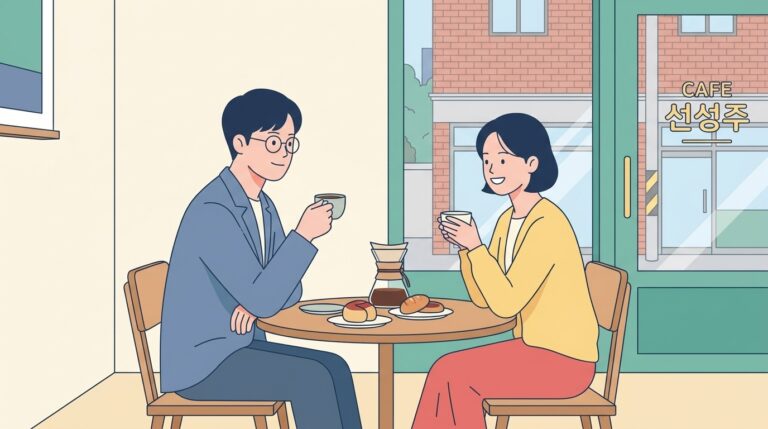
Phase 1: Empathy (Story-immersive Opening)
안녕하세요! 매일한글 에디터입니다. (Hello! This is your Daily Hangul editor.)
Imagine this classic K-drama scenario: You have your very first sogaeting (소개팅, blind date) in just two hours at a chic, minimalist cafe in Seongsu-dong. Your closet has exploded all over the bed. Is a crisp blazer too formal? Is an oversized graphic tee too lazy? You desperately want to achieve that coveted Kku-an-kku (꾸안꾸, effortless chic) look—looking undeniably attractive without seeming like you spent three frantic days planning your outfit.
In Korea, your date outfit is far more than personal aesthetics; it is viewed as your first non-verbal gesture of respect (ye-ui, 예의) and consideration toward your partner. Many intermediate learners tell us: “I know how to say ‘옷이 예뻐요’ (The clothes are pretty), but how do I express subtle modesty about dressing up without sounding stiff like a textbook?”
Drawing from authentic dating experiences and curated feedback from real B1 learners, this guide unpacks the exact vocabulary, nuanced etiquette, and cultural subtext you need to dress with confidence and break the ice smoothly on any Korean blind date.
Phase 2: Deep Dive into 3 Key Expressions
1. 오늘 너무 신경 쓴 티 나나요? (Oneul neomu singyeong sseun ti nanayo?)
- Pronunciation: [Oh-neul neo-moo shin-gyeong sseun tee nah-nah-yo?] (Think of ‘shin-gyeong’ flowing together like ‘scene’ + ‘young’ said smoothly without a hard pause).
- Meaning: Literal: “Does the fact that I paid a lot of attention show today?” | Nuance: “Does it look like I tried too hard today?”
- K-Culture Moment: Seen in romantic comedies when a protagonist arrives at a date wearing a fresh haircut and new jacket, shyly laughing to cut through the mutual tension.
- Editor’s Insight: The word 티 (ti) means an obvious trace or visible clue of an effort or emotion. Asking if your effort “shows” (티 나다) is an endearing, self-aware way to acknowledge you cared enough to dress nicely without boasting.
- Situation Spectrum: Casual (✅) | Semi-formal (✅) | Formal (⚠️)
- 🤔 Think About It: In Western dating, pointing out that you tried hard can sometimes feel uncool. Why do you think Korean dating culture values openly admitting you made an effort for the other person?
2. 깔끔하게 입으려고 노력했어요. (Kkalkkeumhage ibeuryeogo noryeokhaesseoyo.)
- Pronunciation: [Kkahl-kkeum-hah-geh ee-beu-ryeo-goh noh-ryeok-hae-sseo-yo.] (The double ‘kk’ in ‘kkal’ starts with a sharp pop of air at the roof of the mouth, similar to the crisp ‘c’ in ‘clean’).
- Meaning: Literal: “I made an effort to wear clothes cleanly.” | Nuance: “I tried to dress neat and tidy for today.”
- K-Culture Moment: The polite response when your date compliments your outfit (“오늘 멋지시네요!”), balancing modesty with clear appreciation.
- Editor’s Insight: In Korean dating, 깔끔함 (neatness/cleanliness) is ranked far higher than extravagant luxury brands. This phrase signals that your primary goal was to appear presentable and considerate.
- Situation Spectrum: Casual (✅) | Semi-formal (✅) | Formal (✅)
- 🤔 Think About It: Notice how the verb 노력하다 (to make an effort) softens the statement. How does humility function when accepting compliments in your native language?
3. 옷 스타일이 정말 제 취향이에요. (Ot seutair-i jeongmal je chwihyang-ieyo.)
- Pronunciation: [Oht seu-tah-eel-ee jeong-mahl jeh chwee-hyahng-ee-eh-yo.] (Blend ‘chwi’ like the start of ‘cheers’ and ‘hyang’ rhyming with ‘young’).
- Meaning: Literal: “Your clothing style is truly my taste.” | Nuance: “I really love your style / Your style is totally my type.”
- K-Culture Moment: Used midway through a date when mutual chemistry builds and you want to deliver a direct, heart-fluttering compliment about their overall vibe.
- Editor’s Insight: 취향 (personal taste/preference) is a much deeper compliment than simply saying clothes are “pretty” (예뻐요). It implies that their personality, aesthetic, and values resonate with yours.
- Situation Spectrum: Casual (✅) | Semi-formal (✅) | Formal (🚫)
- 🤔 Think About It: Saying someone matches your taste (취향) creates instant intimacy. What words do you use in your culture to show subtle romantic interest through style compliments?
Phase 3: Textbook Korean vs. Real Korean
Situation 1: Complimenting Your Date’s Appearance
- 📖 교과서 한국어 (Textbook): 당신의 옷이 아주 예쁩니다. (Dangsin-ui os-i aju yeoppeumnida. / “Your clothing is very pretty.”)
- 🗣️ 진짜 한국어 (Real-Life): 오늘 스타일 진짜 깔끔하고 잘 어울리세요! (Oneul seutail jinjja kkalkkeumhago jal eoulliseyo! / “Your style today is so neat and suits you really well!”)
- 💡 왜 다를까? (Why is it different?): Koreans rarely use the second-person pronoun 당신 in face-to-face social settings, as it sounds distant or confrontational. Praising the overall harmony (잘 어울리다, to suit well) and neatness (깔끔하다) feels significantly more natural.
Situation 2: Checking if You Matched the Venue’s Vibe
- 📖 교과서 한국어 (Textbook): 제가 적절한 옷을 입었습니까? (Jega jeokjeolhan os-eul ibeosseumnikka? / “Did I wear appropriate clothing?”)
- 🗣️ 진짜 한국어 (Real-Life): 여기 분위기랑 옷이 잘 맞는지 모르겠어요. (Yeogi bunwigirang os-i jal matneunji moreugesseoyo. / “I’m not sure if my outfit matches the vibe here.”)
- 💡 왜 다를까? (Why is it different?): 적절하다 sounds overly bureaucratic. In real life, people reference the ambiance (분위기) with a humble question mark (~는지 모르겠어요) to invite reassurance warmly.
Phase 4: K-Culture Deep Dive & Non-Verbal Etiquette
4-1. 눈치 (Nunchi) & Non-Verbal Cues
- The 1-Second Soft Scan: Never inspect someone’s outfit up and down slowly (위아래로 훑어보기); it is considered judgmental and rude. Instead, take in their overall look in a brief, smiling glance upon greeting, then make steady, warm eye contact.
- Outerwear Etiquette: When entering a restaurant or cafe, neatly hang your coat on the rack or place it cleanly folded beside you. Crumpling your jacket into a ball signals carelessness.
- Shoe Awareness: Many traditional or upscale fusion spots require taking shoes off. Always wear pristine socks without holes or fading!
4-2. Cultural Code: The Art of “꾸안꾸” (Effortless Chic)
In modern K-Dramas like Business Proposal or Crash Landing on You, male and female leads rarely show up in stiff red-carpet attire for casual dates. They master 꾸안꾸 (Kku-an-kku): clean silhouettes, neutral palettes (cream, beige, navy, black), well-steamed fabrics, and subtle accessories. Showing up overdressed (꾸꾸꾸) creates pressure, while dressing too casually (안꾸) displays lack of interest. The sweet spot is showing deliberate, tasteful effort.
Phase 5: Real-Life Roleplay Scenario
- Setting: A warm, sunlit cafe in Seongsu-dong. Soft indie music plays in the background.
- Character: Minwoo (민우) — A 28-year-old UX designer dressed in a clean ivory knit and navy slacks, waiting with an iced americano.
Turn 1
민우: 안녕하세요, 유진 씨 맞으시죠? 실물이 훨씬 멋지시네요.
(Annyeonghaseyo, Yujin ssi majeosijyo? Silmur-i hwolssin meotjisineyyo.)
"Hello, you must be Yujin, right? You look so much cooler in person."
🎭 [민우 stands up with a polite half-bow and warm eye contact.]

Turn 2
유진: 안녕하세요, 민우 씨! 만나서 반가워요. 오늘 너무 신경 쓴 티 나나요?
(Annyeonghaseyo, Minwoo ssi! Mannaseo bangawoyo. Oneul neomu singyeong sseun ti nanayo?)
"Hello, Minwoo! Glad to meet you. Does it look like I tried too hard today?"
🎭 [유진 smiles shyly, lightly adjusting their jacket lapel.]

Turn 3
민우: 전혀요! 완전 센스 있게 입으셨는데요? 코트 색상이 진짜 잘 어울려요.
(Jeonhyeoyo! Wanjeon senseu itge ibeusyeotneundeyo? Koteu saeksang-i jinjja jal eoullyeoyo.)
"Not at all! You dressed with such great sense. That coat color really suits you."
🎭 [민우 smiles gently and pulls out the chair for Yujin.]

Turn 4
유진: 감사해요. 첫 만남이라 깔끔하게 입으려고 노력했어요.
(Gamsahaeyo. Cheot mannam-ira kkalkkeumhage ibeuryeogo noryeokhaesseoyo.)
"Thank you. Since it's our first meeting, I made an effort to look neat."
🎭 [유진 sits down comfortably and sets their bag neatly to the side.]

Turn 5
민우: 그 정성이 느껴져서 감사하네요. 사실 저도 아침에 옷 고르느라 혼났어요.
(Geu jeongseong-i neukkyeojyeoseo gamsahaneyo. Sasil jeodo achime ot goreuneura honnasseoyo.)
"I can feel the thought you put in, thank you. Honestly, I struggled picking my outfit this morning too."
🎭 [민우 laughs lightly, breaking the tension.]

Turn 6
유진: 진짜요? 그런데 민우 씨 옷 스타일이 정말 제 취향이에요.
(Jinjjayo? Geureonde Minwoo ssi ot seutair-i jeongmal je chwihyang-ieyo.)
"Really? But your fashion style is genuinely my type."
🎭 [유진 looks up with confident, friendly eye contact.]

Turn 7
민우: 와, 그런 칭찬 들으니까 오늘 긴장이 싹 풀리네요.
(Wa, geureon chingchan deureunikka oneul ginjang-i ssak pullineyyo.)
"Wow, hearing that compliment completely melts away my nervousness."
🎭 [민우's cheeks flush slightly as he hands over the drink menu.]

Turn 8
유진: 다행이에요! 우리 시원한 커피부터 주문할까요?
(Dahaeng-ieyo! Uri siwonhan keopibuteo jumunhalkkayo?)
"I'm glad! Shall we order some cold coffee first?"
🎭 [Both share a relaxed laugh as they look at the menu together.]
🔀 Interactive Choice Point
Minwoo asks: “사실 저도 아침에 옷 고르느라 혼났어요. 제 옷차림은 어때요?” (Honestly, I struggled choosing clothes this morning. How is my outfit?)
- Choice A: “너무 평범해서 그냥 그래요.” (It’s too plain, just so-so.)
- ❌ Bad: Brutally blunt and ruins the mood immediately.
- Choice B: “완전 남친룩의 정석이세요! 깔끔하고 센스 넘쳐요.” (You’re the textbook definition of the boyfriend look! Neat and full of style.)
- 🏆 Best: Flattering, uses modern Korean dating vocabulary, and highlights his effort.
- Choice C: “명품 브랜드 옷인가요? 비싸 보여요.” (Is that luxury designer clothing? Looks expensive.)
- ⚠️ Risk: Shifts the focus entirely to material wealth rather than personal aesthetic.
Phase 6: 10-Second Emotion Shadowing Drill
Practice these natural rhythm pauses (marked with /) and mimic the recorded emotion:
[😊 기쁘고 수줍게 / Shy & Playful]
“오늘 / 너무 신경 쓴 티 / 나나요?”
(Oneul / neomu singyeong sseun ti / nanayo?)-
[😌 겸손하고 정중하게 / Polite & Warm]
“첫 만남이라서 / 깔끔하게 입으려고 / 노력했어요.”
(Cheot mannam-iraseo / kkalkkeumhage ibeuryeogo / noryeokhaesseoyo.) -
[✨ 솔직하고 설레게 / Confident & Flirty]
“오늘 입으신 스타일 / 진짜 / 제 취향이에요!”
(Oneul ibeusin seutail / jinjja / je chwihyang-ieyo!)
Phase 7: K-Culture Mini Dictionary
- 꾸안꾸 (Kku-an-kku) (Noun/Adjective): Short for ‘꾸민 듯 안 꾸민 듯’ (Looking effortless yet styled). The pinnacle of modern Korean casual fashion.
- 남친룩 / 여친룩 (Namchin-look / Yeochin-look) (Noun): ‘Boyfriend Look’ / ‘Girlfriend Look’. A clean, approachable, neat style that looks ideal for dates.
- 톤온톤 (Tone-on-tone) (Noun): Styling outfits with varying shades of the same color family (e.g., beige coat + cream knit).
- TPO (Time, Place, Occasion) (Noun): Widely used in Korean fashion discussions to describe matching one’s attire appropriately to the venue and context.
Phase 8: Survival Kit for Travelers & Daters
Top 3 Survival Phrases
- 1. 혹시 이 옷에 먼지 많이 묻었나요? (Hoksi i os-e meonji mani mudeotnayo?) — “Is there lint/dust on my clothes by any chance?” (Pro tip: Ask before walking into the venue).
- 2. 오늘 날씨에 딱 맞게 입으셨네요. (Oneul nalssie ttak matge ibeusyeotneyo.) — “You dressed perfectly for today’s weather.” (Safe, universally pleasant icebreaker).
- 3. 화장실 가서 옷매무새 좀 정리하고 올게요. (Hwajangsil gaseo otmaemumsae jom jeongrihago olgeyo.) — “I’ll go to the restroom to adjust my outfit quickly.” (Polite way to excuse yourself to check the mirror).
Editor’s Travel Note
Need a quick outfit upgrade before your Seoul date? Visit a local fashion hub like Hongdae or Seongsu. You can find minimalist, tailored staples instantly. Check store locations via the 네이버 지도 앱 다운로드 (Naver Map app) to browse trendy boutiques or visit high-value retail stores like Musinsa Standard.
Phase 9: “한 발 더 깊이” (One Step Deeper)
In Korean culture, the effort you put into your physical presentation (정성, jeongseong) is directly tied to the respect (예의, ye-ui) you hold for the person you are meeting. Dressing untidily or without thought is not viewed as quirky individualism on a sogaeting; it is often interpreted as a lack of excitement to meet the other person. By balancing neatness with modest phrasing, you show both personal charm and cultural consideration.
💬 Your Turn: What is the most important fashion rule for first dates in your home country? Share your thoughts in the comments below!
Phase 10: FAQ & Common Mistakes
Q: Is wearing a full formal suit or gown expected on a Korean blind date?
A: Almost never, unless the date is an ultra-formal matchmaking meeting organized by parents (맞선, matseon). For standard sogaeting (소개팅), a smart-casual blazer, neat knit, or clean blouse/shirt is ideal.
Q: Can I wear sneakers on a first date in Seoul?
A: Yes, absolutely—provided they are clean, modern lifestyle sneakers (like white leather sneakers). Avoid worn-out gym running shoes or muddy trainers.
Q: What should I say if I accidentally spilled coffee on my outfit during the date?
A: Don’t panic! Use lighthearted self-deprecation: “제가 칠칠치 못하게 흘렸네요! 신경 쓰지 마세요.” (I was a bit clumsy! Please don’t mind it at all.)
🚨 Common Mistakes Warning Board
- Mistake: Over-evaluating the brand names of your date’s clothing.
👉 Correct Action: Focus compliments on color harmony, vibe, and neatness (깔끔함). - Mistake: Using aggressive street slang or overly stiff honorifics on turn 1.
👉 Correct Action: Stick to standard polite 해요체 (Haeyoche) with warm tone intonation. - Mistake: Forgetting sock condition when going to shoe-off cafes/restaurants.
👉 Correct Action: Always wear clean, matching socks on date day.
Phase 11: Action Missions
- 🥉 Bronze Mission (Solo): Stand in front of your mirror and practice the 3 expressions from Phase 2 out loud with authentic facial expressions.
- 🥈 Silver Mission (Social): Post your favorite Kku-an-kku outfit photo on Instagram or your study journal and caption it in Korean:
오늘 제 스타일, 제 취향인가요? - 🥇 Gold Mission (Real-Life): Use
오늘 스타일 진짜 깔끔하세요!the next time you meet a Korean friend or language exchange partner. - 🎮 K-Culture Mission: Watch one episode of a dating show like Heart Signal (하트시그널) or Single’s Inferno (솔로지옥) and write down every time participants compliment someone’s style.
Phase 12: Interactive Quiz Challenge
- Situational Judgment: Your date tells you: “오늘 유진 씨 스타일 진짜 제 취향이에요!” What is the most natural, charming response?
- (A) 당연하죠. 제가 비싸게 샀거든요.
- (B) 감사해요! 첫 만남이라 신경 좀 썼는데 다행이네요.
- (C) 아니에요. 제 스타일은 별로예요.
- Fill-in-the-Blank: Complete the sentence meaning “Does it look like I tried too hard today?”
- 오늘 너무 신경 쓴 [ ] 나나요?
- True / False: In modern Korean blind dates, wearing expensive luxury brands is considered much more attractive than presenting a clean, neat look (깔끔함).
- [ True / False ]
👉 Click to view answers and explanations
-
Answer: (B)
Explanation: (B) politely acknowledges the compliment, shares your genuine effort (신경 좀 썼는데), and expresses relief (다행이네요). (A) is arrogant, and (C) is an excessively negative rejection of the compliment. -
Answer: 티 (ti)
Explanation: 티 refers to a visible sign or indication of effort/feelings (티가 나다). -
Answer: False
Explanation: Korean blind date culture values neatness (깔끔함), appropriate TPO, and thoughtful effort far more than flashy logos or loud luxury items.







