

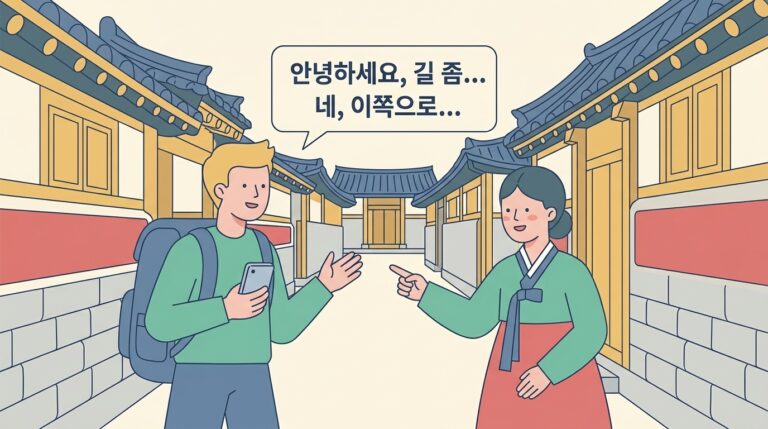
Lost in Seoul? Never Panic Again! How to Ask for Directions Like a True Local
Phase 1: Empathy (Story-Immersive Opening)
안녕하세요! 매일한글 에디터입니다. (Hello! This is your Daily Hangul Editor!)
Imagine this: You are wandering through the charming, maze-like stone-walled alleys of Ikseon-dong in Seoul. The aroma of freshly baked sweet pancakes (hotteok) fills the chilly evening air, vintage neon cafe signs flicker, and you are having the absolute time of your life. But then you look down at your phone. Your battery drops to 4%, Google Maps spins endlessly in circles (because standard GPS routing doesn’t always work seamlessly in South Korea due to local mapping regulations), and suddenly every traditional tile roof looks identical. You are officially lost.
In K-dramas like Crash Landing on You or Hometown Cha-Cha-Cha, when characters get lost, a warm-hearted local mysteriously pops out to guide them with a smile. In real life, however, approaching a busy Seoul commuter rushing toward the subway can feel utterly terrifying if you don’t know what to say.
Don’t worry! After teaching hundreds of beginner learners at Daily Hangul, I have distilled the exact, polite, and foolproof phrases that make locals stop, smile, and eagerly help you find your way. Master these A2-level gems today, and you will turn getting lost from a travel nightmare into your favorite travel story.
Phase 2: Deep Dive into 3 Core Expressions
### 1. 길을 잃어버렸어요 (Gireul ileobeoryeosseoyo)
* Pronunciation: Gireul ileobeoryeosseoyo (Sounds like: "Gee-reul eel-uh-buh-ryuh-ssuh-yo")
* Meaning:
  - Literal: "I lost the road."
  - Actual Nuance: "I am lost / I have lost my way."
* K-Culture Moment: In variety shows like *Running Man*, members frequently scream this into their walkie-talkies when trapped in unfamiliar mission zones.
* Editor's Insight: "길" (Gil) means road/way, and "잃어버렸어요" (ileobeoryeosseoyo) means completely lost something. It clearly states your situation without sounding demanding.
* Situation Spectrum:
  - Casual (to friends): 🚫 (Use "길 잃었어 / Gil ireosseo")
  - Semi-formal (Polite - standard): ✅
  - Formal (Business/Announcements): ⚠️ (Use "길을 분실하였습니다 / Gil-eul bunsilhayeotsseumnida")
* 🤔 Think About It: In English, we say "*I* am lost" (identifying ourselves as lost), but in Korean, you say "I lost the *road*" (the path is what went missing). How does focusing on the path rather than yourself change how you feel when lost?
### 2. 저기요, 혹시 [장소] 어디인지 아세요? (Jeogiyo, hoksi [Jangso] eodiinji aseyo?)
* Pronunciation: Jeogiyo, hoksi [Jangso] eodiinji aseyo? (Sounds like: "Juh-ghee-yo, hoke-shee [Place] uh-dee-een-jee ah-seh-yo?")
* Meaning:
  - Literal: "Over there, by any chance do you know where [Place] is?"
  - Actual Nuance: "Excuse me, do you happen to know where [Place] is?"
* K-Culture Moment: When K-Pop idols film travel vlogs in unfamiliar cities and politely ask passersby for the nearest convenience store or photo booth.
* Editor's Insight: "혹시" (Hoksi) is a magical Korean politeness cushion meaning "by any chance." Adding it turns a direct question into a gentle, non-intrusive inquiry.
* Situation Spectrum:
  - Casual: 🚫
  - Semi-formal (Everyday polite): ✅
  - Formal: ⚠️
* 🤔 Think About It: Why do you think Korean uses softening adverbs like "혹시" (by chance) so frequently when speaking to strangers?
### 3. 어떻게 가야 해요? (Eotteoke gaya haeyo?)
* Pronunciation: Eotteoke gaya haeyo? (Sounds like: "Uh-ttuh-keh gah-yah heh-yo?")
* Meaning:
  - Literal: "How must I go?"
  - Actual Nuance: "How do I get there? / Which way should I take?"
* K-Culture Moment: Used in K-Drama scenes where a character asks a subway station officer how to transfer lines to meet their love interest before the train departs.
* Editor's Insight: "어떻게" (Eotteoke) asks about method or route. Combine this with pointing at a map on your phone for instant, crystal-clear communication!
* Situation Spectrum:
  - Casual: ⚠️ (Use "어떻게 가? / Eotteoke ga?")
  - Semi-formal: ✅
  - Formal: ⚠️ (Use "어떻게 가야 합니까? / Eotteoke gaya hamnikka?")
* 🤔 Think About It: This phrase uses "-야 해요" (-ya haeyo, "must do"). It shows you are actively ready to follow the speaker's instructions.
Phase 3: Textbook Korean vs. Real Korean
Situation 1: Asking where the subway station is
- 📖 교과서 한국어 (Textbook Korean):
지하철역이 어디에 있습니까? (Jihacheol-yeogi eodie itsseumnikka? – “Where is the subway station located?”) - 🗣️ 진짜 한국어 (Real Local Korean):
저기요, 지하철역 어디로 가요? (Jeogiyo, jihacheol-yeok eodiro gayo? – “Excuse me, which way goes to the subway station?”) - 💡 왜 다를까? (Why is it different?):
Textbooks teach stiff formal endings (~습니까), but real locals ask direction (어디로 / which way) rather than static existence (어디에 있습니까 / where does it exist), keeping the rhythm quick and conversational.
Situation 2: Asking someone for a quick moment of help
- 📖 교과서 한국어 (Textbook Korean):
저를 도와주실 수 있습니까? (Jeoreul dowajusil su itsseumnikka? – “Are you capable of helping me?”) - 🗣️ 진짜 한국어 (Real Local Korean):
저기 죄송한데, 길 좀 여쭤봐도 될까요? (Jeogi joesonghande, gil jom yeojjwobwado doelkkayo? – “Excuse me, sorry to bother you, but may I ask for directions?”) - 💡 왜 다를까? (Why is it different?):
Asking “Can you help me?” directly puts immediate pressure on the listener. In contrast, “여쭤보다” (honorific for ‘ask’) paired with “죄송한데” (I am sorry to interrupt) creates a respectful buffer that makes locals eager to help.
Phase 4: K-Culture Deep Dive & Non-Verbal Manners
4-1. 눈치 (Nunchi) & Polite Gestures
When approaching a Korean on the street:
1. Two-Hand Phone Display: When showing an address on your smartphone screen, hold your phone with both hands and tilt it slightly toward them. Holding it with one hand can look casual or dismissive.
2. The 15-Degree Head Bow: Start with a gentle slight nod before speaking your first word (저기요 / Jeogiyo).
3. Physical Proximity: Koreans value personal space. Stop about one arm’s length away so you don’t surprise them, especially if they are wearing earbuds.
4-2. The “Jeong (정)” Culture on the Streets
In Korean culture, there is an emotional bond called 정 (Jeong)—a warm, affectionate sense of communal connection. Don’t be surprised if an older Ajeossi (middle-aged man) or Halmeoni (grandmother) doesn’t just explain the route, but physically walks two blocks with you right to the subway turnstile! It is not intrusive; it is their heartwarming expression of hospitality.
Phase 5: Real-World Roleplay Scenario
Setting: Near Bukchon Hanok Village. You are searching for Anguk Station, but your map stopped loading.
Characters:
* You (Traveler): Slightly anxious but polite A2 learner.
* Min-woo (민우): A 24-year-old college student wearing AirPods and holding an iced Americano.
Dialogue (8 Turns):
- You:
저기요, 죄송한데 길 좀 여쭤봐도 될까요?
(Jeogiyo, joesonghande gil jom yeojjwobwado doelkkayo?)
“Excuse me, sorry to bother you, but may I ask for directions?”
🎭 Hands gently clasped, giving a polite 15-degree bow. -
Min-woo:
네! 어디 찾으세요?
(Ne! Eodi chajeuseyo?)
“Yes! Where are you looking for?”
🎭 Takes off one AirPod and smiles warmly. -
You:
제가 길을 잃어버렸어요. 안국역 어디인지 아세요?
(Jega gireul ileobeoryeosseoyo. Anguk-yeok eodiinji aseyo?)
“I lost my way. Do you know where Anguk Station is?”
🎭 Showing the word '안국역' written on the phone screen with two hands. -
Min-woo:
아, 안국역이요? 여기서 멀지 않아요.
(A, Anguk-yeogiyo? Yeogiseo meolji anayo.)
“Ah, Anguk Station? It’s not far from here.”
🎭 Turning to look down the street. -
You:
어떻게 가야 해요?
(Eotteoke gaya haeyo?)
“How do I get there?”
🎭 Tilting head attentively to listen. -
Min-woo:
이 골목으로 쭉 직진하세요. 편의점 나오면 오른쪽으로 가세요.
(I golmogeuro jjuk jikjinhaseyo. Pyeon-uijeom naomyeon oreunjjogeuro gaseyo.)
“Go straight down this alley. When you see a convenience store, turn right.”
🎭 Pointing straight down the street, then gesturing a right turn. -
You:
쭉 직진하고 오른쪽이요? 감사합니다!
(Jjuk jikjinhago oreunjjogiyo? Gamsahamnida!)
“Straight ahead and then right? Thank you so much!”
🎭 Nodding with bright, relieved eye contact. -
Min-woo:
네, 맞아요! 좋은 하루 보내세요!
(Ne, majayo! Joeun haru bonaeseyo!)
“Yes, that’s right! Have a wonderful day!”
🎭 Waving lightly and walking on.
🔀 Interactive Choice Point
Imagine Min-woo gave directions too quickly and you didn’t catch the last part. What do you say?
- Option A: “다시 말해!” (Dasi malhae! – “Say it again!”)
- 🚫 Feedback (Bad): This is informal banmal. It sounds rude and commanding to a stranger!
- Option B: “죄송하지만, 한 번만 다시 말씀해 주시겠어요?” (Joesonghajiman, han beonman dasi malsseumhae jusigesseoyo? – “I’m sorry, but could you please say it one more time?”)
- 🌟 Feedback (Best): Perfect! Polite, respectful, and crystal clear. Any native speaker will happily repeat and slow down.
- Option C: “몰라요.” (Mollayo. – “I don’t know.”)
- ⚠️ Feedback (Risk): Saying “I don’t know” leaves the conversation at a confusing dead end and makes the other person wonder what went wrong.
Phase 6: 10-Second Emotion Shadowing Drill
Practice these 3 lines out loud, pausing at each / mark and embodying the target emotion:
[🥺 조금 당황하고 조심스럽게 / Slightly flustered & polite]
저기요… / 죄송한데 / 길을 잃어버렸어요.
(Jeogiyo… / joesonghande / gireul ileobeoryeosseoyo.)-
[🤔 집중해서 확인하듯이 / Attentively verifying]
여기서 / 쭉 직진하고 / 오른쪽 맞아요?
(Yeogiseo / jjuk jikjinhago / oreunjjok majayo?) -
[💡 안도하며 진심으로 감사하게 / Relieved & genuinely grateful]
정말 감사합니다! / 좋은 하루 보내세요!
(Jeongmal gamsahamnida! / Joeun haru bonaeseyo!)
Phase 7: K-Culture Mini Dictionary
- 길치 (Gilchi): “Direction-challenged person / Bad with navigation.”
- Usage: When chatting with Korean friends, laughingly say: “저 완전 길치예요!” (Jeo wanjeon gilchiye-yo! = “I have zero sense of direction!”). Instant icebreaker!
- 출구 (Chulgu): “Exit.”
- Usage: Essential for navigating Seoul’s mega subway stations. (e.g., “3번 출구 어디예요?” / Sambon chulgu eodiyeyo? = “Where is Exit 3?”).
- 골목 (Golmok): “Alley / Alleyway.”
- Usage: Seoul’s trendiest cafes and hidden eateries are always tucked away inside golmok.
- 직진 (Jikjin): “Go straight / Straight ahead.”
- Usage: The word taxi drivers and pedestrians say when telling you not to turn left or right.
Phase 8: Traveler’s Survival Kit
TOP 3 Survival Phrases
- 여기 어떻게 가요? (Yeogi eotteoke gayo? – “How do I get here?”)
- Pro Tip: Point your finger directly at the Korean address on your phone note.
- 멀어요? (Meoreoyo? – “Is it far?”)
- Pro Tip: If they answer “조금 멀어요” (Jogeum meoreoyo), prepare to take a bus or subway.
- 걸어갈 수 있어요? (Georeogal su itsseoyo? – “Can I walk there?”)
- Pro Tip: Saves you from hiking up steep Seoul hills unnecessarily!
Editor’s Travel Note
- Must-Have Apps: Google Maps does not support full pedestrian turn-by-turn routing in South Korea due to national security map export laws. Make sure to download the Naver Map navigation app or KakaoMap English guide before departing.
- Subway Mastery: Seoul subway exits are numbered sequentially clockwise. If you ever get lost, find any subway station entrance—it serves as the ultimate geographical anchor!
Phase 9: “One Step Deeper” (Reflective Humanities Note)
In many Western cultures, stopping a stranger on the street is approached with caution to respect privacy. In Korea, however, asking for directions is viewed through the lens of community solidarity. When you ask a local for directions, you aren’t seen as an annoyance; you are seen as an honored guest trying to explore their neighborhood. Embracing this cultural openness will transform how you interact with people in Korea.
💬 Your Turn: What is the most memorable experience you have ever had getting lost in a new city or country? Drop your story in the comments below!
Phase 10: FAQ & Avoiding Misunderstandings
Q: Will Korean locals be annoyed if my Korean pronunciation isn’t perfect?
A: Not at all! Koreans are famously appreciative when foreigners attempt to speak Korean. Even saying a simple “저기요” (Jeogiyo) with a polite smile will immediately open doors.
Q: Should I call strangers “언니 (Unnie)” or “오빠 (Oppa)” to get their attention?
A: Absolutely not! Despite what you see in K-dramas, using Oppa or Unnie with complete strangers on the street is awkward and uncomfortable. Always stick to the neutral and respectful “저기요” (Jeogiyo).
Q: What should I do if the person starts speaking Korean way too fast?
A: Smile warmly and say: “조금 천천히 말씀해 주세요” (Jogeum cheoncheonhi malsseumhae juseyo – “Please speak a little slower”). They will immediately simplify their words or point directions with gestures.
🚨 Common Mistakes TOP 3 & Correct Actions
- ❌ Mistake 1: Shouting “Where is Gangnam?” in English right into someone’s face.
- ✅ Correct Action: Start with a gentle “저기 죄송한데…” (Jeogi joesonghande… – “Excuse me, sorry to interrupt…”).
- ❌ Mistake 2: Calling an older woman “아줌마 (Ajumma)” on the street.
- ✅ Correct Action: While common in old dramas, calling someone Ajumma can feel slightly disrespectful. Use “저기요” (Jeogiyo) instead.
- ❌ Mistake 3: Looking down only at your navigation app while walking.
- ✅ Correct Action: Look up at station exit numbers and store signs—they are bilingual (Korean/English) and much faster to navigate by.
Phase 11: Action Missions
- 🥉 Bronze Mission (Solo Practice): Stand in front of your mirror, hold your phone with two hands, and practice saying
저기요, 길 좀 여쭤봐도 될까요?three times with a gentle smile. - 🥈 Silver Mission (Social Connection): Write your favorite Korean destination in the comments below using the sentence pattern:
[장소] 어디인지 아세요? - 🥇 Gold Mission (Real Life Execution): The next time you are in Korea (or in your local Koreatown), ask a store clerk or pedestrian for a location completely in Korean!
- 🎮 K-Culture Mission: Watch an episode of your favorite K-drama this week and spot when a character uses the word
골목(alley) or직진(straight).
Phase 12: Interactive Quiz Challenge
Test what you have learned today!
- Situation Judgment: You want to ask a passerby where the bus stop is. Which opening phrase is the most natural and polite?
- A) 야! (Ya!)
- B) 저기 죄송한데… (Jeogi joesonghande…)
- C) 이봐요! (Ibwayo!)
- Fill in the Blank: Complete the sentence meaning “How do I get there?”:
- 어떻게 [ ] 해요? (Eotteoke [ ] haeyo?)
- True / False Culture Quiz: In South Korea, Google Maps provides full pedestrian turn-by-turn walking directions everywhere without limitations. (T / F)
👉 Click here to reveal the answers & explanations!
- Answer: B) 저기 죄송한데…
- Explanation: “야” (Ya) is rude slang for “Hey!” among friends, and “이봐요” (Ibwayo) sounds confrontational. “저기 죄송한데” is the golden standard for polite openings.
- Answer: 가야 (gaya)
- Explanation: “가다” (to go) + “-아/어야 하다” (must/should) combines into “가야 해요” (Eotteoke gaya haeyo?).
- Answer: False (F)
- Explanation: Due to national security map data restrictions, foreign map apps like Google Maps have limited walking routing. You should use Korean apps like Naver Map or KakaoMap!
- Explanation: Due to national security map data restrictions, foreign map apps like Google Maps have limited walking routing. You should use Korean apps like Naver Map or KakaoMap!







