

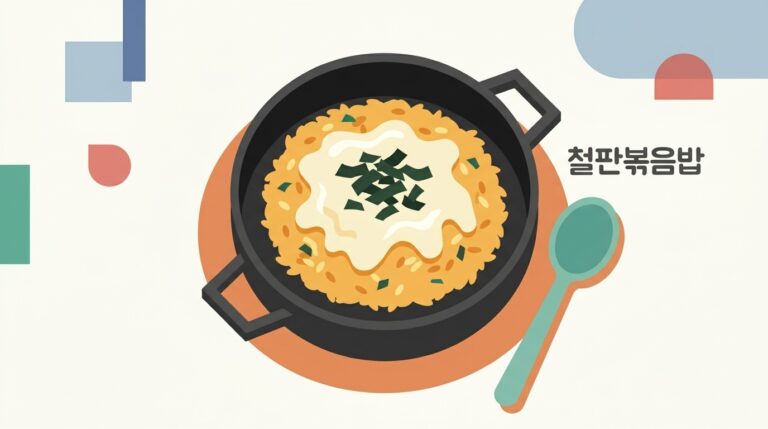
Phase 1: Empathy & K-Culture Scene Setting
안녕하세요! (Annyeonghaseyo!) I’m your Daily Hangul editor and your personal Korean culture navigator!
Picture this: You are sitting at a bustling, smoky Dakgalbi (spicy stir-fried chicken) or Samgyeopsal (pork belly) restaurant in Hongdae with your Korean friends. You’ve eaten all the juicy meat and vegetables. You loosen your belt, lean back, and sigh happily, “I’m so stuffed!”
Suddenly, your Korean friend leans forward with sparkling eyes and asks, “Shall we order dessert now?”
You look around for cake, bingsu, or ice cream. But instead, your friend catches the server’s eye and yells: “사장님, 여기 볶음밥 2개 볶아주세요!” (Sajangnim, yeogi bokkeumbap du-gae bokk-a-juseyo! – Boss, please fry two servings of rice here!)
Wait, rice for dessert?! Welcome to the legendary Korean culinary phenomenon known as ‘K-Dessert’ (K-디저트). In Korea, no hot pot, stew, or grilled meat meal is truly finished until white rice, savory seasoned seaweed (gim), sesame oil, and kimchi are tossed directly onto the sizzling pan to absorb every drop of leftover flavor.
Many intermediate Korean learners freeze here because they don’t know the proper timing, table etiquette, or exact phrases to customize their fried rice. In this guide, backed by real feedback from our Daily Hangul learners, we’ll teach you everything from ordering extra cheese toppings to scraping the crispy bottom (nurungji) like a born-and-raised Seoulite!
Phase 2: Core Expressions Deep Dive
1. 볶음밥 2인분 볶아주세요 (Bokkeumbap i-inbun bokk-a-juseyo)
- Pronunciation: [Bok-keum-bap ee-een-boon bok-ah-joo-seh-yo] (Sounds like “Bok-keum-bap”, with the ‘bap’ popping gently like the word ‘bop’)
- Meaning: Literal: “Please stir-fry 2 portions of fried rice.” / Nuance: “We’re ready to wrap up our meal with the final fried rice course!”
- K-Culture Moment: You will hear this in almost every Korean variety food show (like Delicious Rendezvous or Sixth Sense) right after the main dish wraps up.
- Editor’s Insight: Even if there are three or four of you, ordering 1 or 2 portions (
인분 - inbun) is standard if everyone is already somewhat full. Note that you use Sino-Korean numbers here: 1인분 (il-inbun), 2인분 (i-inbun), 3인분 (sam-inbun). - Situation Spectrum:
- Casual (with friends): 볶음밥 2개 볶아줘! (Bokkeumbap du-gae bokk-a-jwo!) ✅
- Semi-formal (to restaurant staff): 볶음밥 2인분 볶아주세요. (Bokkeumbap i-inbun bokk-a-juseyo.) ✅
- Formal: 볶음밥 2인분 부탁드립니다. (Bokkeumbap i-inbun butakdeurimnida.) ✅
- 🤔 Think About It: In Western dining, dessert is almost always sweet and served separately. Why do you think Korean cuisine embraces a savory carb dish cooked in the same pan as the ultimate finale?
2. 치즈 사리 추가해 주세요 (Chijeu sari chugahae juseyo)
- Pronunciation: [Chee-zeu sah-ree choo-gah-hae joo-seh-yo] (Think of ‘sari’ like ‘sorry’ without the hard ‘r’)
- Meaning: Literal: “Please add a cheese topping.” / Nuance: “Make it extra indulgent by melting mozzarella all over our fried rice!”
- K-Culture Moment: Seen in viral Mukbang videos where the server creates a ‘cheese volcano’ inside the rice mound or torches mozzarella on top with a blowtorch.
- Editor’s Insight: The word
사리 (sari)refers to additional toppings or noodle add-ins in stews and pan dishes (e.g., 라면 사리 – ramen noodles, 떡 사리 – rice cakes, 치즈 사리 – cheese). - Situation Spectrum:
- Casual: 치즈 추가하자! (Chijeu chugahaja!) ✅
- Semi-formal (Standard): 치즈 사리 추가해 주세요. (Chijeu sari chugahae juseyo.) ✅
- Formal: 치즈 사리도 추가 부탁드립니다. (Chijeu sarido chuga butakdeurimnida.) ✅
- 🤔 Think About It: How does your native language refer to ‘extra toppings’? Notice how Korean differentiates between side dishes (
반찬 - banchan) and in-dish add-ons (사리 - sari).
3. 밥 조금 눌러 붙여서 먹자 (Bap jogeum nulleo buchyeoseo meokja)
- Pronunciation: [Bap joh-geum nool-ler boo-chyeo-seo meok-jah] (Pronounce ‘nulleo’ by pressing your tongue softly against the roof of your mouth)
- Meaning: Literal: “Let’s press the rice and stick it a bit, then eat.” / Nuance: “Let’s wait a minute so the bottom layer gets golden brown and crunchy!”
- K-Culture Moment: In K-Dramas, when characters eat together, you’ll often see someone gently tapping the rice flat onto the grill with a metal spoon to maximize surface area.
- Editor’s Insight: The crispy, caramelized layer at the bottom of the pan is called
누룽지 (nurungji). Eating soft fried rice right away is considered an amateur move—true foodies wait for the crunch! - Situation Spectrum:
- Casual (peer to peer): 밥 좀 눌러서 먹자. (Bap jom nulleoseo meokja.) ✅
- Semi-formal (polite suggestion): 밥 조금 눌러 붙여서 먹어요. (Bap jogeum nulleo buchyeoseo meogeoyo.) ✅
- Formal (to elders/superiors): 밥을 살짝 눌려서 드시면 더 맛있습니다. (Babeul saljjak nullyeoseo deusimyeon deo masitseumnida.) ✅
- 🤔 Think About It: Why is food texture (like crunchy nurungji or chewy tteok) given as much appreciation in Korean dining as taste itself?
Phase 3: Textbook Korean vs. Real Korean
Situation 1: Ordering fried rice after finishing your main meal
- 📖 Textbook Korean: 남은 양념에 밥을 볶아 주실 수 있나요? (Nameun yangnyeome babeul bokka jusil su innayo? – Could you please fry rice in the leftover sauce?)
- 🗣️ Real Korean: 사장님, 여기 밥 2개만 볶아주세요! (Sajangnim, yeogi bap du-gaeman bokk-a-juseyo! – Boss, please fry just 2 servings of rice here!)
- 💡 Why the Difference? Textbook Korean is overly explanatory. In real Korean eateries, servers already know you mean the leftover sauce. Simply calling out “밥 볶아주세요” (Fry rice) is clear, natural, and friendly.
Situation 2: Telling your dining partner to wait for the crunchy texture
- 📖 Textbook Korean: 밥이 탈 때까지 가열을 지속합시다. (Babi tal ttaekkaji gayeoreul jisokhapsida. – Let us continue heating until the rice scorches.)
- 🗣️ Real Korean: 누를 때까지 불 끄지 마! (Nureul ttaekkaji bul kkeuji ma! – Don’t turn off the heat until it gets crispy!)
- 💡 Why the Difference? Koreans don’t say “burn the rice”; they use the verb
눌다 (nulda)or눌러 붙이다 (nulleo buchida)(to press/crisp up against the pan). It sounds dynamic and mouth-watering!
Phase 4: K-Culture Deep Dive & Non-Verbal Etiquette
4-1. 눈치 (Nunchi) & Table Manners for K-Dessert
- The Leftover Sauce Rule (양념 남기기): Never eat 100% of the sauce or ingredients in the pan! If the pan is bone dry, the server cannot make flavorful fried rice. Leave 2–3 spoonfuls of sauce and a few pieces of meat/veggies. The server will chop them up with kitchen shears to mix into your rice.
- The Spatula Trance: When the server comes to make your fried rice, conversation among Koreans usually comes to a complete standstill. Everyone stares mesmerized at the server’s rhythmic spatula flips. Don’t touch the spatula while the staff is cooking; let them finish their culinary performance!
4-2. Cultural Code: The Philosophy of K-Dessert
In Korea, rice is not merely a side dish—it is the foundation of energy and life (as captured in the famous saying “한국인은 밥심” – Koreans run on rice power). Even after eating noodles, stew, or Korean BBQ, a meal doesn’t feel psychologically complete without grain. Bokkeumbap acts as the savory curtain call that unifies all the lingering flavors of the dining table.
Phase 5: Real-World Roleplay Scenario
Setting: You are at a famous Dakgalbi restaurant near Sinchon with your Korean classmate Minji (민지) and the friendly restaurant auntie (이모님 – Imonim).
- Minji: 닭갈비 거의 다 먹었다! 이제 슬슬 디저트 시킬까? (Dakgalbi geoui da meogeotda! Ije seulseul dijeoteu sikilkka?)
🎭 Pats her stomach while looking at the remaining sauce on the iron plate.
(We’ve almost finished the spicy chicken! Shall we order dessert soon?) -
You: 디저트? 설마 볶음밥 말하는 거야? (Dijeoteu? Seolma bokkeumbap malhaneun geoya?)
🎭 Smiling with a knowing look.
(Dessert? Don’t tell me you mean fried rice?) -
Minji: 당연하지! 사장님 부르는 벨 좀 눌러줄래? (Dangyeonhaji! Sajangnim bureuneun bel jom nulleojullae?)
🎭 Points at the call bell on the corner of the wooden table.
(Of course! Can you press the call bell for the owner?) -
You: (Presses the bell with a cheerful ‘Ding-Dong’) 여기 볶음밥 2인분 볶아주세요! (Yeogi bokkeumbap i-inbun bokk-a-juseyo!)
🎭 Making clear eye contact with the server.
(Please fry two servings of fried rice here!) -
Imonim (Staff): 네~ 치즈나 날치알 사리 추가해 드릴까요? (Ne~ chijeuna nalchial sari chugahae deurilkkayo?)
🎭 Arrives holding a bowl of rice, chopped kimchi, seaweed, and sesame oil.
(Sure~ Would you like to add cheese or flying fish roe topping?) -
You: 네, 치즈 사리 하나 추가해 주세요! (Ne, chijeu sari hana chugahae juseyo!)
🎭 Nods politely.
(Yes, please add one cheese topping!) -
Imonim (Staff): 1분 뒤에 불 끄고 드시면 바삭해요! (Il-bun dwie bul kkeugo deusimyeon basakhaeyo!)
🎭 Spreads the rice paper-thin across the pan and sprinkles cheese on top.
(Turn off the heat in 1 minute and eat, it’ll be nice and crispy!) -
Minji: 와, 냄새 대박이다… 밥 살짝 눌러서 긁어먹자! (Wa, naemsae daebagida… Bap saljjak nulleoseo geulgeomokja!)
🎭 Lifts her metal spoon ready for action.
(Wow, the smell is incredible… Let’s let it crisp up and scrape it off!)
🔀 Interactive Choice Point
The cheese has melted, and the bottom is sizzling. What will you do?
- Choice A: Pick up your spoon immediately and turn off the gas burner right now.
- Choice B: Wait about 45–60 seconds until you hear a crackling sound, then scrape the crispy bottom layer (nurungji) together with Minji.
- Choice C: Scoop out all the remaining liquid sauce from the side bowl and dump it directly onto the crispy rice.
[Feedback Analysis]
• Choice A (Risk): Turning off the heat immediately won't create that prized crunchy nurungji crust! Patience makes perfection.
• Choice B (Best! ⭐): Spot on! Letting the heat crisp the bottom for about a minute gives you the authentic K-Dessert texture.
• Choice C (Bad): Adding cold liquid back onto the hot rice will make it soggy and ruin the stir-fried texture.
Phase 6: 10-Second Emotion Shadowing Drill
Practice these lines out loud! Pay attention to the pauses (/) and adopt the indicated emotion.
[😊 Cheerful & Confident]
저희 / 볶음밥 2인분에 / 치즈 사리 추가해 주세요!
(Jeohui / bokkeumbap i-inbune / chijeu sari chugahae juseyo!)
(“For us / two servings of fried rice / please add cheese topping!”)-
[🤤 Anticipatory & Hungry]
누룽지 생길 때까지 / 1분만 / 딱 기다리자!
(Nurungji saenggil ttaekkaji / il-bunman / ttak gidarija!)
(“Until the crispy layer forms / just for one minute / let’s wait!”) -
[😍 Delighted & Impressed]
와, / 역시 한국인은 / 후식으로 볶음밥이 진리네!
(Wa, / yeoksi hangugineun / husigeuro bokkeumbabi jinrine!)
(“Wow, / as expected for Koreans / fried rice for dessert is truly the best!”)
Phase 7: K-Culture Mini Dictionary
-
볶음밥 (Bokkeumbap)
Translation: Stir-fried rice.
Usage: In Korea, this refers both to standalone dishes (like Kimchi Fried Rice) and the customary post-meal grilled dish made on tabletop hotplates. -
K-디저트 (K-Dijeoteu)
Translation: K-Dessert.
Usage: A humorous slang term used across Korean social media and variety shows to describe ending savory hotpot or BBQ meals with fried rice, noodles, or porridge rather than sweets. -
누룽지 (Nurungji)
Translation: Scorched / Crispy rice crust.
Usage: The deeply aromatic, crunchy layer of rice that adheres to the base of the pan or stone pot (Dolsot). Highly prized for its nutty flavor. -
사리 (Sari)
Translation: Add-in ingredient / Topping portion.
Usage: Used when adding extra components to simmering or frying dishes (e.g., 라면 사리 – ramen noodles, 우동 사리 – udon noodles, 떡 사리 – rice cakes, 치즈 사리 – cheese).
Phase 8: Traveler’s Survival Kit
🚨 Top 3 Survival Phrases
- 여기 밥 볶아주세요! (Yeogi bap bokk-a-juseyo!)
Pro Tip: Use this standard phrase anywhere with a tabletop pan (Dakgalbi, Gamjatang, Tteokbokki, Gopchang restaurants). - 치즈 사리도 돼요? (Chijeu sarido dwaeyo?)
Pro Tip: Ask this to check if melted cheese topping is available at that specific restaurant. - 불 지금 꺼도 돼요? (Bul jigeum kkeodo dwaeyo?)
Pro Tip: Ask the server if you are unsure whether the heat should be turned off yet.
🧳 Editor’s Travel Note
- Essential Navigation: Check out restaurant reviews on the official Naver Map App download page on Google Play before visiting; search for “볶음밥 맛집” (Top Bokkeumbap eateries) to find legendary spots!
- Table Bell Manners: Most casual Korean eateries have a small call bell attached to the side or corner of the table. Press it once and wait; you don’t need to wave your arms frantically!
- Metal Spoon Technique: When scraping nurungji, hold your spoon at a 45-degree angle and scrape gently toward yourself so you don’t send rice flying across the table.
Phase 9: Stepping Deeper (Cultural Reflection)
In many cultures, eating is an individualized experience where everyone has their own separate plate. In Korean food culture, however, the large central iron pan represents a shared communal bond. Gathering around the grill, watching the steam rise together, and scraping the final crispy bits of rice with shared spoons reflects the quintessential Korean sentiment of 정 (Jeong)—warmth, bonding, and shared life experiences.
💬 Your Turn: In your home country, what is the ultimate “comfort food ritual” you do with friends to finish a great meal? Share your story in the comments below!
Phase 10: FAQ & Common Mistakes
Q: Can I order Bokkeumbap at any Korean restaurant?
A: No. Bokkeumbap as a post-meal dessert is customary at restaurants that use tabletop cooking surfaces, such as Dakgalbi (spicy chicken), Gamjatang (pork backbone soup), Gopchang (grilled intestines), Samgyeopsal (pork belly on iron plates), and instant Tteokbokki pots. It is not served at standalone soup or single-bowl noodle shops.
Q: What if I don’t eat spicy food? Can I still enjoy K-Dessert fried rice?
A: Yes! If the base dish was too spicy, ask the server: “안 맵게 볶아주세요” (An maepge bokk-a-juseyo – Please fry it without making it spicy) or add extra cheese (치즈 사리) and seaweed (김가루) to mellow out the heat.
Q: Is it rude to scrape the bottom of the pan?
A: Not at all! In fact, leaving the crispy nurungji behind is considered missing the best part of the meal. Restaurant owners love seeing clean, well-scraped pans because it shows you truly enjoyed their food!
🚨 Common Mistakes Alert!
- Mistake 1: Eating all the sauce and meat before asking to fry rice.
Correct Action: Leave 10–15% of the sauce and chopped bits in the pan for the best flavor. - Mistake 2: Flipping the rice immediately after the server spreads it flat.
Correct Action: Leave it alone for at least 1 minute on low heat so the crispy bottom layer forms properly. - Mistake 3: Using native Korean numbers for portions (e.g., saying “두 인분” – du inbun).
Correct Action: Use Sino-Korean numbers for counting portions: “2인분” (i-inbun) or use general counters like “밥 2개” (bap du-gae).
Phase 11: Action Missions
- 🥉 Bronze Mission (Solo Shadowing): Say “여기 볶음밥 2인분에 치즈 사리 추가해 주세요!” 3 times in front of the mirror with high energy!
- 🥈 Silver Mission (Social Media): Take a photo of your next home-cooked meal or restaurant visit and caption it with the Korean hashtag
#K디저트and#볶음밥필수. - 🥇 Gold Mission (Live Action): Visit an authentic Korean restaurant or K-Town eatery this weekend, finish your meal, and order fried rice in natural Korean without looking at your notes!
- 🎮 K-Culture Mission: Watch an episode of a Korean food variety show (e.g., Street Food Fighter or I Live Alone) and spot the exact moment someone mentions 볶음밥 after eating meat or hotpot!
Phase 12: Interactive Quiz Challenge
1. Situational Judgment
You are at a Gamjatang (pork soup) restaurant. The soup is almost gone. How do you naturally ask the server for 2 portions of fried rice?
* (A) 밥을 튀겨서 가져오세요. (Babeul twigyeoseo gajyeooseyo.)
* (B) 사장님, 여기 볶음밥 2인분 볶아주세요! (Sajangnim, yeogi bokkeumbap i-inbun bokk-a-juseyo!)
* (C) 쌀 두 개 요리해 주십시오. (Ssal du gae yorihae jusipsio.)
🔍 Click to reveal answer & explanation
Correct Answer: (B)
Explanation: 볶음밥 2인분 볶아주세요 is the natural, polite, and standard way to order. (A) means “deep-fry the rice”, and (C) uses raw uncooked rice terminology incorrectly!
2. Fill in the Blank
Complete the sentence to ask for extra cheese topping:
* “여기 치즈 ________ 추가해 주세요!”
🔍 Click to reveal answer & explanation
Correct Answer: 사리 (Sari)
Full Sentence: 여기 치즈 사리 추가해 주세요! (Yeogi chijeu sari chugahae juseyo! – Please add a cheese topping portion here!)
3. True or False (K-Culture)
Statement: In Korean dining culture, it is considered bad manners to leave the fried rice untouched on the hot grill for a minute to make nurungji (crispy rice).
🔍 Click to reveal answer & explanation
Correct Answer: False (F)
Explanation: Waiting 1 minute for the rice to press and develop a crunchy, caramelized nurungji crust is the golden rule of eating K-Dessert fried rice!







