

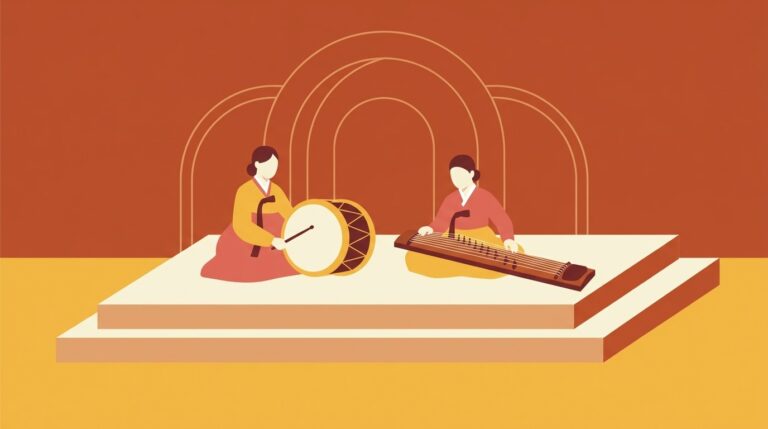
How to Feel the Rhythm of Gugak: The Ultimate Guide to Korean Traditional Performing Arts and Exclamations
Phase 1: Empathy & Storytelling Opening
안녕하세요! 매일한글 에디터입니다. (Hello! This is your Daily Hangul editor.)
Picture this: You are seated at the beautiful National Gugak Center in Seoul, surrounded by the deep, resonant vibrations of the buk (barrel drum) and the expressive, soaring melodies of the pansori singer. You’ve been to Western classical concerts before, so your instincts kick in immediately: sit upright, remain dead silent, and hold your breath until the entire movement concludes.
Suddenly, the Korean elder next to you shouts at the top of his lungs right in the middle of the vocal run: “Eolssigu!” (얼씨구!). Before you can recover from the shock, the drummer chimes in with a booming “Jota!” (좋다!), and the entire hall breaks into synchronized nodding and clapping. You freeze, wondering: Is this allowed? Am I supposed to yell too? What if I scream at the wrong beat and ruin the performance?
This is the quintessential “Gugak Panic” that nearly every intermediate Korean learner encounters. In Korean traditional performing arts (Gugak, 국악), audience silence is actually considered cold and detached! Gugak is not a one-way lecture; it is a collaborative playground fueled by 흥 (Heung – infectious communal joy) and 멋 (Meot – effortless aesthetic flair).
This guide was built from real classroom feedback with dozens of intermediate learners just like you. By the end of this article, you will master the art of traditional audience participation (Chuimsae, 추임새), speak with authentic intermediate nuance, and confidently engage with Korea’s most vibrant performing arts heritage!
Phase 2: Deep-Dive into 3 Core Expressions
1. 얼씨구! (Eolssigu!)
- Pronunciation: [Eol-ssi-gu] (Sounds like “Uhl-see-goo”, rolling off the tongue with a joyful lift at the end)
- Meaning: Literally an ancient rhythmic vocable; practically means “Right on!”, “That’s the spirit!”, or “Oh yeah!”
- K-Culture Moment: You will hear this constantly during Pansori storytelling or dynamic Samulnori (four-percussion) jam sessions whenever the performer hits an intricate rhythm or dramatic climax.
- Editor’s Insight: Eolssigu is not just a word; it is an emotional release. It signals to the artist: “I feel your groove, keep soaring!” It often pairs with its natural partner, Jolssigu (절씨구), forming the classic rhyming chant “Eolssigu jolssigu jal deureogan-da!”
- Situation Spectrum:
- Casual / Peer Jam Session: ✅
- Traditional Gugak Hall: ✅
- Formal Corporate Meeting: 🚫
- 🤔 Think About It: In your home culture, is the audience strictly separated from the performers on stage, or do you have traditional spaces where shouting out is considered polite and necessary?
2. 흥이 난다! (Heungi nanda!)
- Pronunciation: [Heung-i nan-da] (Pronounce ‘Heung’ like the ‘hu’ in ‘hug’ mixed with a deep nasal ‘ng’)
- Meaning: Literally “Joy/energy is arising”; practically translates to “The groove is taking over!” or “I’m feeling the energy surge!”
- K-Culture Moment: Used by variety show hosts on programs like Hangout with Yoo or 2 Days & 1 Night when lively traditional folk music or celebratory dances start moving the crowd.
- Editor’s Insight: Heung (흥) is one of the foundational emotional pillars of Korean psychology. Unlike simple happiness (haengbok), Heung is dynamic, collective, and kinetic—it demands movement, shoulder bounces, and shared smiles.
- Situation Spectrum:
- Casual Gathering / Concert: ✅
- Semi-formal Cultural Tour: ✅
- Solemn Memorial Event: 🚫
- 🤔 Think About It: How does your language express the sudden, unstoppable sensation of collective musical excitement without using plain words like “fun” or “exciting”?
3. 추임새를 넣다 (Chuimsaereul neota)
- Pronunciation: [Chu-im-sae-reul neo-ta] (Think “Choo-im-seh-reul nuh-ta”)
- Meaning: Literally “To insert Chuimsae (exclamatory interjections)”; idiomatically means “To cheer on appropriately”, “To hype someone up”, or “To add active vocal support”.
- K-Culture Moment: In modern workplace or podcast culture, Koreans often say, “Chuimsae jom neo-jwoyo!” when they want their friends or colleagues to react enthusiastically while they are giving a presentation or telling a story.
- Editor’s Insight: At the B2 level, mastering this phrase demonstrates that you understand not just traditional music terms, but how traditional concepts gracefully evolve into modern social metaphors.
- Situation Spectrum:
- Gugak Workshop / Performance: ✅
- Friendly Office / Casual Banter: ✅
- Strict Written Exam / Official Document: ⚠️
- 🤔 Think About It: Why do you think modern Koreans brought a traditional musical term into daily workplace conversations about empathy and active listening?
Phase 3: Textbook Korean vs. Real-world Korean
Situation 1: Praising an Electrifying Traditional Performance
- 📖 교과서 한국어 (Textbook Korean):
- 공연이 매우 감동적이고 재미있었습니다. (Gong-yeoni mae-u gam-dong-jeog-igo jae-mi-isseot-seumnida.)
- “The performance was very moving and interesting.”
- 🗣️ 진짜 한국어 (Real-world Korean):
- 완전 무대를 찢어 놓았어요! 흥이 주체가 안 되네요. (Wanjeon mudae-reul jjijeo noasseoyo! Heung-i juche-ga an doeneyo.)
- “They totally tore up the stage! The energy was so overwhelming I could barely sit still.”
- 💡 Why is it different? While textbook Korean uses safe, flat adjectives, native B2 speakers describe physical impact (tearing up the stage) and emotional overflow (Heung that cannot be restrained).
Situation 2: Encouraging Active Participation During a Show
- 📖 교과서 한국어 (Textbook Korean):
- 박수를 치며 소리를 냅시다. (Baksu-reul chimyeo sori-reul naepsida.)
- “Let us clap our hands and make sounds.”
- 🗣️ 진짜 한국어 (Real-world Korean):
- 추임새 제대로 들어가니까 판이 확 사네요! (Chuimsae jedeoro deureogani-kka pan-i hwak saneyo!)
- “Now that the audience interjections are hitting the right beats, the whole stage has truly come alive!”
- 💡 Why is it different? The word Pan (판) represents the communal playing arena. Real Korean speakers focus on how the collective atmosphere (pan) catches fire through mutual interaction.
Phase 4: K-Culture Deep Dive & Non-Verbal Manners
4-1. 눈치 (Nunchi) & Performance Body Language
- The Breath-Syncing Head Bob (어깨춤 & 고개짓): When listening to traditional rhythms such as Semachi (세마치장단) or Gutgeori (굿거리장단), never sit stiffly like a statue. Keep your shoulders loose. A subtle, natural dip of the head on the primary downbeat signals to surrounding Koreans that you understand the Hohup (호흡 – collective breathing) of the music.
- Timing the Exclamation: Traditional exclamations like “Eolssigu!” (얼씨구!), “Jota!” (좋다!), and “Geureochi!” (그렇지!) must never overlap the singer’s lyrical climax or sudden microtonal shifts. Instead, deliver your Chuimsae in the split-second silence right after a vocal phrase ends or when the drummer lands a resounding syncopated stroke.
4-2. Cultural Code: From Gugak Chuimsae to K-Pop Fan Chants
Ever wondered why K-Pop concerts boast the world’s most intricate, rhythmic fan chants (Eungwon-beop, 응원법)? That dynamic did not emerge out of nowhere. It is directly rooted in Gugak’s centuries-old tradition where spectators are not passive consumers, but active co-creators of the art.
In Pansori, the performance consists of three equal elements: the Singer (Sorikkun), the Drummer (Gosu), and the Audience (Gwanggaek). The old adage “Il-gosu, I-myeongchang, Sam-gwanggaek” (First is the drummer, second is the master singer, and third is the audience) proves that a masterpiece is literally impossible without an engaged crowd shouting out in real time.
Phase 5: Real-Life Roleplay Scenario
Setting: An open-air traditional Madang theater in Bukchon Hanok Village. The sun is setting, lanterns are lit, and a virtuoso Pansori and drum duo is performing Chunhyangga.
Characters:
* You: An intermediate Korean culture enthusiast wanting to blend in smoothly.
* Min-ji (민지): A friendly Gugak graduate student sitting beside you, holding a traditional fan.
[Scene Start]

민지: 🎭 (공연자의 화려한 소리를 듣고 가볍게 어깨를 들썩이며)
와, 오늘 소리꾼 성량이 장난 아니네요!
(Wa, oneul sorikkun seongnyang-i jangnan anineyo!)
"Wow, the singer's vocal power today is no joke!"

당신: 🎭 (장단에 맞춰 고개를 끄덕이며)
맞아요. 북소리 장단이랑 호흡이 딱딱 맞아떨어지는 것 같아요.
(Majayo. Buk-sori jangdan-irang hohub-i ttak-ttak maja-tteo-reojineun geot gat-ayo.)
"Agreed. The rhythm of the drum and their breathing seem perfectly aligned."

민지: 🎭 (미소를 지으며 당신을 돌아보며)
국악 장단을 좀 아시나 봐요? 저 고수(Gosu)분 추임새 넣는 타이밍 좀 보세요.
(Gugak jangdan-eul jom asinabwayo? Jeo gosu-bun chuimsae neonneun taiming jom boseyo.)
"You seem to know your Gugak rhythms! Look at how the master drummer times his interjections."

당신: 🎭 (진지하게 무대를 관찰하며)
네, 소리가 끝나는 순간마다 '좋다!' 하고 받쳐주니까 노래가 훨씬 사네요.
(Ne, sori-ga kkeun-naneun sungan-mada 'Jota!' hago batchyeo-junikka norae-ga hwolssin saneyo.)
"Yes, every time a vocal phrase finishes, he supports it with 'Jota!', making the singing come alive much more."

민지: 🎭 (손뼉을 치며 속삭이듯)
맞아요! 관객도 같이 소리 질러도 돼요. 지금 대목 끝나면 한번 같이 해볼래요?
(Majayo! Gwan-gaek-do gachi sori jilleodo dwaeyo. Jigeum daemok kkeutnamyeon hanbeon gachi haebollaeyo?)
"Exactly! The audience can shout too. When this passage ends, want to try doing it together?"

당신: 🎭 (자신감 있게 호흡을 가다듬으며)
좋아요! 타이밍 놓치지 않고 제대로 외쳐볼게요.
(Joayo! Taiming notchiji anko jedeoro oechyeobolgeyo.)
"Sounds great! I'll catch the timing without missing a beat."

[소리꾼이 극적인 고음을 멋지게 마무리한다 / The singer finishes an intense, soaring vibrato]

당신 & 민지: 🎭 (동시에 두 손을 모아 무대를 향해 환호하며)
얼씨구! 잘한다!
(Eolssigu! Jalhanda!)
"Right on! Fantastic job!"

민지: 🎭 (엄지손가락을 치켜세우며 감탄하듯)
우와, 타이밍 대박! 완전 명창과 명관객의 만남이었어요!
(Uwa, taiming daebak! Wanjeon myeongchang-gwa myeong-gwan-gaek-ui mannam-ieosseoyo!)
"Whoa, legendary timing! That was truly a match between a master singer and a master spectator!"

[Scene End]
🔀 Interactive Choice Point
The singer pauses for a brief dramatic breath before starting a comical storytelling section. What do you do?
* Option A: Remain completely silent, look down at your brochure, and clap quietly 10 seconds later.
* Option B: Loudly shout “얼씨구!” (Eolssigu!) during the dead silence of the dramatic breath before the beat drops.
* Option C: Wait for the drummer’s buk beat to land on the downbeat, nod gently, and shout “좋다!” (Jota!) with warmth.
Feedback:
* Option A (Bad): You miss out on the cultural magic of the venue and make the performers feel like the audience is disconnected.
* Option B (Risk): Yelling in the middle of an intentional artistic breath might break the performer’s concentration.
* Option C (Best!): Spot on! Responding in harmony with the drummer creates the golden tri-party synergy of traditional performance.
Phase 6: 10-Second Emotion Shadowing Drill
Practice reading these sentences aloud, pausing at the slashes (/) and channeling the exact emotion indicated:
[🔥 신명나고 당차게 / Energetic & Confident]
얼씨구! / 장단 한번 / 기가 막히게 들어간다! / 좋다!
(Eolssigu! / Jangdan hanbeon / giga mak-hige deureoganda! / Jota!)
“Right on! / That drum rhythm / is landing exquisitely! / Fantastic!”-
[😌 깊은 감탄과 여운을 담아 / Deep Awe & Lingering Emotion]
명창의 목소리에 / 한과 흥이 / 고스란히 묻어나네요.
(Myeongchang-ui moksorie / han-gwa heung-i / goseuran-hi mudeonaneyo.)
“In the master’s voice, / both sorrow and exhilarating joy / resonate so purely.” -
[🤝 유쾌하고 다정하게 / Playful & Friendly Encouragement]
추임새 조금만 더 넣어주시면 / 판이 훨씬 더 / 뜨거워질 것 같아요!
(Chuimsae jogeumman deo neoeo-jusimyeon / pan-i hwolssin deo / tteugeowo-jil geot gat-ayo!)
“If you add just a few more interjections, / I think this stage / will get so much hotter!”
Phase 7: K-Culture Mini Dictionary
- 추임새 (Chuimsae): Spontaneous verbal cheers and interjections inserted during performances to encourage artists; in modern life, refers to active social listening and enthusiastic agreement.
- 흥 (Heung): A distinct Korean cultural concept denoting an innate, bubbling communal zest for life, dance, and music that overcomes adversity.
- 한 (Han): The deep collective emotional resonance of sorrow, longing, or historical endurance, which is transformed into celebration (Heung) through artistic expression.
- 신명 (Sinmyeong): An elevated state of ecstatic communal excitement and inspiration where performers and audience feel unified in spirit.
Phase 8: Survival Kit for Travelers
Top 3 Gugak Survival Phrases
- 자리에서 사진 촬영 가능한가요?
- Pronunciation: Jari-eseo sajin chwaryeong ganeung-hangayo?
- Meaning: “Is photography allowed from my seat?”
- Pro Tip: Traditional indoor theaters generally forbid flash photography during vocal solos, but encourage it during the final curtain-call parade (Daedongnori).
- 공연 중에 추임새를 넣어도 되나요?
- Pronunciation: Gong-yeon jung-e chuimsae-reul neoeodo doenayo?
- Meaning: “Are audience vocal cheers permitted during the performance?”
- Pro Tip: Asking the usher before entering shows exquisite cultural etiquette.
- 프로그램 북 하나 구입할 수 있을까요?
- Pronunciation: Peurogeuraem buk hana gu-ip-hal su isseulkkayo?
- Meaning: “Could I purchase one program booklet?”
- Pro Tip: Korean Gugak program booklets often contain detailed English synopses of complex narrative songs.
Editor’s Travel Note
- Top Venue Recommendations: Don’t miss the outdoor weekend matinees at the 국립국악원 예매 및 길찾기 가이드 (National Gugak Center in Seocho-dong) or the intimate courtyard setting of 서울남산국악당 공연 정보 확인 inside Namsangol Hanok Village.
- Ticketing & Navigation: Download the 네이버 지도 앱 다운로드 to navigate transit routes seamlessly, and use 인터파크 티켓 외국인 예매 페이지 for simple overseas credit card checkout without domestic phone verification barriers.
Phase 9: “One Step Deeper” (Reflective Essay)
In many classical theatrical traditions across the globe, a rigid boundary—often termed the “fourth wall”—separates the illuminated stage from the darkened, silent spectators. Traditional Korean performing arts actively shatter this boundary through the concept of the Madang (마당 – open courtyard). In a Madang, there is no high stage; the dirt floor is shared equally by the farmer, the aristocrat, the master singer, and the foreign traveler.
By vocalizing your Chuimsae, you are not interrupting an artistic masterpiece; you are supplying the very breath that keeps it alive. It reflects Korea’s egalitarian communal ethos (Dure culture): joy is doubled and grief is halved when vocalized together.
💬 Your Turn: Have you ever attended a musical performance where shouting and physical participation made you feel deeply connected to strangers? Share your story in the comments below!
Phase 10: FAQ & Common Mistakes
Q: Can I use “Eolssigu!” during modern K-Pop concerts or standard indie band gigs?
A: While shouting “Eolssigu!” at a hip-hop or indie show might sound humorous and retro (often bringing laughter from surrounding fans), K-Pop concerts have designated Eungwon-beop (fan chants). Save “Eolssigu!” for Gugak, folk festivals, traditional fusion concerts, or comedic karaoke moments with close Korean friends!
Q: What is the exact difference between “Jota!” (좋다) and “Geureochi!” (그렇지)?
A: “Jota!” translates directly to “Wonderful! / Beautiful!” and is used when a melody sounds exceptionally sweet or powerful. “Geureochi!” translates to “That’s it! / Right on the money!” and is shouted when an artist executes a remarkably difficult rhythmic shift or vocal technique with sheer precision.
Q: What should I do if I am too shy to yell out loud in the theater?
A: That is completely fine! You can show active presence through Chubim-jit (shoulder dances), gentle hand taps on your lap matching the rhythm (Jangdan), and enthusiastic applause at the end of each storytelling round.
🚨 Common Mistakes Top 3
- Mistake: Shouting “Bravo!” or “Encore!” during mid-performance vocal breaks.
- Correct Action: Use traditional Korean exclamations like “Jota!” (좋다!) or “Jalhanda!” (잘한다!).
- Mistake: Clapping only on beats 1 and 3 like in Western pop march tempo.
- Correct Action: Gugak rhythms often run in triplets (3-beat cycles like 12/8 time). Bounce your hands to the 3-beat cadence (Dung-Ddak-Gung).
- Mistake: Treating the Gosu (drummer) as a mere background accompanist.
- Correct Action: Pay equal respect and applause to the drummer; in Gugak, the drummer directs the entire emotional pacing of the singer!
Phase 11: Action Missions & Engagement
- 🥉 Bronze Mission (Solo Practice): Say “Eolssigu!” (얼씨구!) and “Jota!” (좋다!) aloud 5 times in front of a mirror with a bright, open smile.
- 🥈 Silver Mission (Social Share): Leave a comment below using the intermediate idiom
추임새를 넣다in a creative sample sentence about your daily life. - 🥇 Gold Mission (Real-World Execution): Look up a video of a Pansori or Samulnori concert online, and vocalize at least three well-timed Chuimsae cheers along with the live audience!
🎮 K-Culture Challenge Mission: Listen to Agust D’s (BTS Suga) song ‘Daechwita’ (대취타) or Stray Kids’ ‘Thunderous’ (소리꾼). Can you identify the traditional instruments (Taepyeongso, Buk, Kkwaenggwari) and shout your own Chuimsae along with the drop?
Phase 12: Interactive Quiz Challenge
Test your knowledge below! Click on each question to reveal the answers and detailed explanations.
Q1. Situational Judgment: Which exclamation is most natural when a Pansori singer pulls off a technically brilliant vocal transition?
- A) 조용히 하세요! (Joyonghi haseyo!)
- B) 그렇지! 잘한다! (Geureochi! Jalhanda!)
- C) 실례합니다! (Sillyehamnida!)
Correct Answer: B) 그렇지! 잘한다!
Explanation: “Geureochi!” acknowledges the performer’s skill, while “Jalhanda!” encourages them to keep excelling. A means “Be quiet!” and C means “Excuse me!”
Q2. Fill in the Blank: Complete this classic Korean musical saying regarding the audience’s crucial role: “일고수, 이명창, 삼____”
- A) 관객 (Gwanggaek – Spectator/Audience)
- B) 식사 (Siksa – Meal)
- C) 무대 (Mudae – Stage)
Correct Answer: A) 관객 (Gwanggaek)
Explanation: The full traditional proverb is “Il-gosu, I-myeongchang, Sam-gwanggaek”, meaning the first essential is the drummer, the second is the master singer, and the third is the participating audience.
Q3. True or False: In traditional Gugak performances, yelling “좋다!” while the singer is performing is considered rude and disruptive.
Correct Answer: False (F)
Explanation: Unlike Western classical music traditions, well-timed exclamatory interjections (Chuimsae) are an essential, welcome component of Korean performing arts that energize the performers on stage.







