

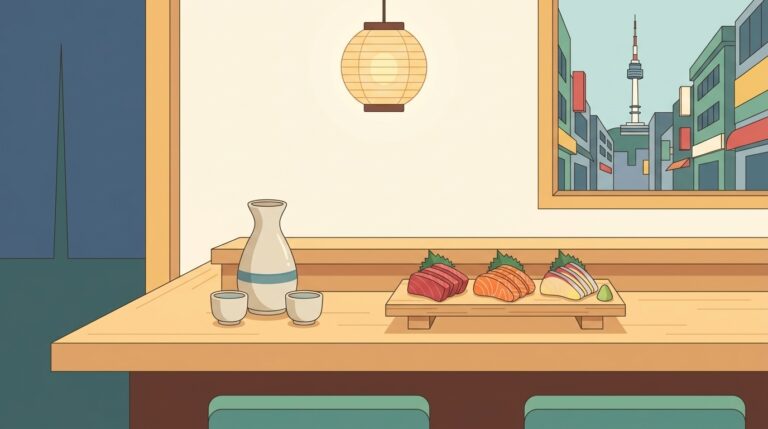
Phase 1: Empathy (Story-Driven Opening)
안녕하세요! 매일한글 에디터입니다. (Hello! I’m your Daily Hangul editor.)
Picture this: It is a crisp Friday evening in Seoul. After a demanding week at the office, your Korean colleagues suggest heading to a cozy, dimly lit 이자카야 (izakaya) tucked away in the back alleys of Euljiro. As you slide open the wooden door, the rich aroma of grilled yakitori and steamed rice fills the room. The waiter hands your table a leather-bound drink menu filled with dozens of premium Japanese sake, shochu, and craft highballs.
Suddenly, the senior manager turns to you and asks, “오늘 어떤 사케로 시작할까요? 취향이 어떻게 되세요?” (Which sake should we start with today? What’s your preference?)
At an intermediate level, you might simply freeze or say “아무거나 좋아요” (Anything is fine). But at a C1 level, alcohol in Korea is not just a drink—it is a sophisticated bridge for conversation, networking, and mutual respect. How do you describe refined taste profiles, suggest pairings with seasonal sashimi, and navigate the delicate social etiquette of pouring and receiving drinks in a hybrid Korean-Japanese dining setting? Based on years of mentoring expatriates and global professionals in Seoul, I have curated this advanced guide to help you converse with elegance, confidence, and natural Korean flair.
Phase 2: Core 3 Expressions In-Depth Analysis
1. 목넘김이 깔끔하고 끝맛에 은은한 산미가 도네요. (Hangul)
- Pronunciation: Mok-neom-gim-i kkal-kkeum-ha-go kkeun-ma-se eun-eun-han san-mi-ga do-ne-yo. (Sounds like: Moke-nuhm-gim-ee kkal-kkoom-ha-go ggeut-mah-seh oon-oon-hahn sahn-mee-gah doh-neh-yo)
- Meaning: Direct translation: “The throat-passing is clean, and subtle acidity circles the aftertaste.” | Nuance: “It goes down exceptionally smooth with a refined, delicate hint of acidity on the finish.”
- K-Culture Moment: Used frequently in gourmet dining shows or upscale K-Drama business dinner scenes (like in Work Later, Drink Now or Agency) when evaluating clean, premium junmai daiginjo sake or dry wines.
- Editor’s Insight: 목넘김 (throat feel / finish) is an essential sensory descriptor in Korean drinking culture. Pairing it with 은은한 (subtle, delicate) elevates your commentary to a true connoisseur level.
- Situation Spectrum: Casual: ✅ | Semi-formal: ✅ | Formal: ✅
- 🤔 Think About It: Notice how Korean describes the physical sensation of swallowing (목넘김) as a distinct dimension of flavor. How does your native language convey mouthfeel versus aftertaste?
2. 사케 특유의 감칠맛이 해산물 안주랑 페어링이 기가 막히네요. (Hangul)
- Pronunciation: Sa-ke teu-kyu-ui gam-chil-ma-si hae-san-mul an-ju-rang pe-eo-ring-i gi-ga ma-khi-ne-yo. (Sounds like: Sah-keh ttoo-kyoo-wee gahm-cheel-mah-shee heh-sahn-mool ahn-joo-rahng peh-uh-ring-ee gee-gah mah-kee-neh-yo)
- Meaning: Direct translation: “Sake’s unique umami pairs with seafood snacks to the point energy is blocked.” | Nuance: “The distinct umami of this sake pairs magnificently with seafood dishes.”
- K-Culture Moment: Overheard at dining counters when tasting fresh sashimi paired with dry, rice-forward sake (카라구치).
- Editor’s Insight: 기가 막히다 literally means ‘so breathtaking that one’s energy/breath stops’, used idiomatically to express perfection. Combining it with modern dining jargon like 페어링 (pairing) showcases sophisticated fluency.
- Situation Spectrum: Casual: ✅ | Semi-formal: ✅ | Formal: ⚠️
- 🤔 Think About It: 감칠맛 (umami/savory depth) is the heart of East Asian palate vocabulary. Why do you think pairing drinks to food (안주) carries such cultural weight in Korea?
3. 오늘은 쌀의 풍미를 제대로 느끼게 도쿠리를 따뜻하게 데워 주시겠어요? (Hangul)
- Pronunciation: O-neul-eun ssal-ui pung-mi-reul je-dae-ro neu-kki-ge do-ku-ri-reul tta-tteut-ha-ge de-wo ju-si-get-seo-yo? (Sounds like: Oh-noo-roon ssahl-wee poong-mee-rool jeh-deh-roh noo-ggee-geh doh-koo-ree-rool ttah-ttoot-hah-geh deh-woh joo-shee-get-suh-yo?)
- Meaning: Direct translation: “Today, so we can properly feel the rice’s aroma, could you warm the tokkuri carafe?” | Nuance: “Could you warm the carafe for us today so we can fully appreciate the rich flavor of the rice?”
- K-Culture Moment: When entering an izakaya on a freezing winter night in Seoul, ordering hot sake (아츠칸 / 데운 사케) to warm the atmosphere before a serious heart-to-heart.
- Editor’s Insight: Asking specifically for 쌀의 풍미 (aroma/depth of rice) demonstrates that you understand the brewing foundation of sake, instantly impressing waitstaff and Korean dining partners alike.
- Situation Spectrum: Casual: ✅ | Semi-formal: ✅ | Formal: ✅
- 🤔 Think About It: Warm alcohol is customary across East Asian culinary history. What cultural values link temperature to the appreciation of taste?
Phase 3: Textbook Korean vs. Real Korean
Situation 1: Recommending a sake profile to someone hesitant
- 📖 교과서 한국어 (Textbook): 이 술은 쌀로 만들어서 단맛이 납니다. 드셔 보세요. (I sul-eun ssal-ro man-deul-eo-seo dan-mas-i nam-ni-da. Deu-syeo bo-se-yo. / This alcohol is made from rice, so it tastes sweet. Please try it.)
- 🗣️ 진짜 한국어 (Real Native C1): 이 사케는 드라이하기보다는 감미와 바디감이 있어서, 사케 입문자도 부담 없이 즐기기 딱 좋아요. (I sa-ke-neun deu-ra-i-ha-gi-bo-da-neun gam-mi-wa ba-di-gam-i iss-eo-seo, sa-ke ip-mun-ja-do bu-dam eop-si jeul-gi-gi ttak jo-a-yo. / Rather than being dry, this sake has a pleasant sweetness and solid body, making it ideal for beginners to enjoy effortlessly.)
- 💡 Why the difference? C1 level Korean integrates professional tasting vocabulary (감미, 바디감, 입문자) to provide polite, reassuring, and nuanced recommendations.
Situation 2: Managing pace or refusing another refill politely
- 📖 교과서 한국어 (Textbook): 저는 배가 부르고 취해서 더 이상 못 마십니다. (Jeo-neun bae-ga bu-reu-go chwi-hae-seo deo i-sang mot ma-sim-ni-da. / I am full and drunk, so I cannot drink anymore.)
- 🗣️ 진짜 한국어 (Real Native C1): 오늘 술이 너무 부드럽게 잘 들어가네요. 주량 조절을 위해 이번 잔은 천천히 음미하면서 마실게요. (O-neul sul-i neo-mu bu-deu-reop-ge jal deul-eo-ga-ne-yo. Ju-ryang jo-jeol-eul wi-hae i-beon jan-eun cheon-cheon-hi eum-mi-ha-myeon-seo ma-sil-ge-yo. / The drink is going down so smoothly tonight. To keep my limits in check, I will sip and savor this cup slowly.)
- 💡 Why the difference? A blunt refusal can unintentionally cool the communal mood (분위기를 깨다). Praising the beverage while framing pacing as “savoring thoughtfully” maintains social harmony.
Phase 4: K-Culture Deep Dive & Non-Verbal Manners
4-1. 눈치 (Nunchi) & Etiquette in Korean Izakaya Settings
- The Two-Handed Pour (두 손 예절): Even when drinking Japanese sake, Korean table manners apply unconditionally if you are dining with Korean seniors or peers. Hold the carafe (도쿠리) with your right hand while lightly supporting your right forearm or wrist with your left hand. When receiving, hold the small cup (오초코) with both hands.
- Turn Away While Sipping (고개 돌려 마시기): If drinking with someone higher in hierarchy (team leader, elder), slightly turn your head and torso away while taking a sip, lightly shielding the cup with your hand.
- Watch the Cup’s Bottom (잔 비우기 눈치): Japanese etiquette allows top-offs before the cup is empty, but traditional Korean 주도 (drinking etiquette) emphasizes pouring only when the cup is completely empty (자작 금지 – don’t pour your own, 완샷 후 첨잔). In modern izakayas, pay attention to which rhythm your company follows!
4-2. The Seoul Dining Scene: Highballs, Sake, and Izakaya Culture
Over the past few years, the younger demographic in Seoul (specifically in Seongsu-dong, Hannam-dong, and Sinsa-dong) has driven a massive renaissance in Japanese-style dining. Highballs made with Japanese whisky and premium artisanal sake have become staples for casual after-work gatherings (회식). Rather than binge-drinking heavy soju, modern professionals prefer sophisticated food pairings where individual taste preferences and craft aesthetics take center stage.
Phase 5: Real-Life Roleplay Scenario
Setting: A sophisticated Izakaya in Hannam-dong. You are having an evening wrap-up dinner with Manager Park (박 팀장님) and Colleague Minji (민지 씨).
- 박 팀장: 오늘 다들 고생 많았어요. 여기 사케 리스트가 꽤 방대한데, 어떤 걸로 골라볼까요? (Oneul dadeul gosaeng manasseoyo. Yeogi sake riseuteuga kkwae bangdaehande, eotteon geollo golla bolkkayo? / Everyone worked hard today. The sake list here is extensive—what should we select?)
🎭 Leaning back comfortably, gesturing toward the menu. - Learner (You): 팀장님, 오늘 모둠 사시미를 주문했으니, 드라이하고 끝맛이 깔끔한 준마이 계열은 어떠세요? (Teamjangnim, oneul modum sasimireul jumunhaesseuni, deuraihago kkeunmasi kkal-kkeumhan junmai gyeyeoreun eotteoseyo? / Manager, since we ordered the assorted sashimi, how about a dry Junmai-style sake with a crisp finish?)
🎭 Politely pointing out a recommended bottle on the list with both hands. - 민지: 오, 좋은 선택이네요! 회에는 역시 산미가 살짝 도는 카라구치 사케가 제격이죠. (O, joeun seontaegineyyo! Hoeeneun yeoksi sanmiga saljjak doneun karaguchi sakega je-gyeok-ijyo. / Oh, great choice! Crisp, dry sake with a touch of acidity is indeed perfect with raw fish.)
🎭 Nodding in agreement with an approving smile. - 박 팀장: 역시 센스가 남다르네요. 자, 다들 잔 들어요. 이번 프로젝트 무사 완료를 위하여! (Yeoksi senseuga namdareuneyo. Ja, dadeul jan deureoyo. Ibeon peurojekteu musa wallyoreul wihayeo! / As expected, your culinary sense is remarkable. Here, raise your glasses. To the successful completion of our project!)
🎭 Pouring the sake carefully into everyone’s cups. - Learner (You): 감사합니다, 팀장님. 제가 두 손으로 받겠습니다. (Gamsahamnida, teamjangnim. Jega du soneuro batgetseumnida. / Thank you, Manager. Let me receive it with both hands.)
🎭 Holding the small sake cup with two hands, bowing head slightly. - 민지: 짠! 와, 향이 정말 화사하고 목넘김이 예술이네요. (Jjan! Wa, hyangi jeongmal hwasahago mokneomgimi yesurineyo. / Clink! Wow, the aroma is floral and the finish is pure art.)
🎭 Lightly clinking glasses below the rim of the Manager’s glass. - 박 팀장: 한 잔 더 채워줄게요. 오늘 기분 좋은데 편하게 마셔요! (Han jan deo chaewojulgeyo. Oneul gibun joeunde pyeonhage masyeoyo! / Let me refill your glass. Mood is great tonight, so drink comfortably!)
🎭 Reaching for the carafe to pour another round. - Learner (You): [Your Turn to Respond]
🔀 Interactive Branching Point
What would you say at this moment?
- Option A: 팀장님, 제 잔이 아직 절반이나 남았으니 이것부터 다 비우고 바로 받겠습니다! (Teamjangnim, je jani ajik jeolbanina namasseuni igeotbuteo da biugo baro batgetseumnida. / Manager, my glass is still half full, so let me finish this first and receive yours immediately!)
- Option B: 이제 술을 그만 마시고 싶으니 잔을 치워 주십시오. (Ije sureul geuman masigo sipeuni janeul chiwo jusipsio. / I want to stop drinking now, so please clear my glass away.)
- Option C: 감사합니다! 그럼 팀장님 잔도 제가 먼저 채워 드리겠습니다! (Gamsahamnida! Geureom teamjangnim jando jega meonjeo chaewo deurigetseumnida. / Thank you! Then let me fill your glass first, Manager!)
Feedback on Choices:
- Option A (Best Choice ⭐⭐⭐): Demonstrates fluent command of Korean 주도 (emptying before receiving refills) while maintaining enthusiastic respect and social energy.
- Option B (Bad Choice ❌): Overly blunt and robotic. Breaks the convivial atmosphere abruptly.
- Option C (Risk ⚠️): Pouring into an elder’s glass before acknowledging their gesture can look like an impatient counter-action. Wait for them to pour or exchange turns respectfully.
Phase 6: 10-Second Emotional Shadowing Drill
Read the following sentences out loud, paying attention to breath pauses (/) and emotional tone cues.
[🍶 감탄하며 입맛 다시듯이 / With gourmet appreciation]- “사케 특유의 쌀 향이 / 입안 가득 퍼지면서 / 끝맛은 기분 좋게 딱 떨어지네요.”
- (Sake teuk-yu-ui ssal hyang-i / ib-an ga-deuk peo-ji-myeon-seo / kkeun-ma-seun gi-bun jo-ke ttak tteol-eo-ji-ne-yo.)
- (“The unique rice aroma of the sake / spreads across the palate / and the finish wraps up with clean satisfaction.”)
[😊 정중하고 세련되게 / Refined and polite]- “도쿠리가 식기 전에 / 따뜻할 때 한 잔 / 먼저 올려 드려도 될까요?”
- (Do-ku-ri-ga sik-gi jeon-e / tta-tteut-hal ttae han jan / meon-jeo ol-lyeo deu-ryeo-do doel-kka-yo?)
- (“Before the tokkuri cools down / while it is warm / may I offer you a cup first?”)
[🥂 다정하고 부드럽게 / Warm and conversational]- “이 집은 안주도 훌륭하지만 / 주류 라인업의 밸런스가 / 정말 수준급이네요.”
- (I jib-eun an-ju-do hul-lyung-ha-ji-man / ju-ryu ra-in-eop-ui bael-leon-seu-ga / jeong-mal su-jun-geub-i-ne-yo.)
- (“This place serves wonderful food dishes / but the balance of their drink lineup / is truly first-rate.”)
Phase 7: K-Culture Mini Dictionary
- 도쿠리 (Dokuri): A bulbous ceramic flask used for serving sake. Often ordered hot (온도쿠리) or chilled (냉도쿠리) depending on the season and pairing.
- 감칠맛 (Gamchilmmat): Deep, savory umami flavor profile. Essential when discussing sake acidity, broth, and fermented accompaniments.
- 반주 (Banju): Alcohol consumed naturally alongside a meal rather than during a wild late-night binge. Drinking sake with sashimi or yakitori is classic 반주 culture.
- 주도 (Judo): The traditional moral etiquette and manners governing drinking, encompassing two-handed pouring, seating arrangement, and pacing.
Phase 8: Survival Kit for Travelers
Top 3 Survival Phrases
- “가장 드라이하고 깔끔한 사케로 추천해 주시겠어요?” (Gajang deuraihago kkalkkeumhan sakero chucheonhae jusigesseoyo?)
- Pro Tip: Use this when confronted with a complex Japanese kanji menu; waitstaff will immediately point to a dry, foolproof bottle.
- “이 요리에는 찬 사케와 따뜻한 사케 중 어느 쪽이 더 잘 어울리나요?” (I yorieneun chan sakewa ttatteuthan sake jung eoneu jjogi deo jal eoullinayo?)
- Pro Tip: Shows culinary curiosity about serving temperatures (히야 vs 아츠칸).
- “잔술(도쿠리)로도 주문이 가능한가요?” (Jansul(dokuri)rodo jumuni ganeunghangayo?)
- Pro Tip: If ordering an entire bottle is too much for a casual dinner, asking for by-the-glass (잔술) or carafes (도쿠리) saves budget and avoids waste.
Editor’s Travel Note
- When reserving popular izakayas or yakitori bars in Hongdae or Gangnam, download and check the CatchTable reservation app for foreign card support.
- Explore hidden neighborhood gems by searching “이자카야 맛집” on the Naver Map mobile application to view genuine Korean local reviews and seasonal menus.
Phase 9: “One Step Deeper” (Reflective Essay)
In Korean society, the dining table is not merely a venue for calorie consumption; it is an intimate theater of human relationships (정, Jung). The adoption and popularity of Japanese izakayas and sake in Korea represent a fascinating cultural hybridity. While the beverages and recipes originate from Japan, the social dynamics at the table remain deeply rooted in Korean relational etiquette—checking on empty glasses, sharing communal appetizers, and using polite honorifics to foster trust.
Learning to navigate this intersection with nuanced sensory language shows that you do not just speak Korean; you understand how Koreans connect over a shared drink.
💬 Your Turn: What is your go-to beverage when enjoying dinner with colleagues or friends? Have you ever noticed differences in drinking etiquette between your country and Korea? Let us know in the comments below!
Phase 10: FAQ & Common Mistakes
Q: Can I pour my own sake when sitting with Korean friends at an izakaya?
A: While casual among close peers, pouring your own drink (자작) in Korean culture traditionally implies loneliness or inattention from table partners. It is always more charming and courteous to pour for others first, prompting them to naturally return the favor.
Q: How do I distinguish between 사케 (Sake) and 청주 (Cheongju) in Korea?
A: Both are clear rice-brewed alcohols. 청주 (Cheongju) is the traditional Korean category of refined rice wine, whereas 사케 (Sake/Nihonshu) specifically designates Japanese-style brewed rice liquor. In modern gastropubs, menus clearly separate Korean traditional 약주/청주 from Japanese 사케.
Q: What is the polite way to hold the sake cup when an older person pours for me?
A: Lift the small cup (오초코) off the table using your right hand, and gently support the base or side of the cup with the fingers of your left hand. Avoid leaving the cup resting flat on the table while someone is pouring for you.
🚨 Common Mistakes (흔한 실수 TOP 3)
- ❌ Mistake 1: Leaving the cup completely on the table while being poured for.
- 💡 Correct Action: Always hold the cup in the air with both hands (두 손으로 들기).
- ❌ Mistake 2: Using overly simplistic words like “달아요” (sweet) or “써요” (bitter) for high-end dining.
- 💡 Correct Action: Use elevated descriptors like 풍미가 깊다 (deep aroma), 감칠맛이 난다 (rich umami), or 목넘김이 부드럽다 (smooth finish).
- ❌ Mistake 3: Pouring sake into a glass that is still 80% full.
- 💡 Correct Action: Wait until the companion has finished or nearly finished their cup before offering a fresh pour.
Phase 11: Action Mission & Engagement
- 🥉 Bronze Level (Solo Practice): Stand in front of a mirror and practice the phrase: “목넘김이 정말 깔끔하네요!” with a satisfied, natural facial expression.
- 🥈 Silver Level (Social Share): Post a photo of your favorite drink or dinner on Instagram with the Korean caption: #반주 #사케페어링 #목넘김예술 and tag
@DailyHangul. - 🥇 Gold Level (Real-Life Mission): Next time you visit an izakaya or Korean-fusion restaurant, ask the server for recommendations using: “해산물 안주랑 어울리는 드라이한 사케 추천 부탁드립니다!”
🎮 K-Culture Mission: Watch an episode of a dining K-Drama (like Let’s Eat or Work Later, Drink Now). Spot the exact moment characters adjust their posture or cup position when drinking with a senior colleague!
Phase 12: Interactive Quiz Challenge
Question 1 (Situational Judgement): You are at an upscale izakaya in Gangnam with your Korean company director. He offers to pour you sake. What is the most culturally appropriate action?
* A) Leave the cup on the table and say “많이 주세요!” (Pour a lot!)
* B) Hold the cup with both hands, receive the pour, turn slightly to the side to take a sip, and express appreciation for its smooth finish.
* C) Reject the pour immediately because your cup still has one drop left.
Question 2 (Fill in the Blank): Complete the sentence to describe a clean finish:
* “이 술은 쌀 향이 은은하고 ________이(가) 정말 깔끔하네요.”
* A) 목넘김 (Mokneomgim)
* B) 발소리 (Balsori)
* C) 숟가락 (Sutgarak)
Question 3 (True/False): In Korean dining culture, pouring your own alcohol (자작) is considered the highest form of respect to others.
* A) True
* B) False
🔍 Click here to reveal the answers and explanations!
- Question 1 Answer: B
- Explanation: Receiving with two hands and turning slightly sideways demonstrates respect (주도), and complimenting the beverage enhances the conversational mood.
- Question 2 Answer: A (목넘김)
- Explanation: 목넘김 means how smooth the liquid feels when swallowing, which is central to evaluating drinks.
- Question 3 Answer: B (False)
- Explanation: 자작 (pouring for yourself) is generally avoided in group settings. Pouring for one another builds mutual warmth (정).
- Explanation: 자작 (pouring for yourself) is generally avoided in group settings. Pouring for one another builds mutual warmth (정).






