

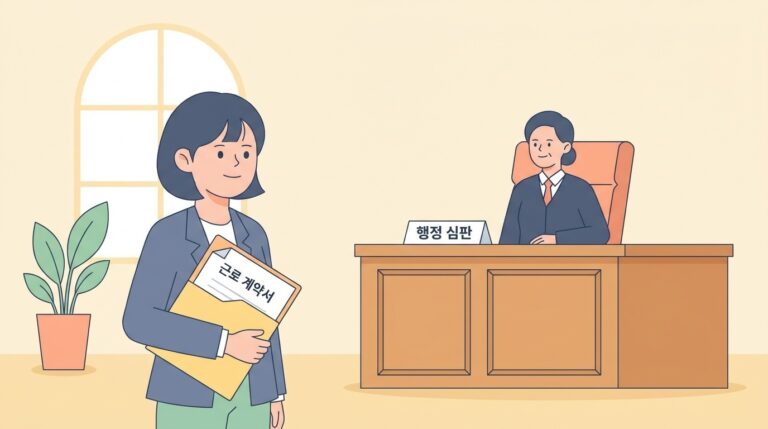
Phase 1: Empathy (Immersive Story Opening)
안녕하세요! 매일한글 에디터입니다. (Hello! This is your Daily Hangul editor.)
Imagine this scenario: You’ve been balancing your intense university studies in Seoul while working 20 hours a week as a barista at a trendy franchise cafe in Hapjeong. You’ve memorized custom drink orders, handled weekend rush hours with impeccable speed, and built a great rapport with regulars. Then, out of nowhere on a Tuesday evening, your store manager sends you a cold KakaoTalk message: “Starting tomorrow, you don’t need to come in. Business is slow, and we’re restructuring our part-time shifts.”
If this felt like a jarring scene straight out of a high-stakes K-Drama like Itaewon Class or Misaeng (Incomplete Life), you are not alone. For international residents and students navigating Korea’s part-time job market (알바, alba), sudden dismissal without warning is one of the most disorienting, vulnerable experiences you can face. Your immediate instinct might be to accept it passively or assume that because you are a foreigner or a part-time worker, you lack institutional recourse.
However, under South Korea’s Labor Standards Act (근로기준법), statutory protections against unfair dismissal (부당해고) apply stringently—even to international part-time workers, provided specific statutory thresholds are met. Navigating the remedy procedure (구제신청) through the National Labor Relations Commission (노동위원회) requires not just legal awareness, but a sophisticated mastery of formal administrative Korean, strategic rhetoric, and an understanding of workplace documentation protocols. Drawing from real labor consultations and administrative tribunal precedents, this advanced C2 guide gives you the precise linguistic tools and cultural playbook to defend your rights with unflinching composure.
Phase 2: Deep-Dive Analysis of 3 Key Legal Expressions
1. 부당해고 구제신청을 제기하겠습니다. (Budang-haego guje-sincheong-eul jegi-hagetseumnida.)
- Pronunciation: [Boo-dang-hae-go goo-je-shin-cheong-eul je-gi-ha-get-seum-ni-da] (Think of ‘jegi’ like asserting a formal challenge in a courtroom debate).
- Meaning:
- Literal: “I will raise an application for remedy against unfair dismissal.”
- Nuanced: “I am formally initiating legal dispute proceedings through the Labor Relations Commission regarding this unlawful termination.”
- K-Culture Moment: This high-register declaration is the exact linguistic turning point seen in legal dramas like Extraordinary Attorney Woo or Queen of Tears, where an employee transitions from a vulnerable subordinate to an assertive legal subject demanding statutory due process.
- Editor’s Insight: The verb 제기하다 (to raise/institute a claim) immediately elevates the discourse into administrative and legal territory. Unlike everyday verbs like 신청하다 (to apply), 제기하다 signifies that you are formally disputing the substantive legality of the employer’s action under Article 28 of the Labor Standards Act.
- Situation Spectrum: Casual 🚫 | Semi-formal ⚠️ | Formal/Administrative ✅
- 🤔 Think About It: In many Western individualistic legal cultures, rights are asserted instantly and confrontational language is normalized early. In Korea, shifting from polite relational markers to statutory formal terminology (-겠습니다) serves as an explicit, dignified boundary marker that signals imminent administrative intervention.
2. 서면 통지의 의무를 위반하셨습니다. (Seomyeon tongji-ui uimu-reul wiban-hasyeotseumnida.)
- Pronunciation: [Suh-myeon tong-ji-eui ui-moo-reul wee-ban-ha-syeot-seum-ni-da] (Roll the ‘tong-ji’ crisp and clear like delivering official notices).
- Meaning:
- Literal: “You have violated the duty of written notification.”
- Nuanced: “Under statutory labor law, firing someone verbally, via text, or through KakaoTalk without a signed physical document outlining grounds and date is legally void.”
- K-Culture Moment: In corporate workplace dramas, an unscrupulous manager sends a curt text message to cut ties quickly. A seasoned labor advocate or HR specialist steps in, brandishing Article 27 of the Labor Standards Act to show that verbal or instant-message dismissals carry zero legal validity.
- Editor’s Insight: Under Korean labor jurisprudence, an employer must notify the employee of both the exact reasons for dismissal and the effective date in written form (서면). Firing an employee via KakaoTalk or SMS is deemed per se invalid (절차적 하자 / procedural defect), entitling the worker to back pay.
- Situation Spectrum: Casual 🚫 | Semi-formal ⚠️ | Formal/Administrative ✅
- 🤔 Think About It: Notice the use of the honorific infix -시- combined with the legal accusation of violation (위반하셨습니다). Why does Korean maintain high politeness morphology even when accusing an adversary of an unlawful act?
3. 원직 복직 및 해고 기간의 임금 상당액을 청구합니다. (Wonjik bokjik mit haego gigan-ui imgeum sangdang-aek-eul cheong-gu-hamnida.)
- Pronunciation: [Won-jeek bok-jeek meet hae-go gee-gan-eui eem-geum sang-dang-aek-eul cheong-goo-ham-nee-da]
- Meaning:
- Literal: “I claim reinstatement to original post and the equivalent amount of wages during the dismissal period.”
- Nuanced: “I am demanding full restoration to my designated position alongside full retroactive compensation for all missed shifts caused by this unlawful termination.”
- K-Culture Moment: This is the concluding prayer for relief (신청 취지) formulated on official Labor Commission remedy petition forms, familiar to anyone following union or labor reform documentaries.
- Editor’s Insight: When filing a petition, you must specify your desired remedy. You can either demand reinstatement (원직 복직) plus back pay, or monetary compensation in lieu of reinstatement (금전보상제) if returning to a toxic workplace environment is unviable.
- Situation Spectrum: Casual 🚫 | Semi-formal 🚫 | Formal/Administrative ✅
- 🤔 Think About It: The concept of 임금 상당액 (equivalent wage amount) reflects Korean administrative precision—it calculates what you would have earned had the employer not unlawfully blocked you from fulfilling your shifts.
Phase 3: Textbook Korean vs. Real Native Korean
Situation 1: Explaining sudden termination to a legal advisor or peer
- 📖 Textbook Korean: 저는 지난주에 회사로부터 부당하게 해고당했습니다. (Jeoneun jinanju-e hoesarobuteo budanghage haegodanghaesseumnida. – I was unfairly dismissed by the company last week.)
- 🗣️ Real Native Korean: 지난주에 갑자기 권고사직이라면서 일방적으로 잘렸어요. (Jinanju-e gapjagi gwon-gosajik-iramyeonseo ilbangjeog-euro jallyeosseoyo. – Last week they suddenly framed it as ‘recommended resignation’ and just unilaterally axed me.)
- 💡 Why it differs: Employers often disguise outright illegal firings under the deceptive label of 권고사직 (recommended resignation) to avoid legal liability. Native speakers explicitly point out the unilateral, disguised nature of the termination (일방적으로 잘렸다) rather than simply using passive dictionary verbs.
Situation 2: Informing management that their dismissal lacks legal standing
- 📖 Textbook Korean: 해고 통지서를 종이 문서로 작성하여 주십시오. (Haego tongjiseo-reul jong-i munseoro jakseonghayeo jusipsio. – Please write the dismissal notification as a paper document.)
- 🗣️ Real Native Korean: 카톡으로 해고 통보하시는 건 근로기준법상 서면 통지 의무 위반이라 무효인 거 아시죠? (Katog-euro haego tongbohasineun geon geunrogijunbeopsang seomyeon tongji uimu wiban-ira muhyoin geo asijyo? – You do realize that firing me over KakaoTalk violates the statutory written notice obligation and is therefore legally void, right?)
- 💡 Why it differs: Advanced native speakers frame the statement as a rhetorical confirmation (~아시죠?), deploying precise statutory terms (근로기준법상 서면 통지 의무 위반) to signal that they cannot be easily intimidated or misled.
Phase 4: K-Culture Deep Dive & Non-Verbal Manners
4-1. Nunchi, Posture & Strategic Documentation
When facing an unfair dismissal scenario in Korea, emotional outbursts or shouting (고성방가) will immediately undermine your credibility before administrative officers. The Korean administrative tribunal values 냉철함 (stoic composure) and 객관적 증거 (objective evidence) above all.
* Single-Party Audio Recording (통신비밀보호법): In South Korea, it is completely legal to record a conversation without the other party’s consent as long as you are one of the active participants in that conversation. Keep your voice measured, polite, and calm while letting the employer make their statements on record.
* Physical Body Language: Maintain upright posture, direct eye contact without glaring (차분한 눈빛), and a restrained tone. When handed a resignation form (사직서), firmly fold your hands in your lap and state clearly: “이 서류에는 서명할 수 없습니다” (I cannot sign this document).
4-2. Cultural Code: The Socio-Legal Context of Misaeng and Songgot
In classic workplace dramas such as Misaeng (Incomplete Life) and the critically acclaimed labor drama Songgot (Awl), Korean workplace dynamics are depicted as intensely hierarchical, structured around collective cohesion (조직 문화). Historically, workers hesitated to file complaints due to fear of relational fallout (체면, social face). However, modern MZ-generation Koreans and international workers increasingly view administrative tribunals not as personal vendettas, but as institutional guarantees of basic human dignity. Approaching the Regional Labor Relations Commission (지방노동위원회) is recognized as an exercise of modern civil rights.
Phase 5: Real-Life Roleplay Scenario
Setting: A preliminary mediation session at the Seoul Regional Labor Relations Commission (서울지방노동위원회) in Mullae-dong, Seoul.
Characters:
* You (민우/Alex): An international graduate student working part-time at a logistics center.
* 점주 김 사장 (Boss Kim): The employer who dismissed you via KakaoTalk after you requested overtime pay.
* 박 공익위원 (Commissioner Park): An experienced public interest commissioner mediating the dispute.
1. 🎭 [차분하게 서류철을 열며]
   박 공익위원: 양측 제출 서면 확인했습니다. 근로자 측은 부당해고 구제신청 이유를 말씀해 주십시오.
   (Yangcheuk jechul seomyeon hwaginhaesseumnida. Geunroja cheuk-eun budanghaego gujesincheong iyureul malsseumhae jusipsio.)
   "I have reviewed the documents submitted by both parties. Will the worker state the grounds for the remedy application?"

2. 🎭 [흔들림 없는 시선으로 위원을 응시하며]
   Alex: 사업주는 5인 이상 사업장임에도 불구하고, 구두 및 모바일 메시지로 일방적 해고를 통보했습니다.
   (Saeopjuneun o-in isang saeopjang-imedo bulguhago, gudu mit mobail mesijiro ilbangjeok haegoreul tongbohaesseumnida.)
   "Despite operating a workplace with five or more employees, the employer unilaterally communicated dismissal verbally and via mobile message."

3. 🎭 [억울하다는 표정으로 목소리를 높이며]
   김 사장: 아니, 알바생이 근무 태도가 불성실해서 그만 나오라고 한 게 무슨 법적 해고입니까? 권고사직에 동의한 거 아닙니까!
   (Ani, albasaeng-i geunmu taedoga bulseongsilhaeseo geuman naorago han ge museun beopjeok haegoimnikka? Gwon-gosajige dong-uihan geo animnikka!)
   "Look, how is telling a part-timer to stop coming due to poor performance an official firing? Didn't you agree to a recommended resignation?!"

4. 🎭 [녹취록과 카카오톡 대화 캡처를 차분히 가리키며]
   Alex: 저는 사직을 수락한 사실이 없으며, 근로기준법 제27조에 따른 서면 통지 절차가 전혀 이행되지 않았습니다.
   (Jeoneun sajigeul surakhan sasiri eopseumyeo, geunrogijunbeop je-i-sip-chil-jo-e ttareun seomyeon tongji jeolchaga jeonhyeo ihaengdoeji anatseumnida.)
   "I never consented to resign, and the written notice procedure under Article 27 of the Labor Standards Act was entirely omitted."

5. 🎭 [턱을 괴고 증거 자료를 확인하며]
   박 공익위원: 사용자 측, 해고 사유와 시기를 명시한 서면 통지서를 교부한 사실이 있습니까?
   (Sayongja cheuk, haego sayuwa sigireul myeong-sihan seomyeon tongjiseoreul gyobuhan sasiri itsseumnikka?)
   "Employer, did you issue a physical document specifying the cause and date of termination?"

6. 🎭 [말문이 막혀 이마의 땀을 닦으며]
   김 사장: 요새 누가 알바한테 그런 종이를 줍니까... 그냥 카톡으로 보냈죠.
   (Yosae nuga albahante geureon jong-ireul jumnikka... Geunyang katog-euro bonaetjyo.)
   "Who gives that kind of paperwork to part-timers these days... I just texted him on KakaoTalk."

7. 🎭 [단호한 어조로 법률적 효력을 짚으며]
   박 공익위원: 서면 미통지는 판례상 명백한 무효 사유입니다. 화해 의사가 있으십니까?
   (Seomyeon mitongjineun panryesang myeongbaekhan muhyo sayu-imnida. Hwahae uisaga itsseusimnikka?)
   "Failure to provide written notice constitutes an unequivocal ground for invalidation under legal precedent. Are you open to settlement?"

8. 🎭 [당당하고 정중하게 신청 취지를 밝히며]
   Alex: 해고 기간 동안의 임금 상당액 지급이 전제된다면 화해를 검토하겠습니다.
   (Haego gigan dong-an-ui imgeum sangdang-aek jigeub-i jeonjedoendamyon hwahaereul geomtohagetsseumnida.)
   "I will consider a settlement provided that retroactive wages for the dismissal period are fully paid."
🔀 Interactive Choice Point
During the hearing, Boss Kim offers: “I’ll pay you 300,000 KRW in cash right now if you cancel this petition and delete your KakaoTalk backups.” How do you respond?
- Option A: “현금은 필요 없고, 공식 화해조서 작성 및 해고 기간의 정상 임금 전액 지급을 요구합니다.” (I do not need off-the-record cash; I demand an official settlement protocol and full payment of statutory equivalent wages.)
- Option B: “알겠습니다. 사장님 사정도 있으니 30만 원 받고 취하서 작성하겠습니다.” (Understood. Since you’re having a tough time, I’ll take 300,000 KRW and withdraw the petition.)
- Option C: “말도 안 되는 소리 하지 마세요! 당장 사장님 영업정지 시킬 겁니다!” (Don’t give me nonsense! I’m going to get your business suspended right now!)
Feedback:
- Option A (Best): 🏆 Masterful Legal Strategy. Insisting on an official settlement protocol (화해조서) carries the same legal weight as a court verdict (재판상 화해). If the employer fails to pay, you can immediately initiate compulsory asset execution without filing a separate lawsuit.
- Option B (Bad): ⚠️ Critical Mistake. Withdrawing your application (취하) in exchange for unrecorded cash forfeits your legal leverage. Once an application is withdrawn without an official settlement record, you generally cannot re-file for the same incident.
- Option C (Risk): 🚫 Counterproductive Escalation. The Labor Commission (노동위원회) deals with labor dispute remedies, not business suspension sanctions. Making emotional, legally inaccurate threats harms your credibility before the presiding commissioners.
Phase 6: 10-Second Emotional Shadowing Drill
Practice matching the exact cadences, pausing at the slashes (/), and adopting the strategic emotional states:
- [⚖️ Cold, Impeccable Legal Precision]
본 처분은 / 근로기준법상 정당한 이유가 결여된 / 명백한 부당해고입니다.
(Bon cheobun-eun / geunrogijunbeopsang jeongdanghan iyuga gyeol-yeodoen / myeongbaekhan budang-haego-imnida.)
“This measure / lacks justifiable grounds under the Labor Standards Act / and constitutes patent unfair dismissal.” -
[🛡️ Unshakable Administrative Boundary]
구두 통보는 / 법적 효력이 발생하지 않으므로 / 공식 서면 통지서를 / 교부해 주십시오.
(Gudu tongboneun / beopjeok hyoryeog-i balsaenghaji aneumeuro / gongsik seomyeon tongjiseoreul / gyobuhye jusipsio.)
“Verbal notification / carries no legal effect; / therefore, please deliver / the official written termination notice.” -
[🤝 Dignified Settlement Stance]
원직 복직 대신 / 해고 기간의 임금 상당액에 상응하는 / 금전보상을 신청합니다.
(Wonjik bokjik daesin / haego gigan-ui imgeum sangdang-aek-e sang-eunghaneun / geumjeonbosang-eul sincheonghamnida.)
“In lieu of reinstatement, / I formally apply for monetary compensation / corresponding to the equivalent wages of the dismissal period.”
Phase 7: K-Culture Mini Dictionary
- 지방노동위원회 (Jibang Nodong Wiwonhoe) | Regional Labor Relations Commission
The primary administrative tribunal under the Ministry of Employment and Labor where workers file unfair dismissal claims, wage dispute interventions, and unfair labor practice remedies. - 상시 근로자 수 (Sangsi Geunroja Su) | Full-Time Equivalent (FTE) Employee Threshold
The statutory metric determining whether key dismissal protections of the Labor Standards Act apply. Unfair dismissal remedy filings through the Labor Commission strictly require a workplace with 5 or more regular workers (5인 이상 사업장). - 구제명령 (Guje Myeongnyeong) | Official Remedy Order
The legally binding administrative judgment issued by the Labor Commission ordering the employer to reinstate the worker and disburse all withheld retroactive wages. - 화해조서 (Hwahae Joseo) | Official Settlement Protocol
A formal settlement document drawn during Labor Commission mediation that has the exact same judicial enforcement authority as a final Supreme Court ruling.
Phase 8: Practical Survival Kit
Top 3 Survival Phrases in a Crisis
- 사직서 작성을 거부합니다. (Sajikseo jakseong-eul geobuhomnida.)
Meaning: “I refuse to sign a voluntary resignation letter.”
Pro Tip: Never sign a 사직서 if you were forced out; signing it categorizes the termination as voluntary departure (자진 퇴사), forfeiting Labor Commission remedies. - 해고 사유를 서면으로 교부해 주십시오. (Haego sayureul seomyeon-euro gyobuhye jusipsio.)
Meaning: “Please provide the grounds for dismissal in writing.”
Pro Tip: If the boss refuses, document that refusal immediately via audio recording or text message. - 노동위원회에 구제신청을 접수하겠습니다. (Nodong-wiwonhoe-e gujesincheong-eul jeopsuhagetseumnida.)
Meaning: “I will lodge a remedy petition with the Labor Relations Commission.”
Pro Tip: Stating this clearly establishes that you are aware of administrative procedures.
Editor’s Strategic Guide & Resources
- Online Remedy Portal: You can file directly online via the National Labor Relations Commission Online Filing Portal (노동위원회 민원마당) using your Alien Registration Card (ARC) digital certificate.
- Foreign Worker Support Hotline: Dial 1350 (Ministry of Employment and Labor Contact Center) and press for foreign language assistance, or contact the Seoul Global Center Labor Consultation Desk for free multilingual legal counseling.
- Statutory Deadline: The application must be filed within strictly 90 days (해고 발생일로부터 90일 이내) from the effective date of dismissal. Missing this 90-day limitation window forfeits jurisdiction entirely.
Phase 9: “One Step Deeper” (Sociolinguistic Insight)
In traditional Korean workplaces, personal sentiment (정, Jeong) and relational hierarchy often blurred the lines between contractual legal boundaries and personal loyalty. For decades, employers relied on this collective harmony mindset to manage part-time and temporary staff informally. However, as Korea has matured into a rule-of-law democracy (법치주의), this informal custom has clashed directly with statutory administrative rights.
Asserting your legal rights through the Labor Commission is not a breakdown of respect; it is the ultimate expression of mature, institutional engagement in modern Korean society. When you use precise, statutory terminology, you participate in Korea’s legal ecosystem as a respected, equal participant rather than an outsider.
💬 Your Turn: Have you ever experienced an ambiguous workplace situation where your contractual rights collided with informal cultural expectations? Share your thoughts or questions in the comments below!
Phase 10: FAQ & Common Mistakes
Q: Can international students on D-2 or D-4 visas file an unfair dismissal petition with the Labor Relations Commission?
A: Yes, absolutely. Labor protection laws in South Korea apply to workers regardless of nationality or visa status. However, to avoid immigration complications, ensure your part-time employment permit (시간제 취업허가) from the Immigration Office (출입국관리사무소) is properly registered before working.
Q: What if my workplace employs fewer than 5 regular workers (5인 미만 사업장)?
A: Workplaces with fewer than 5 regular employees are exempt from Article 23 (Unfair Dismissal Restrictions) and Labor Commission remedy filings. However, they are still required to give a 30-day advance dismissal notice or pay 30 days of advance notice allowance (해고예고수당 under Article 26) through the Ministry of Employment and Labor (고용노동부 진정).
Q: Can an employer simply delete me from the work scheduling app (e.g., Albamon, Shiftee) and call it ‘end of shifts’?
A: No. Unilaterally removing a scheduled worker from the roster without agreement constitutes a de facto dismissal. Capture screenshots of prior schedules, shift records, and the sudden removal as conclusive evidence.
🚨 Common Mistakes Warning Board
| ⚠️ Fatal Mistake | 💥 Why It Harms You | ✅ Correct Strategic Action |
|---|---|---|
| Signing a Resignation Form (사직서) | Transforms illegal dismissal into voluntary quitting (자진퇴사), causing instant dismissal of your petition. | Firmly refuse to sign; declare “해고 통보에 동의하지 않습니다” on record. |
| Filing After 90 Days | The 90-day statutory limitation period is absolute (제척기간). Even one day late results in administrative rejection. | Mark the exact date of dismissal on your calendar and file within 3 weeks. |
| Relying Only on Verbal Memory | The Commission evaluates documented contemporaneous proof, not hearsay. | Maintain text backups, audio recordings, timecards, and bank transfer receipts. |
Phase 11: Action Missions
- 🥉 Bronze Mission (Solo Mastery): Practice articulating the 3 key expressions from Phase 2 out loud with a confident, measured tone without pausing for 1 minute.
- 🥈 Silver Mission (Community Knowledge): Bookmark the Ministry of Employment and Labor E-People Petition Portal (국민신문고 노동민원) and share this guide with fellow international students or expats working in Korea.
- 🥇 Gold Mission (Real-Life Audit): Check your current part-time employment contract (근로계약서) and verify whether your workplace qualifies under the 5-FTE employee threshold (상시 근로자 5인 이상).
- 🎮 K-Culture Mission: Watch an episode of the Korean labor drama Songgot (송곳) or scenes from Misaeng to observe how labor rights counseling and administrative evidence collection are depicted.
Phase 12: Interactive Quiz Challenge
1. Situation Judgment: Your cafe manager tells you over the phone, “Don’t come to work starting Monday, we’re cutting down staff.” What is your most effective next step?
* A) Delete your work chat and look for another job.
* B) Text the manager: “해고 사유와 시기를 명시한 서면 해고통지서를 교부해 주십시오” and back up call recordings.
* C) Visit the cafe during peak hours and demand cash compensation immediately.
2. Fill-in-the-Blank: 노동위원회 부당해고 구제신청은 해고가 발생한 날로부터 [ ]일 이내에 제기하여야 합니다. (The Labor Commission remedy petition must be filed within [ ] days from the dismissal date.)
3. True or False: An unfair dismissal petition (부당해고 구제신청) can be filed through the Labor Commission even if the workplace has only 2 regular employees (2인 이하 사업장).
🔍 Click here to reveal Answers & Detailed Explanations
-
Answer: B
Explanation: Texting a formal request for written notice establishes that you did not voluntarily quit and forces the employer to either retract their verbal firing or document their procedural violation. -
Answer: 90일 (90 days)
Explanation: Article 28, Paragraph 2 of the Labor Standards Act stipulates an unbending 90-day statutory limitation period (제척기간). -
Answer: False (X)
Explanation: Labor Commission remedy filings for unfair dismissal strictly apply only to workplaces with 5 or more regular employees (상시 근로자 5인 이상). Workplaces with fewer than 5 workers are handled via advance dismissal notice allowance claims (해고예고수당 진정) at the regional labor office.






