

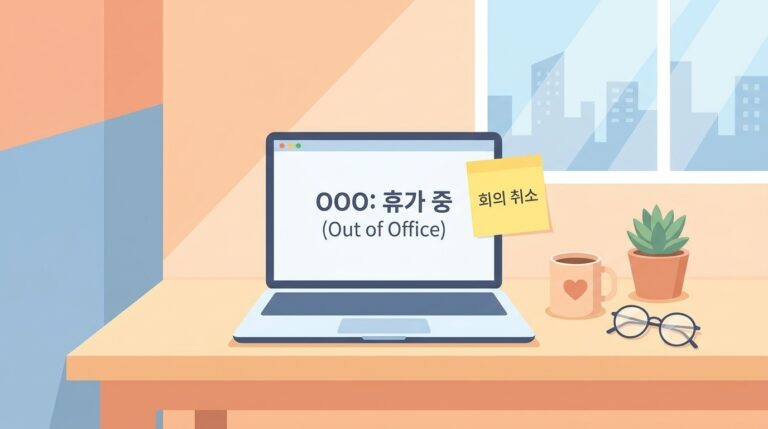
Phase 1: Empathy & Story-Driven Opening
안녕하세요! 매일한글 에디터입니다.
Imagine this familiar scene from your favorite K-office drama like Misaeng or Start-Up: You’ve finally booked that long-awaited trip to Jeju Island or a well-deserved annual leave. Your bags are packed, your tickets are ready, and you are 10 minutes away from shutting down your laptop on a Friday evening in Gangnam or Pangyo. But suddenly, your team chat pings: “Did you configure your out-of-office (OOO) email auto-responder yet?”
A cold sweat hits you. In English, you might casually write, “I’m out of the office until next Monday with limited access to email. Cheers!” But in a Korean corporate setting, email is an intricate blend of high-context respect, precise timeline setting, and proactive reassurance against the notorious Korean ppalli-ppalli (fast-paced) urgency. If your auto-reply sounds too blunt or lacks designated emergency contact information, external partners might assume negligence, while overly apologetic text might sound unconfident.
Over the past decade of coaching foreign professionals working in Korean conglomerates and hyper-growth startups, setting up a flawless, polished auto-responder is consistently one of the biggest anxiety triggers at the B2 level. Today, we’re unlocking the exact phrases, cultural nunchi, and professional nuance that will make your Korean colleagues and clients say, “와, 이 분 일 진짜 센스 있게 잘하시네! (Wow, this person works with incredible tact!)”
Phase 2: Top 3 Core Expressions In-Depth
1. 개인 사정으로 인하여 [날짜]까지 부재중입니다. (Gaein sajeong-euro inhayeo [naljja]kkaji bujaejung-imnida.)
- Pronunciation: Gah-een sah-jeong-oo-ro in-hah-yeo [Date]-kkah-jee boo-jae-joong-im-nee-dah (Think of in-hayeo as sounding like “in high-yaw”)
- Meaning: Literal: “Due to personal reasons, I am absent until [Date].” | Nuance: “I am currently out of office on scheduled leave until [Date].”
- K-Culture Moment: The standard line seen in professional email notifications across Korean corporate culture when taking annual leave (yeoncha).
- Editor’s Insight: Notice the phrase 개인 사정 (gaein sajeong – personal circumstances). In Korean work culture, you rarely need to specify whether you are lying on a beach or having dental surgery. Stating 개인 사정 is universally accepted, highly professional, and sets a firm boundary without being cold.
- Situation Spectrum: Casual ⚠️ | Semi-formal ✅ | Formal ✅
- 🤔 Think About It: Why do you think Korean business communication prefers the collective umbrella term “개인 사정” rather than oversharing detailed personal itineraries like Western OOO replies often do?
2. 급한 용무가 있으신 경우, [담당자/연락처]로 연락 주시기 바랍니다. (Geuphan yongmuga isseusin gyeong-u, [damdangja/yeollakcheo]ro yeollak jusigi baramnida.)
- Pronunciation: Geup-hahn yong-moo-gah ee-ssoo-sheen gyeong-oo, […]ro yeol-lahk joo-shee-gee bah-rahm-nee-dah
- Meaning: Literal: “If you have urgent business, please contact [Person/Number].” | Nuance: “For urgent matters, please reach out to my designated substitute.”
- K-Culture Moment: The classic safety net seen when project leads in dramas step away right before a major client tender pitch.
- Editor’s Insight: Using 용무 (yongmu – business/matter) instead of general words like 일 (il) elevates your tone to a sophisticated B2/C1 business standard. Pairing it with -시기 바랍니다 (-sigi baramnida) delivers a respectful, firm imperative.
- Situation Spectrum: Casual 🚫 | Semi-formal ✅ | Formal ✅
- 🤔 Think About It: In fast-paced business environments, why is naming a specific backup person (daegyeolja) considered a sign of teamwork rather than passing off work?
3. 복귀 후 순차적으로 확인하여 회신드리겠습니다. (Bokgwi hu sunchajeog-euro hwaginhayeo hoesindeuriggessseumnida.)
- Pronunciation: Bohk-gwee hoo soon-chah-jeog-oo-ro hwah-geen-hah-yeo hoe-sheen-deu-ree-gget-seum-nee-dah
- Meaning: Literal: “After returning, I will check in sequential order and provide a reply.” | Nuance: “I will review your message and reply chronologically as soon as I return.”
- K-Culture Moment: The ultimate line that prevents client panic and establishes reasonable expectations upon your return to the desk.
- Editor’s Insight: Pay attention to 회신드리겠습니다 (hoesindeuriggessseumnida). The verb deurida (humble form of juda) humbles the sender, showing high courtesy. The word 순차적으로 (sunchajeogeuro – chronologically/sequentially) gracefully protects you from clients demanding instant answers the minute you clock back in!
- Situation Spectrum: Casual 🚫 | Semi-formal ✅ | Formal ✅
- 🤔 Think About It: How does committing to a “sequential response” protect your post-vacation mental health while maintaining client trust?
Phase 3: Textbook Korean vs. Real Korean
Situation 1: Stating your absence dates
- 📖 교과서 한국어 (Textbook Korean): 저는 지금 휴가 중이라서 메일을 못 읽습니다. (Jeoneun jigeum hyuga jung-iraseo meil-eul mot ilgseumnida. – I am currently on vacation so I cannot read emails.)
- 🗣️ 진짜 한국어 (Real Business Korean): 현재 하계 휴가로 인하여 8월 15일까지 부재중입니다. (Hyeonjae hagye hyugaro inhayeo parwol sibowilkkaji bujaejung-imnida. – I am currently away on summer leave through August 15th.)
- 💡 왜 다를까? (Why the difference?): Textbook phrasing sounds overly childlike and direct (“I can’t read”). Natural business Korean clearly marks the absence category (하계 휴가, 연차, 출장) and uses clean Sino-Korean nouns (부재중).
Situation 2: Asking for understanding regarding delayed replies
- 📖 교과서 한국어 (Textbook Korean): 답장이 늦어서 죄송하지만 기다려 주세요. (Dapjang-i neujeoseo joesonghajiman gidaryeo juseyo. – Sorry my reply is late, but please wait.)
- 🗣️ 진짜 한국어 (Real Business Korean): 즉각적인 회신이 어려운 점 너른 양해 부탁드립니다. (Jeukgakjeogin hoesini eoryeoun jeom neoreun yanghae butakdeurimnida. – We kindly ask for your generous understanding regarding the delay in immediate response.)
- 💡 왜 다를까? (Why the difference?): Saying 기다려 주세요 sounds like an informal personal command. In high-level Korean corporate correspondence, 너른 양해 부탁드립니다 (asking for broad/generous understanding) is the gold standard of professional grace.
Phase 4: K-Culture Deep Dive & Non-Verbal Manners
4-1. 눈치 (Nunchi) & Auto-Reply Etiquette
In Korea, setting an OOO message isn’t merely toggling a button in Outlook or Gmail; it’s a social handshake across the team.
* The Pre-Leave Nunchi Check: Never activate your OOO message silently without giving your team lead (Timjang-nim) and close collaborators a heads-up. Send a quick Slack/KakaoWork note: “팀장님, 휴가 기간 동안 메일 자동 응답 설정해 두었습니다! (Team Leader, I have set up my email auto-responder for my leave period!)”
* Designating the Substitute (대결자/업무 대행자): Always get verbal permission from your designated backup colleague before putting their phone number and email into your auto-reply.
4-2. Cultural Code: The Balance of “Ppalli-Ppalli” and Respect
Korean business runs on hyper-speed (빨리빨리). When an email goes unanswered for more than 4 hours during business hours, Korean clients often worry something went wrong. A well-crafted automated response immediately resets their internal timer and reassures them that their business is valued.
Phase 5: Real-World Roleplay Scenario
Setting: Pangyo Techno Valley tech office. You are finalizing your handover with Assistant Manager Park Su-jin (박수진 대리) before taking a 4-day annual leave.
- Turn 1 (Su-jin): 마이클 씨, 다음 주 월요일부터 연차 맞으시죠? 인수인계 메일 발송하셨나요? (Michael-ssi, daeum ju woryoilbuteo yeoncha majeosijyo? Insuingye meil balsonghasyeonnayo?) 🎭 Looking up from her dual monitors with an encouraging smile. (Michael, your annual leave starts next Monday, right? Did you send the handover email?)
- Turn 2 (You): 네, 대리님! 주요 프로젝트 현황 정리해서 방금 팀 메일로 공유드렸습니다. (Ne, daerinim! Juyo peurojekteu hyeonhwang jeongrihaeseo banggeum tim meillo gongyudeuryeosseumnida.) 🎭 Handing over a neatly organized printed briefing sheet. (Yes, Assistant Manager Park! I summarized key project statuses and just shared it via team email.)
- Turn 3 (Su-jin): 깔끔하네요! 혹시 외부 클라이언트용 자동 응답 메일 문구도 세팅하셨어요? (Kkalkkeumhaneyo! Hoksi oebu keullaieonteuyong jadong eungdap meil mungudo setinghasyeosseoyo?) 🎭 Scanning through your list approvingly. (Clean work! Did you also configure your auto-reply text for external clients?)
- Turn 4 (You): 아직 문구를 다듬는 중입니다. 제가 작성한 초안 한번 봐주시겠어요? (Ajik mungureul dadeumneun jung-imnida. Jega jakseonghan choan hanbeon bwajusigesseoyo?) 🎭 Turning your laptop screen toward her. (I’m still polishing the text. Could you take a quick look at my draft?)
- Turn 5 (Su-jin): 어디 봐요… 음, 부재 기간이랑 긴급 연락처는 잘 적었는데, 회신 관련 안내가 조금 딱딱해요! (Eodi bwayo… Eum, bujae gigan-irang gingeup yeollakcheoneun jal jeogeonneunde, hoesin gwanryeon annaega jogeum ttakttakhaeyo!) 🎭 Pointing gently with her pen. (Let’s see… Hmm, the leave dates and emergency contacts are great, but the line about replies is slightly stiff!)
- Turn 6 (You): 아, 그렇군요! “복귀 후 순차적으로 확인하여 회신드리겠습니다”로 수정하면 어떨까요? (A, geureokunyo! “Bokgwi hu sunchajeog-euro hwaginhayeo hoesindeuriggessseumnida”ro sujeonghamyeon eotteolkkayo?) 🎭 Nodding thoughtfully while making the edit. (Ah, I see! How about modifying it to “I will check and reply chronologically upon my return”?)
- Turn 7 (Su-jin): 완벽해요! 그리고 급한 건은 제 직통 내선 번호 남겨두시면 제가 챙길게요. (Wanbyeokhaeyo! Geurigo geuphan geoneun je jiktong naeseon beonho namgyeodusimyeon jega chaenggilgeyo.) 🎭 Tapping your shoulder warmly with a supportive nod. (Perfect! And for urgent items, leave my direct extension number and I will take care of it.)
- Turn 8 (You): 배려해 주셔서 진심으로 감사드립니다, 대리님! (Baeryeohae jusyeoseo jinsim-euro gamsadeurimnida, daerinim!) 🎭 Bowing slightly with sincere gratitude. (Thank you so much for your consideration, Assistant Manager Park!)
🔀 Interactive Decision Point
Your client sends a high-priority email during your second day of vacation. What do you do?
* Choice A (Best): Rely on your auto-reply and backup colleague. If it’s a true emergency, your colleague will call you. Enjoy your rest.
* Choice B (Risk): Immediately reply on your phone during vacation, breaking your boundary and confusing the client about who is in charge.
* Choice C (Bad): Ignore both the client and your backup colleague’s emergency calls without setting any prior handover.
Feedback: Choice A is the gold standard! A proper Korean OOO setup protects work-life balance while ensuring operational continuity.
Phase 6: 10-Second Emotional Shadowing Drill
Practice reading these out loud with the designated pauses (/) and emotional cues:
[💼 프로페셔널하고 차분하게 / Calm & Professional]
안녕하십니까, / OOO주식회사 마이클입니다. / 현재 개인 사정으로 인하여 / 8월 10일까지 부재중입니다.
(Annyeonghasimnikka, / OOO jusikhoesa Michael-imnida. / Hyeonjae gaein sajeong-euro inhayeo / parwol sibilkkaji bujaejung-imnida.)-
[🤝 정중하고 배려 깊게 / Courteous & Reassuring]
급한 용무가 있으신 경우, / 업무 대행자인 박수진 대리(02-1234-5678)에게 / 연락 부탁드립니다.
(Geuphan yongmuga isseusin gyeong-u, / eommu daehaengjain Park Su-jin daeri-ege / yeollak butakdeurimnida.) -
[✨ 확신과 신뢰를 담아서 / Trustworthy & Crisp]
보내주신 메일은 / 복귀 후 순차적으로 확인하여 / 신속히 회신드리겠습니다. / 감사합니다.
(Bonaejusin meil-eun / bokgwi hu sunchajeog-euro hwaginhayeo / sinsokhi hoesindeuriggessseumnida. / Gamsahamnida.)
Phase 7: K-Culture Mini Dictionary (4 Key Terms)
- 연차 (Yeoncha) | Annual Paid Leave | Used when employees take officially earned vacation days. In office chat: “저 내일 연차 씁니다 (I am taking annual leave tomorrow).”
- 대결자 / 업무 대행자 (Daegyeolja / Eommu Daehaengja) | Designated Substitute / Proxy | The colleague who holds the authority to handle urgent issues while you are out.
- 회신 (Hoesin) | Reply / Response (Business Formal) | A sophisticated alternative to 답장 (dapjang). E.g., 회신 부탁드립니다 (Please provide a reply).
- 외근 / 출장 (Oegeun / Chuljang) | Fieldwork / Business Trip | Oegeun refers to local outside meetings within the city; Chuljang refers to domestic or international travel away from base.
Phase 8: Traveler / Expat Survival Kit
Top 3 Survival Phrases
- 자리 비우셨나요? (Jari biusyeonnayo?) – “Is this person away from their desk?” (Pro tip: Ask this when calling another department before assuming they are ignoring you).
- 언제쯤 복귀 예정이신가요? (Eonjejjeum bokgwi yejeong-isingayo?) – “Around what time are they expected to return to the office?”
- 메일 남겨놓겠습니다. (Meil namgyeonokgetseumnida.) – “I will leave an email for them.”
Editor’s Workplace Tech Note
When working in Korea, make sure your mobile work tools are properly synchronized. You can learn more about workplace communications by downloading the 카카오톡 PC 버전 및 캘린더 연동 가이드 to ensure you never miss critical team updates while keeping your personal OOO boundaries intact.
Phase 9: “한 발 더 깊이” (Food for Thought)
In Korean corporate philosophy, taking time off is never an individual island; it is an exercise in collective balance. When you write 너른 양해 부탁드립니다 (asking for broad understanding), you are recognizing that your absence creates a slight operational ripple for others, and you acknowledge that ripple with humility. By pairing this with 순차적 회신 (chronological response), you establish a healthy professional boundary without breaking communal trust.
💬 Your Turn: Have you ever received or set an out-of-office auto-reply in another language? How does Korean email etiquette compare to your home country? Share your stories in the comments below!
Phase 10: FAQ & Common Pitfalls
Q: Can I use “답장 드리겠습니다” instead of “회신드리겠습니다” in my auto-reply?
A: While 답장 (dapjang) is polite, 회신 (hoesin) is the preferred B2/C1 Sino-Korean business term for formal correspondence and automated messages. Using 회신드리겠습니다 immediately gives your message a polished, executive feel.
Q: Should I include my personal mobile phone number in my auto-reply?
A: Generally, no! In Korean companies, you should list your designated team proxy (대행자) or company department line unless you are an executive or explicitly required to provide emergency on-call contact.
Q: What is the difference between 연차 (Yeoncha) and 휴가 (Hyuga)?
A: 연차 is your formal legal annual leave allotment. 휴가 is a broader umbrella word for any vacation or break (such as summer company holidays or sick leave).
🚨 Common Mistakes Alert Board
- Mistake: Writing “저는 쉬고 있습니다 (I am resting)” in automated messages.
- Correct Action: Use “개인 사정으로 부재중입니다” or “하계 휴가 중입니다”.
- Mistake: Forgetting to specify the exact return date and time zone.
- Correct Action: Always state: “[월/일]에 정상 출근하여…” (Returning to regular duties on [Month/Day]).
- Mistake: Using casual imperative forms like 연락하세요 (Please contact).
- Correct Action: Use the elevated honorific 연락 주시기 바랍니다 (Please reach out).
Phase 11: Action Missions & Engagement
- 🥉 Bronze Mission (Solo Drill): Write out a full 4-line Korean Out-of-Office template on your notepad replacing the dates with your upcoming leave schedule.
- 🥈 Silver Mission (Peer Feedback): Share your completed Korean OOO draft in the comments section below to get personalized correction feedback from our Daily Hangul team!
- 🥇 Gold Mission (Real Life Execution): Set your actual company email or language-exchange auto-responder using today’s template during your next weekend or holiday!
🎮 K-Culture Mission: Watch an episode of the K-drama Misaeng (Incomplete Life) or Agency and spot how office workers sign off their emails and message threads!
Phase 12: Interactive Quiz Challenge
1. Situational Judgment: You are setting an automated email for a 3-day business trip to Busan. Which phrasing is most appropriate?
– A) 출장 때문에 메일 못 봅니다.
– B) 부산 출장으로 인하여 [날짜]까지 부재중입니다. 복귀 후 순차적으로 회신드리겠습니다.
– C) 지금 부산에 가고 있으니 나중에 연락하세요.
2. Fill in the Blank:
급한 용무가 있으신 경우, 업무 대행자인 김민수 대리에게 연락 [________] 바랍니다.
– A) 주시기
– B) 해라
– C) 주다
3. True or False:
In Korean business email etiquette, it is customary to include detailed personal reasons (e.g., specific flight details, family party descriptions) in an automated out-of-office message.
– [ ] True
– [ ] False
👉 Click here to reveal answers & explanations!
- Answer: B | Option B contains the formal business structure (출장으로 인하여, 순차적으로 회신드리겠습니다).
- Answer: A (주시기) | 연락 주시기 바랍니다 forms the standard respectful imperative construction.
- Answer: False | Korean workplace culture respects boundaries; using standard umbrella terms like 개인 사정 (personal circumstances) or 하계 휴가 (summer leave) is standard and preferred.







