

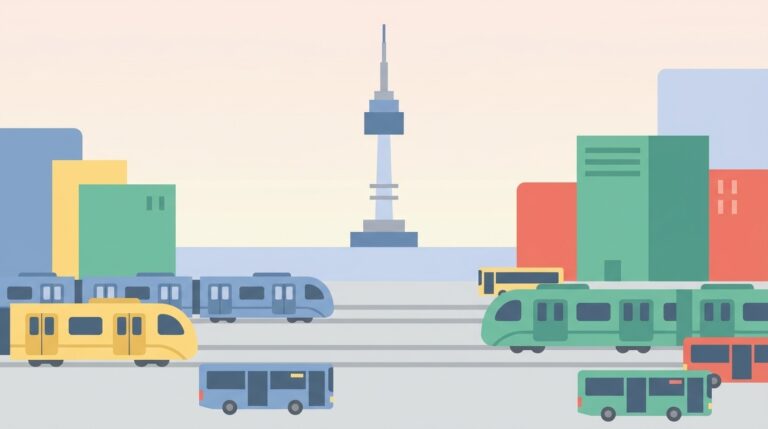
Phase 1: Empathy (Welcome to the Real Seoul!)
안녕하세요! 매일한글 (Daily Hangul) editor here! Imagine this: you’ve planned the ultimate K-drama tour. You start your afternoon taking photos at Gyeongbokgung Palace, and you have a 7:00 PM reservation for Korean BBQ with friends across the river in Gangnam. At 6:00 PM, you hop into a taxi thinking, “One hour is plenty of time!”
Big mistake.
Within ten minutes, you’re stuck on the Olympic-daero highway, surrounded by a sea of red brake lights. The taxi meter is ticking, your friend is texting “어디야?” (Where are you?), and you freeze because you don’t know how to explain what’s happening in Korean. Seoul is one of the world’s most dynamic megacities, but its geography—a massive basin divided by the Han River and ringed by mountains—creates epic bottlenecks during rush hour. Knowing how to describe traffic and navigate Seoul’s legendary transit system will instantly turn you from an anxious tourist into a savvy local navigator!
Phase 2: Core 3 Expressions Deep Dive
1. 차가 꽉 막혀요 (Cha-ga kkwak mak-hyeo-yo)
- Pronunciation: [Cha-ga kkwak mak-hyeo-yo] (Tip: “Kkwak” sounds like a snappy duck quack, indicating something is packed tightly without room to budge.)
- Meaning: Literal: “Cars are tightly blocked.” | Real Nuance: “Traffic is bumper-to-bumper / gridlocked!”
- K-Culture Moment: You’ll hear this in almost every modern K-Drama when the main character is frantically racing across Mapo Bridge to stop their true love at Incheon Airport.
- Editor’s Insight: The adverb 꽉 (kkwak) paints a vivid mental picture of objects jammed together. Saying just “차가 막혀요” means traffic is slow, but adding “꽉” tells everyone you are not moving at all.
- Situation Spectrum: Casual: ✅ | Semi-formal: ✅ | Formal: ⚠️
- 🤔 Think About It: In English, we say “traffic is heavy,” but Koreans describe the road itself as being physically “blocked” (막히다). What does this reveal about how Korean speakers visualize flow and space?
2. 지금 퇴근 시간이라 복잡해요 (Ji-geum toe-geun si-gan-i-ra bok-jap-hae-yo)
- Pronunciation: [Ji-geum twe-geun shi-gan-i-ra bok-jap-hae-yo] (“Toe-geun” rhymes with “we-gun” spoken briskly.)
- Meaning: Literal: “Because it is off-work time now, it is complicated.” | Real Nuance: “It’s rush hour right now, so it’s super chaotic and crowded.”
- K-Culture Moment: A staple line in variety shows like Running Man when cast members struggle to complete missions between 6:00 PM and 8:00 PM in central Seoul.
- Editor’s Insight: 복잡하다 (bok-jap-ha-da) literally translates to “complicated,” but Koreans use it to mean physically crowded, bustling, or messy.
- Situation Spectrum: Casual: ✅ | Semi-formal: ✅ | Formal: ✅
- 🤔 Think About It: Notice how Korean links the reason directly using -(이)라 (because it is). How does combining cause and state help convey polite excuses without sounding defensive?
3. 지하철 타고 갈게요 (Ji-ha-cheol ta-go gal-ge-yo)
- Pronunciation: [Ji-ha-cheol ta-go gal-ge-yo] (“Ji-ha” sounds like “gee-ha”, “cheol” like “ch-u-l”.)
- Meaning: Literal: “I will ride the subway and go.” | Real Nuance: “I’ll take the subway instead (to beat the traffic).”
- K-Culture Moment: Seen in relatable workplace dramas like Misaeng whenever office workers abandon taxis to catch the reliable Seoul Metro.
- Editor’s Insight: The connector -고 (and/then) connects riding and going. In Seoul, telling someone you will take the subway is universally understood as “I want to arrive on time.”
- Situation Spectrum: Casual: ✅ | Semi-formal: ✅ | Formal: ✅
- 🤔 Think About It: In English, “taking” transit feels passive, but the Korean verb 타다 (to ride/mount) emphasizes the active choice of getting on board.
Phase 3: Textbook Korean vs. Real Korean
Situation 1: Explaining that the roads are congested
- 📖 교과서 한국어 (Textbook): 도로에 차량이 매우 혼잡합니다. (Do-ro-e cha-ryang-i mae-u hon-jap-ham-ni-da. / Vehicles on the roadway are highly congested.)
- 🗣️ 진짜 한국어 (Real-life): 지금 길 진짜 많이 막혀요. (Ji-geum gil jin-jja man-i mak-hyeo-yo. / The roads are seriously jammed right now.)
- 💡 왜 다를까? (Why the difference?): Textbook Korean uses formal Sino-Korean nouns (도로, 차량, 혼잡), while real Koreans prefer pure Korean descriptive words (길, 막히다) and emotional amplifiers (진짜 많이).
Situation 2: Warning someone about crowded rush hour subway lines
- 📖 교과서 한국어 (Textbook): 지하철 이용객이 많으니 주의하십시오. (Ji-ha-cheol i-yong-gaek-i man-eu-ni ju-ui-hap-si-o. / Please beware as there are many subway passengers.)
- 🗣️ 진짜 한국어 (Real-life): 지금 9호선 지옥철이에요! (Ji-geum gu-ho-seon ji-ok-cheol-i-e-yo! / Line 9 is pure Hell-train right now!)
- 💡 왜 다를까? (Why the difference?): Locals use vivid slang like 지옥철 (Ji-ok-cheol = Hell + Metro) to warn friends about the intense crowd crush during commuting hours.
Phase 4: K-Culture Deep Dive & Non-Verbal Manners
4-1. Subway Nunchi & Physical Etiquette
When Seoul’s transit gets packed (복잡하다), social etiquette shifts automatically:
* The Backpack Move (백팩 앞으로): Wear your backpack on your front or place it between your feet. Wearing it normally on a crowded Line 2 train will earn you subtle clicks of the tongue (Tsk!) from rushed commuters.
* The “Passing Through” Gesture: Never push aggressively. Instead, tilt your torso slightly forward, gently touch your hands together near your chest, and murmur: “잠시만요, 내릴게요” (Jam-si-man-yo, nae-ril-ge-yo / Excuse me, getting off).
4-2. Cultural Code: The Geography of Seoul’s Commute
In the hit drama My Liberation Notes, the characters spend hours commuting between Gyeonggi Province and downtown Seoul. Seoul’s population exceeds 9.5 million, but over 25 million live in the greater metropolitan area. The Han River creates natural chokepoints across its 30+ bridges. Knowing whether you are traveling Gangnam (South of the River) or Gangbuk (North of the River) during peak hours determines whether you should ever step into a car.
Phase 5: Real-Life Roleplay Scenario
Setting: Gangnam Station Exit 11, 6:45 PM on a rainy Friday. You are meeting your Korean friend Minwoo in Hongdae (across town).
- 민우 (Minwoo): 여보세요? 너 지금 어디야? 홍대 다 왔어? 🎭 [Looking at his watch outside the restaurant]
(Yeo-bo-se-yo? Neo ji-geum eo-di-ya? Hong-dae da wat-seo? / Hello? Where are you right now? Almost in Hongdae?) - 학습자 (You): 미안해! 지금 강남인데 차가 꽉 막혀요. 🎭 [Sighing inside a stationary bus]
(Mi-an-hae! Ji-geum Gang-nam-in-de cha-ga kkwak mak-hyeo-yo. / Sorry! I’m in Gangnam, and traffic is completely jammed.) - 민우 (Minwoo): 아, 금요일 저녁이라 강남 쪽은 진짜 복잡하지. 🎭 [Nodding sympathetically]
(A, geum-yo-il jeo-nyeok-i-ra Gang-nam jjo-geun jin-jja bok-jap-ha-ji. / Ah, since it’s Friday evening, the Gangnam area is super chaotic.) - 학습자 (You): 응, 버스가 10분 동안 한 발자국도 못 갔어. 🎭 [Checking Google Maps frantically]
(Eung, beo-seu-ga sip-bun dong-an han bal-ja-guk-do mot gat-seo. / Yeah, the bus hasn’t moved a single step for 10 minutes.) - 민우 (Minwoo): 그냥 지금 바로 내려서 지하철 타! 2호선 타면 한 번에 와. 🎭 [Pointing down into Hongdae subway station]
(Geu-nyang ji-geum ba-ro nae-ryeo-seo ji-ha-cheol ta! I-ho-seon ta-myeon han beon-e wa. / Just get off right now and take the subway! If you take Line 2, it comes straight here.) - 학습자 (You): 알겠어, 바로 내려서 지하철 타고 갈게! 🎭 [Pressing the bus stop bell]
(Al-get-seo, ba-ro nae-ryeo-seo ji-ha-cheol ta-go gal-ge! / Got it, I’ll get off right now and take the subway!) - 민우 (Minwoo): 조심히 와! 환승할 때 사람 많으니까 조심하고. 🎭 [Smiling warmly]
(Jo-sim-hi wa! Hwan-seung-hal ttae sa-ram man-eu-ni-kka jo-sim-ha-go. / Come safely! Be careful because transfers will be packed.) - 학습자 (You): 응, 도착하면 카톡할게! 🎭 [Dashing down the subway stairs]
(Eung, do-chak-ha-myeon ka-tok-hal-ge! / Okay, I’ll KakaoTalk you when I arrive!)
🔀 Interactive Branching Point
When Minwoo tells you traffic is bad, how do you respond?
- Option A: “택시 기사님한테 더 빨리 가달라고 할게!” (I’ll tell the taxi driver to drive faster!)
- Feedback: 🚫 Risk! No amount of speed helps in a Seoul gridlock, and rushing drivers on wet roads is stressful and rude.
- Option B: “차 버리고 지하철로 갈아탈게. 30분 뒤에 봐!” (I’ll ditch the car and transfer to the subway. See you in 30 mins!)
- Feedback: 🏆 Best! Pragmatic, proactive, and shows you understand how Seoulites solve transit issues.
- Option C: “약속 취소하자. 나 집에 갈래.” (Let’s cancel the plan. I’m going home.)
- Feedback: ⚠️ Bad. Canceling abruptly over normal Seoul rush hour traffic damages your Nunchi friendship points!
Phase 6: 10-Second Emotion Shadowing Drill
Practice these natural rhythm pauses (/) and emotions out loud:
[😫 지치고 답답하게 - Exhausted & Frustrated]- 퇴근 시간이라 / 차가 꽉 / 막혀요.
(Toe-geun si-gan-i-ra / cha-ga kkwak / mak-hyeo-yo.)
- 퇴근 시간이라 / 차가 꽉 / 막혀요.
[💡 번뜩 결심하며 - Quick Decision]- 버스에서 내려서 / 지하철 타고 / 갈게요!
(Beo-seu-e-seo nae-ryeo-seo / ji-ha-cheol ta-go / gal-ge-yo!)
- 버스에서 내려서 / 지하철 타고 / 갈게요!
[🙏 미안하고 서두르며 - Apologetic & Rushing]- 길이 너무 막혀서 / 조금 / 늦을 것 같아요!
(Gil-i neo-mu mak-hyeo-seo / jo-geum / neu-jeul geot gat-a-yo!)
- 길이 너무 막혀서 / 조금 / 늦을 것 같아요!
Phase 7: K-Culture Mini Dictionary
- 지옥철 (Ji-ok-cheol) | “Hell Subway”
- A compound of 지옥 (Hell) and 지하철 (Subway). Refers to peak-hour trains (especially Line 9 and Line 2) packed to over 200% capacity.
- 막차 (Mak-cha) | “Last Train / Bus”
- The most sacred word for nightlife lovers in Seoul. Missing the 막차 around midnight means waiting for night buses (올빼미 버스) or paying taxi surcharges.
- 환승 (Hwan-seung) | “Transfer / Transit”
- Seoul’s transit card system gives you free transfers between buses and subways within 30 minutes. Also used metaphorically in dating (환승연애 – transit love/rebound).
- 뚜벅이 (Ttu-beok-i) | “Pedestrian / Foot Traveler”
- An affectionate term for someone who doesn’t own a car and relies purely on walking and public transit.
Phase 8: Traveler’s Survival Kit
Survival Expressions TOP 3
- 여기서 내릴게요! (Yeo-gi-seo nae-ril-ge-yo!)
- Meaning: “I will get off here!” (Shout this politely toward the driver if the bus door is closing).
- 몇 번 출구로 가야 해요? (Myeot beon chul-gu-ro ga-ya hae-yo?)
- Meaning: “Which exit number should I go to?” (Seoul stations can have up to 20+ exits!).
- 반대 방향으로 탔어요. (Ban-dae bang-hyang-eu-ro tat-seo-yo.)
- Meaning: “I got on the train going in the opposite direction.”
Editor’s Travel Note
- Navigation Essential: Do not rely on Google Maps for walking or driving directions in Korea due to local mapping regulations. Always search for the Naver Map app download or use KakaoMap for real-time bus arrivals and subway car transfer shortcuts.
- Transit Payment: Buy a Climate Card (기후동행카드) for unlimited rides or a standard T-Money Card at any convenience store. Tap in and tap out every single time!
Phase 9: One Step Deeper (Reflection)
Foreign visitors are often stunned by how Seoulites can be intensely hurried (빨리빨리 culture) yet remarkably orderly inside transit stations. People stand strictly in two lines behind designated screen door markers, letting passengers disembark before boarding. This balance between personal urgency and collective harmony is the heartbeat of modern Seoul.
💬 Your Turn: How does your hometown handle peak-hour traffic compared to Seoul? Have you ever experienced a 지옥철 moment? Share your story in the comments below!
Phase 10: FAQ & Common Mistakes
Q: Why do Korean taxi drivers sometimes decline rides during late hours?
A: While illegal, during peak Friday midnight hours near Gangnam or Itaewon, some drivers prioritize long-distance passengers heading out of the city. Using taxi-hailing apps like Kakao T minimizes this issue.
Q: What does ‘배차 간격’ (Bae-cha gan-gyeok) mean on transit displays?
A: It means “dispatch interval”—the time you must wait between consecutive buses or trains.
Q: Can I drink my iced Americano on the Seoul city bus?
A: No! Seoul city regulations strictly prohibit open takeout food and beverages (like cups with straws) on city buses. Finish your drink before boarding, or carry sealed containers.
🚨 Common Mistakes Warning Board
- Saying “차가 복잡해요” instead of “교통이 복잡해요” or “차가 막혀요”
- Correct Action: Cars themselves aren’t complex; the traffic/roads are 복잡해요, while the cars are 막혀요.
- Calling the subway “기차” (Gi-cha)
- Correct Action: Use 지하철 (Ji-ha-cheol) or 전철 (Jeon-cheol) for the city metro. 기차 (Gi-cha) refers to intercity rail like the KTX.
- Forgetting to tap your transit card when leaving the bus
- Correct Action: Always tap out, even if you aren’t transferring; otherwise, you will be penalized with maximum distance fares on your next trip!
Phase 11: Action Missions
- 🥉 Bronze Mission (Solo): Stand in front of your mirror and practice saying: “지금 퇴근 시간이라 길이 진짜 많이 막혀요!” smoothly in under 3 seconds.
- 🥈 Silver Mission (Social): Post an Instagram story or tweet showing traffic in your city with the caption: “우리 동네도 차가 꽉 막혀요! 🚗 #DailyHangul #KoreanStudy”.
- 🥇 Gold Mission (Real Life): Next time you watch a Seoul-based K-drama or vlog, identify the subway line color or spot someone running for the 막차!
- 🎮 K-Culture Mission: Watch an episode of My Liberation Notes (나의 해방일지) and listen for the commute frustrations of the Sanpo siblings.
Phase 12: Interactive Quiz Challenge
Quiz 1: Situation Judgment
You are riding a bus to Myeongdong, but traffic has halted on the bridge. Your meeting starts in 15 minutes. What is the most natural Korean text to send?
* A) 비행기 타고 갈게요.
* B) 차가 꽉 막혀서 조금 늦을 것 같아요!
* C) 도로가 매우 편리합니다.
Quiz 2: Fill in the Blank (B1 Level)
“지금 6시 반이라 ______ 시간이에요. 지하철에 사람이 정말 많아요.”
(Hint: The standard term for leaving work / rush hour)
Quiz 3: True / False Cultural Check
(True / False) In Seoul, you can bring an open cup of bubble tea onto a city bus as long as you hold it carefully.
🔍 Click here for Quiz Answers & Explanations
- Quiz 1 Answer: B (차가 꽉 막혀서 조금 늦을 것 같아요! – Traffic is completely jammed, so I think I’ll be a bit late!)
- Quiz 2 Answer: 퇴근 (Toe-geun) (퇴근 시간 = rush hour / clocking-out time).
- Quiz 3 Answer: False! Open beverage containers are strictly banned on Seoul city buses to prevent spills and burns.







