

Level Up Your Fitness Talk: How to Recommend Korean Home Workout Channels Like a Native
Phase 1: Empathy (Story-Immersive Opening)
안녕하세요! 매일한글 에디터입니다. (Hello! I’m your Daily Hangul editor.)
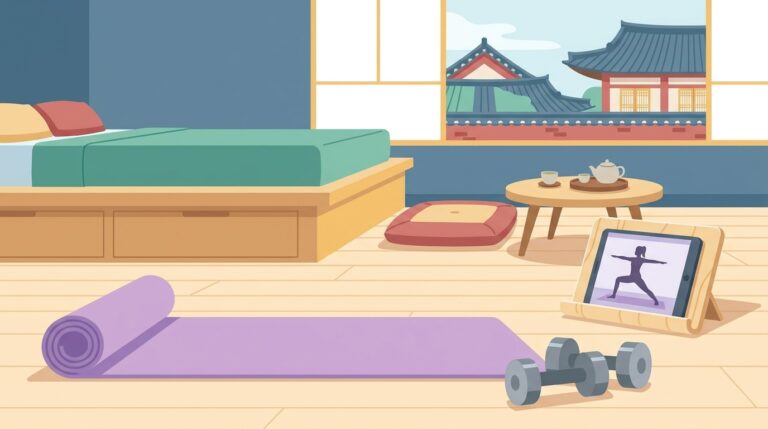
Have you ever rolled out your yoga mat in your living room, determined to start a God-saeng (갓생 – living a productive, diligent life) fitness routine, only to find yourself completely lost in the rabbit hole of Korean YouTube fitness algorithms? You search for a quick 15-minute core routine, and suddenly creators like Shim Euddeum (심으뜸) or Physical Gallery (피지컬갤러리) are shouting rapid-fire gym slang while burning 500 calories in what feels like five minutes.
You want to ask your Korean friends which creator actually gives the best posture cues, or you want to brag about finishing an intense session on Instagram, but textbook phrases like “이 비디오는 운동에 매우 유익합니다” (This video is very beneficial for exercise) make you sound like an instruction manual from 1995.
At a C1 level, mastering fitness discourse isn’t just about knowing anatomical terms; it’s about grasping the vibrant, highly communal subculture of Korean home training (Hom-teu). Based on feedback from hundreds of advanced learners who felt tongue-tied when swapping YouTube recommendations and sharing workout streaks, this guide will equip you with natural, nuanced phrasing to talk fitness effortlessly.
Phase 2: Core Expressions In-Depth Analysis
1. 이 채널 루틴 진짜 빡세다 (I chaeneol rutin jinjja ppakseda)
- Pronunciation: [I chaeneol rutin jinjja ppakseda] (Sounds like: ‘ee cheh-neol roo-teen jeen-jja ppahk-seh-dah’ — emphasize the explosive ‘ppak’ like popping bubble wrap)
- Meaning:
- Literal: “This channel’s routine is really hard.”
- Actual Nuance: “The routine on this channel is ridiculously intense / brutally hardcore (in a rewarding way).”
- K-Culture Moment: Used constantly on Korean YouTube comment sections under high-intensity interval training (HIIT) videos or Tabata workouts when viewers collapse on their mats after round one.
- Editor’s Insight: 빡세다 (ppakseda) is quintessential modern Korean slang denoting something exhausting, demanding, or hardcore. While it was once considered coarse street slang, it is now widely accepted in casual and semi-formal workplace contexts among peers to express intense effort.
- Situation Spectrum: Casual ✅ | Semi-formal ⚠️ | Formal 🚫
- 🤔 Think About It: In English, we often say “that workout killed me.” Notice how Korean fitness culture embraces 빡세다 not as a complaint, but as a badge of honor and collective endurance.
2. 자극점 제대로 짚어 주네 (Jageukjeom jedaero jipeo june)
- Pronunciation: [Jageukjeom jedaero jipeo june] (Sounds like: ‘jah-geuk-jeom jeh-deh-ro jee-peo joo-neh’)
- Meaning:
- Literal: “They really point out the stimulation point properly.”
- Actual Nuance: “They pinpoint the exact target muscle group and cue the contraction perfectly.”
- K-Culture Moment: A hallmark compliment left for precision pilates or physical therapy-based fitness YouTubers who teach micro-adjustments in posture rather than just mindless sweating.
- Editor’s Insight: 자극점 (jageukjeom, target muscle stimulation point) combined with 짚어 주다 (jipeo juda, to identify/pinpoint precisely) demonstrates advanced linguistic control. It elevates your recommendation from a vague “it’s good” to an expert critique of instructional quality.
- Situation Spectrum: Casual ✅ | Semi-formal ✅ | Formal ⚠️
- 🤔 Think About It: Why does Korean fitness vocabulary emphasize “stimulation points” (자극점) rather than simply “feeling the burn”? It reflects a cultural focus on efficiency and biomechanical precision.
3. 홈트 영상 틀어놓고 오운완 인증하자 (Homteu yeongsang teureonotgo ounwan injeunghaja)
- Pronunciation: [Homteu yeongsang teureonotgo ounwan injeunghaja] (Sounds like: ‘home-teu yeong-sang teu-reo-noht-go oh-oon-wahn een-jeung-hah-jah’)
- Meaning:
- Literal: “Let’s turn on a home-training video and authenticate today’s workout finished.”
- Actual Nuance: “Let’s put on a home workout video and post our daily workout proof on social media!”
- K-Culture Moment: Ubiquitous on Instagram stories and fitness group chats where young Koreans post mirror selfies or mat photos tagged with
#오운완. - Editor’s Insight: 홈트 is a portmanteau of Home and Training, while 오운완 is an acronym for 오늘 운동 완료 (Today’s Workout Complete). Pairing it with 인증하다 (injeunghada, to verify/certify) taps into Korea’s hyper-visual accountability culture.
- Situation Spectrum: Casual ✅ | Semi-formal ⚠️ | Formal 🚫
- 🤔 Think About It: How does public “certification” (인증) in Korean digital culture transform individual solitary habits into shared communal milestones?
Phase 3: Textbook Korean vs. Real Native Korean
Situation 1: Recommending an Effective Creator
- 📖 Textbook Korean:
- “이 유튜브 채널의 운동 프로그램은 매우 효과적이고 유익합니다.”
- (I yutyubeu chaeneorui undong peurogeuraemeun maeu hyogwajeogigo yuikhamnida. / “This YouTube channel’s workout program is very effective and beneficial.”)
- 🗣️ Real Native Korean:
- “이 채널 따라 하면 다음 날 근육통 보장이야. 땀 쫙 빠져!”
- (I chaeneol ttara hamyeon daeum nal geunyuktong bojang-iya. Ttam jjwap ppajyeo! / “If you follow this channel, muscle soreness tomorrow is guaranteed. You’ll sweat buckets!”)
- 💡 Why the Difference?: Native speakers rarely describe workouts as “beneficial” (유익하다). Instead, they use visceral, sensory expressions like guaranteed soreness (근육통 보장) or intense sweating (땀이 쫙 빠지다) to convey effectiveness.
Situation 2: Praising Clear Posture Explanations
- 📖 Textbook Korean:
- “강사님이 동작을 아주 정확하게 설명해 줍니다.”
- (Gangsanim-i dongjageul aju jeonghwakhage seolmyeonghae jumnida. / “The instructor explains movements very accurately.”)
- 🗣️ Real Native Korean:
- “초보자도 알기 쉽게 자세를 찰떡같이 짚어줘서 부상 걱정이 없어.”
- (Chobojado algi swipge jasereul chaltteokgachi jipeojwoseo busang geokjeongi eopseo. / “They explain the form so spot-on that even beginners won’t have to worry about injuries.”)
- 💡 Why the Difference?: The idiom 찰떡같이 (chaltteokgachi, literally ‘like sticky rice cake’) colloquially means “flawlessly, perfectly matching/comprehending.” It adds warmth and enthusiasm that clinical adverbs like 정확하게 cannot deliver.
Phase 4: K-Culture Deep Dive & Non-Verbal Manners
4-1. Fitness Nunchi (눈치) & Supportive Manners
When discussing workout routines with Korean peers, avoid asking intrusive questions about specific weight numbers or target areas (e.g., “Are you trying to lose belly fat?”). Instead, frame recommendations around vitality, posture correction (체형 교정), and stress relief.
If a workout buddy mentions they skipped a day, practicing good Nunchi means validating their fatigue before offering encouragement:
* “요즘 야근 많아서 피곤했잖아. 주말에 가볍게 스트레칭 영상이나 같이 보자!”
* (Yojeum yageun manaseo pigonhaetjana. Jumare gabyeopge seuteureching yeongsang-ina gachi boja! / “You’ve had so much overtime lately, of course you were tired. Let’s just do a light stretching video together this weekend!”)
4-2. The “God-saeng” (갓생) Phenomenon & Fitness Ecosystem
In South Korea, fitness has evolved from purely aesthetic body-building into a core pillar of God-saeng—a philosophy of cultivating small, disciplined daily routines to regain a sense of agency amidst high-stress urban life.
YouTube creators act as digital personal trainers for this movement. Channels like Thankyou BUBU (땅끄부부) cater to gentle, stress-free fat burning for busy professionals; Physical Gallery (피지컬갤러리) combines biomechanical rehabilitation with dry humor; and Shim Euddeum (힙으뜸) provides relentless motivational cheer. Recommending the right channel requires matching the creator’s personality with your friend’s current mental and physical state.
Phase 5: Real-Life Roleplay Scenario
Setting: Alex and Minji are chatting on KakaoTalk after work on a Thursday evening, planning their weekend routines.
- 민지: 알렉스, 요즘도 퇴근하고 헬스장 가? 난 요즘 너무 피곤해서 홈트로 갈아탔잖아.
(Alex, yojeumdo toegeunhago helseujang ga? Nan yojeum neomu pigonhaeseo homteuro garatjana.)
“Alex, are you still going to the gym after work? I was so exhausted lately that I switched over to home workouts.”
🎭 [💬 하소연하듯 한숨을 쉬며 메시지를 보낸다] -
알렉스: 나도 야근 때문에 헬스장 끊어놓고 돈만 날렸어. 괜찮은 홈트 채널 있어?
(Nado yageun ttaemune helseujang kkeuneonotgo donman nallyeosseo. Gwaenchaneun homteu chaeneol isseo?)
“Me too. Because of overtime, I wasted my gym membership money. Got any good home workout channels to recommend?”
🎭 [🤦♂️ 머리를 긁적이며 씁쓸하게 웃는다] -
민지: 너 타바타 좋아해, 아니면 자세 교정 위주로 보고 싶어?
(Neo tabata joahae, animyeon jase gyojeong wijuro bogo sipeo?)
“Do you prefer intense Tabata, or do you want to focus on posture correction?”
🎭 [🧐 상대방의 취향을 세심하게 물어보며] -
알렉스: 하루 종일 모니터만 봐서 승모근도 뭉치고 허리도 뻐근해. 자극점 제대로 짚어 주는 채널 원해!
(Haru jong-il moniteoman bwaseo seungmogeundo mungchigo heorido ppeogeunhae. Jageukjeom jedaero jipeo juneun chaeneol wonhae!)
“Staring at a monitor all day made my traps tense and my lower back stiff. I want a channel that pinpoints the target muscle stimulation properly!”
🎭 [💆♂️ 어깨를 주무르며 진지하게] -
민지: 그러면 ‘피지컬갤러리’나 ‘자세요정’ 영상 봐봐. 군더더기 없이 설명이 진짜 깔끔해.
(Geureomyeon ‘Pijikeol Gaelleori’na ‘Jase Yojeong’ yeongsang bwabwa. Gundeodeogi eopsi seolmyeongi jinjja kkalkkeumhae.)
“Then check out ‘Physical Gallery’ or ‘Posture Fairy’. Their explanations are so concise with zero fluff.”
🎭 [✨ 엄지손가락을 치켜세우며 강력 추천한다] -
알렉스: 오, 딱 내가 찾던 스타일이다. 오늘 밤에 바로 따라 해봐야겠네.
(O, ttak naega chatdeon seutairida. Oneul bame baro ttara haebwayatgenne.)
“Oh, that’s exactly the style I was looking for. I should follow along tonight right away.”
🎭 [🔥 결의에 찬 눈빛으로 눈을 반짝이며] -
민지: 좋아! 15분 스트레칭 영상 틀어놓고 다 끝나면 오운완 인증샷 보내!
(Joah! Sibo-bun seuteureching yeongsang teureonotgo da kkeutnamyeon ounwan injeungsyat bonae!)
“Nice! Turn on a 15-minute stretching video, and send your ‘Today’s Workout Complete’ proof shot when you’re done!”
🎭 [📸 핸드폰 카메라 제스처를 취하며 장난스럽게 웃는다] -
알렉스: 콜! 땀 쫙 빼고 인증샷 단톡방에 올릴게.
(Kol! Ttam jjwap ppaego injeungsyat dantokbange ollilge.)
“Deal! I’ll sweat it out and post the proof in our group chat.”
🎭 [🤝 주먹을 불끈 쥐며 하이파이브를 한다]
🔀 Interactive Choice Point
Minji sends you a link to a brutal 30-minute full-body kettlebell HIIT routine with the message: “내일 이거 같이 챌린지할래?” (Do you want to challenge this with me tomorrow?)
- Option A: “이거 썸네일만 봐도 루틴 엄청 빡세 보이는데… 그래도 내일 오운완 도전해볼게!”
- Option B: “저는 체력이 부족하여 그 비디오를 시청하며 운동할 능력이 없습니다.”
- Option C: “너 혼자 해. 난 힘든 거 싫어.”
Detailed Branch Feedback
- Choice A (Best): Perfect! You naturally acknowledged the intensity (빡세 보이다) while matching her proactive camaraderie (오운완 도전). This cements your reputation as an energetic, culturally fluent peer.
- Choice B (Bad): Far too stiff and archaic. It sounds like an artificial intelligence declining a request during a formal test rather than a friend chatting on KakaoTalk.
- Choice C (Risk): While direct, it sounds unnecessarily curt and dismissive in Korean, potentially deflating Minji’s motivational excitement.
Phase 6: 10-Second Emotion Shadowing Drill
Practice these natural rhythm pauses marked with / to master authentic Korean cadence!
[🔥 의욕 넘치고 비장하게 (Determined & full of grit)]- “오늘 홈트 루틴 / 진짜 빡센데, / 끝까지 버텨서 / 오운완 찍는다!”
- (Oneul homteu rutin / jinjja ppaksende, / kkeutkkaji beotyeoseo / ounwan jjingneunda!)
- “Today’s home workout routine / is super intense, / but I’ll endure till the end / and snap my workout proof!”
[🤩 감탄하며 강력하게 추천할 때 (Impressed & recommending enthusiastically)]- “이 선생님 / 동작 설명할 때 / 자극점을 / 기가 막히게 짚어줘!”
- (I seonsaengnim / dongjak seolmyeonghal ttae / jageukjeomeul / giga makhige jipeojwo!)
- “When this instructor / explains movements, / they pinpoint the muscle stimulation / astonishingly well!”
[💦 땀 흘리며 상쾌하고 뿌듯하게 (Sweaty yet refreshed & proud)]- “20분밖에 안 했는데 / 땀 쫙 빠지고 / 갓생 산 기분이야!”
- (Isibunbakke an haenneunde / ttam jjwap ppajigo / gatsaeng san gibuniya!)
- “It was only 20 minutes, / but I sweated buckets / and feel like I lived a truly productive day!”
Phase 7: K-Culture Mini Dictionary
| Term (Hangul + Romanization) | English Meaning | Real-Life & Social Context |
|---|---|---|
| 1. 오운완 (O-un-wan) | Today’s Workout Complete | The holy grail hashtag (#오운완) on Korean social media used to record daily workout consistency and self-discipline. |
| 2. 홈트 (Hom-teu) | Home Training / Home Workout | Refers broadly to any workout done at home without commercial gym machines, including mat pilates, yoga, and resistance bands. |
| 3. 득근 (Deuk-geun) | Gaining Muscle (Lit. ‘Obtaining Muscle’) | A playful blessing often exchanged between gym-goers: “오늘도 득근하세요!” (May you gain quality muscle today!). |
| 4. 쇠질 (Soe-jil) | Pumping Iron / Weightlifting | Slang derived from 쇠 (iron/metal) + 질 (repetitive action). It playfully refers to hardcore weight training with barbells and dumbbells. |
Phase 8: Traveler’s Survival Kit (Fitness Edition)
Heading to Seoul and want to stay fit while traveling?
Top 3 Survival Expressions for Travelers
- “근처에 야외 운동기구 있는 공원 어디예요?”
(Geuncheoe yaoe undonggigu inneun gong-won eodiyeyo?)- Pro Tip: Korean public parks along the Han River or behind residential neighborhoods are packed with high-end free public fitness machines, affectionately nicknamed San-seu-jang (산스장, mountain gyms).
- “호텔 피트니스 센터 이용 시간과 운동복 대여 여부 알 수 있을까요?”
(Hotel piteuniseu senteo iyong sigangwa undongbok daeyeo yeobu al su isseulkkayo?)- Pro Tip: Many Korean hotels provide workout apparel and socks for free or a nominal fee, saving luggage space.
- “오늘 비 오니까 숙소에서 가볍게 스트레칭이나 홈트 해야겠어요.”
(Oneul bi onikka sukso-eseo gabyeopge seuteureching-ina homteu haeyagetseoyo.)- Pro Tip: A great casual line to let your travel companions know you’re taking a self-care recovery morning.
Editor’s Travel Note
If you want an outdoor cardio session instead of staying inside your Airbnb, check out the 따릉이 공공자전거 대여 앱 다운로드 가이드 to rent Seoul’s municipal bikes for less than $1/hour, or use the 카카오맵 실시간 한강 러닝 코스 검색 to find well-lit riverside running tracks.
Phase 9: “One Step Deeper” (Critical Thinking Essay)
In many Western cultures, fitness is traditionally celebrated as an individualistic pursuit of personal aesthetic goals or solitary mental fortitude. In South Korea, however, fitness has been reinvented as a communal ritual of shared momentum. The explosion of home-training YouTube channels and the #오운완 phenomenon reflects an underlying cultural value: 연대감 (Yeondaegam, a sense of collective solidarity). By publicly verifying daily efforts and cheering on peer creators through comments, Koreans transform solitary living-room workouts into an interactive social contract. It isn’t just about building muscle; it is about reassuring one another that we are striving to live our best lives amidst demanding societal pressures.
💬 Your Turn: How does the workout subculture in your country compare? Do you prefer working out alone in private, or does sharing your daily progress with a community keep you motivated? Leave your thoughts in the comments below using today’s Korean phrases!
Phase 10: FAQ & Common Mistakes
Q: Can I use the word “빡세다” in a formal business meeting?
A: Generally no. 빡세다 is colorful colloquial slang. In formal presentations or when speaking to senior executives, use refined equivalents like 일정이 매우 촉박하다 (the schedule is very tight) or 업무 강도가 높다 (the workload intensity is high).
Q: What is the difference between 헬스 (Health) and 홈트 (Homet)?
A: 헬스 (short for ‘Health Club’) refers strictly to commercial gym facilities, gym workouts, or bodybuilding with machines. 홈트 refers exclusively to home-based workouts, calisthenics, mat routines, and YouTube-guided home training.
Q: Is it rude to say “살 많이 빠졌다” (You lost a lot of weight) to a Korean friend?
A: In older generations, this was treated as a compliment, but among modern Korean 20s and 30s, commenting directly on someone’s weight is increasingly sensitive. Instead, praise their energy or routine: “요즘 운동하더니 안색이 진짜 좋아 보인다!” (You look so vibrant and healthy since you started exercising!).
🚨 Common Mistakes Alert
- Mistake: Saying “이 비디오는 힘듭니다” to mean “This workout video is hardcore.”
- Correction: 힘들다 describes your internal feeling of being tired. To describe the routine itself as tough, say “이 루틴 진짜 빡세다” or “난이도가 꽤 높다”.
- Mistake: Translating “Let’s work out” literally as “우리 훈련하자” (Hullyeonhaja).
- Correction: 훈련 means military drills or professional athletic training. Use 운동하자 (undonghaja) for regular workouts or 홈트 하자 (homteu haja) for home routines.
- Mistake: Saying “오운완 했어요” in an academic essay or formal email.
- Correction: 오운완 is strictly internet and conversational slang. Use 오늘 계획된 운동을 완료했습니다 in formal contexts.
Phase 11: Action Missions & K-Culture Challenge
- 🥉 Bronze Mission (Solo Shadowing): Stand in front of a mirror and recite the Phase 6 Shadowing Drill #1 out loud 3 times with maximum fighting spirit.
- 🥈 Silver Mission (Social Engagement): Find a Korean home-training video on YouTube (search:
홈트 15분 타바타) and leave a comment in Korean: “자극점 제대로 짚어 주셔서 감사합니다! 오늘 오운완 완료!” - 🥇 Gold Mission (Real-life Execution): Next time you talk to a Korean language partner or friend, recommend your favorite fitness channel using the phrase: “[Channel Name] 영상 한번 봐봐. 동작 설명이 진짜 깔끔해.”
🎮 K-Culture Discovery Mission: Look up the channel 힙으뜸 (Hip Euddeum) or 피지컬갤러리 (Physical Gallery) on YouTube. Identify at least two slang terms used in their video titles or pinned comments and write down their meanings!
Phase 12: Interactive Quiz Challenge
Test your knowledge with these situational and linguistic puzzles!
1. Situational Judgment: Your friend complains that their neck and shoulders hurt from office work and asks for a gentle channel recommendation. Which phrase is most appropriate?
* (A) “이 타바타 영상 봐봐! 30분 동안 쉬지 않고 뛰면 바로 나아.”
* (B) “승모근 이완이랑 자세 교정 자극점 잘 짚어주는 스트레칭 채널 추천해 줄게.”
* (C) “헬스장 가서 쇠질이나 빡세게 하자.”
2. Fill-in-the-Blank: Complete the social media caption:
* “오늘 야근하고 피곤했지만 홈트 20분 완료! #____ #득근”
3. True or False: In modern Korean fitness slang, 오운완 can be used as a formal noun in professional medical reports. (True / False)
👉 Click to view answers & explanations
- Answer: (B)
- Explanation: Offering posture correction (자세 교정) and muscle tension release (이완) specifically addresses their pain point, whereas (A) and (C) suggest inappropriate, high-intensity workouts.
- Answer: 오운완
- Explanation: The ultimate post-workout hashtag pairing with 득근 (muscle gain) is #오운완 (Today’s Workout Complete).
- Answer: False
- Explanation: 오운완 is internet slang / social media shorthand and is never used in clinical or formal medical contexts.
- Explanation: 오운완 is internet slang / social media shorthand and is never used in clinical or formal medical contexts.






