

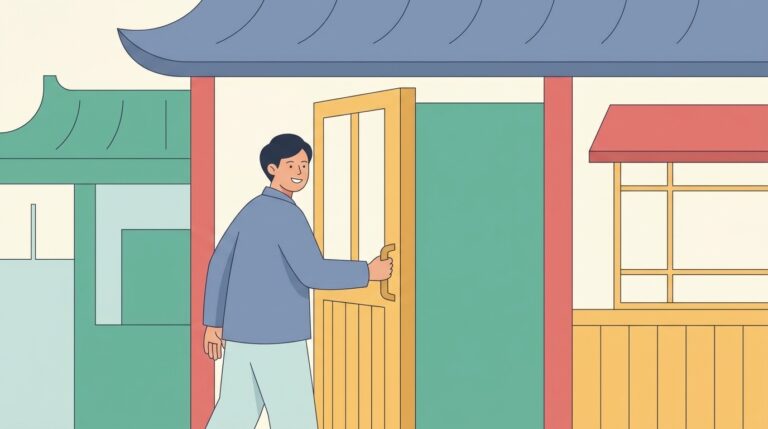
Phase 1: Empathy (Real-life Cultural Context)
안녕하세요! 매일한글 에디터입니다. (Hello! I’m your Daily Hangul editor.)
Picture this: You are on a coffee run or a dinner date in Hongdae or Gangnam with your Korean friends or colleagues. You reach the doorway, instinctively step aside, hold the heavy glass door, make warm eye contact, and politely offer a classic Western “After you, ladies first!” gesture.
Instead of a smooth, movie-like strut through the door, your Korean friend freezes, blushes, steps back, and begins a hurried bow-and-wave battle: “아니에요, 먼저 가세요!” (No, please you go first!). Suddenly, an innocent act of chivalry turns into an awkward doorway dance of mutual deference. If you have ever felt confused about where Western chivalry ends and Korean courtesy begins, you are definitely not alone.
Many intermediate Korean learners wonder: Does Korea practice ‘Ladies First’? Is opening doors and pulling out chairs seen as charming, or does it feel overwhelming? The truth is, while modern Korean dating culture celebrates thoughtful attentiveness (often dubbed “매너남” or manner guy in K-Dramas), traditional Korean social dynamics place age, seniority, and non-imposition above gender-based chivalry.
In this guide, based on real feedback from global learners and real-world social nuances, you will master the exact intermediate expressions, non-verbal cues (nunchi), and cultural balance needed to show impeccable respect without making anyone feel uncomfortable or pressured.
Phase 2: 3 Core Expressions in Depth
1. 먼저 들어가세요 (Meonjeo deureogaseyo)
- Pronunciation: Meon-jeo deu-reo-ga-se-yo (Sounds like “Mun-juh duh-raw-gah-say-yo”)
- Meaning: Literal: “Please enter first.” | Nuance: “Please, after you” (The ultimate universal doorway & elevator polite phrasing).
- K-Culture Moment: Commonly heard in workplace K-dramas when entering conference rooms or elevators, showing considerate respect to seniors, guests, or dates.
- Editor’s Insight: Unlike saying “레이디 퍼스트” (which can sound like a cheesy pickup line or a joke), “먼저 들어가세요” is universally elegant. It shifts the focus from gender chivalry to genuine spatial consideration.
- Situation Spectrum:
- Casual: ⚠️ (To close friends, use “먼저 들어가!”)
- Semi-formal: ✅ (Perfect with dates, acquaintances, colleagues)
- Formal: ✅ (Polite and respectful for business partners or elders)
- 🤔 Think About It: In your native culture, do you prioritize gender or age when holding an elevator door? How does shifting to neutral spatial politeness change the dynamic?
2. 제가 챙겨드릴게요 (Jega chaenggyeodeurilgeyo)
- Pronunciation: Je-ga chaeng-gyeo-deu-ril-ge-yo (Sounds like “Jeh-gah cheng-gyuh-doo-reel-geh-yo”)
- Meaning: Literal: “I will take care of/pack it for you.” | Nuance: “Let me take care of that for you / I’ve got this covered.”
- K-Culture Moment: The classic scene in Korean barbecue (K-BBQ) restaurants where someone sets down the spoon and chopsticks on a paper napkin for everyone, or pours water for their companion before filling their own cup.
- Editor’s Insight: In Korea, “caring” (챙겨주기) is the highest form of everyday romantic and social etiquette. Saying this phrase while opening wet wipes, arranging cutlery, or carrying something heavy expresses deep attentiveness without appearing patronizing.
- Situation Spectrum:
- Casual: ⚠️ (Use “내가 챙겨줄게!”)
- Semi-formal: ✅ (Ideal for dates, friendly dinners, and social gatherings)
- Formal: ✅ (Excellent in client dining scenarios)
- 🤔 Think About It: Why does Korean culture value active micro-care (like setting down utensils) over grand public gestures like pulling out chairs?
3. 부담 갖지 마세요 (Budam gatji maseyo)
- Pronunciation: Bu-dam gat-ji ma-se-yo (Sounds like “Boo-dahm gaht-jee mah-say-yo”)
- Meaning: Literal: “Do not have burden.” | Nuance: “Please don’t feel pressured / No burden at all.”
- K-Culture Moment: When paying for a meal or offering a ride home, this is said to ease the other person’s reluctance to accept generosity.
- Editor’s Insight: Because Korean society values reciprocity, overly grand “Ladies First” gestures (like insisting on paying 100% of everything or carrying every tiny purse) can induce 부담 (psychological burden). Reassuring them with this phrase keeps the atmosphere relaxed.
- Situation Spectrum:
- Casual: ⚠️ (Use “부담 갖지 마~”)
- Semi-formal: ✅ (Warm and considerate during dates or team dinners)
- Formal: ✅ (Polite in professional courtesy exchanges)
- 🤔 Think About It: How does the concept of “feeling indebted” influence etiquette in your culture compared to Korea’s 부담 (burden) dynamic?
Phase 3: Textbook Korean vs. Real Korean
Situation 1: Offering the first turn or seat
- 📖 교과서 한국어 (Textbook): “당신이 먼저 하십시오.” (Dangsin-i meonjeo hasipsio. / You do it first.)
- 🗣️ 진짜 한국어 (Real-life): “편하게 먼저 하세요!” (Pyeonhage meonjeo haseyo! / Feel free to go right ahead!)
- 💡 왜 다를까?: 당신 (Dangsin) can sound confrontational or unnatural in spoken Korean. Adding 편하게 (comfortably) removes stiffness and relieves the other person from feeling on the spot.
Situation 2: Opening doors or helping with items
- 📖 교과서 한국어 (Textbook): “여성을 위해 문을 잡아줍니다.” (Yeoseong-eul wihae mun-eul jab-ajumnida. / I hold the door for women.)
- 🗣️ 진짜 한국어 (Real-life): “제가 열어둘 테니 천천히 오세요.” (Jega yeoreodul teni cheoncheonhi oseyo. / I’ll hold it open, take your time!)
- 💡 왜 다를까?: Direct references to gender chivalry sound artificial in Korean. Natural speakers frame their helpful actions around the other person’s comfort (천천히 오세요 – take your time).
Phase 4: K-Culture Deep Dive & Non-Verbal Manners
4-1. 눈치 (Nunchi) & Gestures
- The Two-Handed Assist: When handing someone a menu, pouring water, or holding an elevator button, use two hands or place your left hand under your right forearm/chest. It transforms a routine gesture into profound respect.
- The Subtle Door Hold: Instead of standing outside the door making a theatrical sweeping bow, step inside slightly, keep your foot/hand on the door, and look back with a warm smile saying, “먼저 오세요”.
- The Table Setting Protocol: In Korean dining, regardless of gender, the person closest to the utensil box (수저통) lays down napkins, places spoons/chopsticks on top, and pours water for others. Doing this effortlessly earns you instant bonus points (센스쟁이).
4-2. Cultural Code: K-Drama Manners vs. Real Life
In K-dramas, you often see the male lead shield the female lead from sidewalk traffic (the “sidewalk swap” or 길 안쪽으로 걷기) or put a jacket over her shoulders when it is chilly. In real life, Korean “manner culture” is less about grand historical Western chivalry and more about 섬세한 배려 (delicate, attentive consideration).
However, note the hierarchy! If you are with a female boss or an elder, Korean Confucian respect for age and rank (연공서열) takes precedence over “ladies first.” Opening the door for an older male manager or a female senior colleague is framed as respect for their status, not gender.
Phase 5: Real-Life Roleplay Scenario
Setting: Entering a trendy café in Seongsu-dong during a busy afternoon with your Korean co-worker/friend, Min-ji (민지).
- Min-ji: “여기 주말에는 줄 진짜 길던데, 오늘은 바로 들어갈 수 있겠어요!”
(Yeogi jumareneun jul jinjja gildeonde, oneureun baro deureogal su itgesseoyo!)
“The line here on weekends is crazy long, but looks like we can go straight in today!”
🎭 [Walks towards the heavy glass door carrying a laptop bag] -
You: “제가 열어둘 테니 먼저 들어가세요!”
(Jega yeoreodul teni meonjeo deureogaseyo!)
“I’ll hold it open, please go on in!”
🎭 [Gently holding the heavy door while making warm eye contact] -
Min-ji: “어머, 감사해요! 제가 자리 먼저 잡고 있을게요.”
(Eomeo, gamsahaeyo! Jega jari meonjeo japgo isseulgeyo.)
“Oh my, thank you! I’ll go grab us a table first.”
🎭 [Smiles pleasantly and walks to an open table] -
You: “네, 편하신 자리에 앉으세요. 메뉴판 제가 챙겨갈게요.”
(Ne, pyeonhasin jarie anjeuseyo. Menyupan jega chaenggyeogalgeyo.)
“Sure, pick whichever seat is comfortable. I’ll bring the menus over.”
🎭 [Grabbing two menus from the counter] -
Min-ji: “우와, 센스 짱! 오늘 커피는 제가 살게요. 아까 문도 잡아주셨으니까요.”
(Uwa, senseu jjang! Oneul keopineun jega salgeyo. Akka mundo jabajusyeosseunikkayo.)
“Wow, such great sense! Coffee is on me today since you held the door earlier.”
🎭 [Pulls out her card with a cheerful grin] -
You: “에이, 아니에요. 부담 갖지 마세요! 같이 나눠 마셔요.”
(Ei, anieyo. Budam gatji maseyo! Gachi nanwo masyeoyo.)
“Ah, no way. Please don’t feel obligated! Let’s just enjoy together.” -
Min-ji: “그럼 커피는 제가 사고, 디저트는 다음에 사주세요!”
(Geureom keopineun jega sago, dijeoteuneun daeume sajuseyo!)
“Then I buy the coffee, and you can buy dessert next time!”
🎭 [Nods happily, finding a comfortable compromise] -
You: “좋아요, 완벽한 계획이네요!”
(Joayo, wanbyeokhan gyehoegineyyo!)
“Sounds great, that’s a perfect plan!”
🔀 Interactive Decision Point
Min-ji offers to pay for the coffee to reciprocate your polite door-holding. What do you do?
- Option A: Firmly grab her wrist/card and say, “남자가 내는 거예요! 레이디 퍼스트 몰라요?” (Men pay! Don’t you know ladies first?)
- Option B: Smile, say “부담 갖지 마세요! 그럼 이번엔 민지 씨가 사고 디저트는 제가 살게요.” and agree to split turns.
- Option C: Stay completely silent and let her pay for everything including your expensive bakery items without saying thank you.
[Feedback Analysis]
- Option A (Bad): Forcing gender roles in modern Korea can feel awkward or overbearing.
- Option B (Best): Balances politeness with modern Korean reciprocal culture (Give & Take).
- Option Risk: Option C risks making you appear inconsiderate (염치없다).
Phase 6: 10-Second Emotion Shadowing Drill
Read aloud with pauses at / matching the assigned emotional cue:
[😊 Kind & Considerate]
제가 / 문 열어둘 테니 / 천천히 / 먼저 들어가세요.
(Je-ga / mun yeo-reo-dul te-ni / cheon-cheon-hi / meon-jeo deu-reo-ga-se-yo.)-
[✨ Attentive & Sweet]
수저랑 물은 / 제가 챙겨드릴 테니 / 편하게 앉아 계세요.
(Su-jeo-rang mu-reun / je-ga chaeng-gyeo-deu-ril te-ni / pyeon-ha-ge an-ja gye-se-yo.) -
[🤝 Reassuring & Relaxed]
너무 신경 쓰지 마시고 / 부담 갖지 마세요!
(Neo-mu sin-gyeong sseu-ji ma-si-go / bu-dam gat-ji ma-se-yo!)
Phase 7: K-Culture Mini Dictionary
- 매너남 (Mae-neo-nam): Manner Guy | A man known for high emotional intelligence, attentiveness, and gentle considerate behavior.
- 센스 (Sen-seu): Sense / Tact / Social IQ | The instinctive ability to read the room (눈치) and provide care before being asked.
- 부담 (Bu-dam): Burden / Pressure | The emotional weight felt when receiving excessive favors or unmatched generosity.
- 더치페이 / 엔빵 (Deo-chi-pe-i / N-ppang): Split the bill / N-split | The common contemporary practice among Korean peers of splitting costs evenly or trading rounds.
Phase 8: Traveler’s Survival Kit
Top 3 Survival Expressions
- “먼저 타세요.” (Meonjeo taseyo.) – “Please get on first.” (Elevators/Subways).
Pro Tip: Hold the elevator door button with one hand and say this. - “제가 도와드릴까요?” (Jega dowadeurilkkayo?) – “May I help you?”
Pro Tip: Perfect when offering help to someone struggling with heavy luggage on subway stairs. - “영수증은 버려주세요.” (Yeongsujeungeun beoryeojuseyo.) – “Please discard the receipt.”
Pro Tip: Smoothly wrap up café/restaurant checkouts.
Editor’s Travel Note
When navigating Korean transit and dining venues, download the 네이버 지도 앱 다운로드 가이드 to find café layouts and elevator locations ahead of time. For quick taxi rides where you can open the door for companions, make sure to check the 카카오 T 앱 사용 가이드 for convenient pre-booked pickups.
Phase 9: “한 발 더 깊이” (Deep Cultural Reflection)
In Western etiquette, chivalry historically stemmed from medieval codes of protecting women. In Korea, however, etiquette originates from Neo-Confucian communal harmony (예의범절), where showing respect is tied primarily to age hierarchy, social position, and guest status, combined with mutual preservation of face (체면).
Modern Korean chivalry does not mean treating women as delicate; rather, it is expressed through everyday mindfulness—such as walking on the street side of the sidewalk, setting down napkins, and ensuring no one feels excluded. Understanding that politeness in Korea is about careful balance rather than theatrical gender gestures will make your social interactions effortless.
💬 Your Turn: Have you ever experienced a difference in door-holding or dining etiquette between your home country and Korea? Share your story in the comments below!
Phase 10: FAQ & Avoiding Misunderstandings
Q: Should I insist on paying for the entire date to follow “Ladies First” in Korea?
A: Not necessarily. While offering to pay the first round or coffee is considered charming, modern Koreans frequently take turns (e.g., one buys dinner, the other gets dessert/coffee). Insisting too aggressively can cause 부담 (burden).
Q: Is pulling out a chair at a casual restaurant seen as romantic in Korea?
A: In fine dining, it is appreciated. In bustling casual eateries (like K-BBQ or snack bars), it might feel overly dramatic or awkward. Instead, pouring water or unwrapping utensils is considered much more natural and thoughtful.
Q: If a female colleague is senior in age or rank, should I still practice ‘Ladies First’?
A: Seniority always takes priority. Address her with proper honorific titles (e.g., 팀장님, 선배님) and let her enter or take the prime seat first because of her status, not her gender.
🚨 Common Mistakes Warning Board
- Mistake: Shouting “레이디 퍼스트!” in English while holding doors.
👉 Correct Action: Use a polite Korean phrase: “먼저 들어가세요.” - Mistake: Carrying a female friend’s small fashion purse without asking.
👉 Correct Action: Offer help only with heavy bags (“가방 무거우시면 들어드릴게요”). - Mistake: Refusing to let your companion ever pay for coffee/dessert.
👉 Correct Action: Graciously accept their reciprocation with a smile (“잘 마실게요!”).
Phase 11: Action Mission & Engagement
- 🥉 Bronze Mission: Practice saying “먼저 들어가세요” 5 times in front of the mirror with a gentle smile and a two-handed gesture.
- 🥈 Silver Mission: Leave a comment below with a sentence using “제가 챙겨드릴게요” in a restaurant scenario.
- 🥇 Gold Mission: The next time you are at a café or elevator with Korean speakers, use “편하게 먼저 하세요” in real life!
- 🎮 K-Culture Mission: Watch an episode of a modern romance K-Drama (like King the Land or Crash Landing on You) and spot 2 distinct “manner moments” (e.g., umbrella angle, setting water cups).
Phase 12: Interactive Quiz Challenge
Question 1: Situation Judgment
You are getting into an office elevator with your female manager (팀장님). What is the most appropriate action?
* A) Push past her and shout “Ladies first!”
* B) Hold the open button with one hand and say, “팀장님, 먼저 타세요.”
* C) Wait for her to push the elevator buttons for you.
Click for Answer & Explanation
Correct Answer: B
Explanation: Holding the button and inviting your manager to enter first (“먼저 타세요”) blends modern attentiveness with proper workplace respect for seniority.
Question 2: Fill-in-the-Blank
Complete the natural Korean phrase for comforting someone not to feel pressured:
“너무 걱정하지 마시고 _________ 마세요.” (Don’t worry too much and please don’t feel burdened.)
Click for Answer & Explanation
Correct Answer: 부담 갖지 (부담 갖지 마세요)
Explanation: 부담 갖지 마세요 is the essential phrase to relieve psychological pressure in gift-giving, paying bills, or offering favors.
Question 3: True / False Cultural Quiz
True or False? In contemporary Korea, paying for 100% of every date without allowing the other person to buy coffee or dessert is mandatory to be considered a “매너남”.
Click for Answer & Explanation
Correct Answer: False (F)
Explanation: Modern Korean dating etiquette embraces reciprocal sharing (trading rounds for meals and café stops), preventing either party from feeling burdened.







