

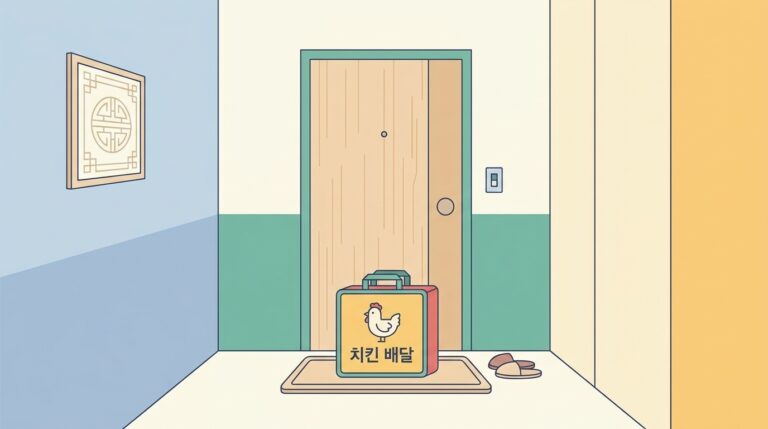
Master Korean Delivery Requests: How to Say “Please Leave It at the Door”
Phase 1: Empathy (Story-Driven Opening)
안녕하세요! (Hello!) I’m your Daily Hangul editor and local culture navigator.
Picture this: It is 10:30 PM in Seoul after an exhausting day of exploring Gyeongbokgung and shopping in Hongdae. Your feet are aching, you are wearing your favorite cozy oversized pajamas, and your stomach is growling loudly. You open a Korean delivery app to order piping hot, golden chimaek (fried chicken and beer). But just as you reach the checkout screen, panic strikes! A blank box labeled 요청 사항 (Requests) stares back at you.
You ask yourself: “What if the delivery rider rings the doorbell and expects a full Korean conversation while I stand there in mismatched pajamas? What if they leave it in the main building lobby downstairs? How do I politely type ‘Please leave it at the front door and ring the bell’?”
If you have ever felt that tiny spike of anxiety ordering food abroad, you are definitely not alone! Hundreds of our beginner students have told us that delivery requests feel like an intimidating final boss battle. Today, we are breaking down this exact scenario into super-easy, natural A2 Korean phrases. By the end of this guide, you will order midnight snacks in Korea with the relaxed confidence of a seasoned local!
Phase 2: Top 3 Core Delivery Expressions
Here are the three essential phrases every food lover needs when ordering delivery in Korea.
1. 문 앞에 놔주세요 (Mun ape nwajuseyo)
- Pronunciation: [Mun ah-peh nwah-joo-seh-yo] (Sounds like: Moon + ah-peh + nwah as in ‘noir’ + joo-say-yo)
- Meaning: Literal: “Please place it in front of the door.” / Nuance: “Please leave it at my doorstep.”
- K-Culture Moment: You will spot this text in almost every modern K-Drama where an introverted character orders tteokbokki to avoid meeting anyone outside!
- Editor’s Insight: 문 (Mun) means door, and 앞에 (ape) means in front of. 놔주세요 (nwajuseyo) comes from 놓다 (to put/place) + ~주세요 (please do for me). It is extremely polite, concise, and standard.
- Situation Spectrum: Casual: ⚠️ (Only to friends) | Semi-formal: ✅ (App requests & delivery riders) | Formal: ✅
- 🤔 Think About It: Why does Korean add ~주세요 (give/do for me) even in written app notes? Notice how Korean politeness softens even practical automated instructions into kind favors.
2. 문 앞에 두고 벨 눌러주세요 (Mun ape dugo bel nulleojuseyo)
- Pronunciation: [Mun ah-peh doo-goh bel nool-luh-joo-seh-yo] (Sounds like: Moon + ah-peh + doo-go + bell + nool-luh-joo-say-yo)
- Meaning: Literal: “Please leave it in front of the door and press the bell.” / Nuance: “Leave it at the door and ring the doorbell once.”
- K-Culture Moment: Perfect when you are wearing headphones playing K-Pop and want a quick audio cue that your food has safely landed.
- Editor’s Insight: 두고 (dugo) means “leave it and…” connecting two actions. If you have a baby or sleeping pets, you can flip this to: 벨 누르지 마세요 (Bel nureuji maseyo – Please don’t ring the bell).
- Situation Spectrum: Casual: ⚠️ | Semi-formal: ✅ (Standard rider request) | Formal: ✅
- 🤔 Think About It: In your home country, do delivery drivers prefer knocking or ringing? In Korea’s dense apartment buildings, electronic doorbells (벨) are standard.
3. 수저 안 주셔도 돼요 (Sujeo an jusyeodo dwaeyo)
- Pronunciation: [Soo-juh ahn joo-syuh-doh dway-yo] (Sounds like: Sue-juh + ahn + joo-shuh-doh + dway-yo)
- Meaning: Literal: “You don’t have to give spoons and chopsticks.” / Nuance: “No disposable cutlery needed, thank you!”
- K-Culture Moment: Eco-conscious variety shows and YouTube lifestyle vlogs constantly highlight selecting this eco-friendly option on food apps.
- Editor’s Insight: 수저 (Sujeo) is a compound word combining 수 (숟가락 – spoon) and 저 (젓가락 – chopsticks). Korean eco-regulations now default to no disposable cutlery unless requested.
- Situation Spectrum: Casual: ⚠️ | Semi-formal: ✅ | Formal: ✅
- 🤔 Think About It: How does modern language evolve alongside environmental policies like plastic reduction campaigns in urban Korea?
Phase 3: Textbook Korean vs. Real-Life Korean
Let’s see how stiff textbook phrases transform into natural everyday Korean that locals type and say.
Situation 1: Asking the rider to drop the package outside
- 📖 Textbook Korean: 현관문 앞에 배달 물품을 배치해 주십시오. (Hyeongwanmun ape baedal mulpumeul baechihaejusipsio.) — “Please arrange the delivery goods in front of the entrance door.”
- 🗣️ Real-Life Korean: 문 앞에 놔주세요! (Mun ape nwajuseyo!) — “Please leave it at the door!”
- 💡 Why is it different?: The textbook version sounds like a formal logistics contract. Real Korean delivery notes prioritize short, polite, and rapid clarity for riders on tight schedules.
Situation 2: Opting out of single-use plastic utensils
- 📖 Textbook Korean: 일회용 수저류의 제공을 거절합니다. (Ilhoeyong sujeoryuui jegongeul geojeolhamnida.) — “I refuse the provision of disposable cutlery items.”
- 🗣️ Real-Life Korean: 수저 안 주셔도 돼요~ (Sujeo an jusyeodo dwaeyo~) — “No cutlery needed, thanks~”
- 💡 Why is it different?: Saying 거절합니다 (I refuse) sounds harsh and robotic. Adding ~도 돼요 (it is okay even if…) expresses a friendly, polite tone.
Phase 4: K-Culture Deep Dive & Non-Verbal Manners
4-1. 눈치 (Nunchi) & Contactless Etiquette
In Korea, 비대면 배달 (Bi-dae-myeon bae-dal / Contactless delivery) has become the standard culture. When you request food left at the door, there is an unwritten Nunchi (social intuition) rule: Wait about 10 to 15 seconds after you hear the doorbell before opening your door.
Why? Delivery riders often hurry to snap a quick proof-of-delivery photo on their phone app and rush toward the elevator for their next order. Opening the door instantly while they are inches away can startle both you and the driver! If you accidentally open the door right as they are walking away, a polite head nod and a cheerful “감사합니다! (Gamsahamnida! / Thank you!)” is the golden standard of Korean manners.
4-2. Cultural Code: The Rider Appreciation Note
Korea has the world’s most hyper-efficient delivery ecosystem (빨리빨리 – Ppalli-ppalli / Fast-fast culture). Because riders work in freezing winters and pouring rain, Koreans frequently add sweet safety wishes to their delivery requests:
* “조심히 오세요 (Josimhi oseyo)” = Please come safely (take your time).
Adding this short phrase shows immense empathy and will instantly warm your driver’s heart!
Phase 5: Real-Life Roleplay Scenario
- Setting: You are staying at an Airbnb officetel in Mapo-gu, Seoul. You ordered late-night tteokbokki. You hear the elevator chime outside your door.
- Characters: You (Hungry K-culture learner) & Rider Park (박 기사님) (A friendly and swift delivery pro).
[Turn 1] Rider Park: (Ding-dong! Rings the bell)
                     배달 왔습니다!
                     (Baedal watseumnida! / Delivery is here!)
                     🎭 Knocks lightly twice on the door.

[Turn 2] You:        (Speaking softly from inside)
                     감사합니다! 문 앞에 놔주세요!
                     (Gamsahamnida! Mun ape nwajuseyo! / Thank you! Please leave it at the door!)
                     🎭 Checking through the door peephole.

[Turn 3] Rider Park: 네, 문 앞에 두고 갑니다! 맛있게 드세요!
                     (Ne, mun ape dugo gamnida! Masitge deuseyo! / Yes, leaving it at the door! Enjoy your meal!)
                     🎭 Snaps a confirmation photo and walks toward the elevator.

[Turn 4] You:        (Waiting 10 seconds, then opens the door slowly)
                     조심히 가세요!
                     (Josimhi gaseyo! / Go safely!)
                     🎭 Bowing lightly with a smile.

[Turn 5] Rider Park: (Turns back at the elevator)
                     네, 감사합니다!
                     (Ne, gamsahamnida! / Yes, thank you!)
                     🎭 Smiles and presses the elevator button.

[Turn 6] You:        (Brings the warm food bag inside and checks the receipt)
                     와, 수저 안 주셔도 돼요라고 썼더니 쓰레기도 없네!
                     (Wa, sujeo an jusyeodo dwaeyorago sseotdeoni sseuregido eomne! / Wow, because I wrote 'no cutlery needed', there's no plastic waste!)
                     🎭 Unpacking the spicy rice cakes on the dining table.

[Turn 7] Rider Park: (Sends standard app message notification)
                     [배달 완료: 문 앞 배송]
                     ([Baedal wallyo: mun ap baesong] / [Delivery Completed: Delivered in front of door])
                     🎭 Rider marks order completed on his smartphone app.

[Turn 8] You:        (Leaving a 5-star review on the app)
                     빠르고 친절해요. 잘 먹었습니다!
                     (Ppareugo chinjeolhaeyo. Jal meogeotseumnida! / Fast and kind. I ate well!)
                     🎭 Enjoying a delicious midnight bite with a K-Drama.
🔀 Interactive Choice Point
The rider rings your bell, but you are not ready to open the door. What do you type or call out?
- Option A: “문 앞에 두고 가세요, 감사합니다!” (Mun ape dugo gaseyo, gamsahamnida!)
- Option B: “야! 거기 둬!” (Ya! Geogi dwo!)
- Option C: “문 앞에 놔라.” (Mun ape nwara.)
Feedback:
* Choice A (Best): Perfect! Polite, clear, and grateful. Uses standard polite endings.
* Choice B (Bad): Extreme rude slang! You are shouting “Hey! Put it there!” in blunt impolite form.
* Choice C (Risk): Grammatically correct but uses Banmal (lowest informal speech). A rider will feel disrespected.
Phase 6: 10-Second Emotion Shadowing Drill
Practice reading these out loud, pausing naturally at each / mark while mimicking the emotional tone:
[😊 Polite & Calm]
문 앞에 / 놔주세요.
(Mun ape / nwajuseyo.)
“Please leave it / at the front door.”-
[🚚 Kind & Thoughtful]
문 앞에 두고 / 벨 눌러주세요! / 조심히 오세요.
(Mun ape dugo / bel nulleojuseyo! / Josimhi oseyo.)
“Leave it at the door / and ring the bell! / Please come safely.” -
[🌱 Friendly & Eco-conscious]
일회용 수저는 / 안 주셔도 돼요~
(Ilhoeyong sujeoneun / an jusyeodo dwaeyo~)
“As for disposable utensils / you really don’t need to give them~”
Phase 7: K-Culture Mini Dictionary
- 문 앞 (Mun-ap) | Doorstep / Front of the door
- Usage: The standard delivery drop-off location option in all Korean delivery and courier apps.
- 비대면 배달 (Bi-dae-myeon bae-dal) | Contactless delivery
- Usage: Highly preferred delivery method in Korea where you receive goods without face-to-face interaction.
- 요청 사항 (Yo-cheong sa-hang) | Special requests / Instructions
- Usage: The text input field where you write notes for the store or the delivery rider.
- 배달팁 (Bae-dal-tip) | Delivery fee
- Usage: Not an optional gratuity tip, but the fixed delivery surcharge added directly to your food total.
Phase 8: Traveler’s Survival Kit
Top 3 Survival Phrases
- 문 앞에 놔주세요 (Mun ape nwajuseyo) — “Please leave it at the door.”
- Pro Tip: Save this phrase in your phone’s quick clipboard or text shortcut.
- 도착하면 전화 주세요 (Dochakhamyeon jeonhwa juseyo) — “Please call me when you arrive.”
- Pro Tip: Useful if your hotel or Airbnb has a locked main lobby gate that requires code entry.
- 1층 로비에 맡겨주세요 (Il-cheung robie matgyeojuseyo) — “Please leave it at the 1st floor lobby.”
- Pro Tip: Essential for hotels that restrict delivery riders from taking elevators to guest rooms.
Editor’s Travel Note
- App Tip: Make sure to check our Naver Map app travel guide to copy your exact Korean address and 5-digit postal code correctly into food apps.
- Hotel Lobby Etiquette: Most major Korean hotels do not allow riders into guest room corridors. Write “호텔 1층 로비에서 받을게요 (I will pick it up at the 1st-floor lobby)” and meet the rider downstairs!
Phase 9: One Step Deeper (Cultural Reflection)
Have you ever wondered why contactless delivery works so seamlessly across South Korea? In many parts of the world, leaving a bag of food or an expensive package outside an apartment door for 20 minutes risks theft or tampering.
In Korea, a combination of widespread apartment CCTV systems, high social trust, and a deep-rooted respect for public safety creates an environment where doorstep delivery is completely normal. Language reflects this trust: writing “문 앞에 놔주세요” is not just a lazy shortcut—it is an exercise in mutual trust between the customer, the rider, and the community.
- 💬 Your Turn: In your hometown, do people leave delivery food right outside the door, or do you always meet the driver face-to-face? Share your cultural differences in the comments below!
Phase 10: FAQ & Common Mistakes
Q: Can I use “문 앞에 놔주세요” at a hotel?
A: Usually, delivery riders cannot access guest floors in hotels due to keycard security. It is better to write “1층 로비에 놔주세요 (Please leave it at the 1st floor lobby)” or meet them directly at the entrance.
Q: How do I tell the rider not to ring the bell because someone is asleep?
A: Simply write “벨 누르지 말고 노크해 주세요 (Please don’t ring the bell, just knock)” or “문 앞에 두고 문자 주세요 (Please leave it at the door and send a text message)”.
Q: What is the difference between “두다” and “놓다”?
A: Both mean ‘to put’ or ‘to leave’. In delivery requests, 문 앞에 두고 가세요 (leave and go) and 문 앞에 놔주세요 (please place it) are used interchangeably by native speakers without any difference in politeness.
🚨 Common Mistakes TOP 3
- Mistake: Typing 문 밖에서 줘 (Mun bakk-eseo jwo).
- Why it is wrong: This is rude informal language meaning “Hand it outside the door.”
- Correct Action: Use 문 앞에 놔주세요 (Mun ape nwajuseyo).
- Mistake: Forgetting the apartment room number or building passcode (공동현관 비밀번호).
- Why it is wrong: The driver will get trapped outside the building lobby!
- Correct Action: Write your entrance code: “공동현관 #1234 (Main lobby code #1234)”.
- Mistake: Thinking 배달팁 (Baedal-tip) is a voluntary cash tip given at the door.
- Why it is wrong: In Korea, tipping at the door is not customary. The delivery fee is already paid in full through the app.
- Correct Action: No need to hand cash tips; just a warm greeting is plenty!
Phase 11: Action Missions
- 🥉 Bronze Mission (Solo Practice): Speak the phrase “문 앞에 놔주세요” out loud 5 times in front of your room door with confident intonation.
- 🥈 Silver Mission (Social Share): Take a screenshot of this guide’s 3 core phrases, tag
@DailyHangul, and share your favorite Korean late-night craving (야식) on Instagram story! - 🥇 Gold Mission (Real Action): The next time you order delivery or write a mock order, type “문 앞에 두고 벨 눌러주세요, 조심히 오세요~” in the request note!
- 🎮 K-Culture Mission: Watch an episode of a modern K-Drama or a Korean food vlog and spot how characters react when their doorbell rings for delivery!
Phase 12: Interactive Quiz Challenge
Test your skills with these 3 quick challenges!
Quiz 1. Situation Judgment
You are studying late at night and don’t want a loud doorbell sound to wake your roommate. Which request is best?
* A) 문 앞에 놔주시고 벨 크게 쳐주세요.
* B) 문 앞에 두고 문자 남겨주세요.
* C) 문 열고 들어오세요.
Quiz 2. Fill in the Blank
Complete the sentence to politely decline single-use chopsticks:
* “수저 안 주셔도 _________.” (Hint: It is okay / fine)
Quiz 3. True or False
In Korea, it is polite to open the door instantly the very second the rider touches your doorstep to grab the food from their hands. (True / False)
👉 Click to reveal answers & explanations!
- Quiz 1 Answer: B) 문 앞에 두고 문자 남겨주세요 (Mun ape dugo munja namgyeojuseyo – Leave it at the door and leave a text).
- Explanation: Choice A asks them to ring loudly, and Choice C invites them inside your home!
- Quiz 2 Answer: 돼요 (dwaeyo).
- Full Sentence: 수저 안 주셔도 돼요 (Sujeo an jusyeodo dwaeyo / You don’t need to give cutlery, it’s fine).
- Quiz 3 Answer: False.
- Explanation: With contactless delivery etiquette, waiting 10–15 seconds gives the rider comfortable space to take a confirmation picture and leave without an awkward doorstep collision!
- Explanation: With contactless delivery etiquette, waiting 10–15 seconds gives the rider comfortable space to take a confirmation picture and leave without an awkward doorstep collision!







